
Daily Updates
1. The Century’s New Cold War (Submitted by Christopher Berry)
2. The New Decade
1. THE CENTURY’S NEW COLD WAR
Despite your thoughts on the recent events in Copenhagen, one thing is clear: “clean,” “alternative” or “green” energy is here to stay. It’s now up to Government and the private sector to find a balance between the global carbon-based energy supply/demand (where demand is increasing) and sustainable clean energy supply/demand (where there seems to be plenty of demand, but inadequate supply for a host of reasons, mainly the high cost). As discovery investors, concerned with cementing our legacies for our families, we should be asking how to invest in and profit from this emerging sector – whether it be with wind, solar, nuclear, biomass, or other emerging alternative energy technologies.
I’d like to advance an idea here. The world is in the beginning stages of a new “Cold War.” If scientists, who warn us of impending climate doom, are proven correct we’re on the verge of another type of mutually assured destruction. The new Cold War I’m referring to revolves around the race to innovate and own energy technologies that can provide safe, clean, and most importantly cheap energy helping increase quality of life of the global populace. It is from these technologies that we can help foment a “green” revolution, strive for a better quality of life and, perhaps, avoid a MAD world.
….read more HERE.
GLOBAL INVESTING GURU and publisher of the infamous Gloom, Boom and Doom report Marc Faber says gold is cheap at $1100 per ounce, reports Commodity Online from its Singapore office.
Faber advises prudent investors to Buy Gold at this current price so they can reap rich dividends in 2010.
In his first New Year comment on the price of gold, the US Dollar and commodities more broadly, Faber said that the most interesting currency that people should invest now is gold as the US Dollar is on a bearish run.
“Gold remains the best bet as a currency these days because of the fact that the yellow metal supply is extremely limited. Gold at the current price of $1110 per ounce is less expensive than when it was sold for less than $300 per ounce years back…”
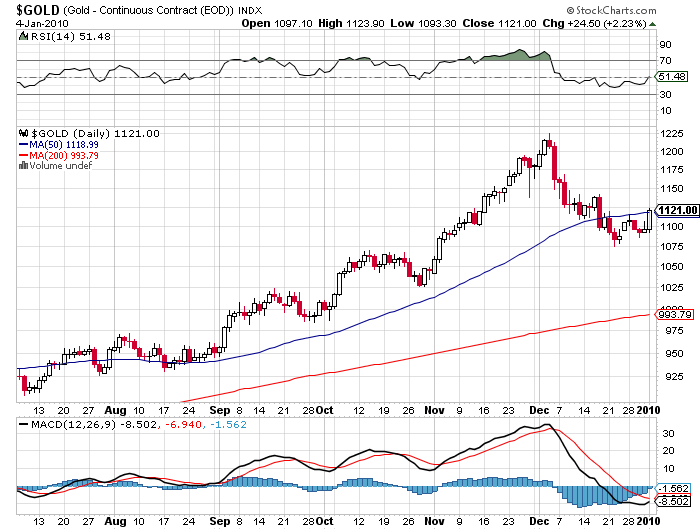
Faber also explains that the Gold Price should be treated in the same way that a company’s stock is treated by investors…
“A company’s stock could be less expensive at $100 than when it was selling for $10, because earnings growth has outpaced the appreciation of the shares and therefore its price/earnings ratio has declined. So gold could be cheaper at the current price than when it was at less than $300 because of the explosion of foreign exchange reserves in the world, zero interest rates, the huge debt overhang, and the expectation of further money printing.”
According to Faber, global reserves of gold have grown from about $1 trillion in 1995 to over $7 trillion today. “Therefore,” he says, “the share of gold in the world’s official reserves has declined from 32.7% in 1989 to a current record low of 10.3%,” he points out.
In this latest interview Faber said that he is still puzzled by the deflationists, who cannot understand how the explosion in foreign exchange reserves over the last 15 years is a symptom of a massive monetary inflation. “Ergo, I could argue that gold is now actually less expensive than when it sold for around $300 per ounce,” he said.
Faber said that central banks in emerging economies keep only a tiny fraction of their reserves in gold. “Eventually, I would expect them to follow the example of the Reserve Bank of India (RBI), which recently bought 200 tonnes from the IMF for $6.7 billion,” Faber pointed out.
“Now, just consider what the impact would be if China were to increase its gold holdings from presently less than 2 per cent of its $2.2 trillion reserves to 6 per cent or 10 per cent. Each 1 per cent increase in gold weighting would mean gold purchases of more than $20 billion, or nearly 600 tonnes,” said Faber, forecasting that Gold Prices may go from $1100 per fine ounce to $1500 or even $5000.
Contrasting gold with the US Dollar, he added that he “would not invest more than a sliver” of his wealth “into something without intrinsic value, something whose positive value is based on nothing more than a set of self-confirming beliefs.”
Faber said that he is not a perennial gold bug. But “when governments spend far more than they collect in taxes (large fiscal deficits), and when central bankers engage in reckless monetary policies and, instead of treating the causes of the problems (excessive debt growth), treat the symptoms (deflationary forces), gold as a currency does make a lot of sense.”
Looking to Buy Gold today? “If there’s an easier way, I’ve yet to find it,” says one BullionVault user…
James Dines’ The Dines Letter is our 2009 Investment Letter Of The Year. The Dines Letter (TDL) had a stellar 2009, up 149.4% by Hulbert Financial Digest count over the 112 months ending in November vs. 27.10% for the dividend-reinvested Wilshire 5000 Total Stock Market Index. (Dines) is Triumphantly ahead over 10 years — 10.7% annualized vs. 0.2%% annualized for the total return Wilshire 5000. – Peter Brimelow, Marketwatch
James Dines’ skill at identifying new bull markets before the investing public and professionals is legendary. In 1995 he recommended the big four of the internet when virtually no one had ever heard of it. In 2002, he announced the new bull market in commodity and a year later he recommended uranium at $8/lb (it peaked at $136/lb). After years of searching he now has a new bull market prediction to tell you about. He will do that in an exclusive interview with me which all attendees to the World Outlook Financial Conference Jan 22 & 23, 2010 in Vancouver will get access to. If his past success over five decades is any indications this could be incredibly lucrative for all who hear it – Michael Campbell
James Dines: Dig gold out of rare earths
From CommodityOnline:
If you are an investor rushing into gold seeking ‘safe haven’ or unsure which stocks to invest in, veteran forecaster James Dines has this advice: Make gold out of rare earth stocks. Rare earths such as lanthanum, cerium, neodymium and many others are used in several emerging technologies such as wind energy, hybrid cars and electronic gadgets like mobile phones. But 97% of the supplies of rare earth metals are with China and they have threatened to cut supplies to the rest of the world.
But Dines assures you that 3% of the available resources are there for you to tap. These stocks which he has been monitoring from 2001 has zoomed 813%, 1,148%, 3,775% respectively since September 2008 (Ofcourse to know more about it, you need to subscribe to Dines Newsletter). Sounds unbelievable. But James Dines has a multi-decade track record of successful predcitons. “Out of James Dines’ last 21 annual forecasts for the Dow Jones Industrial Average, 19 were 100% correct. We know of no other financial analyst in the US or internationally to have surpassed or even matched that track record,” his website claims.
Dines predicted the gold price crash of 1982, the equities bear market that started in 1966, recommended internet stocks that soared 1000% in six years time but consequently bottomed out, predicted the 1997 South East Asian currency crisis, the 9/11 incident that shocked the equity markets among others.
Rare Earths
Here are some of the reasons why James Dine is bullish on rare earths. A single 3MW wind mill requires 700 pounds of neodymium, a Toyota Pirius Hybrid requires 65 pounds of rare earths. Starting 2010, China planst to save greater quantities of rare earths for domestic use by raising export taxes, reducing export quotas. Chinese Government believes that currently neodymium is cheaply priced and if they export more, country would exhaust its resources in 20 years time.
The world’s first rare earth index, Dines Rare Earth Index composed of rare earth stocks had gone up 507% on an annualised basis in October 2009. However, Dines cautions us not to put all eggs in one basket. He points out that gold and silver are also worthy investment. “Only gold and silver are the only assets that climb on mass fear.” The fear to seek a ‘safe haven’ could catapult gold to $3000 to $5000 while silver could rise to $100. Dines continues extremely positive on gold (although he thinks silver will outperform it in the near term) and uranium. In his issue published in mid-December, Dines rated himself as positive on bullion with a short-term stop at $1024 (“no long-term major stop”); negative (presciently) on bonds and positive short-term on stocks. But he did note that six of the 30 world stock markets he charts have broken uptrends, which “puts us on alert.”
Dines believes that fundamental analysis helps to find what to buy but not when to buy but his own visual analysis through point and figure charts and analysis of mass psychology helps investors earn more returns on their hard earned money.
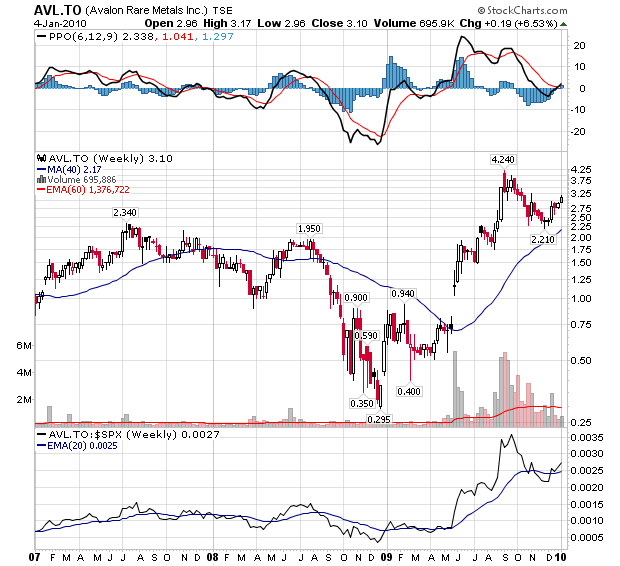
MarketWatch has voted The Dines Letter as their 2009 Investment Letter of the Year. Dines got off to a strong start in 2009, showing his strategic and tactical strengths, according to Peter Brimelow in MarketWatch. Subsequently, Dines unveiled his “rare earths” portfolio, focused on trace elements that he says are essential to computerization. It did very well for him. Dines wrote recently: “The Consolidation of the Rare Earths has probably come down far enough and buying programs should be resumed in Rare Element Resources Ltd. (RRLM.F 3.88, +0.27, +7.38%)

Quest Uranium Corp. (QSUR.F 3.23, +0.28, +9.51%)
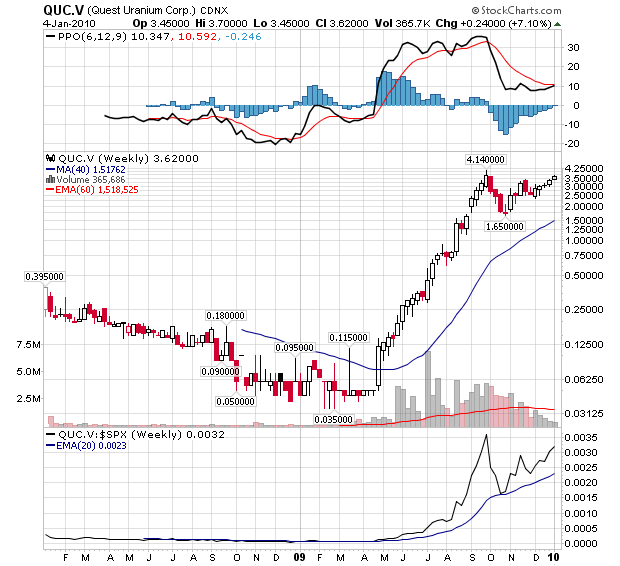
and, for long-term, patient money, Avalon Rare Metals Inc. (AVAR.F 0.54, +0.02, +4.74%) will probably be acquired by a large company at much higher prices.”
Commodity Online India Limited (COIL) is a leading provider of news, information and research reports on commodities through a variety of platforms that include the portal www.commodityonline.com, Mobile Services, research reports and newsletters.
COIL offers consultancy in an array of commodity services, hosts summits and conferences in commodities and provides education services in the field of commodities in India and abroad.
Our web brand www.commodityonline.com is the largest global vertical on commodities. The site is an ideal platform for news, information, communication and research services on a wide variety of commodities.
COIL has offices in Mumbai, New Delhi, Ahmedabad and Kochi and respresentative offices across India.
For more info, get in touch with us at: info@commodityonline.com
A Brave New, Profitable 2010 …
We’re in a new, volatile year. But it will also be a year chock full of new opportunities and profit potential. I’ll show you one of my favorite sectors in a few minutes.
But first, let me help you keep the long-term picture in focus by asking — and answering — some questions for you …
Question #1: Will 3 billion souls in Asia who have just entered the 20th century, let alone the 21st, suddenly stop demanding new, better lifestyles for themselves? For their children?
I don’t think so.
Indeed, China just announced that its gross domestic product for 2008 topped $4.6 trillion, 4.5% higher than expected. And for 2009, China’s economy likely grew more than 9%, putting its GDP at more than $5 trillion, and making China the second-largest economy in the world, displacing Japan.
Moreover, it’s not just manufacturing in China that continues to grow. Over the last two years, by far, it’s been the services sector that has seen the biggest growth, increasing at a 9% clip. The service sector in China now accounts for nearly 42% of total GDP, up from 40.1% in 2008.
That proves, unequivocally, that not only is China growing like crazy, but also that its economy is not just about manufacturing. It’s also about consumption, services, agriculture, and more.
Moreover, there are no signs that China’s economy is going to falter in 2010. Beijing will largely maintain its easy-money policies … pump even more money into its economy … and, importantly, keep its currency pegged to the dollar.
All of this not only means China will continue to boom in 2010, but also that China’s economy could easily overtake the U.S. economy within 10 years.
But it’s not just China that is still firing away on 8-, if not 10- or 12-cylinders. It’s also India, whose economy is growing at better than 7%. And Indonesia, whose economy is growing at better than 4% … Malaysia, growing at more than 7% … and more.
Bottom line: 3 billion citizens in Asia are still on the move, emerging from decades-old policies that kept them largely in the dark ages. And all this is happening as the West, the United States and Europe, get mired down in debt piled upon other unpayable debts … in overregulation … in newly designed and heavily bureaucratic policies … in the threat of rapidly rising taxes, and more.
In short, I see no end at all to the demise of the West, and the rise of the East.
Question #2: Will the severe supply restrictions in many of the world’s natural resources suddenly disappear in 2010, creating an oversupply instead?
I don’t think so.
If anything, with less capital and credit available today, the supply constraints in many natural resources are bound to get worse, not better.
We still face the prospects of peak oil. Peak water. Peak gold. Peak seafood. Peak copper. Peak rare earth metals. And more.
Not just because Mother Earth has limited supplies of these commodities. But also because the financial crisis has forced many natural resource companies to put new exploration projects on hold. Mines, too, have been shuttered over the last two years.
And keep in mind, it’s a lot easier to shut down a mine or an oil well than it is to crank them up again.
All of this is occurring while 3 billion Asians are not only still consuming more natural resources, but also set to see their consumption grow, year-after-year.
How can the world not face severe resource shortages in the years ahead?
Now, ask yourself another very important question …
Question #3: Will the Federal Reserve stop printing funny money to pay off U.S. debts?
I think the notion that the Federal Reserve can exit its recent policies of almost zero-cost money and printing money stands a snowball’s chance in hell of ever happening.
As I showed you a couple weeks ago …
The U.S. federal deficit has exploded 350% higher from $454.8 billion in fiscal 2008 to $1.6 TRILLION in fiscal 2009. Our total national debt: Now $12.1 trillion.
Our debts to foreign countries, chiefly Japan and China, have exploded to 3.5 TRILLION dollars, a 25% increase.
Meanwhile, our contingent national debt — the money our government owes its citizens by way of Social Security, Medicare, Medicaid, Veterans’ benefits, and government pensions — now stands at $106.5 TRILLION!
All told, Washington is now in debt to the tune of nearly $134 TRILLION, an amount equal to $435,702 FOR EVERY MAN WOMAN AND CHILD in the United States.
Patently unpayable? In current dollars, you bet it is!
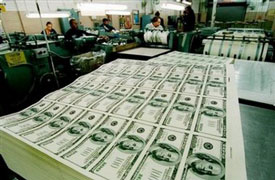
The Federal Reserve will keep interest rates low, keep printing money and keep devaluing the dollar to pay off its massive debts.
But therein is the key to understanding this whole financial mess. Washington does not have to pay off debts with current dollars. It can devalue the dollar and pay off the debts. So instead of defaulting, it pays off the debts with new cheaper money.
It effectively robs Peter, in this case, you, me, and the country’s creditors, to pay Paul.
Which is why there is simply no way the Federal Reserve will do anything but keep interest rates low … keep printing money … and keep devaluing the dollar.
Sure, there will be the inevitable dollar rallies, like the one we’re having now, caused by mistaken views that parts of the world are in worse shape than the United States.
But that’s also what the Romans thought when the denarius caught an occasional rally — even while Rome was burning.
My view: Given the above three forces …
1. The continued rise of Asia, especially China and India, and all the demand it’s creating for better lifestyles for fully half the world’s population.
2. The inevitable supply constraints of natural resources imposed by Mother Nature. And …
3. The infinite printing of money by the Federal Reserve and the resulting depreciation of the world’s reserve currency, the dollar, the medium currently used to buy and sell most of the world’s natural resources …
Means one, and only one, thing …
Natural resources will be the sector to be in again for potentially big profits in 2010.
Watch for my signals in Real Wealth Report. If you’re not already a member, join now. The $99 membership is peanuts compared to the huge profits available in 2010.
Best wishes,
Larry
With nearly three decades of experience in precious metals and natural resource markets, Larry Edelson has played a pivotal role in training Weiss Research staff and in guiding Weiss Research’s customers to prudent investments in these sectors.
His Resource Windfall Trader and Real Wealth Report provide a continuing education on natural resource investments, with recommendations aiming for both profit and risk management. His team of technical analysts helps enhance the timing of investment recommendations with the aim of continually improving performance results for investors.
Mr. Edelson is also an accomplished analyst and writer, making substantial contributions to Weiss Research’s Safe Money Report and Uncommon Wisdom.
He holds a B.A. degree from Columbia University. Mr. Edelson got his start on Wall Street in 1978. By 1980, he had his own firm active in international brokerage, financial analysis and money management.
In the mid-1980s, Mr. Edelson was one of the largest gold traders in the world, responsible for as much as $1.4 billion in daily gold trading volume on the Comex in New York, in today’s dollars. Mr. Edelson also managed several multi-million-dollar natural resource and commodity-based private investment funds.
This investment news is brought to you by Uncommon Wisdom. Uncommon Wisdom is a free daily investment newsletter from Weiss Research analysts offering the latest investing news and financial insights for the stock market, precious metals, natural resources, Asian and South American markets. From time to time, the authors of Uncommon Wisdom also cover other topics they feel can contribute to making you healthy, wealthy and wise. To view archives or subscribe, visit http://www.uncommonwisdomdaily.com.
Right now I’m concentrating on one particular area — the bonds. You remember that I’ve stated repeatedly that the Fed can continue to spew out money until the bond market says it can’t — until the bond market says “Enough”). The bond market is mortally afraid of two phenomena (1) a falling or I should say a collapsing dollar (2) rising inflation. The dollar has been weak, lately. And no wonder, the Fed has been printing “money” around the clock, which is basically inflationary.
Below is a longer-term chart of TLT, the exchange traded fund for the Treasury bonds. You can see the toppy formation — and how close TLT is to touching (or violating) that long rising trendline.
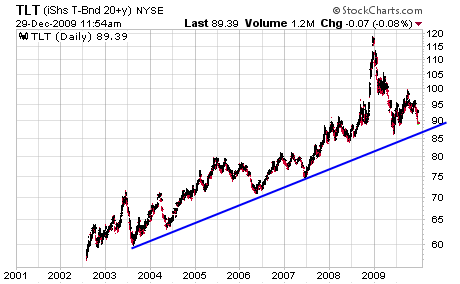
So I’m asking myself, are the bond vigilantes finally saying “Enough”? Bennie Bernanke is the recognized expert on the Great Depression of the 1930s, but I doubt whether our Fed Chief is an expert on today’s “bond vigilantes.” Today the bond market is huge — it dwarfs the stock market. When the “bond vigilantes” get frightened, they sell bonds, the bonds head down — and interest rates head up. That’s a process the Federal Reserve can’t control. The multi-trillion dollar bond market is too big for the Fed to manipulate — of course, the Fed can manipulate short-term rates, but the long-term rates are a force of their own. – Richard Russell – DowTheoryletters.com
Advance warning: Danger of bond market collapse!
by Martin D. Weiss, Ph.D.
If you think 2010 is going to bring investors a carefree, nonstop ride to glory, think again!
Profit opportunities abound, and we intend to be among the first to lead you to them.
But we’re also here to give you advance warnings of threats that can sneak up from behind and catch you by surprise.
Case in point: The danger that Treasury bonds will fall sharply in price, drive up long-term interest rates and ultimately threaten the U.S. recovery.
This is an advance warning because long-term interest rates are still very low. Even if they rise from here, their impact on the economy may not be felt right away.
But if you hold medium- or long-term bonds, you need to get out NOW — before you suffer further damage.
Using nearest futures contracts as the metric, the price of a 10-year Treasury note tumbled from a high of 130.09 on December 18, 2008, to a low of 114.98 on June 18, 2009.
It then spent most of the year’s second half trying to recover from that debacle.
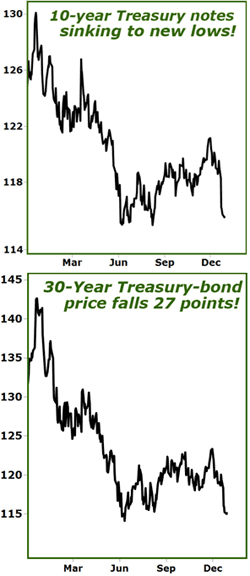
But just in the last few days of December, while most traders were away or asleep, a renewed plunge in Treasury-note prices erased nearly all the gains since June … threatening new lows, paving the way for a new plunge in prices, and driving a new surge in 10-year yields.
The price decline in 30-year Treasury-bond prices has been even more dramatic: An historic 27-point plunge from 142.62 on December 19, 2008, to 115.67 on June 18, 2009 … followed by a feeble recovery … and now, as with Treasury notes, a new, ominous price decline and surge in yields.
The impact on consumers is unmistakable:
Even while Washington seeks to flood mortgage markets with easy money, 30-year fixed-rate mortgage rates are moving sharply higher. And even as the Fed does everything in its power to get Americans to spend, U.S. banks are tightening their credit standards and slapping on new fees.
The causes of the bond market troubles are equally obvious:
We have …
- The biggest and most permanent federal budget deficits in our country’s history — $1.4 trillion of red ink in fiscal 2009 and AT LEAST another $7 trillion in deficits over the next decade.
- The biggest government borrowing binge of all time. Just in the last week of the year, the Treasury Department borrowed $44 billion with the sale of 2-year notes, $42 billion with 5-year notes and $32 billion in 7-year notes, for a total of $118 billion — a new record. Expect more of the same throughout 2010.
- The most inflationary monetary policy of all time, including a sudden, record-smashing DOUBLING of the nation’s monetary base in 2009.
And most ominous of all …
A Government Gone Wild!
This is not a matter of personal opinion or political philosophy. Regardless of your particular persuasion, you cannot deny the folly of Washington’s escapades …
- The U.S. Federal Reserve has tossed its traditional rulebook in the trashcan. It has opened its credit window to brokerage firms, guaranteed trillions of junk credit of the private sector and bought up over a trillion in junk mortgages.
- The U.S. Treasury has bailed out the nation’s largest and most outrageous risk-takers — not only institutions like Fannie Mae, Freddie Mac, Citigroup, Bank of America, AIG, and GM … but, indirectly, also high-rollers like Goldman Sachs and JPMorgan Chase.
- And now, adding madness to insanity, the U.S. government is opening the gauntlet to even more of the same: On Christmas Eve, the Treasury Department announced it will remove the limits on any and all aid to Fannie Mae and Freddie Mac for the next three years.
The intended consequence was to allay investor concerns that these two mortgage giants will exhaust the available government bailout funds.
Treasury officials know that an estimated 3.9 MILLION U.S. homes went into foreclosure last year … and, they know that they can expect more of the same in 2010. So they’re literally pulling all stops to funnel funds into this market.
But the unintended consequences are potentially greater concerns:
- An even deeper hole in the federal budget,
- An even larger avalanche of Treasury borrowings,
- Still lower bond prices, and, inevitably,
- Far higher long-term interest rates.
Most Financial Institutions Highly Exposed
If America’s financial institutions were prepared for higher interest rates, this might not be quite as serious. But as I demonstrated here two weeks ago, nothing could be further from the facts. (See “Three Government Reports Reveal New Looming Risk.”)
Specifically …
- The Federal Deposit Insurance Corporation (FDIC) reports that many more banks are now taking on higher levels of interest-rate risk, leaving them overly exposed to rate rises at precisely the wrong time. They’re stuffing their portfolios with long-term mortgages, which invariably fall in value when interest rates rise. And they’re relying too heavily on short-term financing, which will inevitably be more expensive when rates rise.
- The U.S. Comptroller of the Currency (OCC) reports that America’s largest banks now hold $172.5 TRILLION in derivatives that are directly linked to interest rates, the most of all time. That’s over THIRTEEN times the amount they hold in credit derivatives — a primary cause of the 2008-2009 debt crisis.
- And the Federal Reserve reports that banks aren’t the only ones vulnerable to higher interest rates. Also exposed are credit unions, life and health insurance companies, plus property and casualty insurers.
Bottom line: Don’t march into 2010 as if the word “risk” had been stricken from investment lexicon like four-letter words in a grammar school dictionary.
It hasn’t been; it’s still there. And it mandates continuing caution — to buy excellent values … with strong fundamentals … prudent risk management … and plenty of cash in reserve.
Good luck and God bless!
Martin
Martin D. Weiss, Ph.D., founder and president of Weiss Research, Inc. and a leading advocate for investor safety, is a nationally recognized expert on domestic and international financial markets. With more than 35 years of experience, including many years in Latin America and Asia, Dr. Weiss has helped empower millions of investors to make better financial decisions through his monthly Safe Money and daily Money and Markets.
This investment news is brought to you by Money and Markets. Money and Markets is a free daily investment newsletter from Martin D. Weiss and Weiss Research analysts offering the latest investing news and financial insights for the stock market, including tips and advice on investing in gold, energy and oil. Dr. Weiss is a leader in the fields of investing, interest rates, financial safety and economic forecasting. To view archives or subscribe, visit http://www.moneyandmarkets.com.
-
I know Mike is a very solid investor and respect his opinions very much. So if he says pay attention to this or that - I will.
~ Dale G.
-
I've started managing my own investments so view Michael's site as a one-stop shop from which to get information and perspectives.
~ Dave E.
-
Michael offers easy reading, honest, common sense information that anyone can use in a practical manner.
~ der_al.
-
A sane voice in a scrambled investment world.
~ Ed R.
Inside Edge Pro Contributors

Greg Weldon

Josef Schachter

Tyler Bollhorn

Ryan Irvine

Paul Beattie

Martin Straith

Patrick Ceresna

Mark Leibovit

James Thorne

Victor Adair