
Daily Updates
The Chinese people are increasingly getting entangled in the luster for gold. The Chinese families are on a buying spree of gold ornaments, gold bars, gold coins and gold ETFs. But they are not alone. Chinese mining companies, bullion dealers, gold associations, jewelers and traders are all in the grip of the ‘yellow’ fever with one aim: buy and trade gold. China, indeed, is in the grip of a gold buying frenzy.
In fact, everything about gold is booming across China. 2009 was a test case for China as far as gold trading was concerned. China is today the largest producer of gold in the world. China is all set to overtake India as the largest consumer of the yellow metal. China is also set to outshine several other countries including India and the Middle East to become the largest trading ground for gold in the world.
A gold buying frenzy is spreading across the Chinese landscape–from cities to rural towns–as you can make out from the words of Xiam Zang, a bullion dealer in Beijing: “Chinese people are buying more gold these days. There are increased sales in jewellery shops for gold ornaments, coins and bars. In fact, many people are now convinced that gold is the best investment asset.”
Zang says as gold sales are rising, “there are increased requests from jewellery shops for supplying them with gold.” “Everyone is doing good business in gold in China. The gold buying spree is not just limited to Beijing or big cities. Even in rural areas, people are simply buying gold despite the high prices,” he added.
The massive rise in gold price in 2009 is the main reason for the Chinese craze for gold buying these days, bullion dealers like Zang points out. Gold price gained by a whopping 50 percent in 2009 from $801 an ounce in January to $1,226 an ounce in December thanks to weak dollar and worsening economic conditions in countries like the United States. Investors in China are hooked on to the forecasts some of which predict that gold price would zoom to $2000 per ounce by the end of 2010.
This increased buying spree is the main reason why China is overthrowing India as the largest gold consumer in the world. India used to be the undisputed leader in gold sales and consumption in the last several decades. But high price of gold coupled with tighter tax regime dampened the demand for gold in India in 2009. India that used to import around 400-700 tonnes of gold every year in the last several years imported only 200 tonnes of gold in 2009—the lowest in the decade.
Look at a report on gold buying frenzy in China from Commodity Online:
China is on a gold buying spree and the rush is set to continue in 2010 also as gold jewellery sales in mainland China and Hong Kong are expected to ramp up. According to market experts, present retail price for gold is HK$10,900 per tael and it could climb to HK$11,000 per tael before Lunar New Year.
Gold sales have risen by 10 per cent this year and are expected to accelerate in the coming two months.
A 20 per cent year-on-year sales growth can be expected before Lunar New Year. The revenue from now till mid-February can contribute up to as much as 30 per cent of the full year sales turnover.
Recent bullion purchases by central banks, including India and China, have fueled shoppers’ sentiment and helped sales during past months. The mainland maintained its position as the top buyer of gold last month. It bought 454 tonnes of gold, topping India and Russia.
The mainland now ranks No 6 in the world in gold holdings, but is expected to continue increasing its reserves to dilute its US dollar asset holdings. The gold price has been edging down to below $1,100 per ounce as the dollar gains strength.
Analysts are bullish on gold performance next year. The price for gold may steady in the short term, but analysts are bullish in the long run. Gold’s average price in 2010 may be around $1,100 per ounce. Both industrial and consumer demand would push gold price even higher next year.
Some years back, China surpassed South Africa as the largest gold producer. Latest statistics from the Ministry of Industry and Information Technology say China’s gold output in the 11 months of 2009 till December 1 was 282 tonnes, an increase of 14.6 percent increase over the same period in 2008.
The report said mining companies expanded output last year after bullion prices soared to record highs, with production in November alone reaching 27.952 tons.
On gold demand in the dragon country, the China Gold Association says that the estimated demand for the precious metal was 450 tons in 2009, up 13.8 percent from 395.6 tons in 2008.
“With household income increasing, Chinese consumers are buying more jewelry and investing in gold assets. All of these are boosting gold demand,” said Zhang Bingnan, the general secretary of China Gold Association.
…..read page 2 HERE.
Nonfarm Payrolls This Friday Could Dampen Commodities
Overall this week has not been that exciting. Volume is below average as the big money traders slowly get back into action and wait for Fridays economic data to come out.
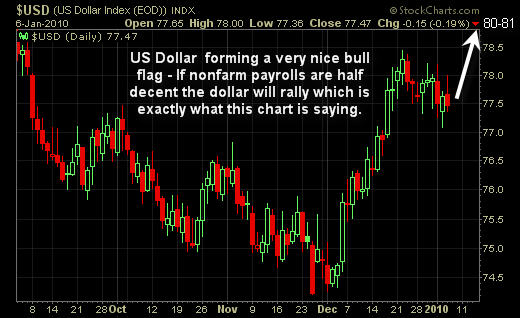
We have seen gold, silver and oil put in a nice rally this week but they are still not in the clear. If we get flat or better unemployment numbers we should see the US dollar rally. This seems to be exactly what the chart is telling us when using technical analysis. Here are the numbers for Friday.
Friday unemployment numbers come out for both the US & Canada.
7:00 AM ET – Canadian Unemployment Rate, Forecast 8.5%, Previous 8.5%
8:30 AM ET – USD Nonfarm Payrolls, Forecast 0%, Previous -11K
8:30 AM ET – USD Unemployment Rate, Forecast 10.1%, Previous 10%
Here is a table I created for understanding what economic data moves stocks, bonds, US$ and gold: http://www.thegoldandoilguy.com/Economic-Indicators.pdf
US Dollar Daily Trend
The current trend of the dollar is now up when looking at the daily chart (higher highs and lows). The strong price thrust in December has formed a nice flag pattern. This is a continuation pattern meaning the dollar should continue higher once this pause is complete.
….read more and view charts on Gold, Oil and Commodities HERE.
If 2008 was the year of financial crisis and 2009 the year of healing via monetary and fiscal stimulus packages, then 2010 appears likely to be the year of “exit strategies,” during which investors should consider economic fundamentals and asset markets that will soon be priced in a world less dominated by the government sector. If, in 2009, PIMCO recommended shaking hands with the government, we now ponder “which” government, and caution that the days of carefree check writing leading to debt issuance without limit or interest rate consequences may be numbered for all countries.
…..read more HERE.
Without any doubt the fastest growing country in the world is also the largest in many ways. CHINA rightfully claims that title.
In total population China dwarfs all others…in territorial area…it is second only to Russia. Furthermore, China’s economic growth – whether measured in annual percent increase in GNP or in absolute total dollar growth is second to none. To be sure the Sino country’s export trade (and resulting Trade Surplus) is the envy of its global competitors. Unfortunately, China’s exponential growth in Foreign Reserves has fostered a serious problem.
SERIOUS FOREX RISK
China’s export trade machine has ‘invaded’ all countries, especially the USA. This resulted in building up a mountain of Foreign Reserves, denominated mostly in US Dollars. Recent data show China has upwards of $2,273 Billion in Foreign Reserves with about 70% denominated in US dollar (*).
Unfortunately, The Peoples Bank of China did not have the foresight to diversity its mounting Foreign Reserves into other currencies like the euro, yen and gold. Consequently, China will suffer a horrific loss in 2009. The loss is composed in two parts: 1)Dollar devaluation, and 2)Price decline of US Treasuries as most of its Foreign Reserves are in this investment vehicle….rather than gold. The following chart clearly demonstrates the relative total return of the US Dollar, US Treasuries and gold during 2009. As of December 29, 2009):

…..read more HERE. (scroll down to the first chart)
Today’s Notes:
1. The Demise of the US Dollar
2. An Old Favorite: A Contrarian
1. THE US DOLLAR
The past five years of US currency movements are shown below in the Bloomberg dollar index. November 2005 was a high point at 92.03. Yesterday the dollar closed at 77.62, a 16% decrease. The dollar bottomed April 18th 2008 at 71.68, a 23% decrease in 28 months. This caused Japan and later OECD authorities to talk about a dollar rescue. That was not necessary however. The threat of China withdrawing from the Fannie Mae and Freddie Mac debt markets caused President Bush’s Treasury secretary to offer the really first “Too Big To Fail” wealth transfer., On July 13th, just 2 days after Countrywide failed, Mr. Paulson guaranteed Fannie and Freddie debt with a $200 billion government insurance policy. That $200 billion upper limit has recently been removed. The immediate impact of the Paulson guarantee was a global short Dollar and Yen covering. During the following 8 months the US dollar soared 23%. The Yen rose 33% in that same timeframe.
However the US currency peaked on March 10th 2009 just about the same time the Citigroup leaked an internal memo citing a profitable first quarter. Then the dollar commenced its decline once again. Stimulated by the dollar carry trade and historically low Fed funds interest rates, the dollar bottomed on December 1, 2009 at 74.36. It has since turned down once again and closed yesterday at 77.62. In spite of the Paulson entreaties, China stopped buying Agency debt in July 2008. In fact, she sold $26.1 billion of Fannie and Freddie debt in the second half of 2008. It is clear that it is China that holds the keys to the treasury.
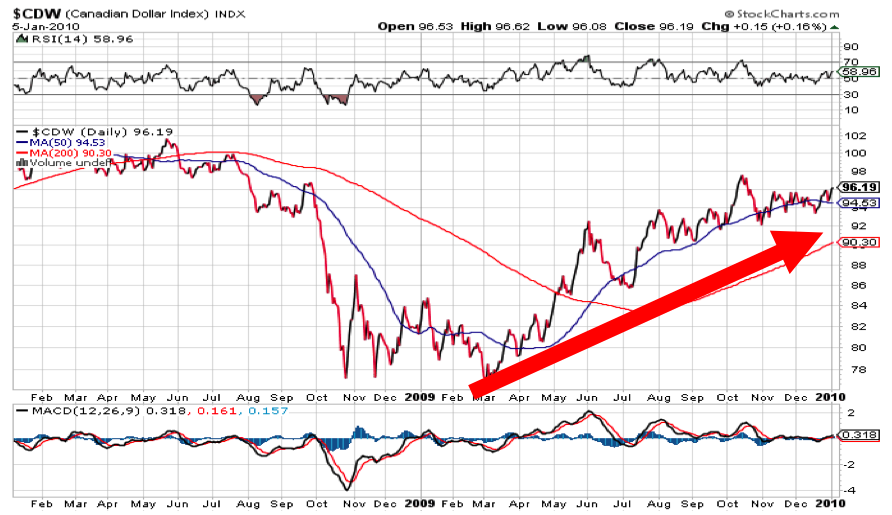
The Loonie (the Canadian dollar) has generally strengthened beginning March 10th, 2009 and appears to want to break the 96.12 level where it traded yesterday.
On January 29, 2009 Premier Wen Jiabo, while at Davos, remarked, that the U.S. had created
Igor Yugens, senior advisor to Russia’s president Medvedev, said of U.S. policy “of “inappropriate macroeconomic policies … an unsustainable model of development by sustained low savings and high consumption … in blind pursuit of profit .. with a lack of self discipline.” Igor Yugens, senior advisor to Russia’s president Medvedev, said of U.S. policy “of course Mr. Obama expects the Chinese and the Russians to buy US Treasury Bills. That is pretty selfish and philosophically it is protectionism.”
……read pages 2-6 HERE.
-
I know Mike is a very solid investor and respect his opinions very much. So if he says pay attention to this or that - I will.
~ Dale G.
-
I've started managing my own investments so view Michael's site as a one-stop shop from which to get information and perspectives.
~ Dave E.
-
Michael offers easy reading, honest, common sense information that anyone can use in a practical manner.
~ der_al.
-
A sane voice in a scrambled investment world.
~ Ed R.
Inside Edge Pro Contributors

Greg Weldon

Josef Schachter

Tyler Bollhorn

Ryan Irvine

Paul Beattie

Martin Straith

Patrick Ceresna

Mark Leibovit

James Thorne

Victor Adair