
Daily Updates
In their exuberance, oil- and gas-industry officials repeat a single refrain when describing the natural gas from Pennsylvania’s Marcellus Shale: A game-changer.
Tony Hayward, chief executive officer of oil giant BP P.L.C., was the latest to gush enthusiastically when he called unconventional natural gas resources like the Marcellus “a complete game-changer.”
“It probably transforms the U.S. energy outlook for the next 100 years,” Hayward said Thursday at the World Economic Forum in Davos, Switzerland.
Until just three years ago, the Marcellus was an obscure name for an obscure rock formation in the backwaters of geological research. Not anymore…
The tipping point came when Penn State professor Terry Engelder demonstrated that the Marcellus holds as much as 500 trillion cubic feet of natural gas the equivalent of total US gas consumption for 25 years. Theres over a trillion dollars worth of gas down there probably much more. Even if the estimate is off by 50% or so (and that 500 trillion cubic foot number might be on the LOW side), Marcellus is a very big resource.
Heres a map showing all of the major shale gas-bearing basins in the US and Canada. The Marcellus is labeled No. 27 and I dont mean in terms of size. As you can see, the Marcellus dwarfs all the others.

The breathtaking emergence of natural gas as America’s energy savior was not in the cards. Just four years ago, after Hurricanes Katrina and Rita devastated Gulf Coast rigs and rattled gas markets, energy pundits forecast a bleak winter of short supplies, high prices, and low thermostats.
The vast scale of shale-gas resources has come into focus quickly, and industry officials are touting the possibility of steady supplies for decades to come.
The Potential Gas Committee in Colorado last year revised its outlook of America’s future gas supply – up 35 percent in just two years. The forecast was the highest in its 44-year history.
The Marcellus Shale is the nation’s fastest-growing producing area. Though it lies under five states, about 60 percent of its reserves are in Pennsylvania, according to Terry Engelder, a Pennsylvania State University geologist.
“America’s energy portfolio has undergone a first-order paradigm shift just in the last two years,” he said. “This is such an exciting thing.”
“Two years ago, we were talking about importing gas from the Middle East,” he said. “And now we have a hundred-year supply of domestic gas?”
For companies like UGI Corp. – the Valley Forge energy company that operates regulated utilities in Pennsylvania that sell natural gas to retail customers and operates unregulated subsidiaries that consume and transport natural gas – the Marcellus Shale represents a game-changing opportunity on several fronts.
 Article from http://www.philly.com/
1. Copper and Deleveraging
2. A few Favorites
1. COPPER ….
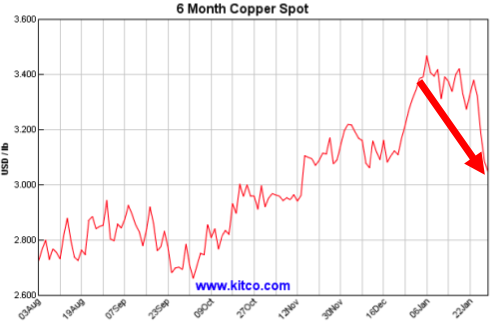
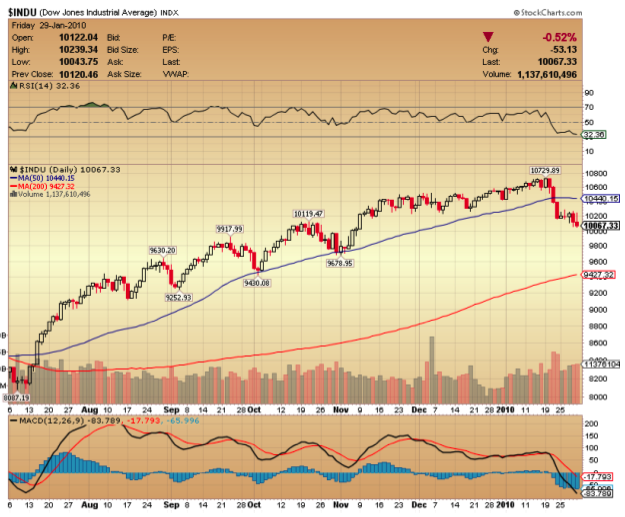
Good riddance to January 2010! It was a month of market malaise, decline and, as we predicted, the beginning of a correction – or worse the resumption of the bear market. The dramatic collapse of the copper market was more important. One look at Kitco’s 6 month graph is instructive. After peaking at $3.40 per pound on January 6th, copper succumbed to an equally dramatic shift in investor psychology. Once again from a shift from hope that the worst was over, to fear that the worst was to come. Between Jan 6th and January 29th copper was sold down – hard. This AM copper is trading down at $3.01. Copper has retreated 12% in three weeks. Furthermore the 50 day moving average is now broken and the MACD is ominous.
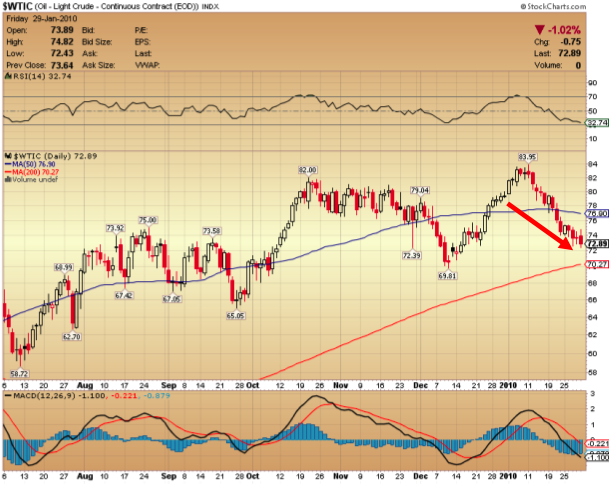
I do not see a bottom on copper yet. The story in WTI oil is identical to that of copper. After peaking early in January (actually intra day at $83.95 on January 11th,) oil has declined in lock step. This AM crude is trading at $73.13 for a one month decline of 13%.
Part of this issue was a message from China that she is reining in liquidity. In the U.S. FOMC member and St Louis Fed Bank’s James Bullard has suggested that deflation is no longer a concern. This suggests tightening for the US economy will soon (6 months?) become an issue for serious debate. The St Louis Fed chief said,
“The reason you can’t give a specific date is that it’s dependent on how the economy performs. If you have a strong economy, it could happen sooner. If you have a weak recovery, or a relapse, it may be later.”
It seems we are still in No Man’s Land from the viewpoint of our central bankers.
If copper is the metal with the “Ph.D. in economics,” that copper and crude oil have joined forces adds weight to the argument. They may be shouting that global economic growth is as yet in question. As deleveraging of the entire developed world continues to gain strength and the US dollar strengthens concurrently, pressure on GDP will increase. The equity markets heard the roar. The Dow could not even manage to end last week on a high note after a fourth quarter GDP (annualized) performance of 5.7%. The DOW failed to revive itself and fell 53 points ending the day Friday on a down note.
Today the White House will propose a $3.6 trillion budget with a record $1.6 trillion deficit. No matter how much fiscal heat as been applied to this economy, it has so far refused to budge at least from an employment perspective. The Obama Administration will propose spending another $25 billion in state aid and a “mini” jobs bill of $100 billion. Let’s hope these are not the millions of “Green” jobs promised in the last jobs bill. This increases the deficit to between 10% and 11% of GDP. We think this is unsustainable. Evidently so does the rest of the world.
This past weekend I spent considerable time reviewing the McKinsey Global Institute’s report on global deleveraging. This is a must read for any one serious in understanding the future; at least the future for the next 5 to 7 years. There are several conclusions that merit attention but one stands out. That is that after a financial crisis such as we have experienced, deleveraging requires, on average, 5 to 7 years. During this timeframe such deleveraging tends to be a drag on economic performance. Further the McKinsey study identifies 5 developed economies likely to be under such deleveraging duress. This leads to our focus on emerging economies, less levered, where discoveries of all sorts will be required. More on that in a future MN but I will speak this week in Phoenix (Cambridge House Symposium) on what I see in our future. In the meantime we all need to recalibrate our thinking because the aftermath of the great debt buildup of 2000 to 2010 is now upon us.
2. SOME FAVORITES
…..continue reading HERE
To sign up for Michael Berry’s Discovery Investing FREE letter go HERE. Michael Berry has been a portfolio manager for both Heartland Advisors and Kemper Scudder where he successfully managed small and mid cap value portfolios. Dr. Berry has specialized in the study of behavioral strategies for investing and has been published in a number of academic and practitioner journals. His definitive work on earnings surprise, with David Dreman, was published in 1995 in the Financial Analysts Journal.
Previously, Dr. Berry was a professor of investments at the Colgate Darden Graduate School of Business Administration at the University of Virginia and has also held the Wheat First Endowed Chair at James Madison University.
Dr. Berry is a respected and dynamic speaker. He regularly presents around the world on topics such as value investing, the role of Austrian Economics in investment management, behavioral investing strategies and is a specialist in developing case studies to teach investors how to invest. While a professor, he published a case book, Managing Investments: A Case Approach.
He has recently focused on the role of precious metals in the asset allocation of the individual investor.
I am posting John Embry’s January 18 speech. I’m posting the entire speech because I think it is so incisive and so important. I have known of John Embry since the ’80s, when another gold bull market was in force. The speech below is an education, and should be read by all my subscribers. John knows that natural forces (bull and bear markets) cannot be reversed or halted by man. Read on, please. – Richard Russell
Remarks by John Embry
Chief Investment Strategist
Sprott Asset Management, Toronto
Vancouver Resource Investment Conference
Hyatt Regency Hotel
Vancouver, British Columbia, Canada
Monday, January 18, 2010
Good afternoon. It is once again a great pleasure for me to address a knowledgeable gathering at Joe Martin’s always excellent Cambridge Conference.
When I was here last year gold was around $850 and there was the usual angst among mainstream commentators fearing a drop to $600 per ounce or worse. Today the price is roughly $300 higher and the same individuals continue to try to frighten the public with prophesies of vertiginous falls in the gold price. Despite this ongoing aggravation, I am even more bullish on the prospects for gold than I was a year ago.
However, despite my consistent enthusiasm for the yellow metal once termed a “barbarous relic” by Lord Keynes, I still have the strong feeling that the vast majority of investors outside this room still haven’t got a clue about gold and they are certainly not aware that gold is experiencing an historic bull market with much, much further to go. What we have seen to date is merely a prelude, and the appreciation we are going to see in future years is going to greatly exceed what we have seen to date. This opinion is based on a number of factor that I will expand on, but the predominant theme is that gold is re-establishing itself as money.
It has been money for thousands of years, a reality that was succinctly summed up by J.P. Morgan in 1912 when he said, “Gold is money and nothing else.” But we go through periods when that reality is obscured, and the decades of the 80s and 90s represent living proof of that. Gold retreated to commodity status in that era, when disinflation was in vogue and the real returns on financial assets were truly remarkable in historic terms.
Gold fell from a peak of $850 per ounce in January 1980 to a low of $252 in July 1999 in an extended bear market. To be fair to gold, it got a significant push to the downside in the latter part of that period from the central banks that were dumping enormous quantities of gold by leasing it through their bullion bank cronies. I would contend that the gold price overshot its economic value by perhaps $150 on the downside. Contributing to this fiasco was the ludicrous auction of half the British gold reserves within 10 percent of the bottom. Today this egregious error is referred to as “the Brown bottom” in recognition of the idiocy of the current British prime minister, who was then finance minister.
However, this is all water under the bridge and I don’t particularly want to dwell on it other than to say that we are now in the phase of the gold market where we are about to benefit mightily from the central bankers’ awesome stupidity at that time.
It is important, though, that everyone realize exactly what happened. The Western central banks supplied massive quantities of gold to the market for at least the past 15 years. Initially this facilitated excessive producer hedging. Then it helped to fund a huge carry trade that greatly enriched their bullion bank cronies. Now it occurs in large part to protect existing huge short positions held by those same banks.
You might be inclined to ask why the central banks would do such a thing. The official explanation for the transparent portion of their activities (i.e., direct sales) was to diversify their reserves. Essentially, why hold gold when you can own an interest-bearing piece of paper in its stead?
But that explanation is purely fatuous and a total smoke screen. The whole process, with the clandestine leasing and swapping of huge quantities of gold, was orchestrated by the United States. It was designed to reduce critical scrutiny of the central banks’ increasingly reckless monetary policy, to allow interest rates to remain at unrealistically low levels and to maintain the U.S. dollar’s supremacy. That this undertaking would inevitably spawn serial financial bubbles, the very same bubbles that brought the world financial system to its knees, was conveniently ignored.
This was all foreshadowed by some remarkable comments by then-Federal Reserve Chairman Alan Greenspan at a Federal Open Market Committee meeting in the early 1990s, remarks that came to light only recently when a transcript of that meeting was scrutinized. Greenspan referred to gold as a “thermometer” and speculated that if the Treasury Department sold a little gold in the market and the price broke as a result, not only would the thermometer no longer be a measuring tool but the lower gold price could affect underlying psychology. Greenspan was unfortunately right in his perverse judgement and shortly thereafter the systematic dumping of gold by the Western central banks moved into high gear.
It really makes you love free markets, doesn’t it?
But what a sorry mess they have created. While in the ’90s, their gambit played out spectacularly with gold collapsing and financial assets flourishing, it sowed the seeds for what has happened subsequently: a robust bull market in gold since 2001 and increasing chaos in the stock, debt, and real estate markets worldwide. To this day the central bankers have remained undaunted and have increasingly intervened in all markets, but despite their annoying periodic raids, their influence is waning dramatically in the gold market.
I would suggest that today central banks are discovering to their increasing discomfort what history has always demonstrated — and that is that manipulation of the free-market process ultimately fails. No amount of government interference and price manipulation can change the reality of the free market over the long term.
In the whole sordid process of the gold suppression scheme for the past 15 years, what has been particularly intriguing to me is that an earlier generation of central bankers unsuccessfully tried to same ploy with gold in the 1960s. Using the considerably more transparent London Gold Pool, they succeeded in holding gold at the then-official price of $35 per ounce for a number of years before being overwhelmed by the reality of the situation. In the following decade of the 1970s, gold rose a mere 2,300 percent.
Armed with the knowledge of that fiasco, one would have surmised that our current central bank geniuses might have considered that their new attempts at price control, albeit considerably more secretive, could meet a similar fate. Alas, the hubris of central bankers is well known, and this just represents another graphic example of their arrogance and awesome incompetence.
However, what remains to play out is the denouement of their current folly. Markets that have been artificially capped tend to catapult upward when the suppression inevitably fails. In my opinion the last experience in the ’60s and ’70s was a mere bagatelle in comparison to what is unfolding today. It has always been accepted that “the greater and longer the manipulation, the greater the eventual price rise is going to be.”
In the latest episode, there has been dramatically more central bank gold expended. Credible estimates suggest that more than 15,000 tonnes, or roughly half of the central banks’ supposed reserves, have already hit the market and are long gone, dangling from the wrists and necks of Indian women, filling vaults in the Middle East and Russia, and, in ever-greater quantity, migrating to China.
In the era of the London Gold Pool, only around 3,000 tonnes were sold to maintain the $35 price. This time the exercise has been dramatically larger and has occurred over a much longer time frame against the backdrop of a considerably more fragile financial structure, particularly in the West. So all of you are free to use your imagination to estimate how high gold is going to go this time.
It is critical to understand what the central banks have done because, in the absence of that knowledge, one cannot appreciate the whole gold story and will find it extremely difficult to recognize the investment opportunity being presented.
However, that is only one critical factor, and, as I said at the outset of my remarks, it is gold’s return as money that is going to be really instrumental in driving gold to prices that would seem fanciful to most at the present time. In reality, it isn’t gold that is changing, because it has been a constant store of value for 6,000 years. It is the value of fiat paper money in which gold is priced that is on the slippery slope to oblivion.
I could talk extensively about what is happening to the value of paper money, but to shorten things up, there is only one expression that you have to know: “quantitative easing.” What a joke that is!
The authorities would have you believe it is some sort of magic elixir and a panacea, but all it represents is the monetization of various forms of debt by unfettered printing of money by central banks. Because the inflationary impact has yet to occur, the linear thinkers would assure you that it isn’t going to be a problem. However, because of ongoing deleveraging and falling velocity of money in the short term, it is only being delayed.
As sure as death and taxes, continuing excessive money creation by the central banks will lead to accelerating inflation. When it begins to manifest itself, the velocity of money will pick up rapidly as people around the world rush to get rid of their increasingly worthless paper currency. In that event, we will rapidly progress from relatively benign inflation to truly frightening levels in a fairly short time.
At this point, I would like to repeat a quotation I used in a recent Investor’s Digest article. It comes from Ludwig Von Mises, the brilliant originator of the Austrian school of economics, which is the only formal economics that makes much sense to me. Long before I was born, which was a long time ago, Von Mises observed: “There is no means of avoiding a final collapse of a boom brought about by credit expansion. The alternative is only whether the crisis should come sooner, as the result of a voluntary abandonment of further credit expansion, or later, as a final and total catastrophe of the currency system.”
That comment is pretty germane to what is unfolding today. Following what was arguably the most abusive credit cycle in history, Fed Chairman Ben Bernanke and his central banking confreres have clearly chosen the latter option, and accordingly, in my opinion, all forms of fiat paper money are headed for a train wreck. Ironically, Bernanke tipped his hand seven years ago in the infamous speech he gave before becoming Fed chairman. He claimed that he could combat deflation by the use of a printing press or, if need be, by dropping money from helicopters to sustain demand. To me his theories were ludicrous at that point and remain so today. Yes, he may avert deflation for a considerable time but at the very probable cost of hyperinflation and the social chaos that inevitably results.
Today the only question in my mind is whether investment demand for gold is going to go berserk as the result of a U.S. dollar collapse or because all the fiat currencies go down the drain together. The U.S. dollar is in its death throes, but will other countries print massive quantities of their own currencies to buy the dollar in an attempt to depress their currencies and keep their economies relatively competitive? To date, I would say that despite the considerable weakness in the dollar, there is abundant evidence that many other countries are printing aggressively to prevent their currencies from rising too much against the dollar.
In any case, I believe we are fated to see a continuing policy of ridiculous monetary ease around the globe, despite rhetoric to the contrary. This will occur because the idea of a double-dip recession or depression, as the case may be, is anathema to the powers that be. Very simply, withdrawing any significant amount of stimulus, be it monetary or fiscal, in the foreseeable future would virtually guarantee another deflationary event, and this time it may be impossible to stop.
Clearly, the United States is the lynchpin of the whole debacle, but most other countries are up their necks in the mess as well.
To begin, let us consider the United States’ fiscal quandary, with a federal government deficit currently running above 10 percent of gross domestic product and representing roughly 40 percent of government expenditures. These numbers are horrific for a country that is providing the world’s reserve currency. A recent study looked at the 28 examples of hyperinflation in various countries since 1980 and included Argentina, Zimbabwe, and many other banana republics. It noted that one common trait was that when the national government deficit exceeded 40 percent of expenditures, the point of no return had been reached. The U.S. is there as we speak and the $389 billion deficit in the first quarter of the 2010 fiscal year was far from reassuring.
While the preceding information is historical and thus factual, there is the matter of the Obama administration having recently admitted that its budget deficits would total $9 trillion (a number that I believe to be wildly optimistic) over the next 10 years. The question that obviously has to be asked is: What person, institution, or government, for that matter, in its right mind would lend money to the United States for the pathetically low interest rates currently on offer?
In reality, who would really be comfortable lending the United States money at any interest rate in the current circumstances, considering that higher rates would just ensure even higher deficits?
So it seems reasonable to assume that more of the deficits will have to be monetized, the dollar will inexorably decline as a result, and the question of confidence will become paramount. If confidence in the dollar is lost, chaos will ensue and those trapped in dollar-based fixed-income assets will see their wealth destroyed, the same fate that befell those who believed in the system in the Weimar inflation in Germany after World War I.
But the United States is far from the only country that is in serious difficulty. Things are as bad, and in certain cases worse, in many other countries. For example, Great Britain is a basket case, which incidentally looks real good on that hypocritical jerk Gordon Brown, who has led his country to ruin. Britain’s central bank has been forced to intensify its quantitative easing program several times to keep the economy barely afloat and its financial system semi-intact.
Japan, with its rapidly aging population, has seen its accumulated public debt reach 200 percent of GDP with no end of that trend in sight.
Europe is no bed of roses either. Despite the soothing words of the head of the European Central Bank, Jean Trichet, and some very vocal comments about current monetary excess from Germany’s Angela Merkel, they appear to have little choice but to keep the money flowing to save Club Med, Ireland, and a whole swath of eastern Europe from oblivion.
China, that paragon of all things economic and financial, had to resort to mandating a humongous increase in bank lending in the first half of last year to keep its economy moving. The ultimate outcome of this endeavor remains to be seen, although it certainly had a salutary impact on Chinese share prices and world commodity quotes. Unfortunately, the resulting massive over-capacity throughout the entire Chinese economy may become an issue.
That brings us to the favorite country of everyone in this room, Canada. I suspect that the Canadian authorities will be forced to deal with reality soon. Despite the hedge funds’ love affair with the Canadian dollar, the economic and financial fundamentals in this country don’t support the current level of the loonie. We are attached at the hip economically to the United States and as our dollar rises, our manufacturing industries or what’s left of them are being destroyed. Budget deficits are exploding at all levels of government.
One year ago the feds didn’t have one, but now the deficit is annualizing somewhere north of $60 billion. Ontario is homing in on $25 billion and even hydrocarbon power Alberta has ruefully admitted that its deficit forecast has risen to $6.9 billion, as very low natural gas prices, among other things, take their toll.
Bank of Canada head Mark Carney and Finance Minister Jim Flaherty know these problems all too well, although much of the public seems blithely unaware, and I am eagerly awaiting Carney and Flaherty’s response. Rumors of aggressive quantitative easing are growing, adding yet another nation to the expanding list practicing this dark art.
Why is all of this significant?
Very simply, it ensures that the demand side of the gold-silver equation is baked in the cake. Investment demand is exploding on a worldwide basis as those with wealth to protect are beginning to comprehend the true extent of the monetary debasement under way. This is only going to intensify as inflation begins to rear its ugly head as the result of the money-printing orgy.
As I mentioned earlier, the velocity of money is going to accelerate as people figure out what is occurring. Why would anyone want to hold a rapidly depreciating monetary asset when it yields next to nothing? At that juncture we will see if the powers that be have the courage to remove significant amounts of stimulus. Since I believe that our debt-logged economies will remain relatively weak and our financial structure exceedingly fragile, I don’t believe they will.
So I find it laughable when people concern themselves with reduced jewelry demand as a factor in the pricing of gold in the current circumstances. Any decline is being dramatically exceeded by rising investment demand, and this phenomenon is only going to intensify. Besides, all great bull markets in precious metals are driven by investment demand as gold reasserts itself in its true role as money. They most certainly don’t occur as the result of gold’s attraction a bauble or as an adornment.
However, as bullish as I am on the demand side of the equation, an equally compelling case can be made on the supply side, which consists of three primary elements — mine supply, scrap recovery, and central bank dispositions. The least important is scrap recovery, but it was briefly a negative in early 2009, when a lot of people around the world couldn’t wait to get rid of their jewelry and realize a little cash for the gold contained in it. However, that sharply abated in the second half of the year and the focus is now back where it should be, on mine supply and central bank dispositions.
One of the key factors that is going to contribute to the ongoing bull market is mine supply, or more accurately stated, lack thereof. Mine supply has been in a steady decline since early in the new century despite the constant rosy predictions of greater supply from the alleged industry expert GFMS Ltd. I have long been of the mind that the decline will continue for some time irrespective of what the gold price does. I base my opinion on numerous factors, including a dearth of quality projects ready for mining, continuing geopolitical and environmental issues, less high-grading as the gold price rises, ongoing capital constraints, and a chronic shortage of skilled miners and mine builders.
Thus I was fascinated when Aaron Regent, the new head of the world’s largest gold company, Barrick Gold, was quoted at RBC’s annual gold conference in London lamenting the state of the gold mining business. He went so far as to suggest that global gold production was in terminal decline despite record prices and Herculean efforts by mining companies to discover new ore bodies in remote areas. He alluded to “peak gold,” implying that production has reached levels that can’t be exceeded, an expression that is commonplace in the oil industry, where the subject has been under discussion for some time.
Following this pessimistic assessment, a more horrifying prediction was revealed in the South African Journal of Science. Chris Hartnady, the research and technical director of a Cape Town based consultancy, stated that South Africa’s famous and extremely prolific Witwatersrand gold fields are around 95 percent exhausted and predicted that production rates should fall permanently below 100 tonnes per year within the next 10 years.
This is truly shocking in that gold production from the Witwatersrand, the largest gold field ever discovered, peaked at around 1,000 tonnes per annum in 1970 and, though falling steadily since, still contributes around 230 tonnes per year or roughly 10 percent of world production.
In view of these two evaluations by knowledgeable industry players, my negative view on production has been reinforced. Gold mine production is in the neighborhood of 2,350 tonnes per year, and I continue to believe that odds strongly favor it continuing to fall rather than show any meaningful increase for the next several years.
That brings me back to the central banks, and I apologize if I am belaboring the point, but I believe their role in the whole saga is neither widely appreciated nor well understood. Because of the remarkable obfuscation in the area, most observers do not realize how much central bank gold has entered the market in the past 15 years to fill the huge and growing gap between true demand and mine and scrap supply.
This is the direct result of misleading accounting by the central banks — accounting, incidentally, that has been endorsed by the International Monetary Fund, the very same IMF that has been threatening the gold market with potential massive sales for a number of years. The central banks have been permitted to use a one-line entry on their balance sheets, which does not differentiate between gold in the vault and gold receivables.
There is copious evidence, if you look for it, that supports the contention that gold receivables have grown dramatically as the result of central banks surreptitiously mobilizing their gold through leasing and swaps. This gold has been dumped in the market and has been essential in filling the natural demand- supply gap, which has probably exceeded 1,000 tonnes per year in most of the years since the mid- to late 1990s. That it also served to significantly depress the price wasn’t an accident.
The significance of the 1,000-tonne-per-annum number is two-fold. First, it represents in the neighborhood of 25 percent of the physical gold supply during the period, showing how truly deficient real sustainable supply is. Second, it virtually guarantees that Western central banks are getting dangerously short of reserves to continue this activity. Just as importantly a number of Eastern central banks — including China and Russia, to name but two — have acknowledged their intentions and are accumulating and will continue to accumulate gold as one avenue to diversify their reserves away from the U.S. dollar.
But India may have stolen a march on all of them when it announced recently that it had purchased 200 tonnes of the well-advertised and long-awaited IMF sale. This was the event that really kicked off the latest leg in the gold bull market, and unquestionably the Indian move drew widespread attention to a historic shift in the attitudes of central banks toward gold. It coincided with a complete cessation of selling by the European central banks, which under the terms of the recently renewed European Central Bank Gold Agreement could sell up to 400 tonnes per year.
Thus just as the Western central banks are being forced to wind down their incessant selling and leasing, the Asians have stepped up as buyers. This is a truly dramatic development and is going to have extremely positive ramifications for the gold price.
In view of the foregoing powerful positive fundamentals for the gold price, I find it almost nauseating that various pundits are referring to gold as overpriced and in a bubble phase. Nothing could be further from the truth, and, in reality, gold continues in its stealth bull market, which has now seen nine consecutive higher year-end closes. Despite this, as I mentioned earlier, it has attracted very little attention from the investing public in general.
The dedicated goldphile has participated throughout, and a number of sophisticated financial players have come on board recently, the latest being the legendary trader Paul Tudor Jones. But the average investor remains uninterested. It is instructive to remember that at the end of the last bull market in 1980, people were lined up around the block outside the Bank of Nova Scotia in downtown Toronto to purchase physical gold. Today the only lines that have formed are outside emporiums set up so the unsuspecting public can unload their gold jewelry for cash. To have a bubble of any significance, there has to be wide public belief, and it certainly isn’t on display in the gold market.
More importantly, if gold were overpriced, the gold producers would be experiencing an earnings bonanza. A close examination of the recent earnings statements of most major gold companies reveals that they are earning very little and are certainly not achieving the return on capital necessary to justify their involvement in a very risky and difficult business.
I find sentiment in the sector to be remarkably subdued in the face of compelling fundamentals. Many attractive junior gold stocks are not even keeping up with the rise in the gold price. If history were any guide, these stocks would be rising at three to four times the rate of the gain in the gold price, but investor skepticism is holding them back.
From a media perspective, if we were approaching the end of a bull market, the newspaper articles and television clips would be universally bullish touting the obvious merits of the yellow metal. There is indeed more coverage recently because of the relentless price rise, but it tends to be skeptical with the bearish commentators continuing to get the most exposure despite having been continuously wrong.
There is no better example of this than an individual who my compliance department would prefer that I not identify. However, I’ll give you a broad hint — he writes virtually daily for a noted Canadian gold Internet site. Dubbed the Tokyo Rose of gold commentators, he is always quoted in articles with a negative slant despite having been consistently wrong since the inception of gold’s bull market. In my opinion, as long as he gets any press at all, we are a long way from the end of this bull market in gold.
Finally, it is widely acknowledged that if the peak gold price in the last great bull market ($850 in January 1980) were to be adjusted to reflect the U.S. inflation rate in the intervening period, it would be equivalent to $2,300 today. That the current gold price is approximately half of that should put to rest any suggestion that this is a bubble.
That’s not to say there aren’t several bubbles forming in other financial markets (most notably in government debt instruments) as a result of a new bout of central bank madness, but gold is not on the list. In fact, I believe that we are many years and several thousands of dollars in price away from the end of this powerful bull market.
In conclusion, I now firmly believe that the chances of gold ever trading below $1,000 per ounce are remote. The only caveat I would offer is that if the world suffered a catastrophic deflationary collapse, an outcome long predicted by the noted Elliot Wave theorist Robert Prechter, gold could briefly be swept under but would then re-emerge with even greater relative strength as the only true safe haven. However, in a world of pure fiat currency, I think that a near-term deflationary outcome is highly unlikely. In fact, I strongly suspect that gold is going to stage a parabolic rise from current levels in the not-too-distant future, a development that will come as a shock to the many detractors of the world’s only real money.
Gold is the only real money because it isn’t someone else’s liability.
This remains one of the best supply-demand imbalance stories I have encountered in my long career and it will only be enhanced by the existence of massive short positions that will be impossible to cover amid myriad paper claims on gold that dwarf the physical supply, which, by the way, is a subject for another day.
Thanks very much for listening. It has been an honor to speak to you.
Be sure to visit and read more at Sprott Asset Management.
“Our immersion in the details of crises that have arisen over the past eight centuries and in data on them has led us to conclude that the most commonly repeated and most expensive investment advice ever given in the boom just before a financial crisis stems from the perception that ‘this time is different.’ That advice, that the old rules of valuation no longer apply, is usually followed up with vigor. Financial professionals and, all too often, government leaders explain that we are doing things better than before, we are smarter, and we have learned from past mistakes. Each time, society convinces itself that the current boom, unlike the many booms that preceded catastrophic collapses in the past, is built on sound fundamentals, structural reforms, technological innovation, and good policy.” – This Time is Different (Carmen M. Reinhart and Kenneth Rogoff)
The Statistical Recovery has Arrived
This Time Is Different
A Crisis of Confidence
Greeks Bearing Gifts
Biotech, Conversations and Babies
When does a potential crisis become an actual crisis, and how and why does it happen? Why did most everyone believe there were no problems in the US (or Japanese or European or British) economies in 2006? Yet now we are mired in a very difficult situation. “The subprime problem will be contained,” said now controversially confirmed Fed Chairman Bernanke, just months before the implosion and significant Fed intervention. I have just returned from Europe, and the discussion often turned to the potential of a crisis in the Eurozone if Greece defaults. Plus, we take a look at the very positive US GDP numbers released this morning. Are we finally back to the Old Normal? There’s just so much to talk about.
The Statistical Recovery Has Arrived
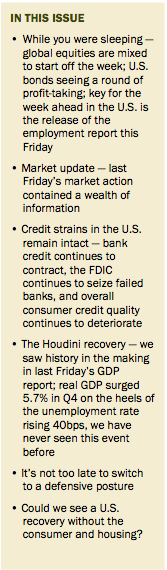
Before we get into the main discussion point, let me briefly comment on today’s GDP numbers, which came in at an amazingly strong 5.7% growth rate. While that is stronger than I thought it would be (I said 4-5%), there are reasons to be cautious before we sound the “all clear” bell.
First, over 60% (3.7%) of the growth came from inventory rebuilding, as opposed to just 0.7% in the third quarter. If you examine the numbers, you find that inventories had dropped below sales, so a buildup was needed. Increasing inventories add to GDP, while, counterintuitively, sales from inventory decrease GDP. Businesses are just adjusting to the New Normal level of sales. I expect further inventory build-up in the next two quarters, although not at this level, and then we level off the latter half of the year.
While rebuilding inventories is a very good thing, that growth will only continue if sales grow. Otherwise inventories will find the level of the New Normal and stop growing. And if you look at consumer spending in the data, you find that it actually declined in the 4th quarter, both annually and from the previous quarter. “Domestic demand” declined from 2.3% in the third quarter to only 1.7% in the fourth quarter. Part of that is clearly the absence of “Cash for Clunkers,” but even so that is not a sign of economic strength.
Second, as my friend David Rosenberg pointed out, imports fell over the 4th quarter. Usually in a heavy inventory-rebuilding cycle, imports rise because a portion of the materials businesses need to build their own products comes from foreign sources. Thus the drop in imports is most unusual. Falling imports, which is a sign of economic retrenching, also increases the statistical GDP number.
Third, I have seen no analysis (yet) on the impact of the stimulus spending, but it was 90% of the growth in the third quarter, or a little less than 2%.
Fourth (and quoting David): “… if you believe the GDP data – remember, there are more revisions to come – then you de facto must be of the view that productivity growth is soaring at over a 6% annual rate. No doubt productivity is rising – just look at the never-ending slate of layoff announcements. But we came off a cycle with no technological advance and no capital deepening, so it is hard to believe that productivity at this time is growing at a pace that is four times the historical norm. Sorry, but we’re not buyers of that view. In the fourth quarter, aggregate private hours worked contracted at a 0.5% annual rate and what we can tell you is that such a decline in labor input has never before, scanning over 50 years of data, coincided with a GDP headline this good.
“Normally, GDP growth is 1.7% when hours worked is this weak, and that is exactly the trend that was depicted this week in the release of the Chicago Fed’s National Activity Index, which was widely ignored. On the flip side, when we have in the past seen GDP growth come in at or near a 5.7% annual rate, what is typical is that hours worked grows at a 3.7% rate. No matter how you slice it, the GDP number today represented not just a rare but an unprecedented event, and as such, we are willing to treat the report with an entire saltshaker – a few grains won’t do.”
Finally, remember that third-quarter GDP was revised downward by over 30%, from 3.5% to just 2.2% only 60 days later. (There is the first release, to be followed by revisions over the next two months.) The first release is based on a lot of estimates, otherwise known as guesswork. The fourth-quarter number is likely to be revised down as well.
Unemployment rose by several hundred thousand jobs in the fourth quarter, and if you look at some surveys, it approached 500,000. That is hardly consistent with a 5.7% growth rate. Further, sales taxes and income-tax receipts are still falling. As I said last year that it would be, this is a Statistical Recovery. When unemployment is rising, it is hard to talk of real recovery. Without the stimulus in the latter half of the year, growth would be much slower.
So should we, as Paul Krugman suggests, spend another trillion in stimulus if it helps growth? No, because, as I have written for a very long time, and will focus on in future weeks, increased deficits and rising debt-to-GDP is a long-term losing proposition. It simply puts off what will be a reckoning that will be even worse, with yet higher debt levels. You cannot borrow your way out of a debt crisis.
This Time Is Different
While I was in Europe, and flying back, I had the great pleasure of reading This Time is Different, by Carmen M. Reinhart and Kenneth Rogoff, on my new Kindle, courtesy of Fred Fern.
I am going to be writing about and quoting from this book for several weeks. It is a very important work, as it gives us the first really comprehensive analysis of financial crises. I highlighted more pages than in any book in recent memory (easy to do on the Kindle, and even easier to find the highlights). Rather than offering up theories on how to deal with the current financial crisis, the authors show us what happened in over 250 historical crises in 66 countries. And they offer some very clear ideas on how this current crisis might play out. Sadly, the lesson is not a happy one. There are no good endings once you start down a deleveraging path. As I have been writing for several years, we now are faced with choosing from among several bad choices, some being worse than others. This Time is Different offers up some ideas as to which are the worst choices.
If you are a serious student of economics, you should read this book. If you want to get a sense of the problems we face, the authors conveniently summarize the situation in chapters 13-16, purposefully allowing people to get the main points without drilling into the mountain of details they provide. Get the book at a 45% discount at Amazon.com.
Buy it with the excellent book I am now reading, Wall Street Revalued, and get free shipping.
A Crisis of Confidence
…..read more HERE. (scroll down to A Crisis of Confidence)
MARKET UPDATE
Last Friday’s action in the markets contained a wealth of information. For one, the headline economic news could not have been any friendlier to the growth and equity bulls (real GDP came in at 5.7% QoQ annualized in Q4, UofM consumer sentimentindex at a two-year high, and the Chicago PMI hits a four- year high. But the good news didn’t just come from the economic data; last week also saw the release of the iPad, Bernanke finally received his reconfirmation from the Senate, and President Obama managed to find more shekels in the cookie jar to top up the $787 billion stimulus with more vote buying goodies such as a $5,000 tax credit to companies for each net new worker they hire and reimbursements for pay hikes. But look what happened on Friday despite all this good news on the economy, Bernanke and evenmore pledged stimulus! The markets, which had initially rallied impressively on the data, but sadly on low volume, then proceeded to turn down substantially — and the selling was on sharply higher volume. If you are bullish on stocks, that is bad news. The Dow, which at one point was up 117 points, ended up tumbling 164 points from the intra-day high in what was a very important outside-reversal day. The Dow, which first crossed the 10,000 mark back in March 29, 1999, is about to make another run at it on the downside. It still amazes us that the index has basically just been moving sideways on either side of that line for 11 years now.
…..read more HERE.
-
I know Mike is a very solid investor and respect his opinions very much. So if he says pay attention to this or that - I will.
~ Dale G.
-
I've started managing my own investments so view Michael's site as a one-stop shop from which to get information and perspectives.
~ Dave E.
-
Michael offers easy reading, honest, common sense information that anyone can use in a practical manner.
~ der_al.
-
A sane voice in a scrambled investment world.
~ Ed R.
Inside Edge Pro Contributors

Greg Weldon

Josef Schachter

Tyler Bollhorn

Ryan Irvine

Paul Beattie

Martin Straith

Patrick Ceresna

Mark Leibovit

James Thorne

Victor Adair