
Daily Updates
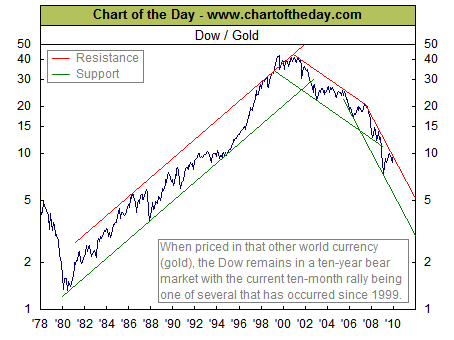
The stock market has been rallying over the past 10 months. So, is the stock market performing well? It all depends on how you measure. When measured in US dollars, the Dow currently trades approximately 29% below its all-time record high. However, when measured with that other world currency (gold), the picture is even more bleak. To help illustrate the point, today’s chart presents the Dow divided by the price of one ounce of gold. This results in what is referred to as the Dow / gold ratio or the cost of the Dow in ounces of gold. For example, it currently takes 9.3 ounces of gold to “buy the Dow.” This is considerably less that the 44.8 ounces back in the year 1999. When priced in gold, the US stock market has been in a bear market for the entire 21st century.
Quote of the Day
“The great merit of gold is precisely that it is scarce; that its quantity is limited by nature; that it is costly to discover, to mine, and to process; and that it cannot be created by political fiat or caprice.” – Henry Hazlitt
Sign up for FREE Chart of the Day HERE
Notes:
– Where’s the Dow headed? The answer may surprise you. Find out right now with the exclusive & Barron’s recommended charts of Chart of the Day Plus.
Click on the Banner for Jack Crooks and others World Outlook Presentations

Quotable
“No gold-digging for me… I take diamonds! We may be off the gold standard someday.” – Mae West
FX Trading – The Short Case for Dumping Gold Here
I just love the Mae West quote above. Funny thing is that many gold bugs cling to the belief (any many marketers who should know better validate said belief) that someday we may return to a gold standard. Until politicians are willing to give back the power that flows to them from spending money created out of thin air, it is highly unlikely we will ever see a gold standard. Going out on a limb, odds of that happening are slim to none.
Speaking of the value of gold; we agree with Mr. Soros that it is in bubble territory, as reported in the Telegraph yesterday. Yield competition to us is the key. If interest rates go up, globally—gold likely gets whacked. I know what you’re thinking—rates ain’t going up. In the industrialized world that may be true, but if China doesn’t break it would seem the emerging world rates are going that way. Australia is expected to hike next Tuesday.
What might be a real wildcard is a rate hike in the US for “technical reasons.”
…..read more HERE.

Gold is now “the ultimate bubble”, billionaire investor George Soros has declared, sparking fears that prices for the precious metal may soon suffer a tumble. Written article at read more…. UPDATE: Russell Disagrees with a penetrating comment
Update 2pm 01/29 Russell Comment — Even a billionaire can talk like a fool. Gold hit a high of 850 back in 1980. Gold is now priced at 1084, just 27% above its price of 27 years ago. How can Soros say gold is in a bubble? My opinion — in view of the incredible recent production of dollars, the dollar should be substantially lower. Thus, it makes more sense to say that the dollar is in a bubble.
Is gold in a bubble? George Soros reignites the debate
INTERNATIONAl. Billionaire financier George Soros is the latest to enter the gold bubble debate, warning that with interest rates low around the world, policymakers are risking generating new bubbles which could cause crashes in the future.
Speaking Thursday to The Daily Telegraph, on the fringe of the World Economic Forum, Soros said: “When interest rates are low we have conditions for asset bubbles to develop, and they are developing at the moment”.
The ultimate asset bubble is gold,” he added.
Investors are piling into the metal amid fears both of potential inflation and fading faith about the stability of previously-assumed safe assets such as government debt, Soros told the newspaper.
Having risen around 40% in 2009 and topping US$1,125 an ounce last month, gold has attracted a lot of interest from investors as well as analysts and media pundits trying to predict its future dirction.
Forecasting asset prices such as commodities has never been a precise science. It involves historical precedent, monetary policies, supply-demand balance, fear factors and many other variables.
what constitutes a bubble?
Is it the rate of growth in the last year, regardless of its magnitude? Is it a comparison with historical real values? Is it speculation? Is it Supply and Demand fundamentals? Is it all of the above?
The debate on asset bubbles, especially gold, has been raging for some time, attracting the attention of prominent investors and commentators incudingNouriel Roubini, calling it a barbaric relic, Jim rogers who in contrast sees gold at US$2,000 within a decade, Marc Faber who sees US$1,000 as a floor and Gold Hand Maktari who had pedicted US$1,200 in 2009.
So, is gold in a bubble?
Nouriel Roubini, a professor at the Stern Business School at New York University and chairman of Roubini Global Economics (RGE), who predicted the current financial crisis said in December the rally in gold prices is developing into a bubble and the precious metal faces “significant risks of a downward correction”.
Writing in a research note published by the Financial Times, Roubini said: “The recent rise in gold prices is only partially justified by fundamentals, and is in part a bubble that could easily go bust.
“The recent rise in gold prices is only partially justified by fundamentals, and is in part a bubble that could easily go bust,” warned Roubini in the report provocatively titled: “The new bubble in the barbaric relic that is gold.”
Speaking in an interview with Dave Nadig of Index Universe (IU.com) in October Roubini said: “My view is to stay away from risky assets. Stay in liquid assets”.
Roubini said asset prices have gone up as a result of liquidity in the system, however he sees a correction looming.
” I don’t know when the correction is going to occur, it could be a while longer, but eventually it will be a pretty ugly correction, across many different asset classes,” he said. “I don’t believe in gold,” Roubini added.
Explaining his reasoning, he added: “Gold can go up for only two reasons. [One is] inflation, and we are in a world where there are massive amounts of deflation because of a glut of capacity. So there’s no inflation, and there’s not going to be for the time being”.
“The only other case in which gold can go higher with deflation is if you have Armageddon, if you have another depression”.
“So all the gold bugs who say gold is going to go to US$1,500, US$2,000, they’re just speaking nonsense,” Roubini said. “Without inflation, or without a depression, there’s nowhere for gold to go,” adding maybe it could happen in three or four years from now. “But not anytime soon,” he said.
Jim Rogers’s view
In contrast to Roubini, Rogers said the only bubble he sees in the Western world now is in US bonds.
“I cannot conceive of lending money to the US for 30 years,” he said. “Other than that, I don’t see any bubbles going on, unless he knows something the rest of us don’t know.”
Rogers thinks that Roubini is wrong about the threat of bubbles in gold and some other assets.
In an interview with Bloomberg Television last month, Rogers said many commodities are still down from record highs. The price of gold will double to at least US$2,000 an ounce in the next decade, he said.
Roubini replied by saying Rogers’ forecast is “utter nonsense.” “Maybe it will reach US$1,100 or so but US$1,500 or US$2,000 is nonsense,” Roubini said.
Jim Rogers reaffirmed his view that gold will reach US$2,000 an ounce over the next decade as government’s money printing will lead to higher prices and, on the supply side, no new mines have been opened for decades.
In a recent interview t with wallstcheatsheet, Rogers, explaining the variables that will push gold higher, said: “It’s very clear there is huge suspicion about paper money around the world. This suspicion is gathering steam. Governments are printing huge amounts of money. This has always led to higher prices. Maybe I am wrong and it’s different this time. But I doubt it”.
Additionally, no new large gold mines have been opened in decades, Rogers said, adding that “some of those mines are over 100-years old and…are all depleting”.
The legendary investor also said central banks have huge Gold reserves above ground — and they are less interested in selling than in the past.
“If you adjust Gold for inflation and go back to its former all-time high in 1980, Gold should be over US$2,000 an ounce right now if you want to say it’s reaching new inflation adjusted all-time highs,” he said.
“I suspect that given all the money printing in the world, we will see much higher prices for hard assets,” he added.
Robert Prechter
Earlier this week Robert Prechter of Elliott Wave told CNBC that this is perhaps the last chance to get out of stocks with the DJIA “in quintuple digits.” He also believes that stocks will fall below the March 2009 lows.
Prechter, agreeing with Roubini’s view, believes that if deflation comes, gold could see a 40% drop from its peak. He feels gold is overbought and starting a new bear move there anyway.
Marc Faber
Marc Faber the Swiss fund manager and Gloom Boom & Doom editor said Gold won’t fall below US$1,000 an ounce again as central banks print money to help fund budget deficits.
Speaking at a conference in London on last month, Faber said: “We will not see less than the US$1,000 level again”.
“Central banks are all the same. They are printers. Gold is maybe cheaper today than in 2001, given the interest rates. You have to own physical gold.”
Gold prices having held above the upside breakout, Faber now sees the US$1,000-mark as the new floor.
China will keep buying resources including gold, he said.
“Its demand for commodities will go up and up and up,” he added. “Emerging economies will grow at the fastest pace.”
Strategy Garden
The arguements for or against gold beeing in a bubble seem compelling. “This, in our opinion calls for a short term consolidation period where bulls and bears fight it out within a narrow range of US$1,050-US$1,150, says a research note from Stategy Garden, the publishers of BI-ME.
The report sees a period of high volatlity in 2010 with gold prices ranging from US$900-US$1,300 on exceptional circumstances and uncertainties about the strength of the recovery and the effect of exiting stimulus activities.
Gold Hand Maktari
The potential volatility in gold prices in 2010 is also shared by one of the most astute forecasters of bullion prices, Gold Hand Maktari.
In a recent email statement received by BI-ME, Gold Hand Maktari says “2010 will see a roller coaster ride with the gold market, thanks mainly to the gradual stability of the global economy and the US Dollar rising and falling to new highs and lows throughout the year.”
The statement, whose source could not be verified by BI-ME, said: “Gold could reach new highs of up to US$1,600 plus per troy ounce in 2010 and set an all time high once more however, due to the global stabilization of the world economy, we will in no doubt see gold plummet. I see gold dropping at some point after heavy gains, to and around the US$900 mark, and dont be surprised at all if it falls further.”
“2010 is a time to be very cautious especially as the economic outlook seems to be improving. 2010 will see an average gold price of US$1,150-US$1,190.”
“We all predict prices to reach a certain high or low in the coming months or years and few are ever correct however, as I stated in 2008 and 2009, we would see gold reach up to $1,200 by the last quarter of 2009, few would have seen that on the cards,” the ‘Maktari’ statement said.
Tom MacNeill: Saskatchewan’s Resources Enriching the World
As if the fairy godmother flicked her magic wand, once drab and droopy Saskatchewan has blossomed into the belle of the ball—and the healthiest economy in Canada. According to Tom MacNeill, undeniably one of the province’s most ardent fans, the transformed province will keep heads turning for the next century. Chairman and CEO of 49 North Resources Inc. [TSX-V:FNR], Tom is reaching out to line up suitors and fill out dance cards to finance a lot of early-stage opportunities in the now-flourishing resources sector that’s leading the economic revolution. It wasn’t magic, though, that sparked the revolution and morphed Saskatchewan from laggard to leader. In this exclusive Gold Report interview, Tom tells us how what once proved Saskatchewan’s economic undoing is now ironically proving a boon. There’s one reason. The socialist sentiment that reigned for generations kept capital out and kept Saskatchewan’s rich resources pretty much buried in the ground. Previous regimes discouraged development to the point of expropriating businesses and driving prospective producers away. They’ve changed their tune, and Tom couldn’t be more gung-ho about it. He’s thrilled to be facilitating the inflow of investment capital to further dynamic junior resource projects in everything from base metals to gold.
The Gold Report: Your website’s home page points out that Saskatchewan has everything the developing world needs except for the capital markets to support projects. You created 49 North specifically to fill that gap. Can you update us on 49 North, progress you’ve made in the last three years and challenges you’re facing over the next couple of years?
Tom MacNeill: Actually I think the greatest challenge is behind us—the state of world capital markets. They are now less volatile. It’s true that Saskatchewan has everything the developing world needs. We’re geologically blessed with the best of both worlds. Half of Saskatchewan lies in the Western Canadian Sedimentary Basin, with all the hydrocarbons and sedimentary resources you could imagine. The northern half of the province is underlain by the Precambrian Shield, so we also have just about every hard rock mineral asset known to man that can be exploited economically.
The only downside is that we never had a capital market that caused a great deal of development in those resources. As some people know, we are the birthplace of socialism in North America. In the 1940s we elected the first socialist government ever in any North American jurisdiction. We made some extraordinary choices—to some degree along the path that Barack Obama is taking the U.S. these days—in that we had tremendous government oversight of all facets of life, including resource exploration and development.
Government hooks in business spook away a regular capital market. Much like Hugo Chavez expropriating assets in Venezuela today, it tells the rest of the world “stay out” because there’s too much sovereign risk. We did that to ourselves. We went through a whole period where we ruined our economic activity because we thought socialism was the neat thing. We came out of it, but we’re still living the hangover.
That means that we have an opportunity suite unparalleled in the world because we simply didn’t develop it even though we knew it was there. The inroads that 49 North has been making are to develop a capital market. Several hundred companies are exploring for various resources in Saskatchewan now, and while I’m developing local interest and awareness, there’s a tremendous investment opportunity for people external to the province.
TGR: Do you see the direction in which Obama is taking the U.S. as additional opportunity for capital markets in Saskatchewan? Or might Saskatchewan catch socialist fever again from south of the border?
TM: No, we won’t. Been there, done that. We know what happens when you have government oversight in resource development. With resources the backbone of our economy; we’re not going to screw up a second time. We watched Alberta develop from a base of 800,000 people to a population of 3 million people while we stayed stagnant at one million people over the last 50 years. It’s not going to happen again. Saskatchewan is immune now because of our previous experience, so to some degree that will make us very attractive to capital worldwide.
Canada has always been mining- and resource-friendly. The U.S. is becoming more and more restrictive. Put a green stamp on something and everybody loves it; put a mining stamp on it and everybody hates it. That’s becoming a very challenging environment, so we see a tidal wave of money flowing into Saskatchewan to take advantage of opportunities we have kept in the ground.
TGR: You’re in the catbird seat of having all these untapped resources.
TM: And we couldn’t be happier about that. I’m a second-generation resource developer. I watched the struggles my father had in this province from the 1950s onward, and I watched the transition. We are in the best place of any jurisdiction in the world. We have virtually zero sovereign risk because of our previous experience, tremendous undeveloped resources, more roads per capita than any jurisdiction in the world because we have all the infrastructure that socialists like to build. Power lines and gas lines run everywhere. Even our left-wing friends in previous administrations started developing good policy and resource royalties. We’ve set the playing field such that we’ll be the belle of the ball for the next 100 years.
We’ve got it all and we’re happy to be a part of early-stage development. That’s what 49 North is about, pointing fingers at good projects. We invest in third-party projects through equities or other instruments, but we also develop our own. We’re absolutely tickled about the opportunities ahead.
TGR: You develop your own projects?
TM: Yes. Because we have a corporate structure, we can actually develop our own projects, which we do. We don’t just develop things in Saskatchewan, either. We have a strong focus on Saskatchewan, but we look anywhere in the world.
TGR: Given such abundant natural resources, how does 49 North prioritize which resources?
TM: Everything tends to move in tandem. But we do get specific. A couple of years back we kicked out most of the uranium exposure in our portfolio and haven’t really gone back into it heavily because I don’t think it’s quite time. Probably late 2010 or early 2011 will be time to do that. I guess what I’m saying is that we look at the commodity, where it is in the cycle, the macroeconomics around it and what the projects are.
We use a lot of macroeconomic factors to figure out what we want to do. After that we answer other important questions. What do we think about the short term and short-term pricing? What’s the capital market going to say about this? Can we finance the project moving forward? Is it the right time in the cycle? It’s usually not the right time to bring a copper project on stream if copper is at $8 because you’re near the end of that cycle. Just about everything I can imagine has seen what I’d consider the short-term bottom in its commodity price, so now is a good time to be putting things back on the books. Right now we’re focusing on light oil in Saskatchewan—we’ve been doing that for the last six months—and base metals projects. It’s time for that.
TGR: We’re at the bottom of their cycles so you’re starting to invest in them?
TM: I think we’re near the bottom. But having said that, I don’t try to pick a perfect bottom. Any time from a year ago to two years from now is a good time to put together a project for most commodities. I’m usually spending money when everybody else is shunning a particular commodity or project or area. In some ways what we do at 49 North is either countercyclical or ahead of the cycle. As an early-stage junior resource guy, the place I live in is the 10-cent equity that we take to $3 to $5; not the $15 stock that goes to $50 because all of a sudden there are 100 years of production ahead.
TGR: In terms of being countercyclical and focused on junior resources, what are some interesting junior resources plays that investors should look at?
TM: Definitely pay attention to potash. It’s absolutely a necessary nutrient for growing crops. You can’t do without it. There’s no way to artificially manufacture it. Saskatchewan’s salt beds contain 50% of the world’s mineable supply, so Canpotex (Canadian Potash Exporters) has become the largest supplier in the world. Pay attention to excellent local developers like Athabasca Potash (TSX-V:API) and Potash One Inc. (TSX-V:KCL).
TGR: Is Saskatchewan’s dominance threatened by Amazon Mining Holding Plc (TSX-V:AMZ), which is drilling on a big potash play at their Cerrado Verde project in Brazil?
TM: Not at all. More power to them. Demand growth will continue. We’re just realizing shortages in potash in the market now, so we’ll see supplies tighten up even further. In my lifetime the population of this planet has doubled, growing from 3 billion to more than 6 billion. A lot of these people are moving up the economic ladder, which means more protein in their diets, which is creating an exponential increase in potash demand. So more potash production is a good thing. You get much better crop yields if you apply the recommended amount of potash to the soil. The more that is mined, the more that is put on fields, the better the harvests are, and the better we can feed the growing population.
TGR: What other opportunities do you see for investors in those masses moving into the middle class?
TM: Any advancement in civilization is great for commodities. China overtook the U.S. as the world’s largest consumer of automobiles in 2009. They are building more cars for all these people. To build cars, you need everything from rubber, lead, zinc and tin to hydrocarbons for the plastics. You need base metals. Hybrids or electric cars need rare earth elements. They need roads, so they need asphalt. Roads need bridges when they come to a river, so they need concrete. That means limestone and kaolin and iron and thermal coal. And coking coal to make the steel to build the bridge.
So infrastructure development in Asia and elsewhere, in the BRIC countries—Brazil, Russia, India and China—will drive the commodity cycle going forward. That’s an unstoppable force. That is tremendous for virtually all commodities. It’s even better for Canada because we’re a commodities country and it’s the best for Saskatchewan because we’ve got just about everything. We’re ready to supply it to the world.
TGR: Earlier you said you’re focusing on base metals. Could you talk a bit about opportunities you’re seeing for companies in base metals in Saskatchewan?
TM: We really have had hardly any base metals production in Saskatchewan ever. In eastern Saskatchewan, most of the mining’s been at the border or on the Manitoba side and policy never promoted Saskatchewan base metals. 49 North’s focus on base metals is due to the fact that we have such extraordinary resources here that have never been developed. We’re looking no further than our backyard to find some of the best copper showings in the world.
We have incredible projects that are 43-101 quality that have never moved forward. We’re doing it simply because nobody else is. There’s another old adage that if you can’t make money at $2 copper, you shouldn’t be in the copper business. Well, we have nearly $4 copper right now, right? So there’s a lot of demand for base metal resources and we’ve never exploited any properly in Saskatchewan. It’s about time we did. We have a wide open field here. It’s like going to a contest and finding out you’re the only entrant. Might as well do it; you’re going to win.
TGR: Can you share with us some of the interesting base metal plays that you’re involved in?
TM: We’re talking about such absolute early-stage projects that we don’t even have a name for the various property packages. They’re not in a corporate structure yet.
TGR: Is gold also prominent among Saskatchewan’s resources?
TM: Absolutely. Saskatchewan has one producing gold mine. In fact, it was founded by my father. It’s the longest-running gold mine in Saskatchewan history. I think they’ve poured about 800,000 ounces. It’ll likely go for the next 25 years, if not longer, because they have two other deposits they’re bringing on stream. There’s an entire gold belt in Saskatchewan that, again, has never been seriously developed because of the lack of a capital market.
TGR: What mine did your father found?
TM: It’s Seabee Gold Mine, under the Claude Resources Inc. (NYSE/AMEX:CGR) banner, and Claude has two other deposits within trucking distance that they’re bringing on stream. Claude also has the Madsen deposit in Red Lake, Ontario, which by my estimation is an analog to the Goldcorp (TSX:G) (NYSE:GG) mine there. The deeper they go, the richer it gets. Some deep drilling suggests that’s the case at Madsen as well.
To put a positive spin on going without a local capital market, one of the neat things is that resources stayed in the ground so opportunities are not hard to find. They say that the best place to find a gold mine is to look from the head frame of an existing mine, and that’s true. If you look at Goldcorp’s Red Lake gold camp in Ontario or any significant gold camp in the world, there’s always multiple mines around an initial one.
As I said, Saskatchewan has one long-running gold mine, and I believe seven other producers over the history of the province. Two are coming on stream. Golden Band Resources Inc. (TSX-V:GBN) is bringing a series of deposits into production shortly and Linear Gold Corp. (TSX:LRR) has the Box deposit in northern Saskatchewan that will be coming on stream.
So it’s like base metals. It’s all there. We’ve always had the potential in Saskatchewan; we’ve just never had enough money spent on it to properly develop the gold industry. The more holes you poke in the ground, the more you find, the more capital it attracts, and the more likely you’re going to have another mine and another and another.
TGR: Any others that you have your eye on?
TM: Otis Gold Corp. (TSX:OOO) in Idaho. Otis has several very interesting projects, but the current one—where historical drilling shows 11 grams over 9.5 meters—really gets me interested. That’s why we’ve been putting Otis in our portfolio and will continue to do so. I want to see how they do with their Kilgore Gold Project because the market’s ready for resources with big tonnage that also come with zones of pretty hot running ore. That means you can define a high-grade resource and treat it almost like an independent underground mine, but also block out a bunch of stuff in the 1- to 5-gram range that really makes it a big tonnage operation. We’re excited about that one and curious to see how they do over the next year in the drill program they have underway.
TGR: One of your top 10 holdings, Pinetree Capital Ltd. (PNPFF.PK), is interesting in that it’s almost like 49 North.
TM: The work that Sheldon Inwentash (Chairman and CEO) and his crew do is similar in a lot of ways. We did a stock swap with Pinetree, so they hold 49 North paper as well. That promotes deal flow through the two enterprises. We offer early-stage opportunities for Pinetree in western Canada and especially Saskatchewan, and part of what we gain from holding Pinetree is tremendous exposure to a bunch of junior and intermediate uranium explorers, as well as a great portfolio of other opportunities.
TGR: But you also have uranium in Saskatchewan.
TM: A lot of Pinetree’s holdings are companies exploring for uranium in Saskatchewan, which holds the largest uranium resource in the world. In fact, we supply 20% of the world’s reactor-grade uranium. The Athabasca sandstone basin is one of our blessings. It has the highest-grade uranium in the world. A couple of the mines regularly bring out ore that is 25% uranium. Hathor Exploration Limited (TSX-V:HAT)—which in my estimation has one of the best near-term potential productive resources in the world—has had intersections as high as 80% uranium over multiple feet.
TGR: So you have gold, base metals, oil, uranium, potash. What have we missed?
TM: We haven’t talked much about infrastructure materials. Saskatchewan has a host of those, too. A world that demands commodities, which I see going forward extraordinarily over the next 25 years, needs limestone and kaolin for cement. We have limestone. Whitemud Resources Inc. (TSX-V:WMK) has a tremendous kaolin resource and is at very early days of developing it. Saskatchewan has probably the largest contained helium resource in the world. Up in the Precambrian, we’ve got just about everything you can imagine. Great Western Minerals Group (GWMG) has one of the world’s largest rare earth deposits. That’s what’s so beautiful about Saskatchewan. We’re incredibly underdeveloped. We have only a million people in a geographical area larger than the U.K. So we’re frontier country. You name it, we have it. We’ve just never had a capital market to take advantage of it.
TGR: And you have the enthusiasm.
TM: Hey, I’ve been in this business my entire life and I’ve stuck to the junior resource end. It’s fun. It’s populated with very interesting characters. It’s also very lucrative. I like riding a story from initiation, whether from a nickel or dime to a few dollars or even $10. Occasionally you’ll catch a ride that takes 10 cents to $20. That’s a thrilling world to be in, but you have to be a lifer. You have to know what you’re doing. That’s usually management first, resource second. Unfortunately, people usually bet on the commodity without realizing that management may not know anything about it.
TGR: Because socialist leanings kept Saskatchewan resources tremendously underdeveloped, where is good management coming from?
TM: Most of the exploration actually is done by companies headquartered elsewhere—typically Vancouver or maybe Toronto. Suppose one of them drills a hole in the ground, hits a few meters of something and needs $10 million to develop the resource. If they can’t raise the money around here, they raise it elsewhere, drill the holes, and take their 10-cent stock to $1. They thus create $90 million worth of wealth, but that wealth doesn’t reside in Saskatchewan. It goes back to Vancouver or Toronto or wherever the money was raised and stays there.
So one of the reasons 49 North was created was to get locals involved and say, “Let’s raise the money here. Then we will have that $90 million for the next project that needs it, and then the next and the next.” That’s been the missing ingredient in the cake that is Saskatchewan—the local capital market. So my agenda in creating that here, by definition, creates a tremendous opportunity for external investors outside the province to piggyback on what we’re doing inside. Almost all of the capital in the hard equity raise we did in June came from outside of the province.
TGR: When we started, you said your greatest challenge was behind you. Is your next challenge just finding the time and the people to get all these projects done?
TM: It’s the people. Here’s an example to help me illustrate that point. Rallyemont Energy, a private company sponsored by 49 North, formed last year, will likely go public very soon. They’ve garnered a tremendous heavy oil land position in Saskatchewan. From historical drilling, they know they have oil. The project probably needs about $20 million. Then they’ll need $200 million to develop it. We can’t raise that kind of capital locally, but we have the institutional connections to get the job done.
In Rallyemont’s case, they have a tremendous management team, so we can do that, but with other companies, this is where we run into problems. The local company needs local expertise. We’ve been shipping people out of Saskatchewan. We educate them here and they move away, so it’s hard to find good management. We need to bring some people back to Saskatchewan and that’s beginning to happen already.
Even so, finding five more Rallyemont-caliber management teams here would be a stretch, so one of the biggest challenges is populating the companies to develop these resources with capable people. With 49 North acting as a sponsor, we have the capital market and there’s no shortage of good projects. Now we need the people to go with them.
TGR: Before 49 North came along, a local capital market was the missing ingredient in your “cake that is Saskatchewan.” Now, the missing ingredient is abundant management talent.
TM: Absolutely. We have no problem finding world-class resources.
TGR: Any last words for our readers today?
TM: A high-level advisor to the Chinese Sovereign Wealth Fund and I had a discussion not long ago, and my observation to her was that we have incredible projects, but they need billions of dollars worth of financing to move forward and we don’t have that kind of money. Her response was that China’s problem is the exact opposite—trillions of dollars and not enough projects to supply the country’s demand for resources.
To make a long story short, the developing world, especially China, knows what Saskatchewan has to offer. Over the next 25 years—or any other time period going forward—we’re going to see our resources developed. One of the reasons I’m so excited about the opportunities here is that we have first-mover status. 49 North gets to be in the very early-stage seed capital that can be so lucrative. We have driven our net asset value from $1.25 to approximately $4.50 over the past year and the market has not yet caught on. At the current level of discount our shares trade at, we view our own stock as one of the best value plays around.
TGR: You have a wonderful story and we appreciate you taking the time to share it with us.
Like many others in commodity country, Tom MacNeill of Saskatoon is a resources guy. Four years ago, based on a sentiment shift suggesting that Saskatchewan was open for business, he established 49 North Resources Inc. basically an incubator fund to raise capital for early-stage projects to develop resources throughout the province. Officially, he serves as President, CEO and Director of 49 North; unofficially he also can arguably lay claim to the Saskatchewan Head Cheerleader title too. A graduate of the University of Saskatchewan (economics with a geology minor) and a Certified General Accountant (CGA), Tom also completed the Canadian Securities Course (with honors) in 1987 and is a Chartered Financial Analyst (CFA). With 25-plus years of experience in resource investment and corporate finance, his work history includes positions as an investment advisor with a major Canadian brokerage firm, management accountant within the mining industry, Chief Financial Officer of a Canadian trust corporation, and extensive resource portfolio management. Since the early 1990s, his focus has been exclusively toward Canadian junior exploration, development and mining opportunities with particular emphasis on Saskatchewan’s increasingly important resource sector.
Want to read more exclusive Gold Report interviews like this? Sign up for our free e-newsletter, and you’ll learn when new articles have been published. To see a list of recent interviews with industry analysts and commentators, visit our Expert Insights page.
On Major Moves, Grandich has been very right and not only saved many investors fortunes, but expanded them dramatically. On November 3, 2007 at the MoneyTalks Survival Conference, Peter Grandich of the Grandich Letter warned that “an unprecedented economic tsunami will hit American beginning in 2008”. Peter advised publicly to short the US market two days from the top in October, 2007 and stayed short until the last week of October, 2008. He began to buy stocks in March 7th, 2009. He also bought oil and oil related investments near the lows after the dive from $147.
….go to visit Peter’s Website.
U.S. Dollar – This is the one market that can most influence others for the foreseeable future.
There were two sayings I often repeated to drive home my incredible bearishness in late 2007 and they were:
“America has been robbing Peter to pay Paul, but Peter is tapped out.”
“The only party that doesn’t know the U.S. Dollar is dead is the U.S. Dollar.”
Both of those sayings are as true today as they were then. The only difference is nothing goes in a straight line in markets and, after a near-universal bearish belief on the dollar late last year we’re witnessing a countertrend rally that can take the U.S Dollar back to the mid-80s basis the U.S. Dollar Index. Such a belief doesn’t change my long-term stance. In fact, such a correction of the downtrend is a necessary evil.
But be advised it’s not my wish to partake on this “pimple” up move since I already have ordered flowers for the wake and play this song whenever someone asks me about the long-term future of the U.S. Dollar.
Precious Metals – First off, I remain rip-roaring bullish on gold and silver. The very fact that bearishness is now the prevailing view among the majority makes me even more enthusiastic (if that’s possible). When you consider how widespread bullishness was in early December and just a 10% correction from the all-time high has led to widespread bearishness of bubbles bursting and $500 gold forecasts, you have to realize this is what has occurred all the way up from under $300. The gold perma-bears, who have a worse record than the New Jersey Nets, have misled the masses all the way up. It would be truly sad if it weren’t so comical how these naysayers can say it’s a bubble or grossly overvalued when nowhere in their track record does it ever show them to have been at least constructive on the gold price. Exactly when was gold ever worthwhile in their book?
I continue to believe $1,300+ is a worthy target for 2010 and there’s not even a hint of a major top. Therefore, I want to stay focused on precious metals with gold, then silver, then platinum and palladium in order of attractiveness for me. Yes, gold can correct some more and (perish the thought) can still decline $50 or so from here. But, with several hundred dollars as upside potential, I’m not sweating the $50 possibility. And, besides, despite the gold perma-bears praying to the U.S. Dollar god to somehow rally enough to kill gold, I that believe in the end gold shall surprise many (again) and show good relative strength against the dollar.
Base Metals – I remain constructively bullish on most base metals but don’t see substantial upside from here. I continue to suggest exposure to base metals but to overweight with gold and silver.
Oil and Gas – Right now I would sooner watch paint dry than be involved long or short on oil and natural gas. This can change but not any time soon.
U.S. Bonds – I remain a growling bear on 10yr. and out Treasuries and would avoid most types of bonds with maturities past a couple of years.
-
I know Mike is a very solid investor and respect his opinions very much. So if he says pay attention to this or that - I will.
~ Dale G.
-
I've started managing my own investments so view Michael's site as a one-stop shop from which to get information and perspectives.
~ Dave E.
-
Michael offers easy reading, honest, common sense information that anyone can use in a practical manner.
~ der_al.
-
A sane voice in a scrambled investment world.
~ Ed R.
Inside Edge Pro Contributors

Greg Weldon

Josef Schachter

Tyler Bollhorn

Ryan Irvine

Paul Beattie

Martin Straith

Patrick Ceresna

Mark Leibovit

James Thorne

Victor Adair