
Daily Updates
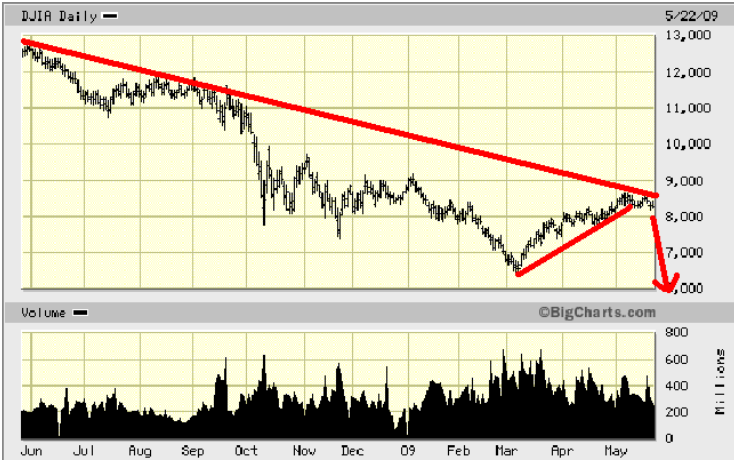
The Grand Old Man of Dow Theory, Richard Russell, is even more direct. He’s predicting a “second round of pain” for stock markets. He wrote, “I note that most analysts are now bullish, and that they are recommending stocks for the ‘continuing advance.’ At the same time, most economists are optimistic, arguing that the ‘longest recession since World War II has ended.'”
–“Typical, last March everyone was bearish and the market was establishing a temporary bottom. Now that everyone is optimistic, the stock market is topping out and the public (the amateurs) are about to receive their second round of pain,” he wrote. Ouch. – Dan Denning The Daily Reckoning Australia
Economic Recovery: The Unresolved Mysteries

02/02/10 Baltimore, Maryland – What a marvelous recovery! But there are so many unresolved mysteries! GDP growth over 5%…but, mysteriously, no jobs…and no rally in the housing market.
And now, to compound the mystery, Mr. Obama has come forward with a $3.8 trillion budget.
The markets like it. Stocks rose 118 points on the Dow yesterday. Gold went up $21. Investors see more hot money on its way…a Vesuvius of it…
The amount of the budget itself is staggering. That’s a lot of money. But even more staggering is the glaring omission: the Obama administration is planning to spend $1.6 trillion it doesn’t have. And that’s on top of the $1.35 trillion it didn’t have, but nevertheless spent, last year. Where is all this money coming from? Another mystery…
Let’s see…put those two deficits together and you’ve got a budget hole as big as the Milky Way… Nearly $3 trillion, or more than 20% of GDP.
Another thing that is mysterious about this galaxy of debt is that it comes just as the economy is supposed to be recovering. If you thought the economy were recovering, why would you risk such a huge, record-shattering deficit?
Nothing quite adds up. The GDP is expanding at a healthy pace – according to the numbers handed out by the feds. But people have few jobs and little income.
“Wage and benefit growth hits historic low,” reports The Wall Street Journal.
Employers aren’t employing. Workers aren’t working. And houses are no longer throwing off cash. That leaves more and more people with empty pockets.
Apparently, not even the feds themselves believe the economy is really out of the ditch. We are already rolling along on the recovery road – supposedly. Still, the feds send out the most expensive tow truck in history!
And now The Financial Times draws the obvious conclusion:
“US Deflation No Longer Seen as a Risk.”
You wanna bet?
The world’s number one economy is running huge deficits. But the world’s number two economy is running even bigger ones. Not much bigger…but slightly bigger.
In Japan, deficits are a bit larger than tax receipts. In America, they are a bit smaller. In both cases they are enormous…and growing.
For all its colossal deficits, Japan has not bought its way out of depression…or out of deflation either. Au contraire, the more it spends fighting deflation the further prices fall.
How could this be? Another mystery. How could government be so inept as to shoot itself in the foot whenever it pulls a trigger? How could it be so near-sighted as to aim for one thing and hit the thing it was meant to protect? How could it be so lame-brained as to do exactly the wrong thing at exactly the wrong time?
We can’t answer those questions…at least, not this minute.
So, let’s turn to the evidence. There it is in yesterday’s news report from Bloomberg:
“Consumer prices in Japan in record fall.”
And there you have another mystery, don’t you? Japan inflates the money supply with its zero rates over more than a decade…and its Godzilla budget deficits. And what happens? Its economy sinks and its consumer prices go down!
And so here comes the US of A following the Japanese lead…in the sincerest form of flattery…
Will it not get the same results?
We don’t know. But we wouldn’t be surprised.
We have a lot more to say about this…
…about how the economic theories behind these moves are corrupt, linear and superficial (if not downright stupid)…
…and about how the real driving force behind these deficits is politics, not economics. Economists are just useful idiots. The politicians are using them to grab more money and power for themselves and their friends…
…but let’s go directly to the denouement of this mystery story. Here’s what is really going on:
First, the GDP growth story is one part statistical noise, one part counterfeit, and one part damned lie. We’re in a depression. It will take years to resolve itself.
That’s why unemployment remains high…and why there will be no recovery in housing prices. They may go up. They may go down. They won’t ever get back to the bubble highs of 2006 – not in real terms. Not in our lifetimes.
Second, the mystery of the $1.8 trillion deficit – it too is a mixture of mendacity, audacity, and intellectual laxity. In short, the feds are spending so much money for one reason only: because they think they can get away with it.
Can they?
Of course not…not really. Here’s what is going to happen…
The reality of the non-recovery is going to catch up with this market. Stocks were down in January. Most likely, they’ll sink for the rest of the year too.
The economy will slide as the de-leveraging process continues. It won’t be straight down. But by fits and starts, the mistakes will be corrected…
…but that brings us back to this $3.8 trillion government budget. Its purpose, in large part, is to prevent the corrections from occurring. The feds will try to turn the US into Zombieland, just like the Japanese feds did. You’ll see massive federal spending taking up some of the slack from the private sector – but essentially wasting money on useless projects. And you’ll see major zombie corporations – GM…AIG…etc – propped up with taxpayer’s money.
Speaking of AIG, special agent Neil Barofsky is on the case. He’s ‘probing’ 25 cases of possible fraud involving TARP funds. The AIG bailout is one of them. The original price tag for saving Goldman’s speculative positions with AIG was $85 billion. The whole tab later came to $182 billion.
The flatfoot Barofsky wants to know where the money went. To tell you the truth, we’re curious too – although we doubt there will be any surprises.
But back on our beat…how the mysteries get resolved…
…we know why the economy is winding down…and we know why the feds are running such huge deficits…
…but big deficits aren’t pushing up prices in Tokyo; they’re having the opposite effect. They’re pushing them down. Does that mean US deficits will get the same results – the economy and prices lower instead of higher?
We don’t know…but our guess is that ‘yes’ is the right answer.
Bill Bonner
Since founding Agora Inc. in 1979, Bill Bonner has found success and garnered camaraderie in numerous communities and industries. A man of many talents, his entrepreneurial savvy, unique writings, philanthropic undertakings, and preservationist activities have all been recognized and awarded by some of America’s most respected authorities. Along with Addison Wiggin, his friend and colleague, Bill has written two New York Times best-selling books, Financial Reckoning Day and Empire of Debt. Both works have been critically acclaimed internationally. With political journalist Lila Rajiva, he wrote his third New York Times best-selling book, Mobs, Messiahs and Markets, which offers concrete advice on how to avoid the public spectacle of modern finance. Since 1999, Bill has been a daily contributor and the driving force behind The Daily Reckoning .
Special Report:The Endless PAYCHECK PORTFOLIO: In three simple steps, unleash a steady flow of work-free income… starting with up to 75 automatic “paychecks” deposited directly into your account.
Supply and Demand: 6 good reasons to invest in Australian resources right now
“The chief risk is paying too much for mediocre businesses during generally prosperous times…” -Benjamin Graham, ‘The Intelligent Investor’, 1949
1) BRIC economies (Ed Note: Brazil, Russia, India, China) shrugged off the GFC (Ed Note: Global Financial Crisis)… The share of world growth from Brazil, Russia, India, and China is projected to double in less than 20 years, reaching 40% by 2025
2) India is growing faster than a crowd at a fist fight… The Indians will spend an estimated US$21 billion a year for the next 10 years on the construction of highways, dams, water treatment plants, and nuclear energy facilities.
3) China wants 400 new cities by 2020… The Middle Kingdom will add more people to its new urban areas in the next 15 years than the entire population of the United States. There will be up to 50,000 new skyscrapers… the equivalent of building 10 New Yorks. In addition there’ll be up to 170 new mass transit systems. There are around 70 in Europe today. Trillions of dollars will be spent building power systems, roads, water and wastewater systems, ports and more.
4) We’ve got everything they need… Australia is home to nearly all the mineral and metal deposits needed for the industrialisation of China and India. We’re sitting on the world’s largest deposits of uranium, nickel, zinc, brown coal, lead, rutile, zircon, and tantalum… and the world’s second largest deposits of gold, silver, copper, bauxite and ilmenite…
5) We can’t pull it all out of the ground fast enough. Aussie miners and explorers are spending record levels on finding and extracting resources: According to The Australian Bureau of Agricultural and Resource Economics (ABARE), $6.1bn was spent on minerals and energy exploration in 2007/08, in real terms, the highest level on record. A further $5.6bn is estimated to have been spent in 2008/09. This is more than double the average of the past 25 years.
6) Aussie miners need YOU… The Minerals Council of Australia says that another 80,000 people will be needed in the resources industry by 2020 to maintain Australia’s share of global production. The council says, “Up until the last quarter of 2008, 142,000 people in Australia’s workforce were directly employed in resources. This number was up by a massive 55,400 jobs over the last
five years.”
Ed Note: Listing of Australian Mining Shares HERE.
Claim my 30-day trial of Diggers and Drillers HERE
Dr. Alex Cowie
The head analyst of our resource investment advisory service Diggers and Drillers – Alex holds a graduate degree in finance and investment from the Financial Services Institute of Australia. Trained in Industrial Equity Analysis and Applied Portfolio Management, he is the editor and chief analyst for Diggers and Drillers and the editor of the Daily Reckoning Week in Review.
Just a quick note to let you know that Endeavour Silver Corporation (EXK) is putting in a Sterling (excuse the pun) performance during this trading session and is up 11.43% as we write as silver gains $0.46, giving us a cheerful start to the week.
Endeavour recently issued a news release covering last years performance and outlining the plans for the coming year which looks to have been well received by the investment community.
Yesterday we stuck our necks on the block when we wrote that we did not expect to see the dollar to trade much higher than ‘80′ while it was sitting at ‘79.50′ and this morning we are pleased to see that it has lost a little of its steam and is trading around the ‘79.202′ level. The metals have responded well today and investors have pushed stock prices higher no doubt putting a lot of pressure on the shorters.
If you missed the video with Vice President Hugh Clarke’s commentary on the 2009 and 2010 exploration programs click here. Well worth watching.
Endeavour can be found on a screen near you as it trades on the following Stock Exchanges:
EXK: NYSE-Amex,
EDR: TSX,
EJD: DB-Frankfurt,
EDR.WT: TSX)
Accumulate as and when you can.


You can catch Tyler Bollhorn’s presentation at the World Outlook Conference last January 22, 23rd/2010
Trading as a Career – 10 Questions Answered
Stockscores.com Perspectives for the week ending January 31, 2010

There are an ever increasing number of people who aspire to trade for a living. Trading seems to be the perfect career with the earnings potential, freedom and enjoyment that it offers. However, while trading is quite simple, it is not easy. Perhaps the most common error aspiring traders make is to underestimate just how much effort it takes to be good at it.
1. How Much Capital Do I Need?
I get asked this question a lot and I never have the same answer. I think that every trader should start out with no money at all. The very first thing you should do is trade on paper without risking your money so that you can learn many of the skills that you will need. Pilots fly in simulators to learn their skills because the cost of making mistakes is too high. So too should traders.
Stockscores.com has just created a trade simulator that we call the Trading Challenge that will allow you to practice trade in real world conditions. You pick trades in real market conditions and can earn a score based on your ability to make good trades. You can compare your results against others in the Stockscores community and learn from your mistakes without having your mistakes cost you a lot. The Stockscores.com Trading Challenge is free to use, do so by clicking here
Once you are ready to use real capital, the amount of capital that you need will depend on what value you put on your time. With $10,000 in your trading account, you might be able to make an average of $200 a day. Is that enough for you to spend your day trading?
With time, you can increase your capital base as you gain confidence and improve your trading skill. However, an increase in capital should only come once you have found success with a smaller amount of cash. I advise those with a million dollars of capital to start with $10,000. The mistakes will cost you less.

2. How Do I Learn To Trade?
I taught myself to trade and I think anyone with lots of time can do it this way. However, you will learn more efficiently if you get some training from someone who knows how to trade and has the ability to teach well. Be careful about whom you choose to take your training from; I have seen good traders who are bad teachers and I have seen good teachers that are poor traders.
For those who would like to learn how to trade this year, I will be teaching three day courses in Toronto, Calgary and Vancouver this spring. On Sunday, I will focus on theory and longer term trading and then we will utilize real market conditions to identify opportunities through Monday and Tuesday. Class size will be limited so anyone interested in attending one of these classes should act quickly, you can send me an email to tylerb@stockscores.com and I will provide the details.
3. Is It Possible to Make a Living Trading Stocks?
This would seem like a silly question to ask but it is an important one because everyone should be aware of the odds. I suspect that at least 90% of people who try to trade end up failing. Does that mean that trading is extremely hard? I don’t think so, it is more that it is just so easy to try.
If anyone could be a doctor then you would have a lot of people who might read a book or two before trying to diagnose and treat illness. And, as a result, you would have a lot of failing doctors. Of course, not anyone can be a doctor without first going to school for a long time and undergoing constant upgrading of their education.
There is no requirement that traders get an education first. Anyone can open an account and risk their capital without getting any accreditation or training. The result is that most people fail in their pursuit to become a professional trader.
There are a lot of people who make their living off of trading and the best traders are the highest paid people in the world. Trader Magazine publishes a list of the top earning traders and last year you had to make at least $125 million to make the top 100. The top traders made over $2 billion – in one year!
So, it is absolutely possible to make a living trading stocks but it requires hard work, practice and determination. Not different than doing anything else well, really.
4. Can I Lose a Lot of Money Trading?
The quick answer is yes! Those who start trading without any knowledge of how to trade will surely lose their capital. They may get lucky in the short term and fall in to a false sense of security about their trading ability. However, eventually, traders who don’t know what they are doing will pay a good deal of tuition to the college of trading.
One of the most overlooked aspects of trader’s approach is good risk management. Traders that are early in their career tend to focus on the entry and then the exit decision. They come up with their formulas for picking the right time to buy or short and dive in to trading without any consideration of the most important skill for traders – risk management.
When I train people to trade, I spend a lot of time focusing on risk management. What size of a position should be taken, when to take a loss, when to take a break from trading – all of these questions must be answered and incorporated in to the trader’s plan. If not, you may as well take your money to Las Vegas, at least there you might get a free drink while you lose your money.
5. How Long Will It Take Me to Become a Good Trader?
This is a hard question to answer because there are many variables that affect a person’s success. I have seen people who became consistently successful after 3 months and others who spent 10 years before they could make a living at it.
Learning the mechanics of trading is not very hard or time consuming, I think most people can have that part figured out in a few months if they get good training to start. What is hard, and what some people can never learn, is how to take their emotions out of trading. Our minds are incredibly powerful and our emotions can make you see things that are not there. The best traders are those who don’t care about the money, and that is a mental state that takes time to achieve.
6. What Kind of Hardware Do I Need?
Trading does not require a lot of computing power (unless you are trading with complex algorithmic models). For most traders, any computer built in the last 5 years will do fine. Trading on a Mac is a little bit of a challenge because most of the financial software does not run well on a Mac. However, if you install Parallels and run Windows on your Mac, you can do fine.
Having multiple monitors attached to your computer will make trading easier since you will have more space to watch your stocks. To have multiple monitors requires multiple video cards or a video card with multiple connections. Not every computer will have the expansion slots necessary to attach more than one video card and monitor so make sure that the machine you have or are considering can do this.
What is probably most important for the trader is a fast and reliable internet connection. You need to get stock price data and the more it is delayed from the source, the greater your disadvantage.
7. What Kind of Software Do I Need?
At a minimum, you need software that allows you to enter your trades. The brokerages offer two types of software for doing this. First, is the web based platform that will run through your Internet browser. Second, is dedicated software that you have to install on your computer.
Web based software is more convenient since you can access it from any computer connected to the Internet. However, it tends to have limited features and may not be as fast for getting updated price information.
Dedicated software can offer many more features for charting, scanning and analyzing the stock market. However, you have to be sure that you are on the machine that you have installed the software on in order to make your trades. And, there may be a cost to this software.
Most good brokers will provide both so that you can have the flexibility of a web platform and the features and power of an installed platform.
8. What Brokerage Should I Use?
Active traders require the fastest connection to the stock exchanges that they wish to trade. This means they should have an account with a direct access broker who can bypass the market maker system to get your orders direct to the exchange. This will mean you get the best price on your trades in the least amount of time.
If you are paying a small “ECN” fee on each of your trades then you are trading with a direct access broker. If not, then the brokerage may be routing your buy and sell orders through a market maker who is working your order for their own profit. While you do not see this cost on your trading statements, that cost is there as you may not be getting the best price in the market.
I trade through DisnatDirect who are rated number one in Canada. Their website is www.disnat.com.
9. What Is The Most Important Criteria for Success as a Trader?
I think that most people believe that intelligence would be the most important factor but I don’t think so. I have seen a lot of very smart people who are miserable traders. Success in one aspect of life does not mean you are destined to be a great trader.
I think the most important factor is a love for trading. Since trading can be frustrating and a challenge to learn, having a passion for doing it will get you through the hard times and ensure that stick with it.
This leads to another important factor – determination. If you give up easily you will not last as a trader.
Finally, having the ability to control your emotions is important. Trading requires fast decisions involving money and that means emotions are easily involved. Trading well requires an emotional disconnect with the money.
10. How Do I Get Started?
Everything new seems complicated and overwhelming. The best way to learn is to break the topic down in to small manageable pieces and learn the pieces before putting them all together. This is how I teach people to trade; we start with the basics and just add pieces to the puzzle gradually. In the end, trading seems quite simple.
First, make sure you like the markets and trading. Perhaps read a book or two and study some of the free content on the Stockscores.com web site. If you find it completely boring, you may not be destined to be a trader. If you can not stop your learning then you are a good candidate to get an education to learn the higher details of trading.

I have created a video showing the process I used to find this week’s feature stocks. Check it out by Clicking Here
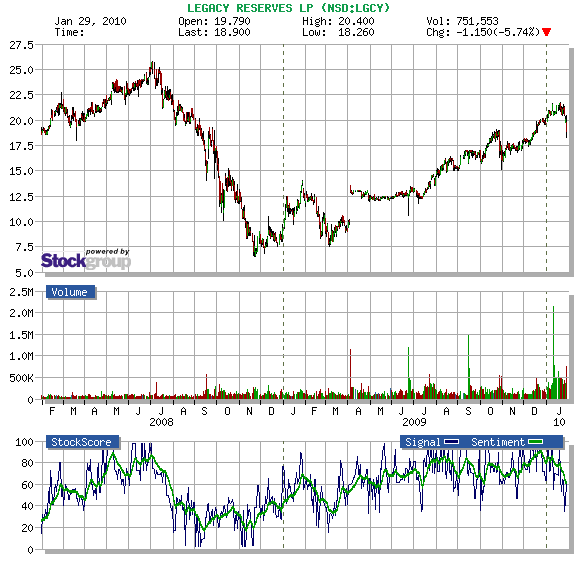
The Reversal of Fortune strategy is a short selling strategy that seeks strong stocks that have had an abnormal down day that breaks the long term upward trend line. Since the overall market is showing weakness right now, this strategy should be effective at taking profits from weak stocks. I ran the Market Scan preset strategy and found a couple of stocks that fit the chart pattern that is needed. These are shown below:

1. STX
STX breaks its long term upward trend line with a abnormal drop in price on abnormal volume. This stock has made considerable gains from its lows and now appears ready to give back some of those gains. Resistance and the stop loss on this trade is at $19.65.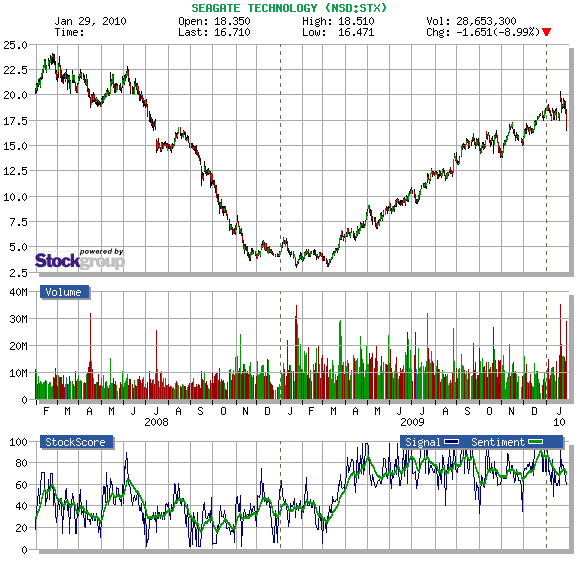
2. LGCY
LGCY has been falling in price for about a week and had its worst drop on Friday as it broke the upward trend line. I think there is a good chance it will bounce higher before it goes lower so you may be able to short sell it at a higher price than we are at right now. Resistance and the stop at $21.50.
Click HERE for the Speaker Lineup at the World Outlook Financial Conferance and click HERE if you want to learn from some of the timeless advice from some of worlds best traders including the very successful Tyler Bollhorn.

Tyler Bollhorn started trading the stock market with $3,000 in capital, some borrowed from his credit card, when he was just 19 years old. As he worked through the Business program at the University of Calgary, he constantly followed the market and traded stocks. Upon graduation, he could not shake his addiction to the market, and so he continued to trade and study the market by day, while working as a DJ at night. From his 600 square foot basement suite that he shared with his brother, Mr. Bollhorn pursued his dream of making his living buying and selling stocks.
Slowly, he began to learn how the market works, and more importantly, how to consistently make money from it. He realized that the stock market is not fair, and that a small group of people make most of the money while the general public suffers. Eventually, he found some of the key ingredients to success, and turned $30,000 in to half a million dollars in only 3 months. His career as a stock trader had finally flourished.
Much of Mr Bollhorn’s work was pioneering, so he had to create his own tools to identify opportunities. With a vision of making the research process simpler and more effective, he created the Stockscores Approach to trading, and partnered with Stockgroup in the creation of the Stockscores.com web site. He found that he enjoyed teaching others how the market works almost as much as trading it, and he has since taught hundreds of traders how to apply the Stockscores Approach to the market.
References
Get the Stockscore on any of over 20,000 North American stocks.
Background on the theories used by Stockscores.
Strategies that can help you find new opportunities.
Scan the market using extensive filter criteria.
Build a portfolio of stocks and view a slide show of their charts.
See which sectors are leading the market, and their components.
Disclaimer
This is not an investment advisory, and should not be used to make investment decisions. Information in Stockscores Perspectives is often opinionated and should be considered for information purposes only. No stock exchange anywhere has approved or disapproved of the information contained herein. There is no express or implied solicitation to buy or sell securities. The writers and editors of Perspectives may have positions in the stocks discussed above and may trade in the stocks mentioned. Don’t consider buying or selling any stock without conducting your own due diligence.
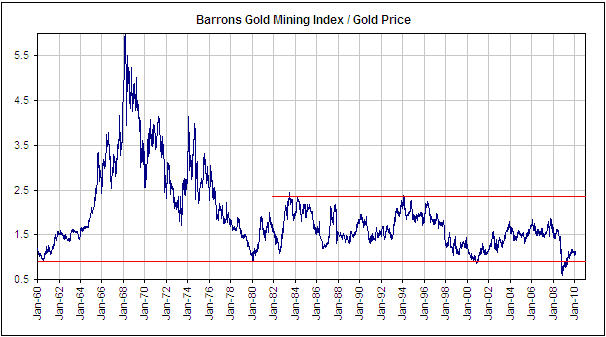
It is widely believed that gold stocks offer leveraged exposure to changes in the gold price, but this belief is false. At least, the historical record suggests that it is false on a long-term basis. As evidence we include, below, a chart of the BGMI/gold ratio covering the past 50 years (BGMI is short for Barrons Gold Mining Index of Large sized Producers).
…..read more HERE (Ed Note: Small Cap Gold Stocks are an exception, and he makes the case)
-
I know Mike is a very solid investor and respect his opinions very much. So if he says pay attention to this or that - I will.
~ Dale G.
-
I've started managing my own investments so view Michael's site as a one-stop shop from which to get information and perspectives.
~ Dave E.
-
Michael offers easy reading, honest, common sense information that anyone can use in a practical manner.
~ der_al.
-
A sane voice in a scrambled investment world.
~ Ed R.
Inside Edge Pro Contributors

Greg Weldon

Josef Schachter

Tyler Bollhorn

Ryan Irvine

Paul Beattie

Martin Straith

Patrick Ceresna

Mark Leibovit

James Thorne

Victor Adair