
Currency
 Just stunning.
German newspaper Der Spiegel reported yesterday that the Bavarian Banking Association has recommended that its member banks start stockpiling PHYSICAL CASH.
Europe, of course, has been battling with negative interest rates for quite some time.
What this means is that commercial banks are being charged interest for holding wholesale deposits at the European Central Bank.
In order to generate artificial economic growth, the ECB wants banks to make as many loans as possible, no matter how stupid or idiotic.
They believe that economic growth is simply a function of loans. The more money that’s loaned out, the more the economy will grow.
This is the sort of theory that works really well in an economic textbook. But it doesn’t work so well in a history textbook.
Cheap money encourages risky behavior. It gives banks an incentive to give ‘no money down’ loans to homeless people with no employment history.
It creates bubbles (like the housing bubble from 10 years ago), and ultimately, financial panics (like the banking crisis from 8 years ago).
Banks are supposed to be conservative, responsible managers of other people’s money.
When central bank policies penalize that practice, bad things tend to happen.
Traditionally when a commercial bank in Europe wants to play it safe with its customers’ funds, they would hold excess reserves on deposit with the European Central Bank.
In the past, they might even have been paid interest on those excess reserves as an extra incentive to be conservative.
Now it’s the exact opposite. If a bank holds excess reserves on deposit at the ECB to ensure that they have a greater margin of safety, they must now pay 0.3% to the ECB.
That’s what it means to have negative interest rates. And for the bank, this eats into their profits, especially when they have tens of billions in excess reserves.
Talk about being between a rock and a hard place.
On one hand, banks stand to lose a ton of money in negative interest. On the other hand, they put their customers’ deposits at risk if they don’t hold extra reserves.
Well, the Bavarian Banking Association has had enough of this financial dictatorship.
Their new recommendation is for all member banks to ditch the ECB and instead start keeping their excess reserves in physical cash, stored in their own bank vaults.
This is officially an all-out revolution of the financial system where banks are now actively rebelling against the central bank.
(What’s even more amazing is that this concept of traditional banking– holding physical cash in a bank vault– is now considered revolutionary and radical.)
There’s just one teensy tiny problem: there simply is not enough physical cash in the entire financial system to support even a tiny fraction of the demand.
Total bank deposits exceed trillions of euros. Physical cash constitutes just a small percentage of that sum.
So if German banks do start hoarding physical currency, there won’t be any left in the financial system.
This will force the ECB to choose between two options:
1) Support this rebellion and authorize the issuance of more physical cash; or
2) Impose capital controls.
Given that just two weeks ago the President of the ECB spoke about the possibility of banning some higher denomination cash notes, it’s not hard to figure out what’s going to happen next.
Neither this email nor content posted on the website SovereignMan.com is intended to provide personal tax or financial advice. Before undertaking any action described in this letter, financial or otherwise, you should discuss your options with a qualified advisor– tax accountant, financial planner, attorney, priest, IRS auditor, Bernie Madoff, et
If you’d like to update your email address or no longer wish to receive our daily emails, click the link below: Update email or unsubscribe
Publisher of Sovereign Man
30 Cecil Street #19-08
Singapore, Singapore – No State 049712
Singapore

 Well, all eyes on US Non-farm Payroll report today. Expected is +193k; previous month +158k…
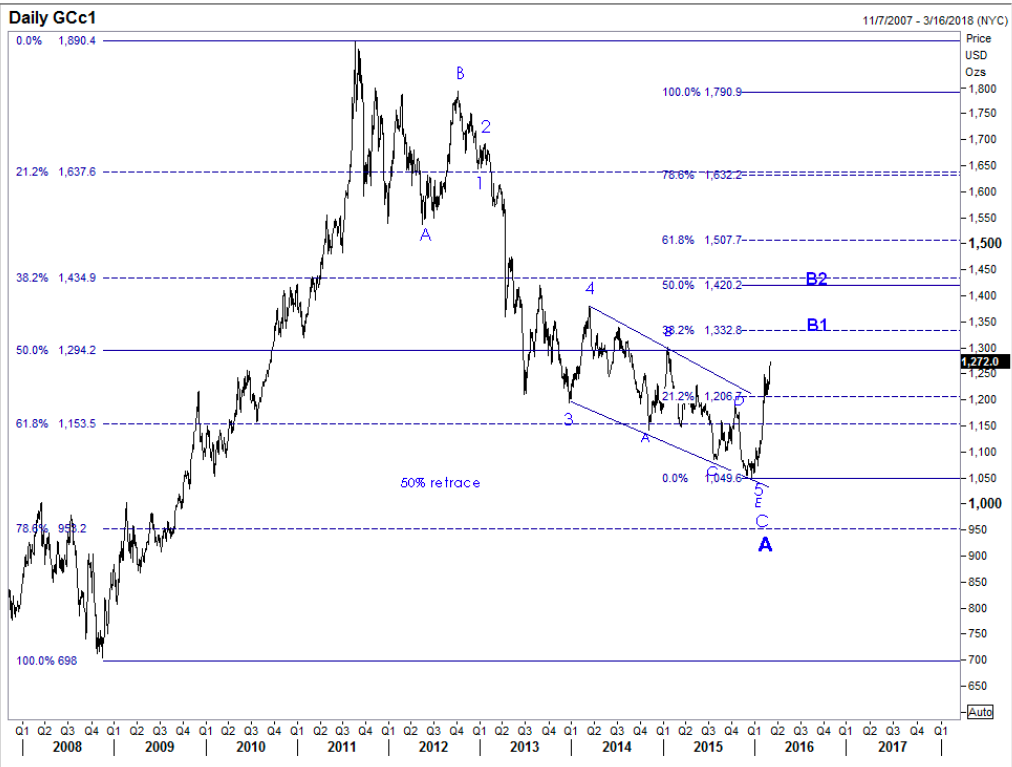
The pack mixed, starting to square up in front of the report; bonds flat, only slightly higher; but gold up again….hmmm…next resistance at 1294-1332; then 1420-1434…gold daily below:

The Conference Board of Canada says BC is again going to lead Canadian Economic Growth. The construction boom that comes along with Vancouver’s booming Real Estate Market is threatened by politicians

I am going to keep this piece, short and sweet as I believe the charts below will speak volumes about where we are in these markets and more importantly, where we are heading.
The world seems to be on the verge of a meltdown but, if so, why are some of the commodities telling a different story?
Copper
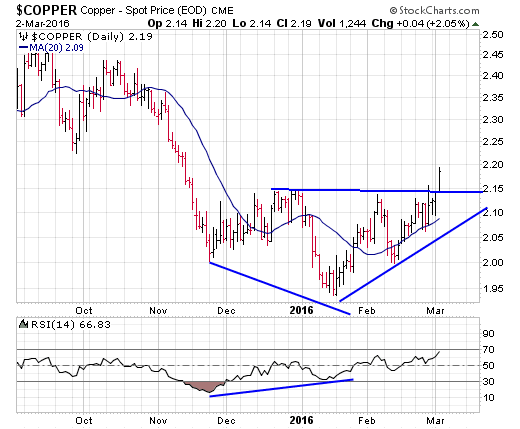
Copper has been on our watch list for sometime now as it is a leading indicator of economic investment and strength and with the recent upside breakout on March 2 all we can say is that copper is trying to tell us something.
Crude Oil
As well crude oil has found a bottom and heading higher and we are sitting at overhead resistance of $35 and looking good.

Gold
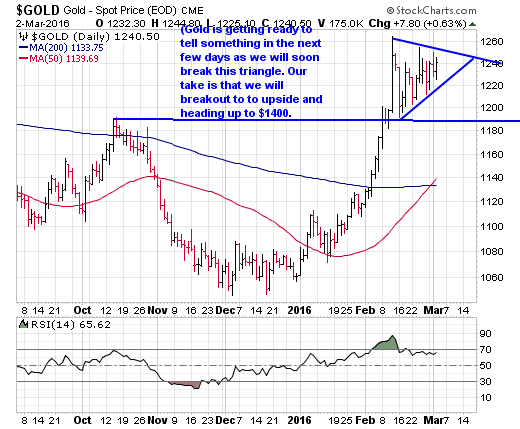
Of course we are biased as we are serious investors in the precious metals, but gold also is trying to tell us something as we are on the verge of breaking to the upside out of this triangle formation (see below) and heading to the $1400 area. Gold seems to be sensing some monetary panic is coming from Central Bankers.
I am highly bullish on the precious metals sector, the common shares and stock warrants.
If you are interested in learning more about my services please join me at http://commonstockwarrants.com/.

Societe Generale is out with its latest quarterly chart of so-called swan risks that threaten to rock the global financial markets. For the most part, the risks remain unchanged from November.
SocGen analysts reiterated that the two highest-probability risks were a British exit from the eurozone, or Brexit, (45%) and an economic hard landing in China (30%). And with the Brexit specifically, there’s the potential economic ripple effect into the rest of Europe, which is already more politically divided than it has been in ages.
The one change from the firm’s most recent black swan chart is that the risk of a new global recession has increased to 20% from 10% in late 2015.
Notably, the size of the swan indicates how big of an impact a given risk would have should it come to be. So although out of the listed risks, SocGen thinks that a Brexit is the most likely to happen, it would not be the most impactful.
“Common to all these risks is the financial conditions component that has the potential to act as an amplifier, both in terms of the individual risks and in linking them together, making each more likely,” the SocGen team wrote.
It’s worth noting that, technically speaking, black-swan risks are by definition extremely unlikely and nearly impossible to predict. So it’s a bit of a contradiction to assign such high probabilities to any of these events. Nevertheless, when these events do materialize, it’s bad. SocGen’s swan chart is just trying to show that major economic and geopolitical risks are brewing that could cause serious problems should they ever come into fruition.
On the positive end, SocGen also points to three upside risks: stronger investment and trade; more fiscal accommodation; and the possibility of fast-track reform.
Check out all the stewing swans below.

SEE ALSO: 14 incredible facts about Texas

-
I know Mike is a very solid investor and respect his opinions very much. So if he says pay attention to this or that - I will.
~ Dale G.
-
I've started managing my own investments so view Michael's site as a one-stop shop from which to get information and perspectives.
~ Dave E.
-
Michael offers easy reading, honest, common sense information that anyone can use in a practical manner.
~ der_al.
-
A sane voice in a scrambled investment world.
~ Ed R.
Inside Edge Pro Contributors

Greg Weldon

Josef Schachter

Tyler Bollhorn

Ryan Irvine

Paul Beattie

Martin Straith

Patrick Ceresna

Mark Leibovit

James Thorne

Victor Adair