
Energy & Commodities
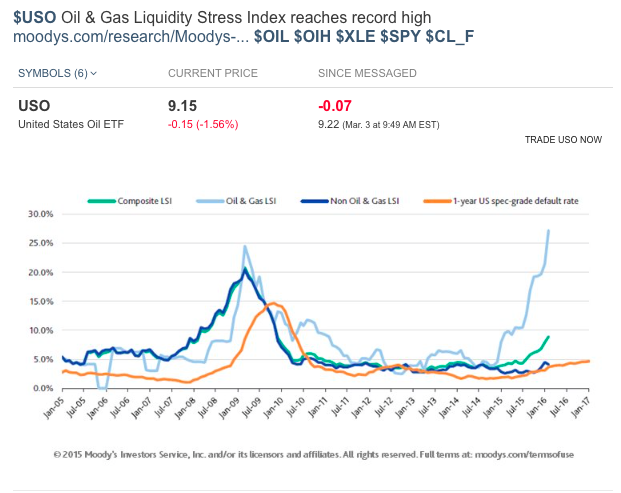
New York, March 02, 2016 — Moody’s Oil & Gas Liquidity Stress Index surged to a record high of 27.2% following the downgrade of the ratings of 19 energy companies in February. The energy LSI has now surpassed its previous high of 24.5% during the last recession, the rating agency says in its most recent edition of SGL Monitor Flash.
February marks the biggest month ever for liquidity downgrades, with the ratings of 17 energy exploration & production companies among the 25 total companies downgraded. Ten E&P companies’ liquidity ratings were cut to SGL-4, Moody’s lowest liquidity rating, along with one energy oilfield services company.
Moody’s also downgraded to SGL-4 renewable energy project company TerraForm Power Operating LLC (B3 negative) and marine services concern Teekay Corp. (B2 negative), each lowered one notch.
“The prolonged weakness in energy sector credit conditions is driving the sustained increase in the LSI,” said John Puchalla, a Moody’s Senior Vice President. “Energy liquidity downgrades came as part of our ongoing review of oil & gas companies globally in light of the weaker price environment.”
Moody’s composite Liquidity Stress Index jumped to 8.9% in February from 7.9% in mid-January and is now at the highest level since November 2009
“The composite LSI has been increasing since November 2014 and has moved above its long-term average,” said Puchalla. “This progression signals that the default rate will continue to rise as the year progresses.”
Moody’s forecasts that the US spec-grade default rate will rise to 4.7% in January 2017 from a current 3.1%. Nevertheless, most liquidity strains continue to relate to commodity price weakness and the resulting derivative effects.
Moody’s subscribers can access this report at http://www.moodys.com/viewresearchdoc.aspx?docid=PBC_187960.

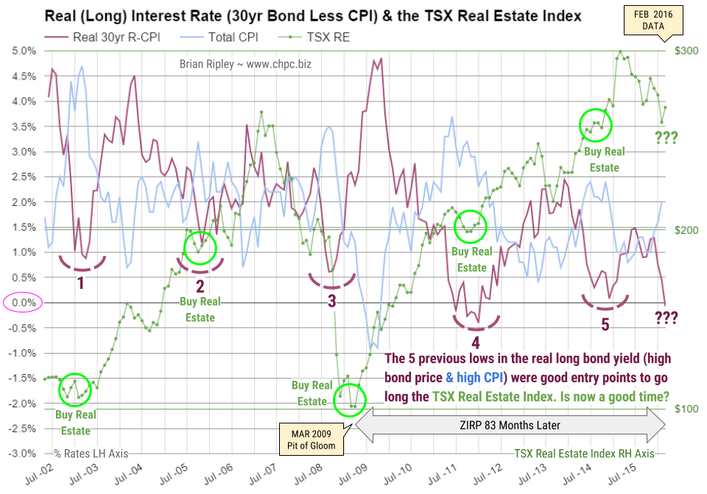
BoC 30yr Bond Rate less CPI and the TSX Real Estate Index
Real Rates of return fall with the rise in CPI or the drop in nominal yields and are defined as “the nominal rate less CPI”.
The chart above shows that in February 2016, the real long interest rate broke down into a negative yield as both the nominal rate fell and CPI moved back up to the loonie depreciated 2% BoC target.
The ongoing commodity deflation reflects withering global GDP and although Canadian exporters benefit from currency depreciation in the short term, importers and Canadian consumers have to trade more of those depreciated loons to maintain lifestyle.

A quote from Mark’s daily VR Platinum Newsletter:
Gold closed up 7.80 at 1240.50. The recent peak of 1263.10 was posted on February 11. Gold traded at 1047.70, a new low on December 2. The gold market was being driven lower in the time-tested manipulation strategy of pushing prices lower to attract selling and enable accumulation. It still appears the U.S. Dollar Index has topped out for the near-term which helped gold. Either way, gold can rally in my opinion. Yes, the COMEX is a fraud. Others concur. Delivery of large quantities is nearly impossible as the COMEX offers cash settlements. That tells you physical supplies are limited if non-existent. Resistance is now 1306 and 1425. Support is 1030-1040 and then 980. My ongoing concern is central bank collusion to keep the price of gold down, growing pressure to control the flow of cash and the spying on bank customers who wish to withdraw cash. What we need to do to throw the bums out that are suppressing prices – rigging! When the financial system crashes either by its own weight or perhaps by actions of Russia, China or Islamic terrorism, think about what assets you want to own – a bank account? – a brokerage account? What if you are locked out? I’m holding my gold and adding all the way down. I would also suggest keeping a generous amount of cash, food, and firearms under the mattress as insurance. That is what the smartest people I know are doing.
via Mark Leibovit
 Bond Timers – #2 for the three-year period ending 12/31/14.
Bond Timers – #3 for the one-year period ending 12/31/15
Gold Timers – #2 for the ten-year period ending 12/31/14.
Stock Market Timers – #4 for the eight-year period and #3 for the ten-year period ending 12/31/14.
 Thoughts from our recent conversation with Alec Ross on his new book, Industries of the Future, which can be listened to on the Newshour podcast page here or on iTunes here.
We frequently hear about automation and artificial intelligence encroaching on paid labor, and many of us want to know about the future of work. Recently, Alec Ross joined Financial Sense to discuss his new book,The Industries of the Future, a number one best-seller on Amazon.

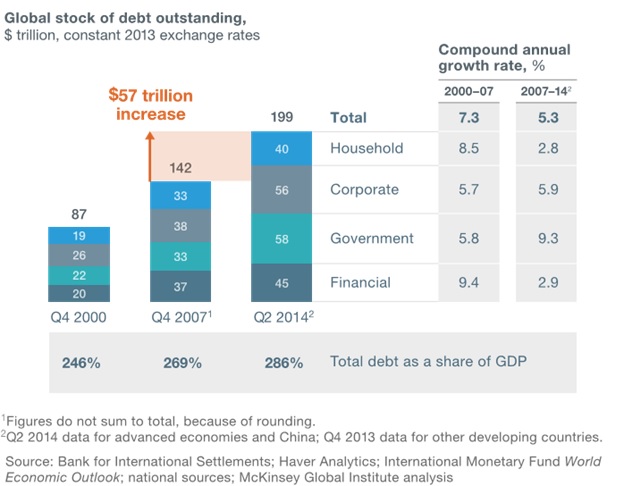
The major global economies have had a staggering debt of $199 trillion as of Q2 of 2014. The most recent figures will be closer to $230 trillion because, after 2014, the ECB, Japan and China have all resorted to ‘massive monetary easing’ programs while the US debt continues to escalate, with every passing second. The total debt, as a percentage of GDP, stood at 286%; the latest numbers will prove to be much worse.


-
I know Mike is a very solid investor and respect his opinions very much. So if he says pay attention to this or that - I will.
~ Dale G.
-
I've started managing my own investments so view Michael's site as a one-stop shop from which to get information and perspectives.
~ Dave E.
-
Michael offers easy reading, honest, common sense information that anyone can use in a practical manner.
~ der_al.
-
A sane voice in a scrambled investment world.
~ Ed R.
Inside Edge Pro Contributors

Greg Weldon

Josef Schachter

Tyler Bollhorn

Ryan Irvine

Paul Beattie

Martin Straith

Patrick Ceresna

Mark Leibovit

James Thorne

Victor Adair