
Energy & Commodities



 The shouts of warning are finally starting to come out from official bodies. Since the collapse of the oil and gas market, we have been writing about the fact that we haven’t seen the worst yet.
As I have previously written, Canada and Russia are two countries that have been absolutely devastated by the crashing oil markets. The oil and gas crash has racked the Canadian economy and resulted in massive layoffs in the industry and those that support it. Yet the ripple effect has yet to take full effect and the corresponding regulatory bodies are just starting to take notice.
The Canadian banking sector, along with the Commodities sector, constitutes a massive part of the Canadian economy. Therefore, it is not surprising to learn that the former is now controlled by the latter and in a major way.
Alarm bells are ringing as growing unease settles across the Canadian banking sector. They know that defaults are coming in a massive way. Most people employed in the commodities sector enjoyed large incomes and therefore they splurged on large and expensive toys to go along with their income, as many people do. Unfortunately, this means another thing – large loans, which are becoming more and more unlikely to be repaid.
The Wall Street Journal is now catching up with this reality as well. In a recent article they highlighted that the Canadian banking sector is horribly under-funded in the face of this growing crisis and points out that Canada’s banking regulators are even taking notice.
“Canada’s banking regulator is urging the country’s major banks to review their accounting practices to ensure they have sufficient reserves as the commodity-price collapse takes a toll on the economy.”
“We want them to take a good look at their accounting practices,” said Superintendent of Financial Institutions Jeremy Rudin. “They should support loss-absorbing capacity and the ability to manage through difficult times in general,” he added.
Regulators are taking notice and for good reason. The amount of exposure that the Canadian banking sector has to the flailing oil and gas markets is massive, equating to roughly C$107 billion!
People should be even more startled by the fact that this industry is nowhere near starting up again, even if prices were to recover tomorrow. It would take time to rehire and restart the production that has been shut down.
This current reality means that this ticking time bomb is set to explode in the hands of the Canadian Banking sector and thus cause a ripple effect across the Canadian economy and undoubtedly across the highly intertwined Western banking structure.
Could Canadian banks be the next spark that lights the match? Will this economic situation be the catalyst that sends us plummeting into the next major financial crisis? It is incredibly possible yet unknown. Sadly, the world is facing many scenarios that could cause similar turmoil.
The views and opinions expressed in this material are those of the author as of the publication date, are subject to change and may not necessarily reflect the opinions of Sprott Money Ltd. Sprott Money does not guarantee the accuracy, completeness, timeliness and reliability of the information or any results from its use.

 Chang and Eng were the first internationally known “Siamese twins”, as a result of their having been exhibited worldwide. Although each had a complete body, they were joined together at the sternum.
In 1870, Chang suffered a stroke and his health deteriorated over the next four years. In 1874, at age sixty-two, he developed bronchitis and died. His brother Eng realised immediately that his continued attachment to his brother meant that he was next. Although he was separated from his twin in an emergency operation, Eng died hours later. He left the problem too long and paid with his life.
Just as with Siamese twins, it’s a risky proposition for one country to have too much dependency on another. If a visitor to Uruguay were to visit a supermarket and examine the origin of the products by reading labels, he would find that Uruguay produces 90% of the food it consumes. In Cuba, however, we read the labels on packaging and see that the great majority of packaged foods comes from Mexico. This suggests that, should food production diminish in Mexico, or should there be political turmoil or shipping problems, Cuba could face significant problems in feeding its people.
A similar problem exists in Canada. Roughly 70% of Canada’s export product is sold to the US, whilst over 60% of its imports come from the US. Of particular concern is oil. The Canadian oil industry cannot survive without the US, as over 99% of its oil production is shipped there. Unless oil returns to a level over $60/bbl fairly soon (don’t hold your breath), and the US doesn’t stop dithering over the pipeline issue, not only will Canadian jobs and oil sales suffer, but entire companies are likely to fail.
Regarding banking, Canadians take pride in their system and rightfully so, as Canadian banks have been nowhere near as cavalier as American banks in recent history. However, without transfers between the two countries (particularly between New York and Toronto), their banks would quickly find themselves in peril. If the US were to find itself in an economic crisis, as appears likely, Canada’s banks would also be in crisis.
In 2007, the US experienced a collapse in its real estate market. Many Canadians felt that they were in better shape, as they did not experience a similar collapse. Unfortunately, though, the Canadian housing bubble continued to grow. Over the last ten years, inflation-adjusted residential real estate prices in Canada have increased by 49.3%, whilst US and EU numbers have gone down. House buyers in Vancouver, Calgary and Toronto are way overdue for a major fall. All that would be needed would be a rise in interest rates to prick the bubble. (Canadian Real Estate values must decline by 35.1% just to be equal to the US.)
Other sectors of the economy, however, have already taken a hit from the North American recession. Jobs have disappeared and wages have not kept abreast of increasing costs. Households have made up the difference with debt, and have committed themselves to a phenomenal level of borrowing. Indebtedness in relation to income has increased dramatically.
All the above (and other factors too numerous to mention) serve as a reminder that, should the US take a fall economically, its Siamese twin will be in for problems that will mirror those of its brother to the south.
If ever there were a time when the cavalry needs to ride in and save the day, it would be over the next year or two. Unfortunately, the opposite is likely to occur. Canadians have recently opted to elect pinup-boy Justin Trudeau as its Prime Minister, who has already promised to steer Canada further into taxation and debt.
To show he means business, he has sold off virtually all of Canada’s three tonnes of gold reserves.
Those of us who are British are still smarting over UK Prime Minister Gordon Brown’s sale of Britain’s gold at the bottom of the market (just under $300) at the turn of the millennium. Mister Trudeau has likely accomplished a similar feat, if it proves true that gold is now at the bottom of its four-year correction and is poised for its next bull market.
In my own country, I deal regularly with Canadian investors, who often say something to the effect of, “The US is headed off the cliff. I know we’ll feel the heat, but thank God, we’re more conservative and it won’t be too bad for us.”
It’s true that in several ways, Canada hasn’t been as stupid as the US, but (especially with Mister Trudeau now in the driver’s seat), as events unfold in the US, they may well make up for lost time. It’s entirely possible that the new Canadian government will shoot itself in the foot repeatedly until they catch up with the US. However, even at best, when the US pulls the “flush” handle on their economy, Canada will caught in the maelstrom.
In 1874, when Chang and Eng died, people queried, “Why didn’t they have the surgery to separate themselves years previously, when it would have assured the longevity of one if the other died?”
Of course, hindsight is 20/20 and it’s no different for nations. Rarely does any nation take the bitter pill of diversifying, prior to a crisis. Almost invariably the “Eng” nation procrastinates until it’s too late and it follows its brother into crisis and/or collapse.
If the reader finds himself nodding at this observation, he may question whether he, as an individual, is prepared. Today, a quiet exodus of Americans has begun. Increasing numbers are diversifying themselves out of the US; moving their wealth (and often themselves) out of their home country so that they won’t be casualties when the odiferous effluvium hits the fan.
However, fewer Canadians share their concern. We’re seeing less of an exodus from Canada. Do they have reason to feel less threatened? Well, certainly we shall see a collapse in several of the world’s most prominent jurisdictions in future. If we base our projections on the fundamentals alone, we might see a crash in China, one in Japan, the EU, then America. Canada might well come in at the end.
However, the fundamentals certainly indicate that all will be hard hit at one point or another and it’s not always the fundamentals that set the order. In the end, it’s generally a series of black swan events that trigger the inevitable, sometimes resulting in a less logical order.
Black swans are, by definition, unpredictable. It may turn out that oil alone could trigger an early fall for Canada. But our concern here should not be over which jurisdiction hits the skids first. Our concern should be the inevitability of the events.
It should be said that it’s far too late in the game to perform surgery that would assure a healthy Canada, if and when the US takes its dive. It’s not, however, too late for Canadians to create individual diversification of investment. They may still sell off their homes and choose to rent for the next few years (better to lose a little than a lot). They may also move their money out of financial institutions and into precious metals in an offshore depository. And if they wish to own property, they might choose to buy land or built property in a jurisdiction that promises to survive the coming economic debacle better than their home country.
There are certainly means and there may be adequate time to avoid the same outcome as Eng.
The author is not affiliated with, endorsed or sponsored by Sprott Money Ltd. The views and opinions expressed in this material are those of the author or guest speaker, are subject to change and may not necessarily reflect the opinions of Sprott Money Ltd. Sprott Money does not guarantee the accuracy, completeness, timeliness and reliability of the information or any results from its use.


“A man sits as many risks as he runs.” ~ Henry David Thoreau
Robin Hood robbed the Rich to help the poor; in the modern day version the Rich rob both Robin Hood and the poor to become even richer. The rich in this case are the greedy corporations and the officers that run the show behind the scenes. In this lazy world, the only thing that matters is money and how to make as much of it as fast as possible. Hence, the best way to boost earnings without doing anything is to buy back boatloads of shares and in doing so artificially boost earnings. It is a perfect scam.
Companies in the S&P 500 Index are poised to purchase over $165 billion of stock this quarter, bringing us dangerously close to taking out the 2007 record. While Mutual funds and the masses are selling the corporate world is buying, proving that the dumb money is not in the know, even though their actions are based on valid data. Logic does not drive the markets; it’s emotions that are the main driving force behind the markets. $40 billion flowed out the markets via mutual fund sales or individual redemptions, but the corporate world more than covered that slack. One could call this is a positive divergence as the corporate world pumped this money into stocks when the markets were tanking, and the masses fled for the exits.
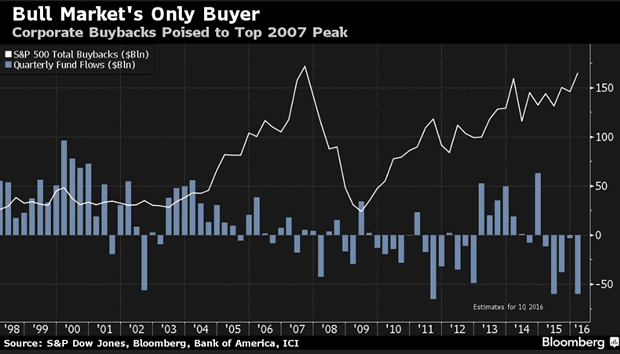
This record binge could continue and here’s why:
Central bankers worldwide are embracing negative interest rates and we all know that low rates favor speculation Look at what the current low rate environment has led to; imagine what will happen in the U.S if rates turn negative. We suspect an all out feeding frenzy will take place. The corporate world will rush in and borrow even more money; the masses will jump into stocks as it will look like earnings are rising, and everyone will have fun until the bottom drops out. The bottom always drops out, but it’s the average Joe that is left holding the can. Nothing has changed, and nothing will change going forward
“Anytime when you’re relying solely on one thing to happen to keep the market going is a dangerous situation,” said Andrew Hopkins, director of equity research at Wilmington Trust Co., which oversees about $70 billion. “Over time, you come to the realization, ‘Look, these companies can’t grow. Borrowing money to buy back stocks is going to come to an end.”‘
“Corporate buybacks are the sole demand for corporate equities in this market,” David Kostin, the chief U.S. equity strategist at Goldman Sachs Group Inc., said in Feb. 23 Bloomberg Television interview. “It’s been a very challenging market this year regarding some of the macro rotations, concerns about China and oil, which have encouraged fund managers to reduce their exposure.” ~ Full story
Companies in the S&P 500 are also flush with cash, so they can borrow the money in the open markets or use some of the cash they have been hoarding. According to Bloomberg, Non-Financial Companies in the SP500 had over $900 billion in cash at the end of 2015; the figure now is probably closer to $1 trillion.
Hedge funds and mutual funds have had a hard time making money over the past few years and have been net sellers as of late. Mass psychology states the masses that always get fried and compared to corporations that are buying back their shares, mutual funds and Hedge funds are sardines.
The Mass Psychology perspective
The trend is up regarding share buybacks, and as Central bankers worldwide are gravitating towards negative rates, it is fairly safe to assume that this trend will continue for quite some time. The masses are not revolting against this form of illicit behaviour and even though the dollar amount deployed to share buybacks continues to rise each year, we are not at the feeding frenzy stage. Hence, expect share buybacks to rise to insane levels.
Nothing short of rising rates could put a damper on share buybacks, and that is not something that will occur anytime soon. The second option is for Congress to pass new laws making restricting companies from blatantly repurchasing their shares with the sole intention of raising their earnings per share. As Congress shares the same bed with these corporate giants, don’t expect such a law to come into effect shortly.
Game Plan
The markets are being manipulated and will continue to be manipulated probably until the end of time, so until the trend changes or share buybacks grind to a halt, every strong pullback has to be viewed as buying opportunity.

-
I know Mike is a very solid investor and respect his opinions very much. So if he says pay attention to this or that - I will.
~ Dale G.
-
I've started managing my own investments so view Michael's site as a one-stop shop from which to get information and perspectives.
~ Dave E.
-
Michael offers easy reading, honest, common sense information that anyone can use in a practical manner.
~ der_al.
-
A sane voice in a scrambled investment world.
~ Ed R.
Inside Edge Pro Contributors

Greg Weldon

Josef Schachter

Tyler Bollhorn

Ryan Irvine

Paul Beattie

Martin Straith

Patrick Ceresna

Mark Leibovit

James Thorne

Victor Adair