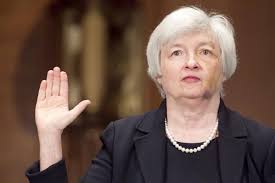
The Federal Reserve’s years-long campaign to sheepishly back away from its own policy forecasts continued in earnest last week when it officially reduced the four expected 2016 quarter point hikes, suggested back in December, to just two. Given the deteriorating economic outlook
, I believe there can be little doubt that the Fed will soon complete the capitulation process and remove all expectations for additional hikes this year. Even before that happens, savvy observers should have already concluded that the Federal Reserve is stuck in the monetary mud just as firmly now as it has been since the dawn of the financial crisis back in 2008.
Rather than actively voicing its retreat in either its March policy statement or in Chairwoman Janet Yellen’s press conference, the market-moving policy shift was buried in the minutia of the Fed’s “dot plot” information array, in which each voting committee member signals their assumptions of where interest rates will be in various points in the future. Those tea leaves needed to be read to reach the conclusion that policy just got significantly more dovish. But despite the Fed’s soft peddling, the policy shift made an immediate impact on markets, with the dollar getting hit by a variety of rival currencies and gold (and more significantly gold miners) climbing to multi-month highs.
But perhaps the greatest casualty of the announcement was the Fed’s own credibility, which is now being stretched to the limit. At Yellen’s press conference last Wednesday, CNBC reporter Steve Liesman, who has perhaps been one of the most reliable supporters of the Fed’s policies, seemed to indicate that even he had grown weary of the Fed’s prevarications, saying to Chairman Yellen: “Does the Fed have a credibility problem in the sense that it says it will do one thing under certain conditions, but doesn’t end up doing it? And…if the current conditions are not sufficient for the Fed to raise rates,…what would those conditions ever look like?”
Yellen’s response was measured and lengthy, but what it really boiled down to was, “Steve, why have you taken our prior forecasts at face value? We never actually offered firm commitments on anything. Nor did we specifically endorse the things that we seemed to have said. And just so you know, you should expect that the things we are saying now will ‘fully evolve’ over time as well.” Or in plain English: “Steve, don’t you know by now that we have no idea what we are talking about, that our forecasts are just guesses, and since we normally guess wrong, why should you expect greater accuracy now? If anything, it should be obvious that our guesses are biased in favor of stronger growth, as the intention is for those rosy forecasts to positively influence sentiment, thereby helping to obscure the problems that, for political reasons, we are hesitant to acknowledge”.
Talk is cheap, and the Fed buys it by the bushel. But when it comes time to actually do something, it is nowhere in sight. In voicing his frustration, Liesman pointed out that core inflation has gone up the past two months (in fact, it has already breached the Fed’s 2% target), that the jobs report was strong (in fact, the economy is creating 200,000 plus jobs per month), and that the GDP tracking forecast has returned to two percent. And while I have explained on many occasions why those data points are all misleading to the upside, Yellen has made no such qualifications. The growing chasm between what the Fed says it is going to do and what it is actually doing is getting increasingly hard for the mainstream to swallow. When it stops going down at all, a market shift of considerable proportions could begin in earnest.
One of the data points that Yellen likes to cling to most fiercely are the reports that show consumers are confident that the economy has improved and that it will continue to do so. But those reports, which I have always believed are poorly constructed, are completely at odds with what voters (who are also consumers) are actually saying at the polls. Presidential primary exit polls in state after state indicate that the economy has been the top issue on the minds of voters. Generally speaking, this should indicate that people are not overly optimistic about the economy. If they were, other issues, such as immigration, national security, the environment, and health care, would be cited as their top concern.
The big surprise this primary season has been the rise of Donald Trump among Republicans and Bernie Sanders among Democrats. Voters aren’t choosing Trump because they like his hair or Sanders because they like his glasses. Both are considered insurgents in their respective parties. They represent change and their popularity should be seen as a sign of deeply-seated economic uncertainty in voters rather than confidence. If confidence were high, candidates more closely aligned with the status quo should be on top.
According to both the Fed and its economic lapdogs on Wall Street, one of the few other bright spots in the economy is the fact that inflation is finally starting to ramp up noticeably. Last week it was revealed that the core Consumer Price Index (CPI) had risen 2.3% from the year earlier (Bureau of Labor Statistics), thereby eclipsing the Fed’s long-sought 2% target. The economists argue that rising prices will soon lead to rising wages. Yes, consumers are paying more for rent, insurance, food and healthcare, but the long-sought wage increases have yet to materialize. For obvious reasons, consumers tend to avoid celebration if their bills go up and their pay does not.
Higher prices may be the leading reason why consumers are not spending at the expected pace. Last month, economists cheered when January retail sales came in at up .2% for the month (up if you excluded autos and gasoline), according to Commerce Department data. In fact, the Atlanta Fed cited these numbers when boosting its annualized 1st quarter GDP forecast to 2.7% (since revised back down to 1.9%) (FRB Atlanta). But, last week we were told that the January retail sales number was revised way down to negative .4% from the positive .2%. Excluding autos and gasoline, the numbers went down from up .4% to down .1% in February. I don’t recall ever seeing larger retail sales revisions to the downside. But because the revisions were so large, the February numbers could be viewed as positive even though they were way below the pre-revision January numbers.
The slowing sales, in turn, are leading to a dangerous increase in business inventories as unsold goods accumulate on shelves. The inventory-to-sales ratio now stands at 1.4, the highest it has been since May 2009, when the nation was in the midst of the Great Recession. In fact, it has never been this high at times when the economy was not in recession. Similarly, data revisions released last week also indicate that we may ultimately post a full year 2015 current account deficit of $481 billion, the biggest number since the recession year of 2008. If interest rates go up, that deficit could grow significantly worse. The industrial production numbers are also on a downward spiral. Recent data show declines for four straight months, the first time since 1952 that this has occurred without the U.S. being in recession. But if we are already in recession, which I expect we are, then at least that statement will no longer be true.
All this adds up to a nearly inescapable trap for the Fed. The economy is weakening while inflation is strengthening. In the meantime, asset prices, which have become the bedrock of any remaining economic confidence, are extremely vulnerable to an interest rate increase.
As a result, we should expect continued jawboning and inaction from the Fed. All it can do is pray that the economy heats up so it can finally do what it has long promised. But if we keep scraping along the bottom like we have, or go further into the danger zone, look for the Fed to take away those remaining two promised hikes just as easily as it did the first two. The last thing the Fed can bear is for a recession that may be bubbling just under the surface to boil over into full view in the months heading into the election. If that occurs, we all may be seeing a great many press conferences from Mar-a-Lago. That is a development that I’m sure Janet Yellen wants to avoid at all costs.



 A 19+ trillion dollar deficit. Record levels of debt. Stocks trading at obscene valuations. Constant printing of money by the Fed. Banks with cash-to-deposit ratios as low as 3%. NSA spying. 50+ million people on Food Stamps in the Land of the Free.
  Leaders faced with unrest, rising demands and dwindling coffers always debauch their currency as the politically expedient “solution.”
 They continue to ramp up big time. This phenomenon is not going away any time soon, not until it crests in 2020 or 2021.