
Daily Updates
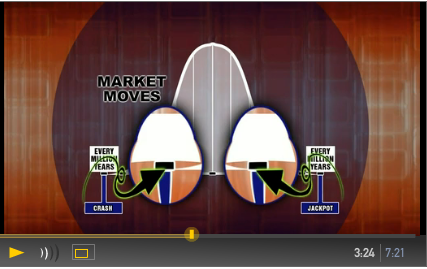
The latest from New York University professor Nouriel Roubini and Black Swan author Nassim Nicholas Taleb is that the risks of rare, “fat tail” events, with their associated financial costs, job losses, and income losses are, in modern times, getting much larger. Two highlight quotes below
Roubini: The US today is having a budget deficit of $0.5 trillion this year, that’s 11 percent of US GDP, that’s not very far from the 13 percent of Greece. And the US is much bigger than Greece.
Taleb: The risks of debt are monstrous, and now we’re facing a future with even more debt. The only, you know, the only hope I had was that someone would do to us what the rest of the world, or Europe and the IMF, are doing to Greece. No democratically-elected government would take the right measure, would go through chemotherapy, would put its population through chemotherapy, which we need to do.
You can advance to the explanation of “Fat Tails” at the 2:14 mark.
Dennis Gartman’s view of Yesterday’s Stock Market Action
“we are fearful of what took place yesterday here in the US for although the Dow did not do so, many of the other broad market indices forged “reversals” to the downside and many of the most important individual equities did the same. We note therefore the chart of Apple’s shares yesterday on the NASDAQ at the upper left of p.1 this morning. Apple has been the clear leader to the upside during this last bull run, and yesterday, having opened on a gap to new all time highs, and having traded firmly most of the day, it collapsed in late trading, closing lower upon the day and closing below the previous day’s lows. This was a classic…a text-book… “reversal” and it should be respected. Further, as we are wont to say, as in battle, so too in investing: when the “Generals” fall, the lesser officers and soldiers are in jeopardy as confusion begins to reign.” For a Trial Subscription go to The Gartman Letter

VS Don Vialoux’s assessment of Yesterday’s Action:
Technical action by S&P 500 stocks was bullish yesterday. Three S&P 500 stocks broke resistance (Amgen, Ball Corp. and MasterCard) and none broke support. The Up/Down ratio improved from 0.95 to (208/214=) 0.97
Technical action by TSX Composite stocks was bullish yesterday. Seven TSX broke resistance ( IESI-BFC, Canadian Pacific, Hudbay Mining, Ivanhoe Mines, Laurentian Bank, Telus and Teck Resources) and none broke support. Break outs were dominated by base metal stocks. The Up/Down ratio increased from 1.02 to (90/83=) 1.08
Interesting Charts
U.S. equity indices tested their 50 day moving average. When they were unable to break above that level, short term selling pressures quickly entered.
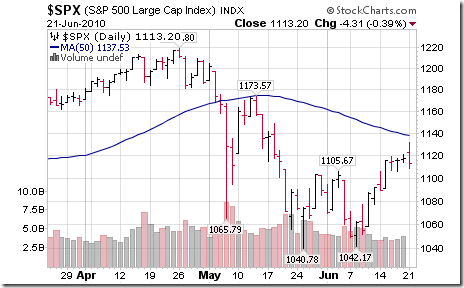
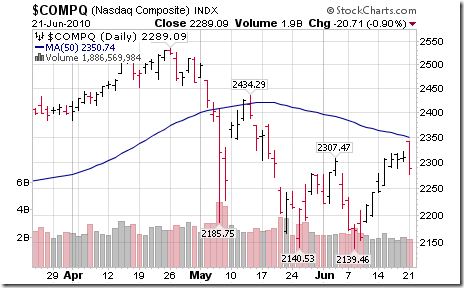
…..read more commentary and view 11 more charts HERE
Quotable
“Those who live by the sea can hardly form a single thought of which the sea would not be part.” – Hermann Broch
FX Trading – Stressed Out
We could refer to our once-upon-a-time Currency Currents that criticized the stress tests administered to US banks, but really we wouldn’t be saying much more than: ‘they were a phony, propaganda-laden strategy that aimed to deceive investors of the obvious risks that remained with US banks.’
….read more HERE
In today’s issue of Breakfast with Dave
• Getting a grip on reality: double-dip risks in the U.S. have risen substantially in the past two months
• The case for bonds: in discussing the outlook for bonds, supply alone cannot be used to predict future price/yield; in our view, deflation has emerged as the primary trend and governments have few bullets left in the chamber to deal with it
• The bond cycle and deflation: while fiscal policy may have a 40% correlation with the direction of bond yields, inflation is twice as important
• Income is king: with corporate balance sheets in terrific shape in Canada and the U.S., the case for credit remains quite compelling
• A shift in G20 tone: A year ago, it was all about fiscal stimulus to bolster the global economy; now the focus is on fiscal stabilization
• Double dip, anyone? In the U.S., we are now seeing the consumer sputter and the housing sector is collapsing again
…..read it all HERE
Gold – The Breakout Must Hold
The downside reversal in the U.S. Dollar during the past two weeks has put a bid under the U.S. gold price. However, the Dollar has become oversold on a daily basis and it is imperative that gold hold $1230 or we will likely see a quick decline to test the May lows of $1166.
The Cup and Handle Pattern is common in gold. This pattern occurs when you have a correction followed by a test of the high and a smaller correction followed by a breakout. The initial rally following a successful breakout measures 61.8% of the height of the base. It currently exists in both the hourly and daily charts with respective measurements of $1300 and $1380.
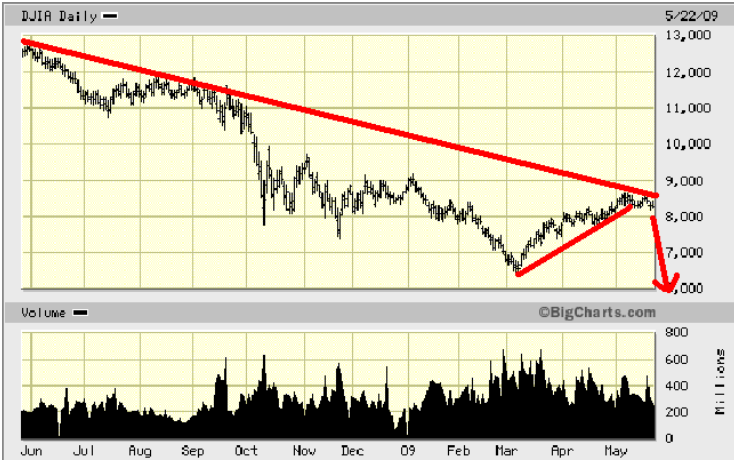
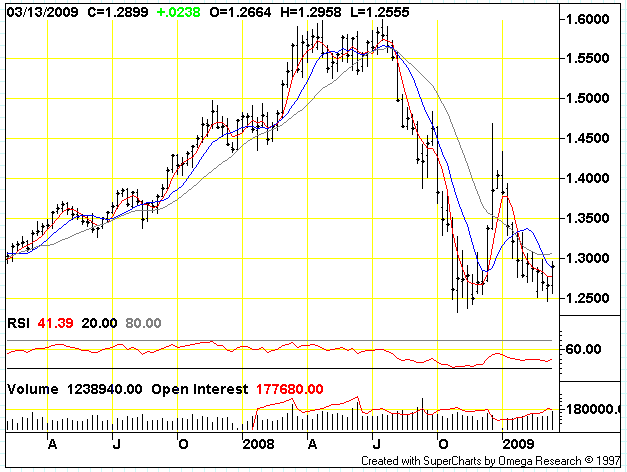
Since 2007 we have seen numerous Cup and Handle patterns in gold that met their initial .618 goals before pulling back to the breakouts:
• Monthly chart of 1980-2007
• May 2006 to September 2007
• March 2008 to September 2009

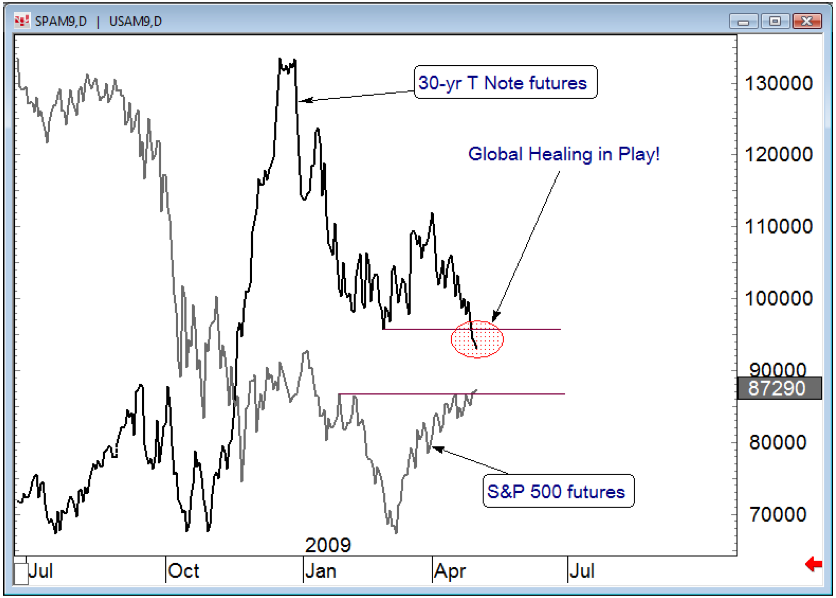
Previous successful examples in gold
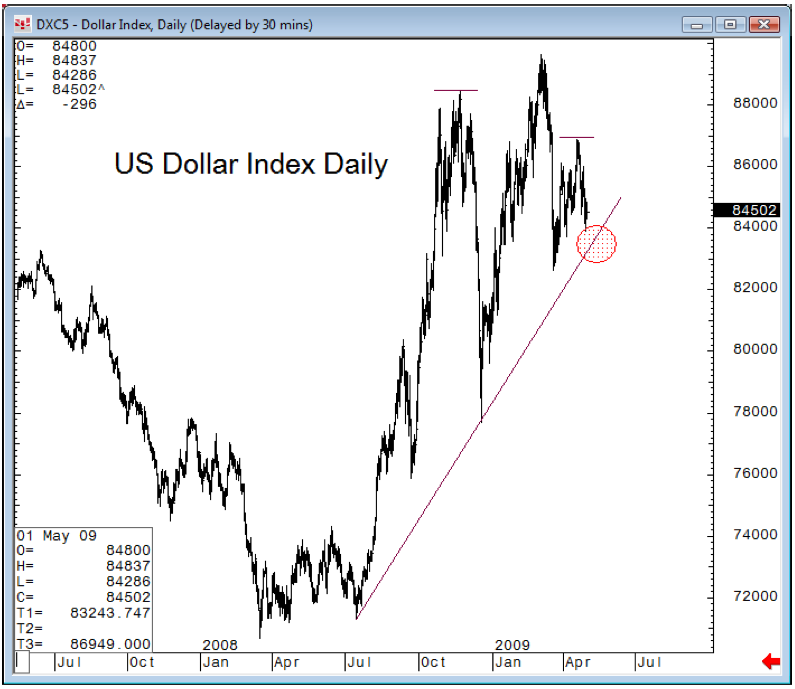

Three important failures
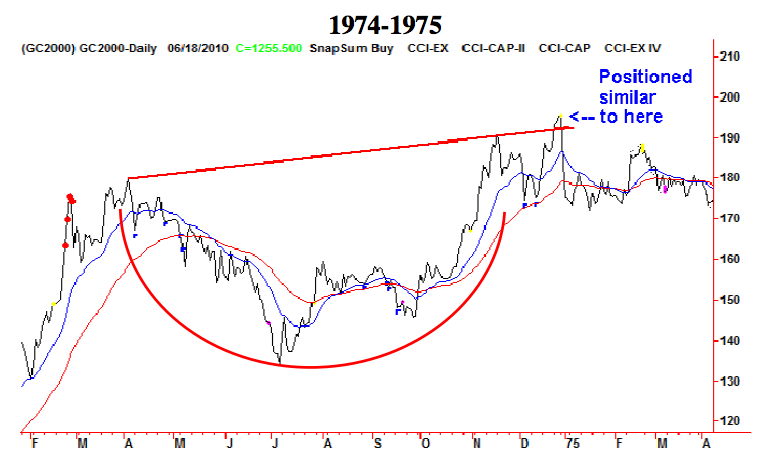
While daily sentiment is at 93% and 95% for gold and silver respectively (www.trade- futures.com ), the weekly sentiment figures are in neutral territory for both. This leads to a conclusion of a possibility of a short term decline within an ongoing bull market.
The opinions in this report are solely those of the author for the private information of clients. Although the author is a registered investment advisor at CIBC Wood Gundy, this is not an official publication of CIBC Wood Gundy and the author is not a CIBC Wood Gundy analyst. The views (including any recommendations) expressed in this report are those of the author, and are not necessarily those of CIBC Wood Gundy. The information contained in this report is drawn from sources believed to be reliable, but
that accuracy and completeness of the information is not guaranteed, nor in providing it does the author or CIBC Wood Gundy assume any liability. The information given is as of the date appearing on this report and neither the author nor CIBC Wood Gundy assume any obligation to update the information or advise on further developments relating to the information provided herein. This report is intended for distribution in those jurisdictions where both the author and CIBC Wood Gundy are registered to do business in securities. Any distribution or dissemination of this report in any other jurisdiction is strictly prohibited. The author and / or CIBC Wood Gundy may have holdings in the companies discussed and may offer advice or have an investment banking relationship with the companies discussed in the report.
-
I know Mike is a very solid investor and respect his opinions very much. So if he says pay attention to this or that - I will.
~ Dale G.
-
I've started managing my own investments so view Michael's site as a one-stop shop from which to get information and perspectives.
~ Dave E.
-
Michael offers easy reading, honest, common sense information that anyone can use in a practical manner.
~ der_al.
-
A sane voice in a scrambled investment world.
~ Ed R.
Inside Edge Pro Contributors

Greg Weldon

Josef Schachter

Tyler Bollhorn

Ryan Irvine

Paul Beattie

Martin Straith

Patrick Ceresna

Mark Leibovit

James Thorne

Victor Adair