
Daily Updates
 NEARBY KC HARD RED WINTER WHEAT: It Really Has Been Amazing, Hasn’t It?:
The rush higher began right at the seasonal turning point…June 15th… when the harvest for hard and soft red winter wheat has historically ended, but this is nothing short of stunning….. and it has caught even the best professionals and grain trading exports off guard.’
“The only market that counts these days is the grain market for grains have leapt to the centre stage everywhere as news of the Russian-Ukrainian- Kazakhstani agriculture problems spreads like proverbial wild fire. Having traded to the limit up yesterday for a short while, and having accumulated pools for a short while, wheat quietly closed at the limit. It is trading materially higher this morning as those who’ve contracted wheat out of Russia for sales abroad now find themselves in a most uncomfortable position. They’ve sold grain they now do not have.
They had it once; they’ve become short of instead.” – Dennis Gartman
Drought Forces Russia to Ban Grain Exports
Russia yesterday (Thursday) banned grain exports after unrelenting heat left the country with its worst drought in at least a half-century.
Wheat rose to a 23-month high after Russia, the world’s third-largest grower, announced a ban beginning Aug.15 that will last through the end of the year. Corn and rice prices also surged yesterday after Russian Prime Minister Vladimir Putin said a ban on those grains would be “appropriate” in light of skyrocketing prices.
Domestic grain prices gained 19% last week, faster than at the peak of the global food crisis in 2008. The ban includes wheat, barley, rye, corn and flour exports, according to the government decree that also set aside nearly $1.2 billion for stricken farmers…..read more HERE
Fields of Dreams
Imagine yourself standing in fields of soy and sugar cane that carpet the land out to the horizon as far as you can see and sweeping blue skies overhead. Only an occasional tree or silo gives you any sense of distance.
You are standing on a vast savannah that is one of the most productive farming regions in Brazil. Called the cerrado, it produces 54% of Brazil’s soybeans, 28% of its corn and 59% of its coffee. It also supports 55% of Brazil’s beef industry.
It’s an immense area – about 200 million hectares (or 494 million acres) – with about half of the land still available to convert to producing farmland or to support livestock. This has been, and remains, a kind of frontier of world agriculture. When you look at the amount of new arable land cultivated in the past 30 years, much of it has come from right here.
Though Brazil didn’t win its sixth World Cup, the country is in a good spot. It has a few things the world will really need over the next couple of decades as the global population rises by more than 70 million people a year. It has land, water and plenty of sunshine. Good for growing things.
I’ve been thinking about Brazil more and more as I study what’s going on in the world’s agricultural markets. More and more, I come to the conclusion that Brazil will have a big hand to play. For investors, there will be a variety of opportunities. Some of these won’t be obvious from afar.
For instance, not all land in the cerrado is equally attractive. There is a big factor to consider: How easily can you get what you grow to market? For most of Brazil, the answer is “not easily.”
In Mato Grosso, the land is flat and there is plenty of rainfall. A farmer can enjoy three harvests a year, usually rotating between soy, corn and cotton. The land is also cheap there, which is what attracts me. But there is a big problem: The roads to the river port are in poor condition. The Economist recently reported that farmers here spend 38% of their revenues just to get their produce from the farm to the docks. Even then, some ports are just inadequate to the task and ships queue up as far as the eye can see, waiting to load.
(This is what made me think of Peter Fleming’s comment, “A man in a hurry will be miserable in Brazil,” which I quoted in yesterday’s issue. Brazil is not a place where things happen quickly. By some estimates, Brazil needs to double its investment in infrastructure to keep up with growth. That will be an opportunity in itself.)
Yet wander further south to Mato Grosso do Sul. Head to Campo Grande (which means “Great Field.”) This is the capital of the state. Here you will find an existing rail line to São Paulo. A new ethanol pipeline is in the works that will also link Campo Grande with São Paulo. There is a new rail link under development, too, that will link Campo Grande with the port at Paranagua.
So infrastructure here is better than in some of the other inland areas, and it is improving. The land here, though, is still cheap. In part, that’s because the soil is very old and is low in nutrients needed to become productive farmland. But that creates a wonderful opportunity.
An investor today can buy the raw land for around $2,500-3,000 per hectare. Then, over a three-four year period, you could remediate the land by adding lime and fertilizers and planting restorative crops such as soy. This is a straightforward and proven process and largely self-funding.
At the end of the period, you’ve got good productive land worth at least double what you paid for it. The market values farmland based on how much it produces. How many sacks of soy, for example, does it produce per hectare? The better they yield, the higher the price.
That’s the idea behind a new fund forming to take advantage of the situation. It is targeting 45 sacks per hectare, which would fetch $6,300 per hectare. After management fees, the investor would earn an estimated 27% annual return, on his way to doubling his money.
Of course, an investor could do a lot better if soy prices were higher. Also, the impact of the new infrastructure will likely raise the price of land, too. It’s a good situation.
I plan to visit Brazil in September to get a firsthand look at the cerrado and Campo Grande. You are invited to come along. We’ll meet with Rob Hill, the director of the fund I mentioned above, and you’ll have the opportunity to invest if you choose. (The minimum investment is now $100,000.) He’s a good guy and knows the agricultural story in Brazil better than anyone I’ve ever met. I’m sure we’ll get all kinds of good intelligence from Rob.
Also, we’ll meet with Helio Netto, from Sotheby’s International Realty, who specializes in Brazilian farms and agribusiness. Alan Marks, a professor of economics at the University of Campo Grande, will give us context. These are just a few of the folks we’ll meet.
We’ll also spend some time in São Paulo. And if you’d like, when the business part of the trip is over, we’ll head out to Rio de Janeiro to relax and enjoy a bit of Brazil. It should be a good and very educational trip.
Call Barb Perriello for more information on the trip at (800) 926-6575, extension 104, or send an e-mail to barb@opportunity-travel.com. The dates are Sept. 19-25. I hope you can join me.
In the meantime, I continue to seek out good investments in agriculture (both in and out of the stock market), which I think will be a good business to be in for many years to come. I also have been keeping a watch list of Brazilian stocks and stocks that should benefit from the transformation happening in Brazil. I’ll share some of the more interesting ones with you in a future letter. Stay tuned…
Chris Mayer
for The Daily Reckoning
Chris Mayer studied finance at the University of Maryland, graduating magna cum laude. He went on to earn his MBA while embarking on a decade-long career in corporate banking. Chris has been quoted over a dozen times by MarketWatch, and has spoken on Forbes on Fox. He has also spoken on CNN Radio, and has made multiple CNBC appearances. Chris is the editor of Capital and Crisis and Mayer’s Special Situations, a monthly report that unearths unique and unconventional opportunities in smaller-cap stocks. In 2008, Chris authored Invest Like a Dealmaker: Secrets From a Former Banking Insider.
Speaking on the road ahead for US markets, Investment Guru Marc Faber said he does not see the S&P going to 1,000 levels. He feels the July 1 low of 1,010 will hold. “If the S&P 500 goes to 1,000, then you may be better off being in shares than in government bonds, and bank deposits. I don’t believe we will go to 1,000. Massive quantitative easing will come between 870 and 950 on the S&P and my inclination is to believe that the July 1 low at 1,010 will hold. The worse the economy becomes, the more they will print money, and the more equities can go up.”
He sees more quantitative easing forthcoming. “The Fed will continue to monetise. They will never let up. They will print and print and print, until the final crisis wipes up the entire system.”
Below is a verbatim transcript of the interview.
Q: We have got a report that the Fed might consider rolling over their purchases. How should investors read that?
A: Investors should have listened to me already six months ago , when I wrote that the Fed would continue to monetize—and this is my view—they will never let up. They will print and print and print, until the final crisis wipes out the entire system.
Q: Is that because they are more concerned about deflation than anything else?
A: They are very bad forecasters of economic events in particular—that was the case for Mr Greenspan but Mr Bernanke is in the same boat. He has no clue what the economy is doing and so they misread in 2007 the severity of the forthcoming crises and then they misread the last few months the strength of the economy, which shows no signs of strengthening but signs of weakening everywhere in the world and therefore I would argue that the Federal Reserve with its policy, and with the writings and papers Mr Bernanke has published about the great depression, that more quantitative easing will be forthcoming and significantly more.
Let’s say they push money into the system that is true it may not go into stimulating capital investments, it may not go into consumption but it will go somewhere. Now this somewhere in the last few years has been mainly emerging economies that have accumulated huge foreign exchange reserves as a result of the US trade and current account deficit that led to the surpluses in these emerging economies.
There isn’t outlet for excessive money creation. It can be in agricultural commodities or it can be in emerging economies or one day it could in wages in the United States—I do not think it will happen. But we have inflationary pressures in emerging economies and eventually I suppose that this labour arbitrage in the world and the imbalances—overconsumption in the US and capital spending and essentially savings in emerging economies—that this will lead to a readjustments of currencies and also to a readjustments of cost in other word that labour cost in emerging economies will go up substantially whereas in the Western world they will be flat to down in other words that real wages in the Western world will decline. But in this environment, you can’t be overly dogmatic. There will be a lot of bouts of inflation—sudden explosions in prices like last year.
Everybody in the world has some concerns about the ultimate value of the US dollar and also obviously about the value of US government bonds, because if the fiscal deficits stay at this level and in my opinion, they are likely to actually increase over time, then you will have a credit problem in US, sooner or later. It will not happen in next three years, but thereafter. So I think that the diversification out of US dollar treasuries is desirable and that’s why I am not all that negative about equities.
If you look at the different investment alternatives—equities, bonds, real estate, commodities and precious metals—I think that equities should be represented in a portfolio, in particular, if you are very bearish about the world long-term, you probably be better-off in equities than in bonds.
Q: Just looking at where the wheat prices have gone at the moment. You like the soft commodities?
A: Somebody said before that markets are now highly correlated and that’s true to some extent but not true from other perspective. Say 2008 everything went down and the US dollar rallied and the US government bonds rallied and more recently it’s been when you have a strong day in the stock market bonds go down and so forth. So not everything is correlated and the same applies to agricultural commodities.
I wrote already six months ago that unlike any other commodity the agricultural commodities had gone down in 2009 certainly unlike the industrial commodities and that wheat was, at the beginning of the year, at 200 years low in real terms and when food prices move they move a lot and they have a huge impact on the world because there are studies that have been made by the Federal Reserve Bank of St Louis that show that actually food prices are a leading indicator of inflation. So I think that at the agricultural sector is actually quite attractive.
Q: How much of this attractiveness in the agricultural sector is tied to the growth we are seeing over in China, in India where there is so much high demand for agriculture?
A: There are two factors in agriculture—obviously demand, expanding when you have people moving from poverty to the middle class and than to more affluent class they eat more specially protein rich types of food and then you have the other impact that is more meaningful and this is supply interruptions by droughts and floods and so forth. This year we have a lot of unusual weather. We have floods in Pakistan and we have heat waves in Russia and so forth that may disrupt crops.
Years ago, people would categorize themselves as either “growth” or “income” investors. The latter group typically consisted of people who were either retired or independently wealthy.
Today the lines are a little fuzzier …
Many younger investors like to see cash flowing into their portfolios regularly as they wait on long-term profits, while retired folks want inflation-beating growth potential on top of steady dividends.
Can you have it both ways? You can certainly try — with a good chance of succeeding, too! And the new world of exchange-traded funds (ETFs) makes your job a whole lot easier.
Today I’m going to talk about a sector with a long history of generating both capital gains and current income: Utilities.
My Money and Markets colleague Nilus Mattive recently listed the utilities sector as one of his top picks for dividends. And I think he is right on.
So why is the utilities sector so attractive right now?
I’m sure you’ll agree that we are in uncharted economic waters. Investors are nervous about the future. Many care more about the return of their investment than the return on their investment.
When people are forced to prioritize their spending, they cut out the luxuries first. Hence non-luxury sectors like health care, utilities, and consumer staples have long been considered “defensive” investments. On a relative basis, they tend to do better than other sectors during economic downturns.
Utility companies provide electricity, natural gas, water, and other services that are essential to modern life. Moreover, the complex infrastructure necessary to deliver these services means they usually have little competition. The result: Healthy profit margins, in good times or bad.
On the other hand, utility stocks are still stocks. They get caught up in market turbulence along with other sectors. That’s why I prefer …
Utilities ETFs:
Growth & Income in One Package
ETFs give you diversification as well as convenience — usually for a very reasonable cost. And here is a quick rundown of some utilities sector ETFs you may want to consider:
- SPDR Utilities (XLU) is the granddaddy of all ETFs in this sector. Not only is it the oldest with inception in 1998, it’s also the largest by far. XLU had assets of more than $3 billion as of the most recent quarter end. XLU is a large-cap fund; essentially, it is the utilities portion of the S&P 500. That means it is well-known and very liquid.
- Vanguard Utilities (VPU) and iShares Dow Jones U.S. Utilities (IDU) are two more name-brand ETFs covering this sector. Both are much smaller than XLU, in terms of both size and trading volume. They are still decent funds, though, if you are looking for diversified, domestic utilities exposure.
- PowerShares S&P SmallCap Utilities (XLUS) is a new ETF, only a few months old. As the name suggests, it specializes in the small-cap corner of the utilities sectors. This is a good niche — many of these companies could become takeover targets as the industry consolidates.
- iShares S&P Global Utilities (JXI) is one-stop shopping for utilities stocks from around the world. Almost 60 percent of the portfolio is based outside the U.S., including Japan, the United Kingdom, Germany, Hong Kong, Brazil, and more. This global exposure only adds to the sector’s appeal, in my opinion.
- WisdomTree International Utilities (DBU) and SPDR S&P International Utilities (IPU) both exclude the U.S. and dedicate substantially all their assets to foreign stocks. Does this make them riskier? Yes, but the return potential is higher, too, especially if the U.S. dollar loses value against other currencies.
The estimated yield on utilities ETFs currently runs in the 3 percent to 5 percent range — not bad considering long-term Treasury bonds are yielding 3 percent or less.
When you look at total return (capital gains plus dividends), most utilities ETFs have nicely outperformed the broad market benchmarks over the last few years. And if the economy remains weak, which I think it will, look for the ETFs I’ve just named to keep outperforming nicely.
Best wishes,
Ron
P.S. You can find a handy listing of all sector ETFs, including utilities, in my new ETF Shopper’s Handbook. Inside, you’ll discover a wealth of useful data including trading volume, liquidity, yield and more for 1,000+ ETFs and ETNs. You can get the ETF Shopper’s Handbook — FREE — when you order my ETF Field Guide. Click here for more information.

August, the eighth month of the year, is the last month before the traditional harvest time in the Northern Hemisphere. Thus, the old saying was “If the 24th of August be fair and clear, then hope for a prosperous Autumn that year.”
So far, the month of August has been very fair and clear for the stock market…and for the commodities markets. These buoyant trading days of early August continue last month’s bullish action in both the stock and commodities markets.
But as we approach the harvest season, my thoughts turn first to the rumblings in the grain pits. Agricultural commodities have been rallying strongly for several weeks. All the farm goodies enjoyed a nice jump after falling fairly sharply during the early part of this year.
These strong agricultural prices have been helpful for most of the “ag-focused” stocks I have recommended to the subscribers of Mayer’s Special Situations. The ag plays I favor focus primarily on fertilizers or irrigation equipment.
Sugar, is another agricultural product worth paying attention to. I think we’re in good position for another big sugar rally. I’ve been doing a lot of work on Brazil lately, in preparation for my upcoming trip there. And while I knew Brazilian infrastructure was poor, my research really hammers home to me just how bad it is. What does this have to do with the price of sugar?
Well, Brazil is a big sugar producer. Apparently, there are 122 ships sitting around in Brazilian ports waiting to load sugar for export. Some trucks are waiting as long as 40 hours to unload their cargo on these ships. What a mess! It makes me think of what Peter Fleming wrote in Brazilian Adventure, “A man in a hurry will be miserable in Brazil.” You need a lot of patience to operate in this market.
Heavy rains have something to do with it. Ports have stopped loading, to try to minimize water damage. In any case, the sugar coming out of Brazil may be less than normal. I listened in to comments by Cosan’s CEO (Cosan is a big Brazilian sugar refinery) and he thought there would be less sugar produced this year than the year before.
Another factor to add into this: India’s monsoon season had about 16% less rain than normal for June. India is a big producer and consumer of sugar. This is not a good sign for the sugar crop there.
Inventories of sugar are already pretty low. F.O. Licht, a firm with a 130-year history in commodities, reported that the Philippines, India, Pakistan and Indonesia are “virtually out” of sugar reserves.
No surprise, then, that speculators are loading up on sugar again
A recovery in sugar prices would likely aid stocks like Imperial Sugar (NASDAQ:IPSU), which took a beating in its last quarterly report as sugar took a big dip. In coming quarters, this may well reverse.
By the way, the performance of coal is worth noting. We’ve talked about China’s voracious appetite for coal, in particular the metallurgical coal, used in making steel. It can’t make enough to satisfy its own demand.
This next chart makes that really clear:

China has a yawning gap in met coal, and those blue bars on the chart show you how much it’s had to import. This is likely a long-term and permanent gap. So I expect there will be good opportunities in supplying China with met coal in the years ahead.
One other interesting note in this admittedly brief and haphazard commodity survey: Palladium may be giving off a clue. Over the weekend, I read an interesting letter by John Clemmow at UBS, who put forward a novel idea about the relationship between palladium and gold.
Palladium is an important industrial metal. Lately, it’s become more exciting, because it is the key metal used in diesel engines. These engines are selling strong because of demand from emerging markets – a trend expected to continue for years. Along with this, Russia is, apparently, close to exhausting its stockpiles of the metal. But no one knows for sure, as such stockpiles are state secrets.
In any case, palladium is a market that appears to be in surplus. This is a trend that doesn’t seem likely to end anytime real soon. Mine supply is not likely to decline. If anything, it will rise. Plus, there is a lot of palladium in stock.
Yet palladium rose recently to $488 per ounce, the highest price since June 23. This is in sharp contrast to the gold price, which is down. Clemmow notes, “Gold…can be many things, but as I’ve pointed out before, [it] only massively outperforms in a climate of fear. Palladium is – to me – the ultimate risk on metal trade. If it is going up, then so should the price of other risk assets.”
Clemmow finds that a palladium-gold ratio tracks the stock market closely. “The news that palladium is rising while gold is falling is just another signal that risk is coming back to the market.” Here is his chart:
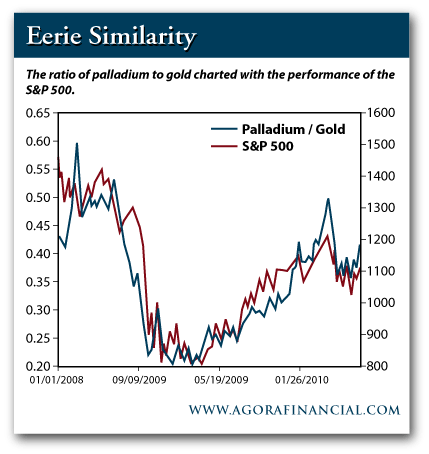
As I say, it’s a rather novel indicator, another measure of fear or lack thereof. Right now, it shows fear receding and risk assets rising. Clemmow’s indicator says stocks are headed higher. We’ll see.
In the meantime, there are many curious wrinkles in the commodity markets these days and lots of opportunity. It’s a great unfolding drama with never-ending twists and turns. Forced to hazard a guess today, I’d bet August is very sweet for sugar and that agricultural commodities in general continue to lead the pack.
Chris Mayer
for The Daily Reckoning
Chris Mayer studied finance at the University of Maryland, graduating magna cum laude. He went on to earn his MBA while embarking on a decade-long career in corporate banking. Chris has been quoted over a dozen times by MarketWatch, and has spoken on Forbes on Fox. He has also spoken on CNN Radio, and has made multiple CNBC appearances. Chris is the editor of Capital and Crisis and Mayer’s Special Situations, a monthly report that unearths unique and unconventional opportunities in smaller-cap stocks. In 2008, Chris authored Invest Like a Dealmaker: Secrets From a Former Banking Insider.
If a panic in the broader markets put liquidity-crunch-induced pressure on the gold price, the meltdown should be less severe than in 2008 and the eventual rebound could be dramatic, possibly triggering the mania we’ve been calling for. Remember: the market crash drove gold almost down to $700 in October ’08, but the same fear drove it almost back to $1,000 by February ’09. Silver topped that with a 60% rebound over the same period. As the debt-glue holding everything together continues to lose its grip, the ride will only get rougher. As bad as 2008 was, if the Crisis Creature appears to be coming back when everyone on Main Street thought it was dead, the fear should be much worse – and that should drive gold way, way north. It’s possible the fear, coupled with the lack of any safer alternatives, could prevent gold from melting down at all, sending it instead straight through the roof into the clear blue Mania Phase sky……
…..read more HERE
-
I know Mike is a very solid investor and respect his opinions very much. So if he says pay attention to this or that - I will.
~ Dale G.
-
I've started managing my own investments so view Michael's site as a one-stop shop from which to get information and perspectives.
~ Dave E.
-
Michael offers easy reading, honest, common sense information that anyone can use in a practical manner.
~ der_al.
-
A sane voice in a scrambled investment world.
~ Ed R.
Inside Edge Pro Contributors

Greg Weldon

Josef Schachter

Tyler Bollhorn

Ryan Irvine

Paul Beattie

Martin Straith

Patrick Ceresna

Mark Leibovit

James Thorne

Victor Adair