
Daily Updates
A Brief Excerpt from Richard Russell. Richard has made his subscribers fortunes. One of the best values anywhere in the financial world at only a $300 subscription to get his DAILY report for a year. HERE to subscribe. Richard has been Bullish Gold since below $300. He also loaded up on bonds in the early 80’s when US Treasuries where yielding 18%+. A 30 year bonds through compound interest would turn $1,000 into $300,000 at maturity. (include reinvestment of interest income, which Richard does as his view is compounding interest is the ROYAL ROAD to RICHES)
I’m thinking that there are a lot of desperate investors in this fair land. After all, you can’t buy a decent, well-rated bond and receive any interest. Stocks, by historical standards, are expensive, and if you don’t need ’em, my instinct is to live without ’em. Money market funds pay you little or nothing, and here you have an extra worry — you have to wonder what they are invested in.
Hey, how about buying a foreclosed house? Great idea, except that now you’re a neophyte entering a business you know nothing about. Sure, buy a house within walking distance of the beach, but these houses are all sky-high in price, and their owners are in no hurry to sell. How about buying a really cheap house out on the desert? That’s a fabulous idea, if you’re a Cactus.Wait, how about buying a recognized work of art by Matisse or Cezanne? Here, if the painting is one of their better works, the prices are sky-high and art, like houses, is usually very illiquid. You have to sell ’em at auction. The truth, you’re better off buying stock in Sotheby’s. It’s the auction houses that usually make the big bucks. That is unless you were smart enough to have bought your Matisse painting back in 1949.
OK, you’ve got me. I’m out of breath. How about doing nothing? That might work, depending on what you own now. If you’re loaded with gold or cash or high-grade big-carat diamonds, I’ll agree — do nothing. Maybe hang up a hammock in your back porch and turn on some good 1950s music. Tommy Dorsey or Artie Shaw will do.
It must be obvious — today’s crazy economy and low-volatility stock market are messing with my poor brain. I think of Marc Faber’s prediction that in the long run, “We’re all toast.” Will it be that bad? Can it be that bad? I got through World War II and the Great Depression, and I’m going to give it my all to get through the “toasty” times that Marc Faber foresees.
Maybe I’m too obsessional and maybe the Southern Cal sun has gotten to me, but I honestly think I can get through what I call the “hard rain” era with gold. Gold has been around a long time. Nations have fought for gold. California wwn ahes opened up via mens’ lust for gold. Have we finally reached the time nobody knows anything? If that’s where we are, I’ll bet my future on gold.
The 85 yr. old writes a market comment daily since the internet age began. In recent years, he began strongly advocated buying gold coins in the late 1990’s below $300. His position before the recent crash was cash and gold. There is little in markets he has not seen. Mr. Russell gained wide recognition via a series of over 30 Dow Theory and technical articles that he wrote for Barron’s during the late-’50s through the ’90s. Russell was the first (in 1960) to recommend gold stocks. He called the top of the 1949-’66 bull market. And almost to the day he called the bottom of the great 1972-’74 bear market, and the beginning of the great bull market which started in December 1974. Only a $300 subscription to get his DAILY report for a year. HERE to subscribe.
U.S. Stock Market – While those who have bet on a fall off the cliff continue to be disappointed, the “Don’t Worry, Be Happy” crowd can’t get no real satisfaction on the employment side. As hard as it seems to be for most, I continue to suggest a neutral position. I would consider some bearish spread plays if the DJIA somehow got up to 11,000 or so.
Gold – When you think gold and Grandich, this is what should come to mind – “We’re in the mother of all gold bull markets.” And to all the crap about gold bubbles, tops, etc, I recommend this to the “Tokyo Roses” of the world.
U.S. Dollar – There’s a likely period of consolidation and even a little countertrend rally near as sentiment is extremely bearish and market deeply oversold. But while the 80+ area on the U.S. Dollar Index can hold for awhile, to me it’s only a question of when, not if, it breaks below.
U.S. Bonds – Very Bearish
Oil and Natural Gas – Leave completely alone either way.
Check out Peter’s new postings:
Things – HERE
Gold Permabears Never Learn – HERE
With all of the attention given to deflation recently, I thought it might be interesting to think about how this scenario could affect gold. After all, gold is thought to be the ultimate investment in a time of inflation. Does this mean deflation will destroy the value of gold?
More interesting than the question, in my view, is the road to the potential answer because there simply isn’t a clear one. However, based on everything I’ve read and researched, the outcome is closer to no: today’s deflation will not topple gold.
1. Gold’s Primary Trend Is Up – Gold’s decade-long chart tells us that if deflation is taking hold, it will not destroy the value of gold. We know this because this chart captures every fundamental possibility including that of deflation and in the face of this possibility, gold’s long-term and primary trend remains very clearly up.
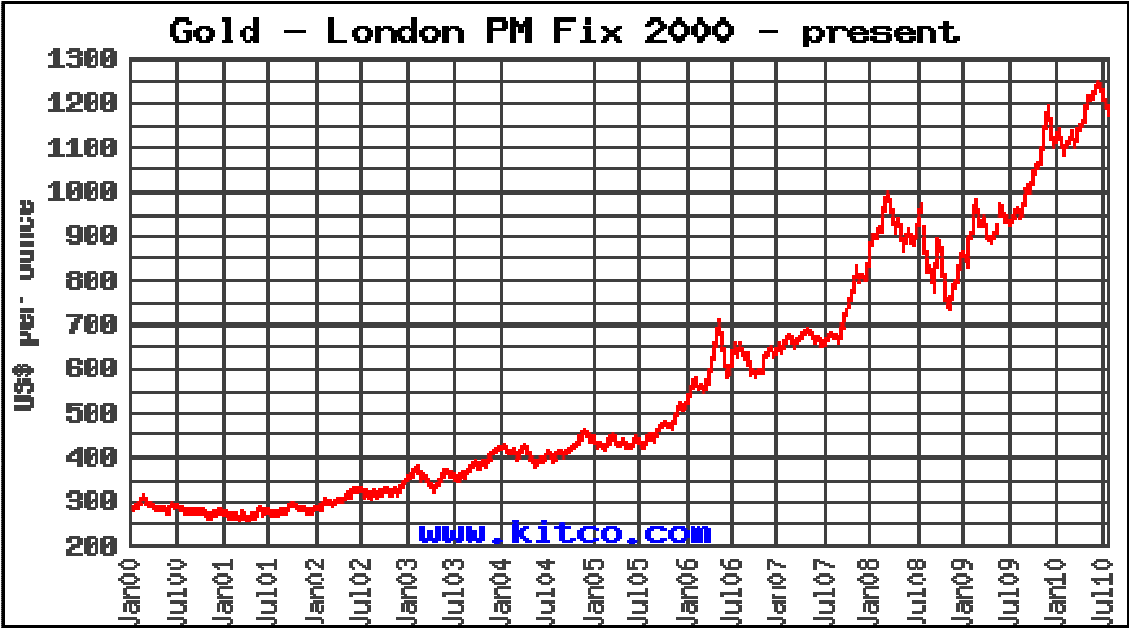
2. Today’s Deflation Will Bleed Into Hyperinflation – I believe the chart above is telling us the story of today’s variety of deflation or the sort that will twist into hyperinflation due to the world’s unsustainable 30-year borrowing binge that’s been transferred to the public sector, and thus sovereign debt and the underlying currencies, from the private sector. Under these circumstances, gold will be subject to the general decline in prices that will take hold under deflation as discussed above, but on a relative basis, gold will hold value due to the collective desire to hoard one of the oldest and most accepted transferrable stores of value.
3. Ultimate Hoarding Vehicle – Sam Hewitt of Sun Valley Gold Company makes the very strong point that in past U.S. deflations, individuals had the choice to hoard either in paper currencies or in gold. “The historical record,” according to Mr. Hewitt, “Demonstrates that loss of confidence in the issuer of paper currency is often a sufficient reason for individuals to choose gold over paper currency.”
While the conversation about the coming collapse of fiat currencies has become rather popular in many circles more recently, the chart above is telling us that many more people have been having this conversation for at least ten years. It is not a coincidence that that the run-up in gold occurred as the world’s debt storm was completing its final phases.
I also believe that the chart above is telling us that there have been many individuals who have been choosing to hoard gold due to a collective lack of confidence in a paper currency that may be pulverized by the U.S. deficit.
….read pages 2-5 HERE
The Golden Decade
As gold hovers near $1,200 an ounce and pundits speculate about a ‘gold bubble’, it’s important for investors to remember that a mere decade ago the picture was very different. In the year 2000, gold sat at an unimpressive annual average of $279 an ounce – a two-decade low. At that time, most analysts thought gold was finished as a monetary metal. They said its price would never recover and only kooks with tin hats would invest in it. I was one of the very few financial commentators publicly saying that gold was not only viable, but entering a long-term uptrend.
With the benefit of hindsight, we can all see that the consensus was wrong. Gold has performed remarkably against the Dow, NASDAQ, and US real estate. The reason I was able to confidently forecast this result is because I ignore the ‘certainties’ determined by Wall Street consensus, and instead study the fundamental trends.
2000’s – The Great American Century?
Ten years ago, the United States was the world’s largest consumer of energy, house prices were steadily appreciating nationwide, the government was running a budget surplus, and there was widespread consensus that the world had entered a period of Pax Americana – stability brought about by permanent US dominance.
Overseas, the euro was just getting to its feet, no Western country could even imagine facing default, and the only BRICs anyone had heard of were the ones used to build houses. These circumstances were extremely bearish for gold, especially as the dollar was at a multi-year high against other major currencies.
But I correctly perceived that this grand tapestry would quickly unravel.
The Tortoise & The Hare
China started moving toward a market economy in the late 1970s. In the ensuing decades, their economy grew exponentially as more than a billion people won the economic freedom to compete in the world economy. While others were stuck in the Cold War mentality of the US versus the Soviet Union, where the Soviets’ collapse guaranteed America’s perpetual dominance, I was paying attention to this Chinese freight train that was gaining on us at a million miles an hour.
I saw that while the entire Third World was embracing capitalism, the West was embracing ever more lavish entitlements, ever more debt, and was using inflation to pay for it all. Developing economies were buying many of these new dollars, thus keeping the dollar index deceptively high; but all chickens come home to roost and I knew this inflation would come back to haunt us.
Moreover, all the money printing was creating tremendous distortions in the domestic economy – first the dot-com bubble, then the housing bubble, then the financials bubble, all the way to the current Treasuries bubble.
2010 – The Great American Collapse
Today, China is the world’s largest consumer of energy, American house prices are at generational lows, Washington is running deficits in the trillions (an order of magnitude used only sarcastically back in 2000), and the United States is suspending military exercises because they might upset the Chinese government.
Since 2000, the euro became the world’s backup reserve currency, Iceland’s economy collapsed, Greece averted this fate only by the grace of its neighbors, and savvy American investors have turned to the BRICs for growth and preservation of capital.
This transformation of the global economy, and the turbulence that accompanies it, has been bullish for gold. We have now seen the yellow metal reach new nominal highs, causing former critics to go silent for awhile, then re-emerge claiming there is a ‘gold bubble.’
Bubble or Bull?
In response, I will return to the only strategy that ever matters to long-term investors – analyzing the fundamentals. The truth is the fundamental trends haven’t changed.
The US government continues to add new spending programs (Obamacare, homebuyers tax credit, extended jobless benefits) and new regulations (1099s for small transactions, bank taxes, credit card fee limits), undermining our competitiveness and driving us deeper into debt. Though the euro has grown up somewhat, it is still too young and too troubled to take the place of the dollar as the world’s reserve. The Chinese government has maintained a counterproductive peg between the yuan and the dollar which is only beginning to be relaxed. This process would have to be completed before the Chinese currency could win reserve status.
In short, the dollar is closer than ever to collapse and there is no other national currency ready to take its place. I believe the world may soon discover that there is no better alternative than history’s proven money – gold.
Some of you might be familiar with these arguments, and say they are old hat. The same Wall Street analysts who missed the dot-com bubble and the real estate bubble are now warning that gold has already had its run up and is way overvalued. However, they were making this same argument back in 2006, with gold at $600/oz.
Meanwhile, in April of that year, I wrote a commentary with a few personal observations: none of my mining stocks had split, precious metals investors were not rubbing shoulders with real estate moguls or dot-com millionaires, and I was still running my gold investment division with only one employee. On TV, Flip That House wasn’t followed by Deal That Gold. My taxi driver wasn’t offering me hot bullion tips. In fact, nine out of ten people you stopped on the street couldn’t even tell you the current price of gold within $200! And that’s still the case today.
A Healthy Appetite For Gold
A decade after gold started its current bull run, we are still at half its inflation-adjusted peak. The run-up has been slow and orderly, with the price consolidated over the last three months at around $1,200. Dips like the recent drop below $1,160 have been correctly identified as bargain buying opportunities.
Despite a long rally without a major reversal, Wall Street aurophobes still refuse to see gold as a good investment; but they were wrong on the fundamentals in 2000, and the fundamentals haven’t changed. As the world edges closer to the collapse of the US dollar system, gold prices have nowhere to go but up.
I continue to recommend that investors hold five to ten percent of their wealth in physical precious metals. Aside from the likelihood that gold and silver will rise in price, precious metals offer timeless benefits, such as financial privacy, elimination of counter-party risk (if you store them yourself), as well as protection from government confiscation, onerous securities regulation, and punitive tax rates.
Unfortunately, there are a lot of scammers out there who take advantage of rational interest in gold coins to sell people irrational investments. That is why I am so proud to finally offer a straightforward, ethical, no-gimmicks way to buy gold and silver coins and bullion, Euro Pacific Precious Metals. My company does not sell numismatics, proof sets, commemoratives, leveraged contracts, or any product that distracts from our goal: preservation of your capital. I encourage you to add precious metals to your portfolio now, because those waiting for a big correction before coming aboard may just miss the train entirely.
For more information about Peter Schiff’s new gold coin and bullion company, Euro Pacific Precious Metals, Click Here.
“Until someone explains how a government can quadruple its deficit in a year and come close to doubling its spending in four, I will believe that our currency is slated for a serious – and possibly shocking — devaluation. Inflation is devastating to anyone who owns lots of stuff denominated in U.S. dollars (like, say, cash in the bank or a Chinese Fort Knox full of T-bills). It erodes the value of every dollar you have – which is why the goal of investing is to build dollars faster than inflation undoes them. An employee who makes $15 an hour and finds that he can suddenly buy only three gallons of gas with an hour’s wages instead of six has been made substantially poorer.
“At the same time, inflation has all kinds of winners. Some are obvious – the guy with a bunch of gold bars is already cashing in via those “send us you gold in an envelope” commercials that should be interpreted as a precursor to the apocalypse. But other winners include those who have anything to sell that can be priced in U.S. dollars. Grocery stores, for example, will have pricing power they haven’t experienced in years. And our $15-an-hour worker will likely command meaningful wage increases for the first time since the early ’80s (shame that his groceries will cost more, but still…), and commodities from land to sugar to copper will command higher prices. Producers of American goods and the American hospitality industry should see demand grow.
“As for what you should do if you accept the premise that inflation is afoot, it’s pretty simple: Trade your dollars, which are declining in value, for stuff that appreciates in value. Gold, baby.”
-
I know Mike is a very solid investor and respect his opinions very much. So if he says pay attention to this or that - I will.
~ Dale G.
-
I've started managing my own investments so view Michael's site as a one-stop shop from which to get information and perspectives.
~ Dave E.
-
Michael offers easy reading, honest, common sense information that anyone can use in a practical manner.
~ der_al.
-
A sane voice in a scrambled investment world.
~ Ed R.
Inside Edge Pro Contributors

Greg Weldon

Josef Schachter

Tyler Bollhorn

Ryan Irvine

Paul Beattie

Martin Straith

Patrick Ceresna

Mark Leibovit

James Thorne

Victor Adair