
Daily Updates
Tomorrow is my dad’s 63rd birthday and his card is on its way. Of course, I already sent him a few presents more than a week ago — the first recommendations for his new income portfolio. And I’m happy to say that those first positions are doing great so far.
One of them — a foreign utility company — already produced a 6.3 percent return in the first six trading days my dad owned it (and that includes the commission to buy it).
Let me put that into perspective for you: While it represents just four percent of the overall portfolio, this one income stock has already handed dad four times the return he would have received had we left his ENTIRE portfolio sitting in a money market fund for a full year!
And for a number of reasons, I think this is just the beginning of what dad can expect from this new holding. That’s because it’s one of my favorite …
Foreign Dividend Payers with a Currency Kicker!
Like I said, this company is a foreign utility. But it trades here in the U.S. as an American Depositary Receipt (ADR).
ADRs give U.S. investors a way to buy overseas shares without having to use foreign trading desks, and with all the same protections and assurances they’re used to with regular domestic stocks.
Thus, ADRs can quickly and easily give you a stake in other countries that may be growing faster than the U.S. … or where specific trends may be presenting unique profit opportunities.
Better yet, they can help you profit from foreign currencies. That’s because ADRs trade in relation to their foreign-listed counterparts, which are priced in their home currencies. So if the foreign currency appreciates against the U.S. dollar, an American investor’s ADR holdings will automatically increase in value, too.
In addition, the same dynamic is at work with any dividends paid by the ADR: Since the U.S. investor is receiving dividends in dollars, but the rate is determined in a foreign currency, the paychecks can grow just by virtue of the foreign currency rising against the greenback.
The inverse is also true, or course. But if you do your homework, you can clearly tilt the odds in your favor when it comes to currency effects. The key is simply selecting ADRs that are based on currencies you consider undervalued relative to the greenback.
I Call These Companies Income Triple Plays Because
That Added Currency Potential Is Just the Beginning
Perhaps the best part is that the potential for a currency kicker is just the icing on the cake when it comes to dividend-paying ADRs.
For starters, you still have the possibility of regular capital appreciation as you would with any stock.
Again, take my dad’s current holding — one of the primary reasons I recommended it was because I think it is inherently undervalued at current levels, whether you’re looking at it in its home currency or U.S. dollars.
Why? Because investors have been discounting this company’s operations because of where they’re located and I think they’re completely underestimating just how much cash these businesses will generate even during continued economic weakness.

The shares haven’t been trading much higher than they were during the major market bottom in March 2009. So in my mind, not only does that give them built in downside protection, it means they have far more appreciation potential if the markets rise from here.
In fact, I believe the ADR could easily double from current levels within the next year. It has traded that high in the recent past.
What about dividends? The stock’s current indicated yield is north of 8 percent annually … and the company has boosted dividends consistently!
So when you combine it all — generous and rising dividends, capital appreciation potential, and a currency kicker — it becomes pretty obvious why I call select foreign dividend payers “income triple plays” and also why I’ve told my own father to put some of his retirement funds into one.
As part of an overall portfolio, they can provide a much needed income boost and provide much-needed diversification. I encourage you to do some digging on your own — you’ll be amazed at what’s out there right now!
Best wishes,
Nilus
P.S. What about the other recommendations I made for Dad’s Income Portfolio? He also bought a very attractive energy company, and is sitting on open gains there too. Plus, dad still has an open order on a telecom company (we’re waiting to see if he gets filled on that one). If you want all the details on my current — and future — recommendations, plus the chance to see my own dad’s actual brokerage statements, join our new service today. A full year will run you just $89! Click here for all the details.
This investment news is brought to you by Money and Markets. Money and Markets is a free daily investment newsletter from Martin D. Weiss and Weiss Research analysts offering the latest investing news and financial insights for the stock market, including tips and advice on investing in gold, energy and oil. Dr. Weiss is a leader in the fields of investing, interest rates, financial safety and economic forecasting. To view archives or subscribe, visit http://www.moneyandmarkets.com.

This Excerpt from Mark Leibovit’s VR Silver Newsletter covering Stocks, Bonds, Gold, US Dollar, Oil CLICK HERE
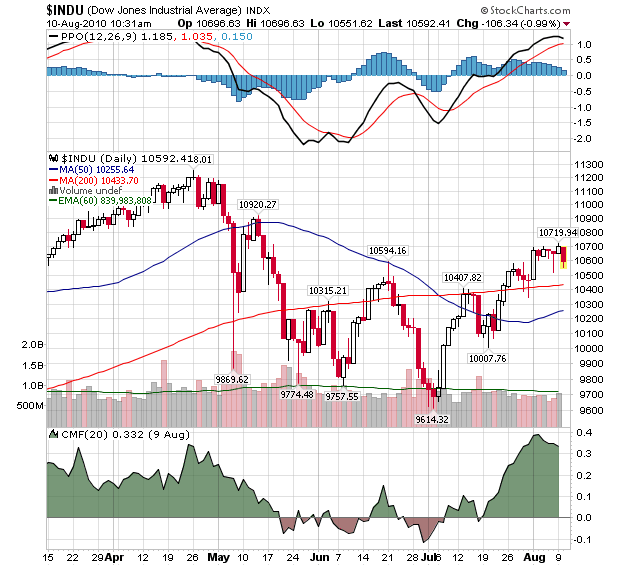
Trading in stocks and other financial instruments was boring and range bound yesterday as traders waiting for this afternoon’s much anticipated Fed announcement. No US economic news yesterday also contributed to the slow sideways trading. The Dow was up 45.19 at 10,698.75, the S&P 500 was up 6.15 at 1127.79, and the Nasdaq Composite was up 17.22 at 2305.69. Volume was very light and breadth was positive.
But today should be different. First, China announces its latest CPI figure. Before the opening in the US, the government announces the productivity report for the second quarter. Then, this afternoon the FOMC is expected to announce new stimulus measures, while also expected to downgrade its economic outlook. All this on a Turnaround Tuesday. Not just any Turnaround Tuesday, but one that precedes a Weird Wollie Wednesday, which means we could have two days of extra volatility.
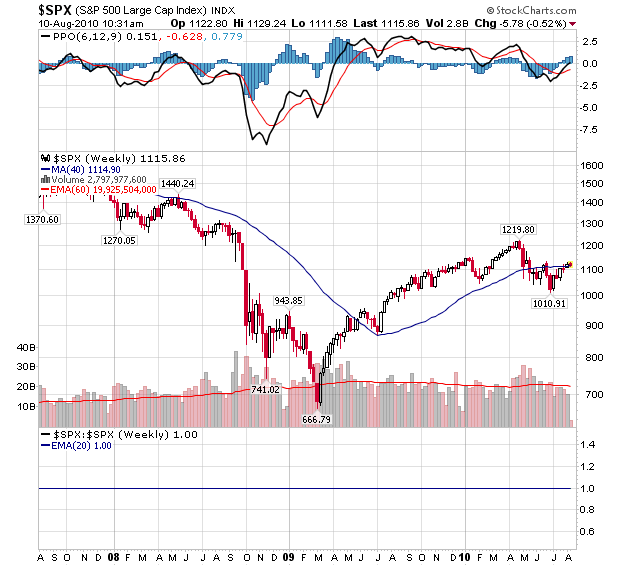
While all the above could cause extra volatility, the market indexes are continuing to test resistance. A number of indexes have already broken out to new 3-month highs, including the NYSE Composite, Dow Industrials, and Dow Transports, but just as many have failed to do so, including the S&P 500, NASDAQ, and Russell 2000. One small jump today could propel all the indexes to new highs and provide a boost for the bulls. But with everything dependant on the Fed now, the market can just as easily fall on today’s news.
The ‘Street’ and the world are holding their breadth to see what kind of rabbit Bernanke can pull out of his hat to save the U.S. economy from sinking further and to help allay further fears of a deflationary spiral. Is there anyway this is bullish? The ship is sinking and Bernanke throws us more of the same life rafts that didn’t work before. Ultimately, it comes down to lack of confidence. Bernanke can prime the pump all he wants and, yes, he can temporarily drive the markets higher, but at what cost? And, will he ultimately get the desired results?
Marks VRTrader Silver Newletter covers Stock, TSE Stocks, Bonds, Gold, Base Metals, Uranium, Oil and the US Dollar.
More kudos – Mark Leibovit was named the #1 Intermediate Market Timer for the 10 year period ending in 2007; the #1 Intermediate Market Timer for the 3 year period ending in 2007; the #1 Intermediate Market Timer for the 8 year period ending in 2007; and the #8 Intermediate Market Timer for the 5 year period ending in 2007. NO OTHER ANALYST SURVEYED APPEARED IN ALL FOUR CATEGORIES FOR INTERMEDIATE MARKET TIMING AS PUBLISHED IN TIMER DIGEST JANUARY 28, 2008!
For a trial Subscription of The VR Silver Newsletter covering Stocks, Bonds, Gold, US Dollar, Oil CLICK HERE The VR Gold Letter is available to Platinum subscribers for only an additional $20 per month, while for Silver subscribers the price is only an additional $70.00 per month. Prices are going up very shortl, so act now! Separately, the VR Gold Letter retails for $1500 a year! The VR Gold Letter is published WEEKLY. It is 10 to 16 pages jam-packed with commentary and charts. Please call or email us right away. Tel: 928-282-1275. Email: mark.vrtrader@gmail.com
Will the U.S. economy experience hyperinflation……. or deflation like Japan?
via ZeroHedge:
Whether one believes in inflation or deflation, one thing is certain: in many ways the current US experience finds numerous parallels to what has been happening in Japan for not one but two decades. While major economic, sociological and financial differences do exist, the key issue remains each respective central bank’s failed attempts to reflate its economy. While long a mainstay of Japan, if the first failed version of our own QE, which pumped $1.7 trillion of new liquidity into the system, is any indication, future comparable efforts by our own Fed will be met with the same outcome (and hopefully with the same political result: the half life of an average Japanese prime minister is 6 months – if only our career politicos knew their tenure in office could be capped at half a year…). There is of course the “tipping point” optionality discussed earlier by Ambrose Evans-Pritchard, when comparing the hyperinflationary timeline during the Weimar republic, which noted that it took just a few months for the economy to slide from a period of price stability to outright hyperinflation. Either way, for an ironic look at the Japanese deflation scenario, targeted more at novices although everyone will likely learning something from it, we present the following informative clip from, ironically, the National Inflation Association, which asks whether Japan is a blueprint for America’s imminent lost decade(s).
Stockscores.com Perspectives for the week ending August 8th, 2010
Why Traders Fail
In this week’s issue:
Weekly Commentary
Strategy of the Week
Stocks That Meet The Featured Strategy

Trading is simple, but not easy. Despite its simplicity, most people who try to trade have a hard time finding consistent profitability. Trading well is as much about doing certain things right as it is about avoiding the common mistakes. Here is a list of the common causes of trader failure.
1. Lack of Knowledge
Trading does not have to be complex or involve a sophisticated understanding of capital markets. In one day, I can teach a person the skills that I use as a trader. However, like riding a bicycle, being good at applying those skills takes practice and usually involves some painful mistakes through the learning process. You probably were pretty wobbly the first time you pedaled a bicycle but, with time, you found your balance and got good at it. Trading is no different.
However, unlike riding a bike, there are thousands of ways to trade. You have a choice in what you trade, the hold period for your trades and the strategies you apply.
There are many options for people looking to learn trading. You can take classes, study online, read books or try to figure it out on your own. Each approach to learning has a cost; don’t underestimate the price for how you intend to learn.
With so many approaches to acquiring the knowledge you need to trade, there is not necessarily just right and wrong ways to learn. It becomes a question of what is right for you, what best fits your learning style. What is most important is that you get educated before you risk a penny of your money in the market. Most people can’t beat the market because they don’t know what they are doing. Don’t let a lack of knowledge ensure your failure.
2. Poor Risk Management
The focuses for most aspiring traders are the decisions to enter and exit the trade. They spend a lot of time trying to find the right stock to buy and then try to make a good decision on when to enter. They miss out on the most important component of the trading process.
Risk management is that often forgotten piece of the trading puzzle. Without capital to trade with, you have nothing to do. Protect your capital first and never try to get rich overnight. Some might get lucky in the short term but those who fail to manage risk over the longer term will go broke. That is guaranteed.
For every trade, you need to know your downside. Being wrong is part of trading so you must have a plan for what to do when you are wrong. (continued below)
- Get the StockSchool Pro Free

Open and Fund a brokerage account with DisnatDirect and receive the StockSchool Pro home study course free, including special Pro level access through the DisnatDirect client website. Offer only available to Canadian residents. For information, click HERE
3. Insufficient Capital
Since being wrong is part of a profitable trading strategy, you need to allow for drawdowns of your capital base. There will be times when market conditions will not be great for the strategies you are applying.
When planning your trading business, you must allow for this potential deterioration of capital. You may make five steps backward before you start to go forward, make sure you have the capital to ride out these losing periods.
4. Trading Without Proven Strategies
I have seen a lot of people trade without a strategy that they have tested. They think that they can beat the market by doing things that make sense. This is often the biggest problem with people who are successful in other areas of life.
It is a bad idea to think that you can beat the market by being smart. The markets rarely do what makes sense, at least in the context of the information that we have. This is because the market often moves on information that most of us just don’t have.
For that reason, it is smart to have a set of trading rules that you first test exhaustively before you trade. Your testing must determine whether the rules yield a positive expected value. Over a large number of trades, your rules should make a profit. What happens on any individual trade really does not matter.
5. Failure to Follow Rules
The rules you define and test are only effective if you follow them. While this is easy for all of us to understand, it is a very hard thing to actually do. We break rules because we are afraid of losing money. Emotion is a hard thing to overcome.
To minimize the impact of emotion requires a comfort with the risk you are taking. Most traders find that paper trading, simulated trading without using real money, is not too hard. It is only when they have their capital at risk that they start to make mistakes.
The solution to this problem is to not take more risk than you are comfortable with. The best traders are those who don’t care about the money. The more you can do to take out emotion, the better your chances will be to follow the trading rules.
6. Lack of Determination
Doing anything well requires the determination to learn and gain expertise. This is very much the case for trading because it is such an emotional pursuit. There will be times when the novice trader will feel overwhelmed with emotion and ready to give up.
I don’t think trading is something that can be done well by someone who does not like it. Having a passion for trading is what will get you through the hard times and ensure that you stick with it when your heart may tell you otherwise.
7. Poor Focus
The shorter the time frame you trade, the more focused you need to be. Position trading (hold period measured in weeks or months) is not that demanding mentally because you have a lot of time to make your trading decisions. Swing trading (hold period measured in days) requires you make quicker decisions but is not as demanding as day trading. The day trader (hold periods measured in hours or minutes) has to make decisions in only seconds and work hard to not miss out on good trading opportunities.
It is hard to trade if you have a lot of distractions while you are trading. You have to do what is necessary to avoid letting outside factors have an effect on your trading decisions.
8. Inability to Adapt
The market is constantly changing and you need to be able to adapt with it. That means applying trading strategies that are appropriate for the present conditions; you may not want to apply a buying strategy in a market with strong downward momentum.
Avoiding chasing the market with your rules is a challenge that many traders have trouble with. You should have a set of trading principles that do not change over time, these based on source of opportunity that you are pursuing. Do not constantly change the rules of your tested and proven strategies.
However, how and when you apply your strategies will change as the market evolves. I keep a stable of trading strategies that I apply as conditions warrant.

I run a lot of Market Scan on Stockscores.com through the week in search of stock picks. Friday’s results did not yield any great opportunities but a couple of stocks came up on Thursday that I think deserve consideration:

1. T.ARE
T.ARE broke out from an ascending triangle pattern on Thursday and held up well while the market was weak on Friday. Volume is strong lately and the Sentiment Stockscore has recently crossed above 60. Good potential so long as it can hold above support at $10.95.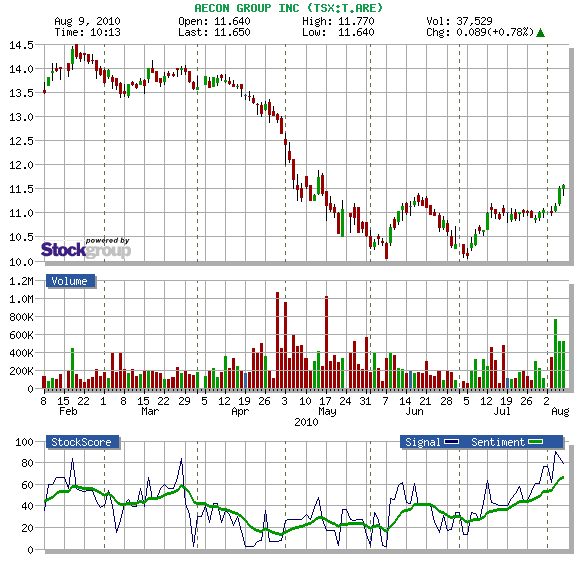
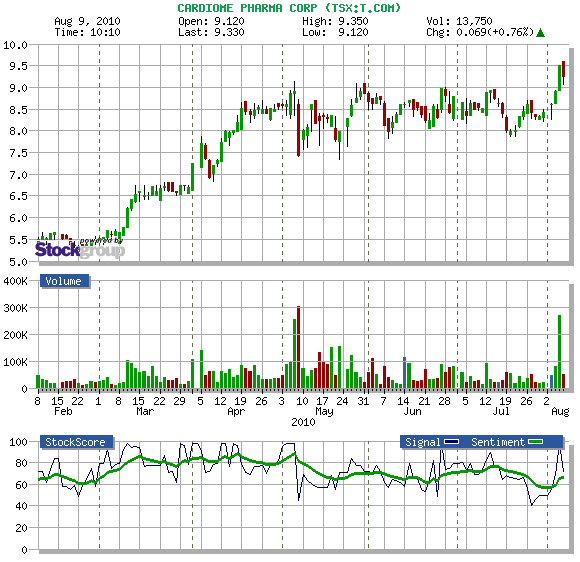
2. T.COM
I have watched T.COM for a few days now; it is building optimism and moving through resistance. I am watching for the next day that it can close above its open (green candle on the daily chart) as it looks to be making a pull back now. The stock needs to hold above support at $8.25 to stay healthy.
References
Get the Stockscore on any of over 20,000 North American stocks.
Background on the theories used by Stockscores.
Strategies that can help you find new opportunities.
Scan the market using extensive filter criteria.
Build a portfolio of stocks and view a slide show of their charts.
See which sectors are leading the market, and their components.
Click HERE for the Speaker Lineup and to Purchase the video if you want to learn from some of the worlds best traders including Tyler Bollhorn.

Tyler Bollhorn started trading the stock market with $3,000 in capital, some borrowed from his credit card, when he was just 19 years old. As he worked through the Business program at the University of Calgary, he constantly followed the market and traded stocks. Upon graduation, he could not shake his addiction to the market, and so he continued to trade and study the market by day, while working as a DJ at night. From his 600 square foot basement suite that he shared with his brother, Mr. Bollhorn pursued his dream of making his living buying and selling stocks.
Slowly, he began to learn how the market works, and more importantly, how to consistently make money from it. He realized that the stock market is not fair, and that a small group of people make most of the money while the general public suffers. Eventually, he found some of the key ingredients to success, and turned $30,000 in to half a million dollars in only 3 months. His career as a stock trader had finally flourished.
Much of Mr Bollhorn’s work was pioneering, so he had to create his own tools to identify opportunities. With a vision of making the research process simpler and more effective, he created the Stockscores Approach to trading, and partnered with Stockgroup in the creation of the Stockscores.com web site. He found that he enjoyed teaching others how the market works almost as much as trading it, and he has since taught hundreds of traders how to apply the Stockscores Approach to the market.
Disclaimer
This is not an investment advisory, and should not be used to make investment decisions. Information in Stockscores Perspectives is often opinionated and should be considered for information purposes only. No stock exchange anywhere has approved or disapproved of the information contained herein. There is no express or implied solicitation to buy or sell securities. The writers and editors of Perspectives may have positions in the stocks discussed above and may trade in the stocks mentioned. Don’t consider buying or selling any stock without conducting your own due diligence.
Martin here with a quick update on foreign markets.
One year ago, in our 2009 Global Forum, we forecast a massive shift of wealth — from the United States, bogged down with huge deficits and chronic, long-term unemployment … to emerging markets, enjoying the most rapid growth on the planet.
Now, that shift is in full swing …
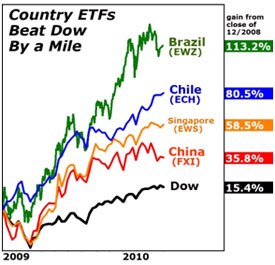
Since the beginning of 2009, despite the biggest government bailouts and stimulus of all time, the Dow Jones Industrial Average is up only 15.4 percent.
In contrast …
FXI, our favorite exchange traded fund (ETF) focused on China’s blue chips, has gained 35.8 percent in the same period, beating the Dow by 2.3 to one …
- The ETF tied to Singapore’s market (EWS) has gained 58.5 percent, trumping the Dow by 3.8 to one …
- The ETF for Chile (ECH) has jumped 80.5 percent, or 5.2 times faster than the Dow, and …
- Our favorite Brazil ETF — EWZ — has surged by a whopping 113.2 percent, or 7.35 times better than the Dow!
In other words, for every $10,000 investors might have made in the Dow since the beginning of 2009, you could have made $73,500 simply buying and holding the Brazil ETF.
This is no fluke. We see a similar pattern of vast outperformance in virtually all time frames we review and nearly all emerging markets we sample.
Nor is this strictly a market phenomenon. As we’ve told you repeatedly in recent years, we see powerful forces driving a wider and wider wedge between …
- the mediocre performance of old and tired economies of the West and …
- the vibrant, rapidly growing economies of the East and South.
Specifically …
In the U.S., deficits have now emerged as a major drag on the economy.
A few months ago, the Congressional Budget Office estimated that the president’s budget would result in record-breaking, back-to-back deficits of $1.5 trillion in 2010 and $1.3 trillion in 2011.
But that was before the latest bad news on the economy, and certainly before Friday’s dismal jobs report. Not only was the labor market far weaker than Wall Street and Washington expected, but it also turned out that many prior jobs gains touted by the government were a mirage, wiped away by the single stroke of a statistician’s revisions.
John Williams, editor of Shadow Government Statistics, explains it this way:
“As suggested by the deterioration and revisions in today’s labor market report, the recently-hailed economic recovery has all but evaporated. … Market recognition of the re-intensified downturn is spreading, along with recognition of sharply negative implications for the federal budget deficit, for Treasury funding needs, [and] for banking system solvency. …
“July’s headline unemployment rate held at a seasonally-adjusted 9.5 percent, but not because of a stable employment environment. To the contrary, continued shrinkage of the labor force … reflects an increasing number of longer-term unemployed giving up looking for work and moving … into the discouraged worker category.”
Including discouraged workers who have given up looking for work for more than a year (excluded from the government’s official tally), Williams estimates that true unemployment in the United States now stands at 21.7 percent!
In contrast …
China’s economy grew by 9.1 percent, or nearly four times faster than the U.S; and this year is expected to grow 10.5 percent, or as much as five times faster.
Singapore’s economy expanded by an unprecedented 17.9 percent in the first half of the year, or nearly double China’s pace. Singapore’s prime minister is predicting “a slowdown” in the second half, helping to contain the yearly GDP growth to “only” 13 to 15 percent for the year. But that would still be about six or seven times faster than America’s GDP growth.
Meanwhile, Brazil and Chile now have the potential to catch up with the rapid growth in Asia. Indeed, in many respects, they are stronger than China and the two other BRIC countries — Russia and India.
Consider these facts:
- Unlike Russia and China, Brazil and Chile have true democratic elections and the rule of law.
- Unlike India’s, their exports are broadly diversified.
- Perhaps most important: Unlike the U.S., they have virtually no foreign debts.
Bottom line: Asian markets are greatly outperforming the U.S. … and key South American markets are poised to leap ahead of most of Asia’s.
This investment news is brought to you by Money and Markets. Money and Markets is a free daily investment newsletter from Martin D. Weiss and Weiss Research analysts offering the latest investing news and financial insights for the stock market, including tips and advice on investing in gold, energy and oil. Dr. Weiss is a leader in the fields of investing, interest rates, financial safety and economic forecasting. To view archives or subscribe, visit http://www.moneyandmarkets.com.
-
I know Mike is a very solid investor and respect his opinions very much. So if he says pay attention to this or that - I will.
~ Dale G.
-
I've started managing my own investments so view Michael's site as a one-stop shop from which to get information and perspectives.
~ Dave E.
-
Michael offers easy reading, honest, common sense information that anyone can use in a practical manner.
~ der_al.
-
A sane voice in a scrambled investment world.
~ Ed R.
Inside Edge Pro Contributors

Greg Weldon

Josef Schachter

Tyler Bollhorn

Ryan Irvine

Paul Beattie

Martin Straith

Patrick Ceresna

Mark Leibovit

James Thorne

Victor Adair