
Bonds & Interest Rates
Fed Sends Mixed Message
A rally on Wall Street evaporated Wednesday as investors wrestled with mixed messages from the Federal Reserve.
After yesterday’s Broad Blunt Hints from St. Louis Fed President James Bullard and New York Fed President William Dudley. who both essentially said the Fed was going to keep fueling Asset Bubbles by keeping interest rates a breath away from zero by continuing with its present bond-buying program.
Bernanke confirms that stance late this morning PST by stating “A premature tightening of monetary policy could lead interest rates to rise temporarily, but would also carry a substantial risk of slowing or ending the economic recovery and causing inflation to fall further,”
Bernanke also stated that after keeping its key short-term interest rate near zero since December 2008, he expects it to stay there for a “considerable time” as the recovery strengthens, Bernanke said.
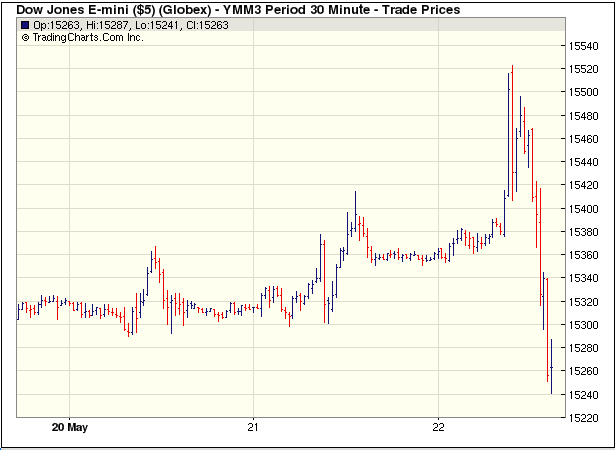
The Dow had surged more than 150 points earlier in the day as investors welcomed comments from Fed chairman Ben Bernanke, who told lawmakers that withdrawing monetary stimulus prematurely could derail the economic recovery.
….SUDDENLY
….the momentum faded after the Fed released minutes from its latest policy meeting, which ended May 1.
The minutes said some members of the monetary policy committee were willing to dial down the Fed’s bond-buying program as soon as June if the economic recovery becomes sustainable.
Some good analysis of those minutes by John Hilsenrath:
Federal Reserve minutes from its April 30-May 1 policy meeting suggested it is heading toward some difficult debates on when to pull back its bond buying program.
Below are key passages in the minutes and how to read them:
1) “A number of participants expressed willingness to adjust the flow of purchases downward as early as the June meeting if the economic information received by that time showed evidence of sufficiently strong and sustained growth; however, views differed about what evidence would be necessary and the likelihood of that outcome.”
WHAT IT MEANS: The Fed will debate at its June 18-19 meeting whether to reduce its $85-billion per month bond-buying program, but officials don’t appear near a consensus on the matter. Fed chairman Ben Bernanke suggested in testimony to Congress earlier in the day that he wanted to avoid moving prematurely toward pulling back.
2) “Several participants pointed to the improvement in interest-sensitive sectors, such as consumer durables and housing, over the recent period as evidence that the purchases were having positive results for the economy.”
WHAT IT MEANS: The Fed talks about the costs and benefits of its policies. So far, they think the bond buying program is still helping the economy.
3) “Economic data releases over the intermeeting period were mixed, raising some concern that the recovery might be slowing after a solid start earlier this year, thereby repeating the pattern observed in recent years. Various views on this prospect were offered, from those participants who put more emphasis on the underlying momentum of the economy, noting the strengthening in private domestic final demand, to those who stressed the growing fiscal restraint or the other headwinds still facing the economy.”
WHAT IT MEANS: Fed officials are hesitant about their next step on monetary policy in part because they’re especially uncertain about how the economy unfolds in the next few months, in the face of tighter fiscal policies.
4) “Both headline and core PCE inflation in the first quarter came in below the Committee’s longer-run goal of 2 percent, but these recent lower readings appeared to be due, in part, to temporary factors; other measures of inflation as well as inflation expectations had remained more stable. Accordingly, participants generally continued to expect that inflation would move closer to the 2 percent objective over the medium run.”
WHAT IT MEANS: The Fed’s favored inflation measures have dropped well below its 2% target, but officials aren’t deeply concerned about it yet.

Quotable
“One ought never to turn one’s back on a threatened danger and try to run away from it. If you do that, you will double the danger. But if you meet it promptly and without flinching, you will reduce the danger by half.”
Commentary & Analysis
~ Sir Winston Churchill
If China Real Estate = Forced Savings…”Danger Will Robinson!”
In case you weren’t aware of it, China’s currency, by virtue of its soft “peg” to the US dollar, is very strong relative to the rest of its Asian competitors, as you can see in the various weekly charts below:
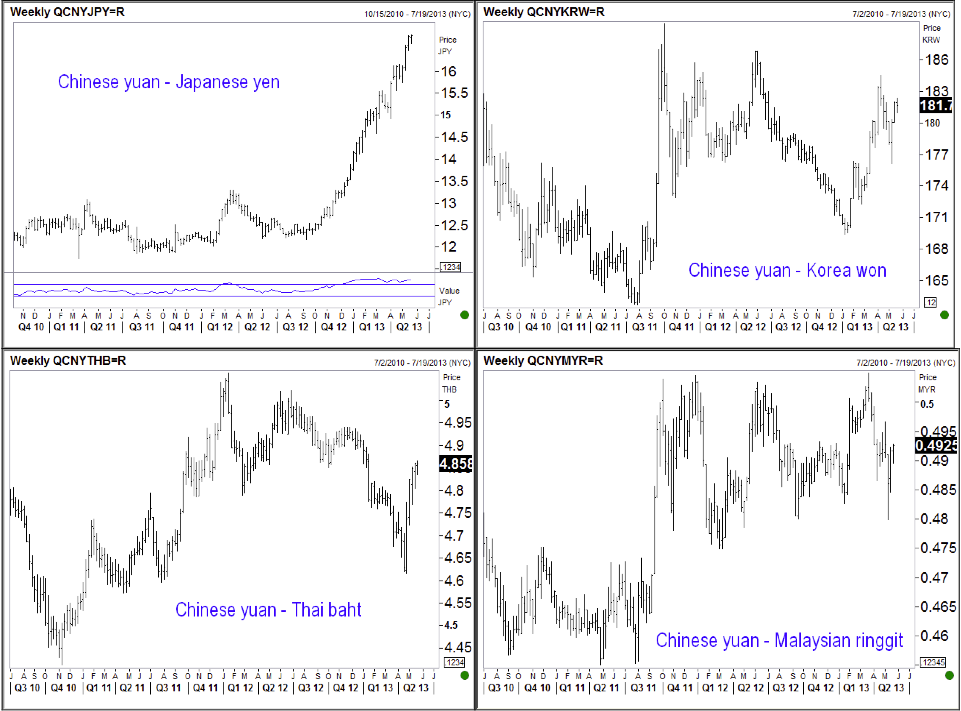
The weakness in the Japanese yen is leading the way of course. The question is: Is this a bad thing for China?
If we assume China is still beholden to the export-cum-investment model, this is likely a “bad” thing. But, if we assume China is and must make that transition we and others have talked about for years—to a more balanced economy whereby households gain a greater share of Chinese wealth relative to targeted industries and sectors—then this relative strength in the yuan is a “good” thing. Why?
1. A stronger currency raises China’s relative purchasing power as it relates to imports. And the China demand engine is badly needed in a world of declining aggregate demand.
2. A relative decline in Chinese exports and its current account surplus and forex reserves by definition represents a lower level of “forced savings.” And if the transition to a more balanced economy whereby households gain a greater share of wealth, savings (throughout the economy, i.e. households and businesses alike) will decline.
Here is the tricky part; I pose it in the form of a question: How does the Party hand over the necessary degree of “freedom” to the household sector, allowing them to spend money more freely on a global basis, which would allow for a faster transition and more normalized economy, and at the same time maintain the “viability” of the Party itself in matters economic?
I may be totally off-base here on my global macro flows, but I think “forced savings” upon the Chinese households (financial repression) to fund the export-cum-investment model is one of the primary drivers of Chinese real estate, i.e. where else can the average Chinese put his/her money? We are told there are three generations of Chinese citizens’ savings invested in real estate.
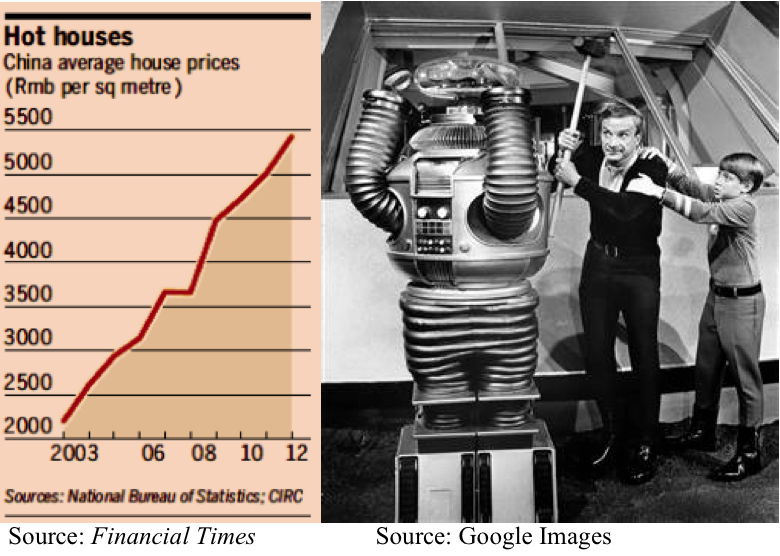
Put another way, if China’s currency continues to appreciate and Chinese households find other opportunities to invest, some outside China, I would imagine other real estate markets and a host of other asset classes would appear to be a much better relative value than Chinese real estate at the moment.
As you can see, no matter how you slice it or dice it, this “necessary transition” for China presents them with opportuinty and danger. It is a process we all need to continue to watch very closely.
Jack Crooks
Black Swan Capital

3D Printing! NASA funding a 3D food printer, and it’ll start with pizza
 Also, CFM International, the world’s largest manufacturer of commercial airline engines, is using some 3D-printed components to help improve the fuel efficiency of its new line of jet engines by 15 percent. Earlier this month, the company — which is co-owned by GE and French aerospace giant Snecma — announced that it had decided on the final configuration of parts that are going into its new line of LEAP-1B engines for use in the Boeing 737 MAX commercial jets. So far, there have been 1,185 orders for planes with the new engine, and CFM said it expects to complete its first test by the middle of 2014.
The LEAP-1B is just one of a lineup of three different LEAP engines: The LEAP-1A is the larger, more powerful version and the LEAP-1C is the smallest of the line. But all three use 3D-printed parts, or more accurately, parts sintered of metal powders out by a laser, including valves and aircraft gaskets. By 2020, GE predicts that up to 10,000 componentsinside a jet engine will all be manufactured via similar means. GE just acquired some 3D-printing companies to help it along this process late last year, so expect the company’s dreams of more fuel-efficient aircraft to really take flight in later years.
The Verge
About:
The Verge was founded in 2011 in partnership with Vox Media, and covers the intersection of technology, science, art, and culture. Its mission is to offer in-depth reporting and long-form feature stories, breaking news coverage, product information, and community content in a unified and cohesive manner. The site is powered by Vox Media’s Chorus platform, a modern media stack built for web-native news in the 21st century.

 George Soros switches from physical gold to gold stocks and that is very bullish for gold prices … Ever the investor who loves to confuse markets – remember how his description of gold as the ‘ultimate bubble’ confused some folk as he bought the metal himself – George Soros has done it again with his gold ETF sales. Today the global financial press is awash with reports that Mr. Soros has sold gold again. True. But he has reinvested that money in a far more risky investment in gold miners whose performance is leveraged against the gold price. They go up faster than the gold price and they fall further when it comes down too. – GoldSeek
Dominant Social Theme: Gold, the barbaric metal.
Free-Market Analysis: We learn in this short article that billionaire investor George Soros is betting on mining stocks. “Very bullish,” for gold, the article tells us. Here’s more:
 “if someone has the guts to get in the market now”……”Silver To Soar A Stunning 400% & Gold $1,500 In 10 Months
“The HUI and gold have have had three major buying opportunities since the bull market started roughly 12 years ago. Each one has led to huge profits and we are now at the fourth bottom which will produce the greatest amount of profits since the bull market began.
So we’ve hit the bottom and now we are headed higher, and there is no limit as to how high gold and silver can go from here. Looking back, this will be seen as the greatest opportunity of all if someone has the guts to get in the market now….”
…..read it all HERE


-
I know Mike is a very solid investor and respect his opinions very much. So if he says pay attention to this or that - I will.
~ Dale G.
-
I've started managing my own investments so view Michael's site as a one-stop shop from which to get information and perspectives.
~ Dave E.
-
Michael offers easy reading, honest, common sense information that anyone can use in a practical manner.
~ der_al.
-
A sane voice in a scrambled investment world.
~ Ed R.
Inside Edge Pro Contributors

Greg Weldon

Josef Schachter

Tyler Bollhorn

Ryan Irvine

Paul Beattie

Martin Straith

Patrick Ceresna

Mark Leibovit

James Thorne

Victor Adair