
Currency
 There’s always a war going on somewhere — frequently, alas, with the US either instigating or providing the weapons. But lately the tension has risen to Cold War levels, with lots of different people driving the action.
In Syria, Russia is forcing the American Empire to play catch-up:
U.S. Weaponry Is Turning Syria Into Proxy War With Russia
(New York Times) — Insurgent commanders say that since Russia began air attacks in support of the Syrian government, they are receiving for the first time bountiful supplies of powerful American-made antitank missiles.
With the enhanced insurgent firepower and with Russia steadily raising the number of airstrikes against the government’s opponents, the Syrian conflict is edging closer to an all-out proxy war between the United States and Russia.
The increased levels of support have raised morale on both sides of the conflict, broadening war aims and hardening political positions, making a diplomatic settlement all the more unlikely.
Syria’s neighbors are being pulled into the conflict by ISIS:
Turkish officials claim ‘concrete evidence’ of Isis link to bombings
(Guardian) – Turkish officials said they had firm evidence linking Islamic State to the twin suicide bombings that killed scores of people at a peace rally in the country’s deadliest ever terrorist attack.
Officials also hit back at accusations that the state was responsible for the massacre, saying 2,000 security personnel had been deployed to protect the peace rally, and rejected accusations that the ruling party sought to exploit the violence to bolster its chances at snap elections due next month.
Turkish government sources told the Guardian there was “concrete evidence” linking Isis to the bombing, and that they had established links to a July bombing in the southern border city of Suruç that had also been blamed on the militant group. Officials said that at least 97 people had been killed in the bombings, although rally organisers put the death toll at 128.
The Israel/Palestine conflict has gone from simmer to boil:
Israelis killed in Jerusalem bus stabbing and car ramming
(Guardian) – In an almost simultaneous attack in a Jewish neighbourhood of the city on Tuesday morning, an assailant rammed a car at speed into a bus stop before stabbing bystanders, killing one and injuring two others.
Footage showed those waiting at the stop thrown into the air and the driver, a man in a blue T-shirt, running from the car with what appears to be a meat cleaver and hacking at one of the people knocked down. He moved on to start attacking an older looking ultra-orthodox man before being shot by a security guard.
By 1pm local time three Israelis had been killed in four separate attacks and more than 20 injured, half a dozen of them seriously, as Israeli security forces moved to swamp Jerusalem. There were also two reported stabbing attacks in the central Israeli city of Ra’anana.
Amid calls by Jerusalem’s mayor, Nir Barkat, to seal Palestinian neighbourhoods of the city, the Israeli prime minister, Binyamin Netanyahu, ratcheted up his rhetoric at a special session of the Knesset on Tuesday evening.
“Israel will settle scores with those who are killing and those who are encouraging them. Anyone who raises their hand against us will have their hand cut off,” he told the session.
Iran, just weeks after signing a nuclear deal with the US, tests an apparently-banned missile:
U.S.: Iran missile test ‘likely’ violated U.N. resolution
(CNN) – Iran’s test this weekend of a new surface-to-surface ballistic missile “likely” violated a U.N. resolution, an administration official told CNN on Monday.
Based on information the administration has so far, the test appears to be in violation of U.N. Security Council Resolution 1929, which stipulates that Iran cannot engage in any activities related to ballistic missiles.
The Emad (Pillar) surface-to-surface missile, designed and built by Iranian experts, is the country’s first long-range missile that can be precision-guided until it reaches its target, said Brig. Gen. Hossein Dehqan, Iran’s defense minister.
China’s territorial demands pull the US into a game of chicken:
U.S. Tells Asian Allies That Navy Will Patrol Near Islands in South China Sea
(New York Times) — The United States has been briefing its allies in Asia on plans to conduct naval patrols near artificial islands built by China in the disputed South China Sea, a move that could escalate tensions with Beijing after President Xi Jinping’s recent visit to Washington, American and Asian officials have said.
The “freedom of navigation” patrols, which would come within 12 nautical miles of at least one of the islands, are intended to challenge China’s efforts to claim large parts of the strategic waterway by enlarging rocks and submerged reefs into islands big enough for military airstrips, radar equipment and lodging for soldiers, the officials said.
Though China claims much of the South China Sea as sovereign territory, the 12-mile zone around the new islands is particularly delicate because international law says such artificial islands do not have sovereign rights up to the 12-mile limit.
And lest South Americans feel left out:
Colombia and Venezuela Trade Barbs as Ties Fray
(Wall Street Journal) – Colombia’s President Juan Manual Santos, in his harshest words yet amid an escalating border crisis, dismissed the Venezuelan government’s claims that Colombia is to blame for Venezuela’s economic troubles and rampant crime.
“The Bolivarian Revolution is self-destructing,” said Mr. Santos in a speech Wednesday, referring to Venezuela’s socialist system, which is named after 19th Century icon Simon Bolivar. “Problems in Venezuela are made in Venezuela, not made in Colombia,” he said.
His comments came three weeks after Venezuelan President Nicolás Maduro began closing key border crossings and forcing thousands of Colombian immigrants out of Venezuela.
The closure has left thousands of people along the normally porous border in limbo, with families separated and cross-border commuters unable to get to work. More than 20,000 people, most of them poor Colombians clutching bags of clothing or carrying appliances, have flooded back across the border into Colombia after being deported or forced to leave by Venezuelan soldiers, the United Nations says.
Horrible stuff, most of this. But not surprising. Badly-run countries tend to look abroad for enemies to distract from their domestic mismanagement, and since pretty much everyone is mismanaged these days, saber rattling and worse is to be expected.
Still, it’s been a while since nuclear powers were fighting on opposite sides in the same theater and playing bumper cars with aircraft carriers. History teaches that big wars frequently start with small miscalculations, and right now China, Russia and the US are giving themselves and each other lots of chances to screw up.
It might seem trite to bring monetary policy into what for millions of people is a life-or-death struggle. But this is a finance blog and geopolitical crisis has traditionally been met with easy money. So today’s world-gone-mad is yet another reason why the (quickly-vanishing) talk of higher interest rates will soon give way to tax cuts, negative interest rates, and massive new spending…and capital controls, wealth confiscation and the banning of cash. Living far from the Middle East does not mean you’re safe.

UBER is now worth $51 billion, the largest taxi company in the world and it doesn’t have any cars!
The world’s economy has always been dependent on startups and innovative business ideas, the graphic below shows what the current landscape looks like as well as who the driving forces are behind today’s entrepreneurial race….click on image below to see Full Visual Graphic
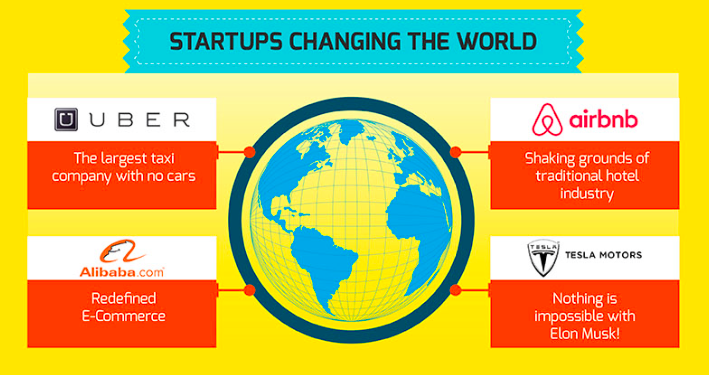
or view the full graphic below. Click on it to see the full size:

 The nature of investment advice has changed substantially in recent years. Advances in information access have eliminated the need for someone to “find” good investments. Managing risk, managing costs, taking a holistic approach and sharing common investment goals have become more critical… CLICK HERE to watch the complete video
The Evidence-Based Investor Video series is a service provided by Paul Philip and the team at Financial Wealth Builders Securities

“Earnings are the mother’s milk of stocks.”
—Old Wall Street adage
Alcoa is the first major company to report its quarterly results, so it often sets the tone for the rest of earnings season. If Alcoa’s results are any indication, things could get very ugly very fast.

It’s no secret that commodity prices have dropped, but the impact on corporate profits is worse than Wall Street expects.
Alcoa reported earnings well below Wall Street’s already-lowered expectations of 7 cents per share on $5.57 billion in revenue; much lower than the 13 cents per share on a $5.65 billion forecast.
Alcoa shares got hit hard on that big miss, and while nobody likes losing money, it is a painful reminder that nothing goes up forever.
In the last 15 years, we’ve seen two painful bear markets that temporarily wiped out investors’ capital: $5 trillion during the dot-com bust and $7 trillion in the financial crisis of 2008.
The stock market goes up and the stock market goes down, but one thing that doesn’t change is the hunt for companies that are still growing their earnings.
If you can identify those companies… you will make money.
The earnings of the 500 stocks that make up the S&P 500 peaked in the third quarter of 2014 and have fallen since then. However, that doesn’t mean profits are falling everywhere.

Six out of the nine broad sector categories have seen their profits fall. Profits of energy companies (no surprise) have dropped the most, followed by Consumer Staples, Financials, Industrials, Materials, and Utilities.
However, the profits of Health Care (+28.7%), Consumer Discretionary (+12.1%), and Information Technology (+10.6%) are up during the same period.
More importantly, the stocks in those sectors that are growing their profits also delivered the best performance. As the chart below shows, Health Care and Consumer Discretionary were the two strongest-performing sectors.

The moral of the story is, of course, that identifying the sectors with the strongest-growing profits is more important than the bull versus bear market debate.
So what’s the earnings outlook today?
The S&P 500 is now trading at 17 times trailing 12-month earnings based on the consensus year-end earnings estimate of $111.62.
Those earnings estimates, however, have been steadily declining—from $137.19 in March 2014 to $111.62 today.

What about 2016? The average estimate for the S&P 500 is $131.46, which implies a 17.5% increase in corporate profits over the next year.
Of course, the actual earnings number will be different—perhaps a bit higher or perhaps even lower. But regardless of what the actual 2016 earnings end up being, there will certainly be sector winners and sector losers.
Our challenge is to make sure you stay away from the sector losers and concentrate on the sector winners.
Who will that be? That’s the million-dollar question, but I believe it’s NOT going to be energy and materials companies. You’ve been warned.

Tony Sagami
30-year market expert Tony Sagami leads the Yield Shark and Rational Bear advisories at Mauldin Economics. To learn more about Yield Shark and how it helps you maximize dividend income, click here. To learn more about Rational Bear and how you can use it to benefit from falling stocks and sectors, click here.

 Quick Summary: War, central banks are losing control, and a derivative disaster – will lead to rising gold prices.
Gold Prices Will Rise Because …
A) War in Syria, Ukraine, Middle East, South China Sea and other places seems more likely each month. History shows that wars are inflationary, commodities increase in price, and governments finance wars with debt and fiat currency. We want higher gold prices and no war, but the “powers-that-be” will do what is necessary to increase their power and wealth, and if that requires war, then expect more war.
When armies invaded other countries throughout history, were they more interested in confiscating gold or paper currencies? Who wants fiat currency when it is circling the drain on its way toward zero? In troubled times the preferred asset is gold, not devaluing paper currencies issued by insolvent countries and central banks.
B) Central banks will lose control over interest rates and that will pose a huge risk to the global financial system. Expect much higher gold prices as rising interest rates force insolvent governments to more aggressively monetize debt and devalue their currencies.
Unless you believe that central banks can hold interest rates low for decades, regardless of what markets, investors, and individuals believe is appropriate, there is significant risk of rising interest rates.
C) A derivative disaster as a consequence of rising interest rates – is a bomb waiting to explode. The fuse is probably burning at this moment…
- There are over $500 Trillion in interest rate derivatives outstanding. We can safely assume that banks have taken an initial skim for their commissions, and that the derivative contracts are substantially under-margined.
- The current plan is that those derivative contracts will protect borrowers from interest rate risks in the future, just like the previous plan was that derivative contracts would protect from the sub-prime mortgage markets in 2008.
- The plan in 2008 failed, the financial system nearly “froze up” and the Fed cranked out over $16 Trillion in new currency, swaps, guarantees, bailouts, and other paper. Debt has dramatically increased but economies have not recovered.
- The global system is now more leveraged than in 2008, debt is roughly $60 Trillion higher, and the derivative contracts “protecting” borrowers are currently many times larger than in 2008.
- New York, London, Brussels, Frankfurt, and Tokyo – we have a problem.
- The problem is structural, increasing, and highly dangerous. The “snowflake” that will start the “avalanche” of financial destruction could fall at any moment or not for several years.
- Unless the “powers-that-be” allow a highly destructive deflationary depression that will result from such an implosion, central banks are likely to print hundreds of trillions of currency units to “paper over” the problem.
- Currency units will devalue, the purchasing power of savings will disappear, and gold prices will revalue HIGHER.
- Place your trust in gold (and silver) … or trust that your assets, savings, and purchasing power will be protected by bankers, politicians, and fiat currencies. It should be an easy choice.
From Daniel Ameriman:
“One could even say that by having created such a fantastically large level of risk the financial firms are effectively blackmailing the governments to make sure they never have to pay out, and the governments are allowing this because 1) so much money is being made by connected insiders; 2) it hasn’t actually blown up yet; and 3) the voters have no clue about what is actually happening.
There is an elaborate vocabulary and mathematics for derivatives that goes well beyond the knowledge of most financial professionals, let alone the general public. They are created by the largest and most prestigious financial firms in the world. Yet, once the veneer of these layers of impenetrable mathematics, jargon, “expertise” and the perception of overwhelming financial authority is pierced – what is left is nothing more than a basic form of insurance scam, i.e. collecting premiums for policies that can’t be honored. And if something does go wrong with that scam – then it is all of us who are the ones who will pay together, as taxpayers and investors.”
Gold prices will rise …
- Because of war, increasing debt to pay for those wars, and the inevitable destruction of purchasing power of fiat currencies.
- Because insolvent, hopelessly indebted countries owe far more than can ever be repaid in CURRENT dollars, euros, pounds and yen – and therefore central banks will “print” and devalue.
- Because, regardless of the story promoted by politicians and bankers, it is unlikely that interest rates can be maintained at multi-generational lows for several more decades.
- Because the inevitable derivative disaster will make the 2008 crisis look like a summer rain compared to the financial hurricane that approaches.
-
Because “if something does go wrong with that [derivatives] scam – then it is all of us who are the ones who will pay…”
- Because history shows that people trust gold more than fiat currencies. It should be an easy choice.
When gold prices rise in earnest (ask the High Frequency Traders for a precise date) they are likely to rise rapidly and cause financial media comments such as, “Nobody saw that coming…”
Gary Christenson
The Deviant Investor


-
I know Mike is a very solid investor and respect his opinions very much. So if he says pay attention to this or that - I will.
~ Dale G.
-
I've started managing my own investments so view Michael's site as a one-stop shop from which to get information and perspectives.
~ Dave E.
-
Michael offers easy reading, honest, common sense information that anyone can use in a practical manner.
~ der_al.
-
A sane voice in a scrambled investment world.
~ Ed R.
Inside Edge Pro Contributors

Greg Weldon

Josef Schachter

Tyler Bollhorn

Ryan Irvine

Paul Beattie

Martin Straith

Patrick Ceresna

Mark Leibovit

James Thorne

Victor Adair