
Currency
“In order for the deflationary theme to play out we will need to see a strong US dollar which will affect the commodities complex and other important currencies of the world. Below is a closeup view for the US dollar that now shows the bullish falling wedge in breakout mode with one backtest to the top rail so far.”

….click on chart or HERE for larger charts and comprehensive analysis


Attached is our Maison Energy Monthly for November 2015. We remain in the bear camp but expect the final shake-out to occur over the next 5-8 weeks and for oil to bottom in the low US$30’s/b. A Table Pounding buying opportunity should occur at that time. Investment Ideas for the bottom and purchase prices are included in the issue.

There is a sneaky industry bubbling up around oil.
The foundations of this industry were built back in the 1800s and are one reason America is the country it is today.
She’s got a lot of assets — and heck, the robber barons couldn’t keep their hands off.
If you haven’t guessed by now, I am talking about railroads.
Over the past 6 months, railroad companies have experienced a lot of downward pressure due to dropping production from the U.S. oil patch.
However, with talks of a Norfolk takeover and veto of the Keystone XL pipeline, this old time industry is putting the pedal to the metal and stocks are shooting north.
Below, Greg Guenther gives his take on the US rail industry and which company offers a way to make a pretty penny before the year is up.
2 Transportation Catalysts that Could Hand You Double-digit Gains
In a sea of red, one group of stocks is flashing green again.
And now takeover rumors in this sector are attracting a lot of investor attention. If you act now, you could quickly nab double-digit gains—no matter how the market acts over the next couple of weeks…
What stocks am I talking about? Railroads.
While the major averages drooped more than 1% three days ago, the U.S. Railroad Index chugged nearly 3% higher.
The catalyst? Rumors that Canadian Pacific Railway is in the early stages of taking over Norfolk Southern Corp. And let me tell you something—these railroad stocks desperately needed it. Investors have squashed the major railroad stocks to a pulp this year. Before the takeover rumors started flying, Norfolk Southern stock was down nearly 25% year-to-date.
The oil crash has been a double-edged sword for transportation stocks. While fuel costs are down, decreased activity in America’s shale basins means trains are shipping less crude across the country. But thanks to Monday’s pop and recent news, we could be seeing the beginnings of some tradeable bottoms in the rails…
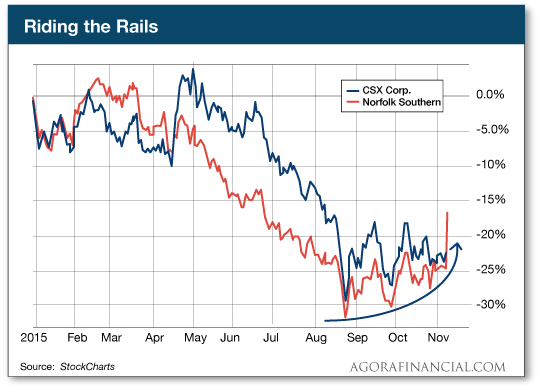
Norfolk Southern Corp. rallied double digits to close out the trading day. CSX Corp even spiked 3% in sympathy of the takeover news.
But aside from takeover chatter, even the news cycle is turning back in favor of the ailing rail stocks. You probably heard that the Obama administration finally deep-sixed the Keystone XL Pipeline after seven years of nonsensical review. But hey, screw pipelines! We toss our crude onto trains that may or may not occasionally derail in a fiery disaster.
Either way, the focus is back on the trains. Before all this nonsense was set in motion over the weekend, Forbes reminds us that the “big 4” U.S. railroad stocks– CSX, Kansas City Southern, Union Pacific, and Norfolk Southern – were all down at least 25% on the year.
“But there’s a reason Warren Buffett and Berkshire Hathaway bought Burlington Northern a few years back. Railroads are durable businesses,” Paul Karos, senior portfolio manager at Minneapolis’ $4 billion Whitebox Advisors, told Forbes. “Barriers to entry are high, margins are expanding and the group should benefit if the U.S. stays out of recession.”
During the first half of the year, transportation stocks couldn’t catch a bid. While the Dow Jones Industrial Average chopped along near breakeven, its cousins over at the Dow Jones Transportation Average piled up double-digit losses by early July. Now’s your chance to play a snapback rally in the transports as all of this train news comes to a head…
Check out CSX Corp. (NYSE:CSX). After trending lower for months, CSX is beginning to attract strong buying on almost every dip:
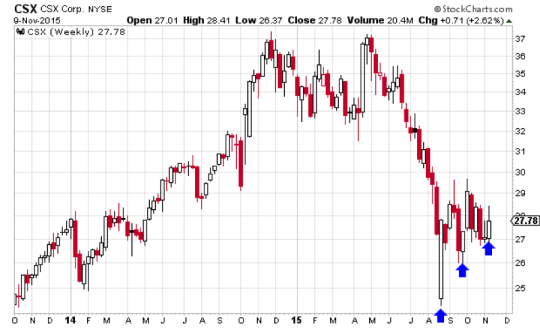
Monday’s 3% move higher on strong volume should help snap this stock out of its malaise. And it offers you the perfect chance to hop on and ride the rails to double-digit gains before the year is up.
So be sure to hop on this gravy train today.
Sincerely,
Greg Guenthner


In This Week’s Issue:
– Stockscores Trader Training – November Webinars
– Stockscores’ Market Minutes Video – Weekly Market Analysis
– Stockscores Trader Training – The Money Can’t Matter
– Stock Features of the Week – Weakness Ahead
Stockscores November Webinars
First webinar for November runs this Thursday at 6pm PT (9 ET) with more planned for the following week. Click here to see the schedule and topics.
Stockscores Market Minutes Video – Weekly Market Analysis
See my analysis for the US and Canadian stock markets plus Gold, Oil and the US Dollar. Important developments for the week ahead.Click Here to Watch To get instant updates when I upload a new video, subscribe to the Stockscores Youtube Channel.
Trader Training – The Money Can’t Matter
What are your motivations for trading the stock market? If you are a relatively normal person then it is likely that you trade to make money. However, I have found that trading to make money is dangerous because of the emotional attachment we have to our cash. The
best traders have different motivations.
Consider something as simple as crossing the road. What do you think about when crossing a busy street? Are you solely motivated to achieve the obvious goal of getting to the other side? Not likely. You are probably thinking a lot about getting to the other side without getting run over.
While this seems obviously silly, the correlation that can be made to trading demonstrates an important point. When we focus on money, when we are motivated by greed, we tend to ignore the obvious. If you are trading to make money then a number of psychological problems enter the trading decision.
First, we worry about missing out on an opportunity. We may look at a trade and think that it is not ideal but still “pretty good”. We remember the last “pretty good” trade set up that came along and how it did really well. We remember the pain that we associate with missing out on that pretty good trade set up that we ignored and that motivates us to take this trade, even though it is less than ideal.
Would you cross a busy road if you had a “pretty good” chance of making it without being hit? Would you jump out of an airplane if there was a “pretty good chance” that your parachute would open?
Second, when our trading decisions are motivated solely by money, we tend to work very hard to find something to trade. While a good work ethic is important to be successful in life, working hard to identify opportunities in the stock market is not always good. Doing so means we work hard to find things that are not obvious, and therefore, may not be good enough to even be worth trading. I find that my very best trades are the ones that I don’t have to think twice about, those that jump off my trading screen when the stock is in front of me. I don’t work hard to find them, they find me.
Third, when we trade just to make money we tend to sell our winners too soon. We want to lock in that good feeling of making a profit and don’t want to ever feel the frustration of having a winner turn in to a loser. So, we exit the stock when it feels good or at the first sign that the trade might make us feel bad. This causes us to not ride out the inevitable pull backs along a longer term trend.
Finally, focusing on the money causes us to now manage risk ineffectively. When we think about how much we “could” make if the stock goes up then we might buy a position larger than we are willing to lose. By taking too much risk, we are more likely to not sell our losers when they reach a sell signal or exit our winners too soon because of the fear that the winner will turn in to a loser.
Rather than focus on money when you trade, I want you to focus on being right. Do your analysis on a stock and then ask, “am I right to buy this stock?” “Am I right to short sell this stock?”
Make your trading an intellectual exercise, a challenge to your brain to be right more than you are wrong. Take your focus off of the green and on to the black and white. The easiest way to do this is to only look at the charts and not look at your account’s profit and loss indicator. I strongly believe that if you focus on making the right decision instead of focusing on making money, you will end up making more of it anyway.

The six week upward trend for the market was broken today indicating that there will be some near term profit taking in US stocks. I have found that the best way to take advantage of market weakness is through the VIX related ETFs. Below are the two that I will focus on trading as long as the volatility continues.

1. VXX
VXX is what I play on a day like today (Monday) when there is heavy selling in stocks as it tends to go up when the market goes down. It is based on the implied volatility of the S&P 500 index futures. The more people are worried about a correction, the more protection they buy in the futures market and that raises the implied volatility. i base my trading decisions on the intraday chart rather than the daily which tends to be too slow.

2. XIV
XIV represents the inverse of the VXX, it will go up when the market makes its inevitable bounces in a downward trend. Since a trend rarely goes straight up or down, I like to switch back and forth between this and the VXX as prices gyrate within the trend.

References
- Get the Stockscore on any of over 20,000 North American stocks.
- Background on the theories used by Stockscores.
- Strategies that can help you find new opportunities.
- Scan the market using extensive filter criteria.
- Build a portfolio of stocks and view a slide show of their charts.
- See which sectors are leading the market, and their components.
Disclaimer
This is not an investment advisory, and should not be used to make investment decisions. Information in Stockscores Perspectives is often opinionated and should be considered for information purposes only. No stock exchange anywhere has approved or disapproved of the information contained herein. There is no express or implied solicitation to buy or sell securities. The writers and editors of Perspectives may have positions in the stocks discussed above and may trade in the stocks mentioned. Don’t consider buying or selling any stock without conducting your own due diligence.

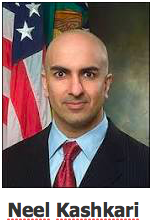 As you probably heard by now, Neel Kashkari was named president of the Minneapolis Fed.
Ordinarily, when a regional Federal Reserve bank gets a new president, it is not national news. Patrick Harker at the Philly Fed—crickets.
But Neel Kashkari is something of a celebrity. Most recently, he ran for governor of California. He had some good ideas that didn’t involve raising state income taxes to exorbitant levels. He even beat incumbent Governor Jerry Brown so badly at their only debate that Brown refused to participate in any more debates.
But in the end, it was hard for Kashkari to shed the Republican stigma in California—even as a pro-choice, pro-marriage-equality Republican. He lost, but not ignominiously. Nobody expected a Republican to win in California.
Before that, Kashkari ran equities at PIMCO (a big deal), but most people remember him for being the administrator of TARP, otherwise known as the Troubled Assets Relief Program, otherwise known as “The Bank Bailouts,” conducted under Treasury Secretary Hank Paulson in 2008-2009.
Before that, Kashkari worked at Goldman Sachs.
Pretty good resume for a guy who is 42. I am 41, and I’ve done some cool stuff, but not that cool.
Outside of the resume bullet points, who, exactly, is Neel Kashkari?
Not an Economist
That’s right, Neel Kashkari is not an economist. He is actually an engineer by training, with a Wharton MBA. I’m sure he will fit in great at the Fed (sarcasm).
I can’t tell you how pleased I am that a non-economist will be joining the Fed.
People have spent the last 48 hours poring over Kashkari’s Twitter feed to divine his monetary policy views. Kashkari admittedly does not have the most authoritative voice on social media, sometimes veering off to talk about things like cheap plane tickets on Twitter. I’ve been following him for years and haven’t gotten much out of it.
Suffice to say that Kashkari is probably going to be a hawk. Perhaps not in the mold of Thomas Hoenig or even Richard Fisher, but he is certainly not a dove. Many people also thought Ben Bernanke was a policy dove, but he really wasn’t. He was a registered Republican, and his thoughts on quantitative easing were shaped by his research into the Great Depression.
Kashkari publicly disapproved of Yellen’s nomination. He would seem to have some ideas on how things should be run differently.
Anyone else as Minneapolis Fed president wouldn’t pose much of a threat to the current monetary policy orthodoxy, but Kashkari is something of a celebrity and political lightning rod—someone who has ties to the media, someone with a megaphone who can make things really difficult for Yellen and Fisher. Translation: he is going to be a big pain in the ass.
Of course, outgoing Minneapolis Fed President Narayana Kocherlakota was equally outspoken—the other way. He was the most dovish member of the Fed, most recently advocating for negative interest rates. My sense is that the Minneapolis Fed board of directors accelerated his departure.
What This Means
What it means, potentially, is that we will have one outspoken FOMC member (in 2017) agitating for higher interest rates who will probably get on TV even more than St. Louis Fed President James Bullard. So lots of drama, lots of theatrics, and lots of fireworks.
We will probably also have certain politicians again complaining about the nomination process for regional Fed presidents. That’s three Goldman Sachs alumni in a row.
Some people will call Kashkari a lightweight. I would not underestimate him. (I do not underestimate anybody.) They are going to plunk a free-market capitalist with an engineering degree and an MBA in the middle of all the professors and see what happens.
I do think it is important to note that I have reversed/modified my earlier call that there would be no rate hike in 2017. There will be a rate hike in December, but then none all of next year. The same political constraints apply. I updated my view about two weeks ago in The Daily Dirtnap, after the October meeting.
But when Kashkari finds himself on the FOMC in 2017, it will be right after the elections, giving the Fed free rein to do pretty much whatever it wants. If the consensus is that the Fed is “behind the curve,” expect them to catch up very quickly.
2017 will be an exciting year for the bond market—and not in a good way.
Jared Dillian
Editor, The 10th Man
For those of you who want to get my thoughts on such things on a more frequent basis, consider a subscription.
Jared’s premium investment service, Bull’s Eye Investor, is available now. Click here for our introductory offer. For Jared, no asset class or type of investment is off limits. From an iconic sports outfitter to a particularly liquid frontier-market ETF—Jared picks the best vehicles for his subscribers to profit from tomorrow’s trends today. Put Jared’s ingenious mix of market analysis and trader’s intuition to work in your portfolio today. Follow Jared on Twitter at @dailydirtnap.


-
I know Mike is a very solid investor and respect his opinions very much. So if he says pay attention to this or that - I will.
~ Dale G.
-
I've started managing my own investments so view Michael's site as a one-stop shop from which to get information and perspectives.
~ Dave E.
-
Michael offers easy reading, honest, common sense information that anyone can use in a practical manner.
~ der_al.
-
A sane voice in a scrambled investment world.
~ Ed R.
Inside Edge Pro Contributors

Greg Weldon

Josef Schachter

Tyler Bollhorn

Ryan Irvine

Paul Beattie

Martin Straith

Patrick Ceresna

Mark Leibovit

James Thorne

Victor Adair