
Market Opinion
The mini “melt-up” in the U.S. Stock Market continues. In 2008, professional money managers and the like were asked, “How come you didn’t get me out?” Now, they’re being asked, “How come you didn’t get me in?” Justifably or not, the U.S stock market continues to rise sharply without any major setbacks. This is causing more people in whether they like it or not. Hitting DJIA 10,000 is only going to intensify this need as the media plays up the event.

My target remains DJIA 10,500 – 11,000. If and when its hit, my plan is to put back on my perma-bear suit. But for now, sit back and watch the “Don’t Worry, Be Happy” crowd do their thing.
The very short-term key (like in hours or a few days) is – you guess it, the U.S. Dollar. It’s now below key support of 76 on the U.S. Dollar Index. A further sell-off should limit or avoid any metals correction but a reversal could bring on a sharper correction. I don’t like to hedge but it’s a coin flip right now so stay tuned.
Lots of emails about Continental Minerals (KMK-TSX-V $1.40). What I can tell you is this:
The latest deal has created lots of interest in Asia. This is a big deal having two different Chinese mining companies taking a major stake in the same company. Both have been playing up their interests in the financial media. I’m told by KMK that Asian institutional interest has gone bonkers since the announcement (You can see it in the big increase in volume). KMK management tells me they’re on a road tour promoting KMK for the first time in quite awhile and key management is heading for China as we speak. Hmmm…
I will be out of the office all next week. I will be interviewed on BNN next Tuesday at 4:15PM EST. I look forward to seeing many of you at Michael Campbell’s conference on October 24th. There will be a special “after-hours” workshop where I will expand on my latest thoughts.
…..go HERE for Peter’s comment on near term prospects for all metals and mining shares.

On Major Moves, Grandich has been very right and not only saved many investors fortunes, but expanded them dramatically. On November 3, 2007 at the MoneyTalks Survival Conference, Peter Grandich of the Grandich Letter warned that “an unprecedented economic tsunami will hit American beginning in 2008”. Peter advised publicly to short the US market two days from the top in October, 2007 and stayed short until the last week of October, 2008. He began to buy stocks in March 7th, 2009. He also bought oil and oil related investments near the lows after the dive from $147.
….go to visit Peter’s Website.
Peter Grandich at 7:10 PM on Tuesday, October 13th, 2009
Of all the “claims” I’ve heard from the gold bears/weak-knees bull camp, without a doubt this one today takes the cake:
“…Gold is NOT in a bull market. The dollar is in a bear market…”
Hello? Ah, a declining U.S. Dollar “Is” bullish for gold. It truly amazes me to see how long someone can be wrong and continue to find “innovative” ways of twisting in the wind.
Speaking of the dollar
How to know when gold is at a top? This is hysterically funny!
There’s a correction/consolidation out there so when it comes, rest assured the gold bears/weak knee bulls will say for the umpteen time, gold has topped. At this point, it should be only a pause that refreshes.
I believe it’s fool-hearty to think a diplomatic solution will be reached over Iran.
I’ve written about the political price the U.S. is going to pay for it’s outrageous debt and spending habits.
Commentary on Strathmore Minerals
I’m truly thrilled and grateful for the man upstairs for giving one of the best Christian men I ever met another job in the NFL
On Major Moves, Grandich has been very right and not only saved many investors fortunes, but expanded them dramatically. On November 3, 2007 at the MoneyTalks Survival Conference, Peter Grandich of the Grandich Letter warned that “an unprecedented economic tsunami will hit American beginning in 2008”. Peter advised publicly to short the US market two days from the top in October, 2007 and stayed short until the last week of October, 2008. He began to buy stocks in March 7th, 2009. He also bought oil and oil related investments near the lows after the dive from $147.
….go to visit Peter’s Website.
The Currency Cabal
On October 6th, The Independent newspaper of London set off shock-waves around the world with a report that secret meetings were held between the OPEC states, China, Russia, and others, in which the participants charted a course toward a new world reserve currency. Not surprisingly, the U.S. dollar nosedived on the news. The rout was only stemmed by Saudi and Chinese officials publicly denying the story.
Whether or not this particular reporter got all his facts straight is largely immaterial. If such meetings have not been occurring, they soon will be. All the ingredients to stir financial discontent in these nations are present. It’s not a question of if we will move to a post-dollar world, but when.
We have warned continually that if the U.S. government persists in profligate spending, financed by debt and currency debasement, the greatly privileged reserve status of the dollar will be in jeopardy. We have also argued that with shrinking confidence in the stability of fiat currencies, gold itself will resume its reserve role in some capacity, boosting its price considerably. The recent gold surge indicates that this view has wide support.
It is becoming clear that President Obama will offer no “change” from former President Bush II’s policy of dollar debasement. It is a policy of covert war on the U.S. dollar. It has been coordinated and executed under both presidents by Fed Chairman Bernanke. While a cheaper dollar serves many interests from the U.S. government’s perspective (easier repayment of debt, for instance), it will be a burden for the vendors of dollar-priced oil (OPEC) and the holders of large amounts of dollar-based reserves (China and Japan). As these interests become increasingly antagonistic, a currency crisis threatens.
In the early 1920’s, the Pound Sterling was considered ‘as good as gold.’ At the 1922 Rome central bank meeting, the British were persuaded to allow their notes – which were fully convertible into gold – to become the first paper reserve currency. They would be held and used by central banks in place of each storing its own gold bullion. After the Great Depression, the U.S. dollar – also convertible into gold – emerged even stronger than Sterling and gradually eroded Sterling’s influence. In 1945, the Bretton Woods Agreement confirmed the U.S. dollar’s role as the world’s reserve currency and cemented its status with the creation of the International Monetary Fund and World Bank.
Reserve status has bestowed very great privileges. Most central banks keep gold and U.S. dollar currency (‘as good as gold’) in their reserves. As a natural corollary of this policy, most internationally traded commodities are priced in U.S. dollars. As a result, governments and corporations buying international products, such as oil, have to change their domestic currency into U.S. dollars.
Furthermore, any country in trade surplus with America has found it advantageous to keep its reserves in U.S dollars and invest them in the U.S Treasury market. This built-in international demand for dollars has enabled the U.S government to finance enormous and persistent national debts. In turn, this has financed a standard of living beyond that which America could afford from its natural trade balance and domestic productivity.
With dollars so ubiquitous, global monetary policy has been essentially outsourced to the Federal Reserve. The downside for most of the planet is that America has been able to set interest rates at a level that best suits its own political needs at the expense of others economic needs.
Although a nation whose currency enjoys reserve status is given a great many advantages, the privilege does come with responsibility. Many nations believe that America has abused its privileges by debasing its currency. The criticism is justified.
First, a cheaper currency represents a covert trade tariff on imports and subsidy on exports. The U.S. government is desperate to boost its economy and may see this mercantilist strategy as in its interest.
Second, ‘official’ U.S. Treasury debt stands at some $11.8 trillion. But this is only half of the story. The ‘off-balance sheet’ debts and obligations of the U.S. government add up to an unimaginable $43 trillion and counting! In short, this debt can never be satisfied – at least in real dollars. The government is debasing the dollar in order to avoid the consequences of decades of reckless economic policies.
For some time, there has been talk of challenging the dollar’s reserve status. But key nations have refrained in order to test the policies of President Obama. Instead of change, they have seen even more massive spending on health, education, and bailouts.
If this new currency cabal is successful at unseating the U.S. dollar, we will see rapidly rising prices domestically – especially for gold. Severe social and economic disruption may follow. But it is all due to Washington’s unwillingness to restructure itself.
As a passing shot, Iran has just announced it will not accept U.S. dollars in payment for its oil. The last nation to offer such a challenge, Iraq, was invaded only months later by President Bush II. Already, President Obama appears to be considering joint strikes against Iran to ‘protect Israel and the world from an Iranian nuclear threat.’ Of course, none of this will change the fundamental economic dislocation that is causing America’s descent. In fact, war is one of the most expensive propositions a government may entertain. One thing is virtually certain: if the missiles start to fly, then gold is sure to soar.
For a more in-depth analysis of our financial problems and the inherent dangers they pose for the U.S. economy and U.S. dollar, read Peter Schiff’s 2007 bestseller “Crash Proof: How to Profit from the Coming Economic Collapse” and his newest release “The Little Book of Bull Moves in Bear Markets.” Click here to learn more.
More importantly, don’t let the great deals pass you by. Get an inside view of Peter’s playbook with his new Special Report, “Peter Schiff’s Five Favorite Investment Choices for the Next Five Years.” Click here to download the report for free. You can find more free services for global investors, and learn about the Euro Pacific advantage, at www.europac.net.
John Browne is the Senior Market Strategist for Euro Pacific Capital, Inc. Mr. Browne is a distinguished former member of Britain’s Parliament who served on the Treasury Select Committee, as Chairman of the Conservative Small Business Committee, and as a close associate of then-Prime Minister Margaret Thatcher. A graduate of the Royal Military Academy Sandhurst, Britain’s version of West Point and retired British army major, John served as a pilot, parachutist, and communications specialist in the elite Grenadiers of the Royal Guard.
In addition to careers in British politics and the military, John has a significant background, spanning some 37 years, in finance and business. After graduating from the Harvard Business School, John joined the New York firm of Morgan Stanley & Co as an investment banker. He has also worked with such firms as Barclays Bank and Citigroup. During his career he has served on the boards of numerous banks and international corporations, with a special interest in venture capital. He is a frequent guest on CNBC’s Kudlow & Co. and the former editor of NewsMax Media’s Financial Intelligence Report and Moneynews.com. He holds FINRA series 7 & 63 licenses.
CRUSHING the U.S. dollar!
Gold stocks surge 8% in one day!
Next, get ready for my new recos
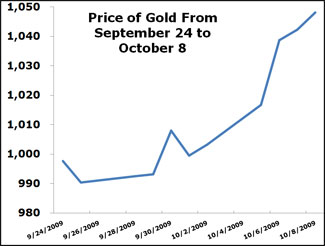 Source: Bloomberg
Metals, foods and other resources soaring!
Resource investors seeing massive daily gains!
I’m about to pull the trigger on a bundle of resource investment recos …
Each one carefully designed to help YOU harness the remarkable money-making power of this historic resource price explosion …
But if you’re not on-board, you could miss them entirely!
I tried to warn you this would happen.
Just yesterday, Washington announced that the final, official federal deficit for fiscal year 2009 was $1.4 trillion — three times the previous record — a clear sign that we can expect even greater Treasury borrowing and even faster Fed money-printing ahead.
The reaction from global investors came quickly: Overnight, the U.S. dollar fell to an eyelash of its 14-month low and is still falling like a rock.
As a result, the price we pay for crucial resources took off like a scalded dog:
- Gold bullion prices surged 1.4 percent to a new all-time record high, breaking through the $1,058-per-ounce barrier.
- Silver roared 2.5 percent higher. Platinum increased 1.3 percent and palladium posted 2.5 percent gains. Oil rose 1.3 percent.
- Corn, wheat, oats, rice, soybeans, cocoa, coffee, pork bellies, feeder cattle, all jumped — some as much as 2 percent to 3 percent — in a single session.
- Equinox Minerals jumped 5.15 percent …
- Rio Tinto jumped 5.23 percent …
- European Goldfields jumped 7.45 percent …
- Atlas Iron jumped 8.2 percent …
- Fortescue Metals jumped 9.12 percent …
- Hallador Petroleum jumped 11.3 percent …
- And many other resource stocks surged even higher!
This great natural resource boom is real. It’s happening now.
Big money is being made with these investments! I do NOT want you to be left behind!
Here’s what I’m asking you to do to protect your family and profit:
FIRST, If you missed our presentation of Washington’s Secret War on the Dollar or want to watch it again, turn up your computer speakers and then CLICK THIS LINK to watch it now!
FAIR WARNING: The investment intelligence and investment recommendations in this video are so red-hot, we can NOT leave it online for long. The ONLY way to make sure you don’t miss this crucial investment event is for you to watch it right away!
AND SECOND, after you’ve watched this startling video, be sure to CLICK THIS LINK to claim five free Emergency Profit Guides that reveal my favorite investments to help you protect and grow your wealth.
Best wishes,
Larry Edelson
Surviving the “learning curve” to eventually profit in the market is the most difficult thing that many of us will ever do. Here are some tried and tested elements for successful trading that should help you through the process: The first fundamental is; “Know thyself!” Think about the outcome that you expect from your trading activities and your portfolio. Are you normally a conservative person or do you feel comfortable traveling at warp speed? How will your type of trading affect you emotionally? Can you handle the volatility of day trading or are you happier with long-term, conservative plays. Once you determine your risk/reward attitude, you can construct your positions and plays accordingly.
Next, you must understand (completely!) any strategy that you are using and what your specific goals are for that particular trade. You can’t make good decisions without knowing the mechanics of a specific technique. Don’t use complex or advanced methods simply because they are intriguing. The BEST strategy is the simplest one that accomplishes your goals! Once you have a candidate in mind, do your homework! Know the company and the calendar (any upcoming events, earnings dates, scheduled announcements etc).
When you have a good knowledge of a stock and its industry, you are way ahead of the investor that buys and sells on rumors or tips. Remember, “knowledge is power!” and with the tools on the Internet, there’s just no excuse for not being well informed about any company or industry group. When you are ready to trade, use simple proven techniques! One of the oldest phrases is; “Buy on down days, Sell on up days” and it is really not that difficult. Successful traders develop target prices for all potential plays and they know their exits before going in. They take the human factor out of trading by using STOPS and GTC orders. When news or events change the character of the play, they make the necessary adjustments. Learn to trade on YOUR terms, not the markets’!
After you take a position in a particular issue, stay informed by monitoring all the news and announcements affecting your play. This is one of the easiest rules to follow with all of the online information now available. Determining when to exit a play is a matter of personal preference and YOU are the only one who can decide how you will trade. Most professional traders are happy with consistent monthly returns of 5%-10%.
The most painful lesson comes when you close a losing trade. It’s very difficult to learn to close out losing plays early but the simple fact is; There is no reason to hang on to a losing position when there are so many other profitable plays that deserve your time and money. Accept your losses, learn from your mistakes (and evaluate each one critically) then move on! Success will come when you create a favorable balance between hard work and patience. Too many traders give up after a few losing plays, long before they have time to learn (and absorb!) the various methods required for profitable trading.
As your portfolio increases, diversify! There is always something to be said for becoming an expert on a few specific issues but don’t confuse the basic ideas. By spreading out across industries (and instruments), you can avoid the agony of violent swings in a particular stock or sector and limit losses when the unexpected occurs. Just remember the Titanic…
Letter from Michael Campbell HERE.
Marks VRTrader Silver Newletter covers Stock, TSE Stocks, Bonds, Gold, Base Metals, Uranium, Oil and the US Dollar.
More kudos – Mark Leibovit was named the #1 Intermediate Market Timer for the 10 year period ending in 2007; the #1 Intermediate Market Timer for the 3 year period ending in 2007; the #1 Intermediate Market Timer for the 8 year period ending in 2007; and the #8 Intermediate Market Timer for the 5 year period ending in 2007. NO OTHER ANALYST SURVEYED APPEARED IN ALL FOUR CATEGORIES FOR INTERMEDIATE MARKET TIMING AS PUBLISHED IN TIMER DIGEST JANUARY 28, 2008!
For a trial Subscription of The VR Silver Newsletter covering Stocks, Bonds, Gold, US Dollar, Oil CLICK HERE
The VR Gold Letter is available to Platinum subscribers for only an additional $20 per month, while for Silver subscribers the price is only an additional $70.00 per month. Prices are going up very shortl, so act now! Separately, the VR Gold Letter retails for $1500 a year! The VR Gold Letter is published WEEKLY. It is 10 to 16 pages jam-packed with commentary and charts. Please call or email us right away. Tel: 928-282-1275. Email: mark.vrtrader@gmail.com .

Marks VRTrader Silver Newletter covers Stock, TSE Stocks, Bonds, Gold, Base Metals, Uranium, Oil and the US Dollar.
More kudos – Mark Leibovit was named the #1 Intermediate Market Timer for the 10 year period ending in 2007; the #1 Intermediate Market Timer for the 3 year period ending in 2007; the #1 Intermediate Market Timer for the 8 year period ending in 2007; and the #8 Intermediate Market Timer for the 5 year period ending in 2007. NO OTHER ANALYST SURVEYED APPEARED IN ALL FOUR CATEGORIES FOR INTERMEDIATE MARKET TIMING AS PUBLISHED IN TIMER DIGEST JANUARY 28, 2008!
For a trial Subscription of The VR Silver Newsletter covering Stocks, Bonds, Gold, US Dollar, Oil CLICK HERE
-
I know Mike is a very solid investor and respect his opinions very much. So if he says pay attention to this or that - I will.
~ Dale G.
-
I've started managing my own investments so view Michael's site as a one-stop shop from which to get information and perspectives.
~ Dave E.
-
Michael offers easy reading, honest, common sense information that anyone can use in a practical manner.
~ der_al.
-
A sane voice in a scrambled investment world.
~ Ed R.
Inside Edge Pro Contributors

Greg Weldon

Josef Schachter

Tyler Bollhorn

Ryan Irvine

Paul Beattie

Martin Straith

Patrick Ceresna

Mark Leibovit

James Thorne

Victor Adair