
Daily Updates
I don’t think the question really is what is gold worth but what are currencies not worth – Shayne McGuire
My title’s awful pun on a recent Hollywood movie (No country for old men, directed by the Coen Brothers in 2007) represents not so much an environment associated with the lack of places for Austrian economists to hide; indeed it is meant to suggest the opposite result, namely that all users of fiat money will eventually lose faith and turn to the one commodity that cannot be mal-adjusted by central banks, namely gold.
Just over two years ago, when gold was still trading at US$600 or so an ounce, I wrote an article titled In gold we trust (Asia Times Online, September 8, 2007), the title of that article being a wordplay on the motto on all US dollar currency notes (“In God We Trust”). As the precious metal has now gone to new stratospheric levels since then, reaching a high of over $1,118 this week, the question is raised – what is the future?
At the basic level, and before delving into the outlook for financial instruments and their opposite (namely gold), it must be stated quite clearly that this article isn’t about providing investment advice. Rather, it is meant to highlight certain arguments in favor of, as well as against, the notion of using gold as a replacement for everyday financial instruments.
The most common financial instrument of all is the US dollar (see The dead dollar sketch, March 4, 2008). The problem is that the US dollar does not carry the purchasing power associated with currency when that dollar was first granted to you.
In other words, if you were to rifle through grandpa’s old trench coat pockets and find a US dollar note from the 1950s, one can be sure of only one thing – what the US dollar would have purchased in the 1950s would be far in excess of what it could purchase today, pretty much anywhere in the world.
On the other hand, while the price of gold has moved around a fair bit over the intervening period, it is unlikely that you will find many countries in which an ounce of gold today purchases markedly fewer items than it did in the 1950s. At the very least, it would reflect the same purchasing power of an equalized basket of goods (example – an average household’s monthly expenses on food and clothing) as it did back then. In effect, it is a true store of purchasing power.
This is an important distinction to make between any notion of price changes as we look ahead: the point about gold is not whether its price will go up or down; but that the value at the end of the cycle would likely be equal to the same purchasing power as it has today. Likely, not positively.
What do central bankers want?
If the notion of defining what gold is proves difficult, then perhaps a negative feedback loop addressing what other alleged stores of value (that is, fiat currencies) are not would prove useful.
The one thing that fiat currencies are not is a hedge against inflation. The person who is most likely the world’s most cerebral central banker, Mervyn King of the Bank of England, made a remarkable speech on November 11 wherein he stated the bank’s intention to adopt an easy monetary policy over the near term.
As a famously inflation-targeting central banker of the school of Paul Volcker, the former US Fed chairman, these comments were clearly in need of explanation, which King provided:
Inflation has been unusually volatile recently. It is currently 1.1%, having been 5.2% only a year ago. Such volatility is likely to continue in the short run. Inflation is likely to rise sharply over the next few months, to above the target, reflecting higher petrol price inflation and the reversal of last year’s temporary reduction in VAT [value-added tax]. Monetary policy can do very little to affect these short-run movements in inflation. So the MPC [monetary policy committee] must look to the medium term when inflation is determined by the path of nominal spending relative to the supply capacity of the economy. To do that the MPC must restore the level of money spending to a path consistent with eliminating the margin of spare capacity, and ensuring that the outlook for inflation is in line with the 2% target.
Anyone who invests in fixed-income markets will read that paragraph with dread; for those without a full background in the market I would explain as follows: the focus on pushing inflation targeting away from the near term towards an undefined medium term (is that three months or three years?) suggests that the Bank of England is effectively targeting negative real interest rates (that is, the difference between interest rates and inflation is negative).
…..read interesting 2nd half of the page 2 HERE
Ed Note: Tyler Bollhorn gave superb insights into how to trade in the Money Talks in the Money Talks Super Summit available by video by clicking on the banner above or HERE.:
No Fear
Stockscores.com Perspectives for the week beginning Nov 15nd, 2009

I think that many traders have a hard time believing that they can make money by buying a stock and waiting. Most of us are not taught to make our money work for us but instead that we must work for our money. Go to a job, put in the time and you get a pay check. Work hard, your pay checks will grow. But the thought that you can make money by putting your feet up is a difficult thing for most to grasp.
With that mental programming, most of us have difficulty holding on to our strong stocks and letting the profits grow. If we buy a stock at $1 and it goes up to $1.20 in a couple of days we are likely to sell. In some ways we think of this fast return as good luck, not much different than buying a winning lottery ticket. We have a fear that someone is going to figure out that we have benefited from a mistake and so we better get out now before we get discovered.
This thinking is strengthened when we own a marginal stock and it goes down as quickly as it went up. If we take a marginal trade we should expect marginal results but somehow we only remember the negative feeling of watching a paper profit turn in to a loss. We tell ourselves that next time we will sell at the first sign of weakness and crystallize the gain. Avoiding pain is human nature.
- Get the $3,600 StockSchool Pro Free by just opening an account at:

- DisnatDirect named the number one Canadian brokerage for Traders by Surviscor! Open and Fund a brokerage account with DisnatDirect and receive the StockSchool Pro home study course free, including special Pro level access through the DisnatDirect client website. Offer only available to Canadian residents. For information, click here
Our next trade is of higher quality but we sell it on a short term weakness and lock in a quick but relatively small profit. While lost in self congratulations we realize that someone named Murphy is writing the laws of trading and we watch the stock march ever higher with us eating the stock’s dust. We have jumped off of a high speed bus that is headed for Profit City.
So what is behind this destructive behavior? It is that deep routed emotional response to danger that keeps us out of trouble but also makes us avoid a greater feeling of fulfillment.
Fear is what makes us sell our winners too early and hold our losers too long.
The best traders are not afraid of holding on to strong stocks, they are afraid of holding on to losing stocks. What do you do?
If you are a normal human being, you do the opposite. Think about the last loser that you owned. As the stock fell lower and lower, what was it that you told yourself over and over?
“It will bounce back eventually, I will just be patient.”
What your subconscious mind was really saying was, “It is much too painful to sell this loser and see that loss of my hard earned capital. I will hold on with the hope that it goes back to what I paid for it and then I will sell.” And of course, it continued lower because there was something wrong with the company and it deserved to go lower.
So what can be done to fight our destructive minds? How can we program ourselves to hold on to our winners and dump the losers? How can we trade without fear?
Here are my Seven Criteria for Fearless Trading:
Trade Quality
Our fears are confirmed when we enter marginal trades. If you only trade the best opportunities you will trade less but you will have greater success. This will put you on the road to fearless trading and help you to simplify the trading approach. Write down your rules and do nothing if every rule is not satisfied. When you consider a stock, look for a reason to avoid the trade. If you can’t find one then you have a trade worth taking.
Buy With Confidence
The rules that you trade with have to have a foundation of success. You have to believe in your rules or you won’t believe in holding the stock through the shakeout periods in the longer term up trend. Analyze and test the strategy until you have proven to yourself that it works. Then trade it slowly without a lot of risk so you can gain a greater level of confidence that it works.
Don’t Watch the Scoreboard
Sports fans don’t spend a lot of time watching the scoreboard during a game, it only matters when the game is over. In trading, the scoreboard is the profit and loss figure for your account. If you focus on the scoreboard it is likely that you will lose sight of what is happening in the game. As a technical trader, all that matters to me is what the chart is telling me.
Plan Your Losses
Before you enter a trade, figure out what needs to happen for you to consider the trade a loser. For me, that is a move through chart support; I plan to exit the trade when the stock goes through a psychological floor price on the chart. Understanding where that point requires some experience and knowledge but once you know how to identify support on the chart, plan your losses.
Plan the Trade
I find it helpful to predict pull backs. My rational side knows that stocks can not go straight up and that they must suffer pullbacks to recharge buyer interest and shake out weak holders. My emotional side feels fear when those pull backs happen. If I plan my trade and build in expectations for the counter trend pull backs I can deal with them better and have a greater chance of not succumbing to the fear when they do.
Don’t Fall in Love
I don’t want to know too much about what a company is doing because I have found that the more I like a stock the more likely I am to not listen to the message of the market. There is a lot of bias in the information that we receive about companies and what they are doing. The ultimate arbiter of truth is the market itself; we should have a greater faith in the opinions of thousands of market participants than a few biased sources of information.
Tolerate Risk
Without risk, there is no potential for return. To avoid trading with fear we have to be comfortable with the risk. If not, we will let fear guide our decisions and those decisions will probably be wrong. Therefore, do not take more risk on a trade than you are comfortable losing. Plan your losses based on how much you are willing to lose and let that determine the size of your positions.
The Profit is in the Patience
When a trade is working, let it work for you. A business owner does not fire her best employee. A hockey coach does not send his best player to the minor leagues. A company does not stop making their best products. Hang on to your best stocks with the same attitude. Hold the stock until there is a rational reason to exit the trade rather than selling because it feels good. If you are taking quality trades and trading without fear, you will feel better over the long run.
The time to get started on your reprogramming is now. Don’t expect to break habits built up over a life time in a couple of days. The battle against your fears is one that takes time win but with determination you can do it.

A move lower next week is likely although it is not certain (nothing is ever certain in the stock market!). We have to adapt our strategy to what will probably happen in the market, so we should be approaching next week with some ideas for shorting stocks.
I don’t feel that the market is topping out and on the verge of a long term downward trend. For now, a few days of weakness and a pull back to the upward trend line is what is likely. Therefore, our strategy should be to short with a relatively short term time frame for the hold.
That means a swing trade is best and, for this, I like to look to the Exchange Traded Funds. There is too much potential for surprises with individual stocks but the indexes that the ETFs are based on will move lower if the overall market moves lower. Plus, there are some ETFs established to go up when the market goes down.
Here are some swing trade ideas for next week:

1. SPY
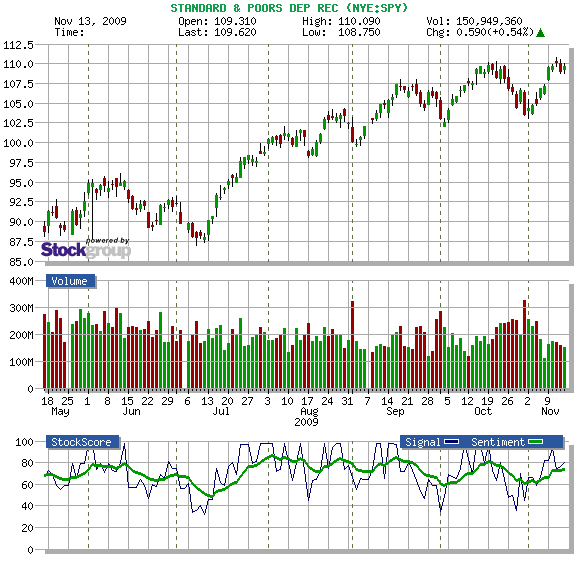
the SPY broke its upward trend line on Thursday, rallied back on Friday but formed a falling top. It looks like it will go lower; I would consider the trade a bust if the daily close can be above $110.09. You can also trade this by going long the SDS, a leveraged short ETF that goes up if the market goes down.
2. IBB
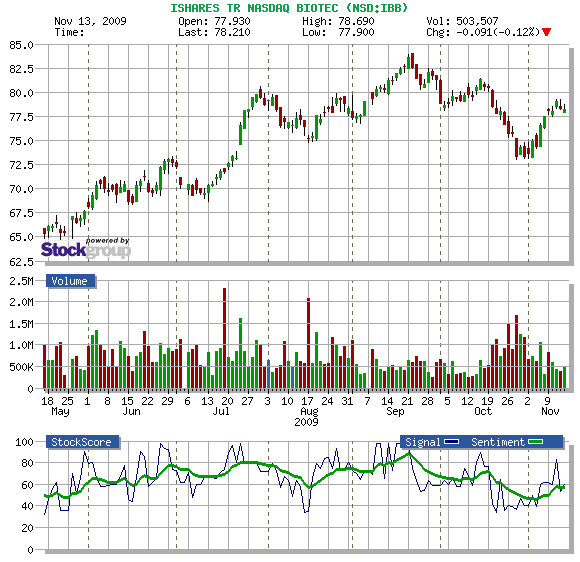
I like a short on IBB because the daily chart shows a series of falling tops forming and the intraday 60 minute chart shows a break of the short term upward trend line. If there is a close above resistance at $79.27, dump it.
3. T.XIU
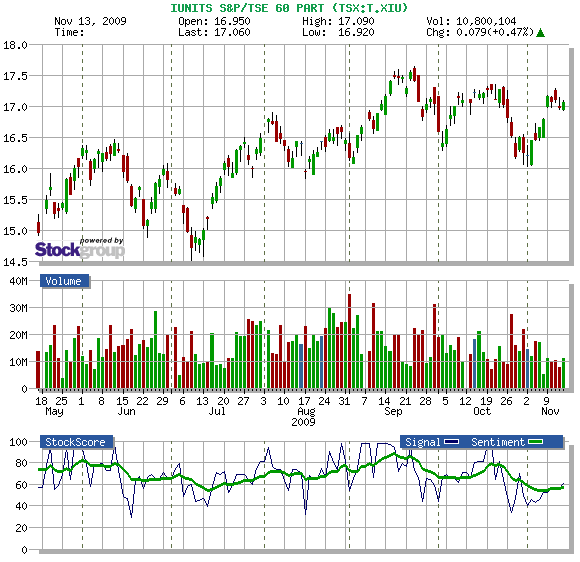
T.XIU hitting resistance at the downward trtend line, it should go lower next week. Set your stop loss point at $17.30. You can also consider the leveraged short ETF T.HXD which will go up if the market goes down.
Click HERE for the Speaker Lineup and click HERE if you want to learn from some of the timeless advice from some of worlds best traders including the very successful Tyler Bollhorn.

Tyler Bollhorn started trading the stock market with $3,000 in capital, some borrowed from his credit card, when he was just 19 years old. As he worked through the Business program at the University of Calgary, he constantly followed the market and traded stocks. Upon graduation, he could not shake his addiction to the market, and so he continued to trade and study the market by day, while working as a DJ at night. From his 600 square foot basement suite that he shared with his brother, Mr. Bollhorn pursued his dream of making his living buying and selling stocks.
Slowly, he began to learn how the market works, and more importantly, how to consistently make money from it. He realized that the stock market is not fair, and that a small group of people make most of the money while the general public suffers. Eventually, he found some of the key ingredients to success, and turned $30,000 in to half a million dollars in only 3 months. His career as a stock trader had finally flourished.
Much of Mr Bollhorn’s work was pioneering, so he had to create his own tools to identify opportunities. With a vision of making the research process simpler and more effective, he created the Stockscores Approach to trading, and partnered with Stockgroup in the creation of the Stockscores.com web site. He found that he enjoyed teaching others how the market works almost as much as trading it, and he has since taught hundreds of traders how to apply the Stockscores Approach to the market.
References
Get the Stockscore on any of over 20,000 North American stocks.
Background on the theories used by Stockscores.
Strategies that can help you find new opportunities.
Scan the market using extensive filter criteria.
Build a portfolio of stocks and view a slide show of their charts.
See which sectors are leading the market, and their components.
Disclaimer
This is not an investment advisory, and should not be used to make investment decisions. Information in Stockscores Perspectives is often opinionated and should be considered for information purposes only. No stock exchange anywhere has approved or disapproved of the information contained herein. There is no express or implied solicitation to buy or sell securities. The writers and editors of Perspectives may have positions in the stocks discussed above and may trade in the stocks mentioned. Don’t consider buying or selling any stock without conducting your own due diligence.
So what was all that Depression fuss about?
Ed Note: One of Michael Campbell’s favorites, Donald Coxe has 35 years of institutional investing and money management experience in the United States and Canada, and a unique background in North American and global capital markets.
The Power of Zero
The US economy grew 3.5% in the Third Quarter, and all the major economic numbers now being reported suggest this one will be even stronger. Stock prices are soaring.
In case, you’ve forgotten:
Sixteen months ago we were heading into the Midnight Massacre, when Messrs. Bernanke and Paulson launched the rescue of Fannie, Freddie and Wall Street.
That swiftly evolved into the Age of Bailouts, with Congress enlisted in emergency funding for Wall Street’s biggest, boldest and brashest bankers on a scale that made IMF rescues of entire nations look like chump change. Only Lehman was allowed to experience the Schumpeteresque-slaughter reserved for capitalist cupidity and stupidity. Operating with scripts and strategies conceived on the fly, varying prescriptions of emergency assistance were extended, under panic conditions, to Citigroup, Merrill Lynch, Morgan Stanley, AIG and Goldman Sachs.
Since then, the Obama Administration and the Pelosi-led Congress have been moving to take charge of some of the commanding heights and strategic valleys of the US economy. Highlights: takeovers of General Motors and Chrysler, a defi cit of 12% of GDP, $790 billion in handouts and assistance under the rubric of economic stimulus, a costly new national health care system, and a vast array of tax and trade global warming programs whose tentacles will reach into almost every sector of the economy.
To date, his rescue operations are succeeding. As Joe Biden put it, “A year ago we were talking about falling into Depression. Now we’re talking about the shape of the recovery.”
But deeply-wounded investors should be cautious about throwing caution to the winds. Among the signs that the stimulus package didn’t repair the potholed yellow brick road to prosperity is the upside breakout in the Bad News Asset: Gold.
This month, we begin our analysis by discussing the anniversaries of the births of two new eras. First, the Age of Global Capitalism, which began 20 years ago with the Fall of the Wall. Second, the apparent ending of that era a year ago with the return of Big Government as Economy Manager with the election of Barack Obama. We weren’t sure then how he was going to deliver everything his thrilled backers wanted, but we knew that he wanted to be a transformative President and he cited Reagan as such a leader—even though he said Reagan had the wrong views.
With that background, we search for an appropriate investment strategy for tumultuous times. While the talk is of trillions in stimulus, foreclosures, bailouts and defi cits, we have decided to focus on a humble number— Zero—which is roughly the rate on government short-term funds, high-grade money market funds and inflation across the US, Canada, Japan, and most of Europe.
We are leaving our cautious Asset Mix unchanged. Risk assets—other than US real estate prices—are bubbling upward everywhere, but the big banks’ balance sheets remain overloaded with the unmarketable unmentionables, and US regional banks—the backbone of the real economy—are now being engulfed by their exposure to commercial real estate and consumer loans as unemployment continues to climb.
Published by Coxe Advisors LLC
Distributed by BMO Capital Markets

Basic Points
A monthly publication of opinions, estimates and projections prepared by Donald Coxe of Harris Investment Management, Inc. (HIM) and BMO Harris Investment Management Inc. (BMO HIMI). Basic Points is available exclusively to clients of BMO Nesbitt Burns, BMO Harris Private Banking (Canada), Harris Private Bank (U.S.) and BMO Capital Markets.
If you are a client, you can download Basic Points from the BMO Capital Markets Research sites. For a password to access these sites, please complete this form. If you have any questions, please contact us.
If you are not a client of BMO Capital Markets and would like to be referred to a BMO Capital Markets representative for Don Coxe Research, please email us.
Ed Note: Be sure to watch the hilarious video HERE of a man trying to sell an $1100 1oz Gold Maple Leaf to 10 different Americans for $50, $20, $5…even a Starbucks coffee. No one would touch it and few new its value. One fellow said at best its worth $200!
Gold.. Do we finally have your attention?
The past two weeks have brought two massive paradigm shifts to a Gold market that has been morphing literally on a daily basis for the past few months. During this time, the pundits and purveyors of misinformation and tripe have done their best to ‘student body left’ Gold back into obscurity as an ancient, barbaric relic. They certainly get an ‘A’ for effort. Now that Gold has made its debut above $1100 an ounce, they’ve switched their tactic and are now calling it a bubble. We’ll deal with why this cannot be the case in a bit.
For the past 9 years now, students of history and common sense have been literally shouting from the rooftops that Gold was the place to be as the monetary tradewinds shifted back in 2000 and the fiat inflationary cycle began to go parabolic. While the multi-trillion dollar deficits might be a surprise to many, for those who understand how these things work, it is just a mundane repetition of history and yet another confirmation that man cannot alter the laws of economics or his own intrinsic predilection to ignore events past.
From 2000 up until recently, there was a constant battle going on. Central banks and the IMF would sell off their physical Gold to suppress the price. Between 1999 and 2002, Gordon Brown, then England’s Chancellor of the Exchequer made the extremely wise decision to sell a good chunk of Mother England’s Gold (395 tonnes) in the $275-$300/oz area. The people were so enthralled by this obvious economic genius that they made him the Prime Minister. All sarcasm aside, this was only one prong of the tactic to suppress Gold prices. The second prong consisted of large New York and London banks mercilessly shorting Gold in the paper futures markets. For most of the last nine years, the bulk of these futures contracts were rolled over or settled in cash; taking delivery wasn’t really en vogue. There have been many people such as Jim Sinclair working hard in the trenches to educate people on the merits of taking delivery and fighting the cartel by taking their playing chips off the table. Gold in your possession cannot be leased out by a central bank to various third parties, nor can it have futures contracts written against it.
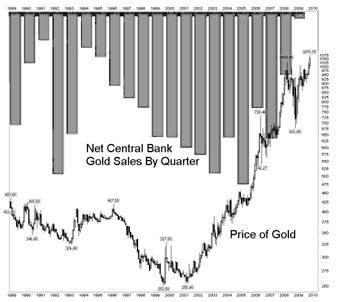
Despite even these herculean suppression efforts, the price of Gold made the journey from $275 to $940 in fairly short order. Surely, there were many gut checks in there; days when the metal lost 5% and the pundits would scream the bubble had burst and it was all over, now please buy some mortgage backed securities. There were some epic struggles like the Battle for $700 shown below.

Through the past nine years the game was played under the rules of central banks and the IMF. In the past two months, countries, large players, and even Gold producers have turned the game on its head. Suddenly everyone wants physical metal, not paper promises. And don’t give us the 90% bars either; we want the good stuff. Suddenly, there are instant buyers for IMF sales that were previously guaranteed to suppress prices. Suddenly an IMF sale sparks a rally to a new all-time high. China tells NY and London banks to take a long stroll off a short pier by issuing a directive to its state banks to walk away from commodity derivatives contracts. And, even more telling, central bank selling has been dropping steadily over the past few years and has been nearly nonexistent in 2009.
And finally, Barrick is closing its infamous hedge book. What was once a 20 million ounce boat anchor on the price of Gold has become a multibillion dollar boat anchor around Barrick’s neck and they’ve finally had enough. The book, now around 3 million ounces will be closed by next year according to Barrick boss Aaron Regent.
Oddly enough, it is not the collapsing US Dollar that is driving this decision, but rather a realization that Gold production likely peaked in 2001 and that even a tripling in exploration budgets across the mining sector has yielded precious little in the way of new discoveries. During this entire time period, demand for Gold has been rising consistently, thanks in no small part to the continual abuse of paper currencies by governments around the globe. The existence of serious supply-demand dislocations immediately rules out the prospect of a speculative bubble. Granted, there are plenty of smaller players who are dabbling in Gold without the slightest bit of understanding as to why they’re doing it. The next correction will undoubtedly send many of them running back to mainstream newsletter writers demanding a refund. After all, they were supposed to be living on the beach in 6 months; the advertisement said so!
The shattering of the old paradigm as it relates to Gold is very similar to a paradigm that was shattered with regard to stock investing nearly a decade ago. In that case, the conventional logic was that the market always went up in the long run. And for 18 years, that had absolutely been the case. Even the crash of 1987 hadn’t done much to derail the bull market. However, when we crossed into the new century, the paper paradigm changed with the major indices going NOWHERE in the past 9 years and change. Yet many conventional financial professionals are still investing as if it were 1995 then blaming the markets for client losses when they should be blaming their own inability to see that our world has changed dramatically.
Unfortunately, another of the very negative sides of the attack on Gold have been the ad hominim attacks on proponents of Gold-backed currencies and those who promote the reality that Gold is in fact real money. The attackers use the term ‘Gold Bug’ to paint a picture of little men sitting in fallout shelters wearing tinfoil hats with stashes of food, water, and enough weapons to make the debate about Iran seem pretty foolish. That just isn’t the way it is. Simply put, a Gold bug is someone who understands Gold’s historical role as money and seeks to educate others in this regard while protecting their own assets from the abuses heaped on paper currencies by their custodians.
So today I, an admitted Gold bug, ask: Now… do we finally have your attention?
Article courtesy of Andrew Sutton of Financial Sense University – Ed Note: Very good article and information.
Euro at $1.50 is ‘disaster’ for Europe
France has given its clearest indication to date that the surging euro is a threat to Europe’s fragile recovery and will not be tolerated for much longer.
“The euro at $1.50 is a disaster for the European economy and industry,” said Henri Guaino, right-hand man of President Nicolas Sarkozy.
The currency has risen 15pc in trade-weighted terms since March, equivalent to six quarter of a percentage-point rises in interest rates. It briefly flirted with $1.50 against the dollar on Tuesday before falling back on intervention fears.
What concerns European policymakers most is the lockstep rise against China’s yuan. Beijing has clamped the yuan firmly to the weak dollar for over a year, quietly benefiting from the export advantages. It accumulated $68bn (£41bn) in reserves in September alone as a side-effect of holding down the currency. Fresh reserves are mostly being invested in eurozone bonds, pushing the euro higher.
French finance minister Christine Lagarde said…
….read more HERE.
-
I know Mike is a very solid investor and respect his opinions very much. So if he says pay attention to this or that - I will.
~ Dale G.
-
I've started managing my own investments so view Michael's site as a one-stop shop from which to get information and perspectives.
~ Dave E.
-
Michael offers easy reading, honest, common sense information that anyone can use in a practical manner.
~ der_al.
-
A sane voice in a scrambled investment world.
~ Ed R.
Inside Edge Pro Contributors

Greg Weldon

Josef Schachter

Tyler Bollhorn

Ryan Irvine

Paul Beattie

Martin Straith

Patrick Ceresna

Mark Leibovit

James Thorne

Victor Adair