
Daily Updates
“If you can tell me something else where the fundamentals are so attractive…I’d be happy to put my money there,” said Jim Rogers, the famed investor and self-made billionaire in a recent interview. “But I don’t know of any other place.”
What’s he talking about? Agricultural commodities like soybeans, wheat and corn.
We begin our analysis with some simple “big picture” truths. The world’s population has more than doubled since 1950 – from about 2.5 billion to 6.7 billion. By 2050, there will be more than 9 billion people on the planet. Almost all of this growth will occur in the emerging markets like China and India. And their populations will all be doing one thing, for sure – eating.
Now, hang on. I know that is a banal insight by itself, but this story has more layers than a tiramisu. After population growth, he second layer is the mix of food eaten, which is important. These undeveloped economies are becoming wealthier. Predictably, as people everywhere have done and continue to do when they have a little more money in their pockets, they change their diets. They spend more on food. The average Chinese person spends 40 cents of every additional dollar earned on food. In India, it’s about 70 cents of every additional dollar. What do they buy?
They buy more meat, more fruits and more vegetables. Their calorie intake rises. That’s why the UN says we’ll need to boost food production by 70% by 2050 – a big task, given increasing restraints on water and quality arable land.
How do we meet that demand? Here the plotlines start to thicken and things get interesting…
Let’s look at soybeans specifically. China is the largest importer of soybeans and has been since 2000. China was once the largest exporter of soybeans, but flipped to a net importer in 1995. It may well be impossible for China to meet its demands for soybeans by producing more of its own. Passport Capital, an astute hedge fund, estimates that in order to grow enough soybeans to become self-sufficient, China would need to cultivate an area about the size of Nebraska.
That looks impossible against China’s arable land base, which has been in decline since 1988 – this despite the fact that China subsidizes agriculture. Another reason is the low level of water resources in China. (See the nearby chart “Who Has Water… And Who Doesn’t.”) Soybeans require a lot of water – 1,500 tonnes of water for one tonne of soybeans.

This chart is telling. Who has lots of water? Brazil. So it is no surprise to discover that the increase in demand for soybeans from China has largely been met by increasing soybean acreage planted in Brazil. (Brazil is the second largest exporter of soybeans in the world, behind the US and ahead of Argentina and Paraguay.)
The easiest way for China to get around its water shortage is to import soybeans. By importing soybeans, Passport calculates that China is effectively importing 14% of its water needs.
It looks likes this trend will continue for quite some time. When you look across the world, arable land per person is in decline. (Arable land simply means land that can be used for farming; it doesn’t mean that it is currently used for farming.) But one nation has more potential for converting arable land into producing farmland than anybody else, by a country mile. It’s Brazil again.
Brazil has a large tropical savanna known as the cerrado. You can think of it as the world’s arable land bank. It’s an area of about 250 million acres – about as big an area as all of the arable land in the US. It gets plenty of rainfall and sunshine. The soil is very old and runs deep. But there is a problem: The soil is nutrient poor. You need to add a lot of potash and phosphate – two key nutrients – to grow soybeans there.
According to estimates by SLC Agricola and Morgan Stanley, the average new acre of farmland in the cerrado requires 14 times the amount of phosphate and three times the amount of potash of a typical American acre. This means that it is expensive to grow grains here. You need a high soybean price to make it worth the effort – and there is more to it than just adding the nutrients. There is road and rail access, for instance. Someone would have to build all that out, too.
So now we are in a position to connect some dots on this story. China’s increasing population and affluence will drive its soybean imports. These imports will come mainly from Brazil. And Brazil, as it converts more arable land to producing farmland, will need a lot more potash and phosphate.
What is true of soybeans is also true of wheat and corn and rice and other agricultural commodities. All of them face the same challenges for water and land. All of them require lots of fertilizer.
I’ve not mentioned the biofuel component. But this is another big pull on demand for grains. The US alone aims to produce 15 billion gallons of ethanol by 2015. All over the world, biofuel demand now competes with “dinner plate” demand for supplies of grain.
This is not a gloom-and-doom scenario. It simply means that there is a lot of support for higher prices for agricultural commodities. Inventory levels still remain low worldwide. Grain prices are all well off their highs. After adjusting for inflation, many of them are as cheap as they’ve been in decades.
This is why Jim Rogers said he likes the agricultural commodities. I couldn’t agree more.
I also mentioned how this idea was hard to kill. In the Great Depression, purchases for jewelry and clothing and the like fell by 50%. But purchases for food – even for meat – held steady. We’ve seen similar patterns in recent busts. In the Asian Crisis of 1998–2001, the demand for food held steady, even while other markets collapsed.
Put it all together and you have a great case for higher grain prices. You also have an environment that is very good for fertilizers – in particular, potash and phosphate.
To be continued in tomorrow’s edition of The Daily Reckoning…
Regards,
Chris Mayer,
for The Daily Reckoning
Sign Up for the FREE Daily Reckoning Flagship e-letter HERE.
Now in its 10th anniversary year, The Daily Reckoning is the flagship e-letter of Baltimore-based financial research firm and publishing group Agora Financial, a subsidiary of Agora Inc.
The Daily Reckoning provides over half a million subscribers with literary economic perspective, global market analysis, and contrarian investment ideas. In short, The Daily Reckoning shows you how to live well even in uncertain times.
Published daily in six countries and three languages, each issue delivers you a feature-length article by a senior member of our team and a guest essay from one of many leading thinkers and nationally acclaimed columnists.
So…what can you expect each day from The Daily Reckoning?
Beginning in the next few days, you’ll get The Daily Reckoning every Monday through Friday in your email inbox, served with uniquely refreshing investment opportunities and paired with a healthy dose of humor and skepticism you’re unlikely to find elsewhere.
It was back in late 1999 that I first contacted Dr. Marc Faber in Hong Kong and sought his advice on investments. I had come across him on a website and bought a book about his past predictions. He was not as well known then outside Asia.
But what I had noticed was that he agreed with me that stock markets looked way overvalued as the Millennium approached and were heading for a crash. We met in his dingy office in Central in Hong Kong and I have been a fan ever since.
Yet a decade later and in my book not much has changed. I was perfectly right not to buy equities in 1999. They have moved sideways only, with some enormous fluctuations, and still look significantly overvalued. Today the S&P is in the mid-80s on price-to-earnings and actually much higher than in 1999.
Miracles do not happen
In March this year global stock markets crashed to a low point. Since then we have seen an almost miraculous recovery in financial markets, and a stabilization of global trade and industrial output at lower levels after a bigger and faster fall than in 1929.
But I don’t believe in miracles. What caused this recovery in financial markets is the aggressive printing of money, particularly in the US and UK via so-called quantitative easing. Equities have risen on this tidal wave of liquidity and currencies have devalued.
The result is a monstrous bubble in financial markets, bigger than in 1999 before the dot-com collapse. Dr. Faber has also noticed this phenomenon but appears convinced that money printing will continue to pump up the bubble on each correction, until a final collapse on some distant day.
I remain overly cautious perhaps, although I have made several great investments in the past decade unlike those who invested in the stock market in 1999. I think when you can identify an obvious bubble then it is best to be humble and stand aside, and not hope that you will be closest to the exit door when it blows up.
Having faith in the Fed
My faith in the ability of the Fed and US government to permanently deny gravity is also limited. I am a non-believer. Dr. Faber also heaps scorn on Mr. Bernanke and yet appears blinded by his charisma into thinking he can always make black turn into white.
What if the rally since March turns out to be part of the phase four down cycle described by Dr. Faber in his own investment classic ‘Tomorrow’s Gold’? Then it is a false recovery based on false optimism about a coming recovery, when in reality a further downturn is coming as the stimulus package and low interest rates become unsustainable.
Liquidity fueled rallies are notoriously fickle. Like J.P. Morgan’s taxi on a rainy Friday night in New York it tends not to be there when you need it most.
So if you put money into equities for 2010 then you are investing in a market completely miss-valued on fundamentals and prompt up by a liquidity bubble that is bound to ultimately pop.
The cunning plan of the banks is apparently to shift their bad debts into equity before the market crashes, thereby finally dumping their bad debts on to shareholders. If Marc Faber is right about the Fed’s ability to keep the bubble going, they might pull it off.
Cash and gold
Cash or gold sound a better investment, for in equities you risk losing a great deal of money and the upside will be limited. As in late 1999 I would sooner play safe and invest to make real money when asset prices are very much cheaper. That opportunity will occur again but only after the equity bubble has blown up.
Is it not odd that equity markets are leveraging up again just as business around the world is de-leveraging? That alone ought to keep you out of equities. For it means real business is still contracting. And do you want to buy shares in a contracting business? Why no of course not, and yet that is exactly what you are doing if you buy equities now, so why do it?
Stock markets around the world also still look highly valued by historical standards, even that bubble of 1999 has never fully deflated. In the past stock markets have faced long periods of much lower price-to-earnings ratios, and that is not where you will want to be invested for future capital gains.
About Peter Cooper:
Oxford University educated financial journalist Peter Cooper found himself made redundant by Emap plc in London in the mid-1990s and decided to rebuild his career in Dubai as launch editor of the pioneering magazine Gulf Business. He returned briefly to London in 1999 to complete his first book, a history of the Bovis construction group.
Then in 2000 he went back to Dubai to become an Internet entrepreneur, just as the dot-com market crashed. But he stumbled across the opportunity to become a partner in www.ameinfo.com, which later became the Middle East’s leading English language business news website.
Over the course of the next seven years he had a ringside seat as editor-in-chief writing about the remarkable transformation of Dubai into a global business and financial hub city. At the same time www.ameinfo.com prospered and was sold in 2006 to Emap plc for $27 million, completing the career circle back to where it began a decade earlier.
He remains a lively commentator and columnist as a freelance journalist based in Dubai and travels extensively each summer with his wife Svetlana. His financial blog www.arabianmoney.net is attracting increasing attention with its focus on investment in gold and silver as a means of prospering during a time of great consumer price inflation and asset price deflation.
Quotable
“The westerners who thought they knew what they were doing could use many such
lessons in how the world works.
“For example, I was recently told by an investment dealer how the whole mess could
have been avoided if only the ruler of Dubai had agreed to offer a state guarantee for all
the Dubai World paper. Regrettably, he apparently had a better understanding of the
value of empty buildings in the desert than they did.” – John Dizard
FX Trading – Contributing thoughts …
I’ve included a link at the end of this article where Jack is talking to HoweStreet.com …
discussing the expectations for the US dollar and its counterparts, as well as our
perspective on Japan, UK, Eurozone and the potential for global market fallout from
Greece. Be sure to listen in. But first …
….read more HERE

Gold took a beating Friday, closing down more than 4%. That’s the biggest one-day decline in 21 months.
The sell-off was sparked by a better-than-expected jobs report. Understandably, some readers may be scratching their heads at the following equation:
more jobs = lower gold prices
How could that be? Because Wall Street interpreted the jobs data as confirmation that we’ve turned the corner. If the Fed doesn’t have to print more money, inflation will be tamer. And since gold is essentially insurance against Armageddon and inflation… it fell.
It’s a bit early to be declaring victory, though. The real test comes when the Fed starts tightening. They are propping up housing and stock markets via massive asset purchases (mortgage-backed securities and the like). And that’s not going to change any time soon, with 25% of homeowners underwater on their loans…
There’s simply no way the Fed can stop propping up the market. The wave of option ARM and Alt-A liar loan resets doesn’t peak until 2013. Take a look:
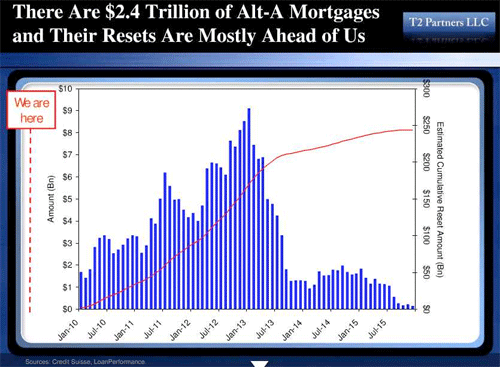
f the current government programs are allowed to expire, the market reaction will be violent. And our economic leaders have shown that they’re willing to do almost anything to prop up the markets.
For example, what would happen to the housing market if the Fed stopped buying all that Freddie and Fannie debt? (Debt to the tune of $1.25 trillion to be bought up by April, when the current plan is set to expire.)
Well, there would be no market for mortgages, and rates would shoot up. Housing prices would collapse and defaults would skyrocket.
So will the Feds let this happen? Doubtful. They’ll step in and attempt to fix the economy. And we know how they “fix” things: more debt, more printing… Inflation is inevitable.
Those betting on a quick and sustainable recovery will be disappointed. And I’ll take the other side of that bet, when the time comes.
It’s also worth noting that the jobs report wasn’t even that great: 52,000 of the jobs added were temporary positions, brought in for the holiday rush. An increase in temp jobs sometimes signals the start of a rebound in employment. Those workers are let go in January and February… it happens every year.
Another issue is that the November unemployment data is preliminary. How many of us were happily surprised by Q3’s 3.5% GDP growth, only to see it revised to 2.7%?
Inviting Inflation
The bottom line is that Bernanke and crew actually want inflation. It’s easier than the alternatives: raising taxes or slashing spending. And it will help erase debts. It will also wipe out the savers and reward the borrowers — but that seems to be the path we’re on, like it or not.
Besides, do you really think they will allow America’s debt to be paid off with dollars worth more rather than less?
Of course not. Devaluing our currency and printing money are part of a strategy. A reckless and morally hazardous one, but still a strategy.
So that’s why I still am bullish on precious metals. I’m hoping for a nice pullback in gold and silver. It’ll be a great buying opportunity. Once everyone realizes that the Fed’s printing presses are just getting warmed up, it’ll be off to the races again.
I’ll be looking to snap up some junior gold miners on a pullback. If you’re looking for specific names, my colleague Greg McCoach is one of the best in the business. He uncovers tiny miners with big potential, including one company whose stock launches 2% for every 1% gold prices jump. He calls it “gold’s doubling effect” — and you can read more about this profit opportunity right here.
Until next time,
Adam Sharp
Analyst, Wealth Daily
You can subscribe to the FREE Wealth Daily e-letter HERE.
Ben S. Bernanke doesn’t know how lucky he is. Tongue-lashings from Bernie Sanders, the populist senator from Vermont, are one thing. The hangman’s noose is another. Section 19 of this country’s founding monetary legislation, the Coinage Act of 1792, prescribed the death penalty for any official who fraudulently debased the people’s money. Was the massive printing of dollar bills to lift Wall Street (and the rest of us, too) off the rocks last year a kind of fraud? If the U.S. Senate so determines, it may send Mr. Bernanke back home to Princeton. But not even Ron Paul, the Texas Republican sponsor of a bill to subject the Fed to periodic congressional audits, is calling for the Federal Reserve chairman’s head.
I wonder, though, just how far we have really come in the past 200-odd years. To give modernity its due, the dollar has cut a swath in the world. There’s no greater success story in the long history of money than the common greenback. Of no intrinsic value, collateralized by nothing, it passes from hand to trusting hand the world over. More than half of the $923 billion’s worth of currency in circulation is in the possession of foreigners.
In ancient times, the solidus circulated far and wide. But it was a tangible thing, a gold coin struck by the Byzantine Empire. Between Waterloo and the Great Depression, the pound sterling ruled the roost. But it was convertible into gold—slip your bank notes through a teller’s window and the Bank of England would return the appropriate number of gold sovereigns. The dollar is faith-based. There’s nothing behind it but Congress.
But now the world is losing faith, as well it might. It’s not that the dollar is overvalued—economists at Deutsche Bank estimate it’s 20% too cheap against the euro. The problem lies with its management. The greenback is a glorious old brand that’s looking more and more like General Motors.
You get the strong impression that Mr. Bernanke fails to appreciate the tenuousness of the situation—fails to understand that the pure paper dollar is a contrivance only 38 years old, brand new, really, and that the experiment may yet come to naught. Indeed, history and mathematics agree that it will certainly come to naught. Paper currencies are wasting assets. In time, they lose all their value. Persistent inflation at even seemingly trifling amounts adds up over the course of half a century. Before you know it, that bill in your wallet won’t buy a pack of gum.
For most of this country’s history, the dollar was exchangeable into gold or silver. “Sound” money was the kind that rang when you dropped it on a counter. For a long time, the rate of exchange was an ounce of gold for $20.67. Following the Roosevelt devaluation of 1933, the rate of exchange became an ounce of gold for $35. After 1933, only foreign governments and central banks were privileged to swap unwanted paper for gold, and most of these official institutions refrained from asking (after 1946, it seemed inadvisable to antagonize the very superpower that was standing between them and the Soviet Union). By the late 1960s, however, some of these overseas dollar holders, notably France, began to clamor for gold. They were well-advised to do so, dollars being in demonstrable surplus. President Richard Nixon solved that problem in August 1971 by suspending convertibility altogether. From that day to this, in the words of John Exter, Citibanker and monetary critic, a Federal Reserve “note” has been an “IOU nothing.”
To understand the scrape we are in, it may help, a little, to understand the system we left behind. A proper gold standard was a well-oiled machine. The metal actually moved and, so moving, checked what are politely known today as “imbalances.” Say a certain baseball-loving North American country were running a persistent trade deficit. Under the monetary system we don’t have and which only a few are yet even talking about instituting, the deficit country would remit to its creditors not pieces of easily duplicable paper but scarce gold bars. Gold was money—is, in fact, still money—and the loss would set in train a series of painful but necessary adjustments in the country that had been watching baseball instead of making things to sell. Interest rates would rise in that deficit country. Its prices would fall, its credit would be curtailed, its exports would increase and its imports decrease. At length, the deficit country would be restored to something like competitive trim. The gold would come sailing back to where it started. As it is today, dollars are piled higher and higher in the vaults of America’s Asian creditors. There’s no adjustment mechanism, only recriminations and the first suggestion that, from the creditors’ point of view, enough is enough.
So in 1971, the last remnants of the gold standard were erased. And a good thing, too, some economists maintain. The high starched collar of a gold standard prolonged the Great Depression, they charge; it would likely have deepened our Great Recession, too. Virtue’s the thing for prosperity, they say; in times of trouble, give us the Ben S. Bernanke school of money conjuring. There are many troubles with this notion. For one thing, there is no single gold standard. The version in place in the 1920s, known as the gold-exchange standard, was almost as deeply flawed as the post-1971 paper-dollar system. As for the Great Recession, the Bernanke method itself was a leading cause of our troubles. Constrained by the discipline of a convertible currency, the U.S. would have had to undergo the salutary, unpleasant process described above to cure its trade deficit. But that process of correction would—I am going to speculate—have saved us from the near-death financial experience of 2008. Under a properly functioning gold standard, the U.S. would not have been able to borrow itself to the threshold of the poorhouse.
Anyway, starting in the early 1970s, American monetary policy came to resemble a game of tennis without the net. Relieved of the irksome inhibition of gold convertibility, the Fed could stop worrying about the French. To be sure, it still had Congress to answer to, and the financial markets, as well. But no more could foreigners come calling for the collateral behind the dollar, because there was none. The nets came down on Wall Street, too. As the idea took hold that the Fed could meet any serious crisis by carpeting the nation with dollar bills, bankers and brokers took more risks. New forms of business organization encouraged more borrowing. New inflationary vistas opened.
….read more HERE. (start just below the images of the coins on the left)
-
I know Mike is a very solid investor and respect his opinions very much. So if he says pay attention to this or that - I will.
~ Dale G.
-
I've started managing my own investments so view Michael's site as a one-stop shop from which to get information and perspectives.
~ Dave E.
-
Michael offers easy reading, honest, common sense information that anyone can use in a practical manner.
~ der_al.
-
A sane voice in a scrambled investment world.
~ Ed R.
Inside Edge Pro Contributors

Greg Weldon

Josef Schachter

Tyler Bollhorn

Ryan Irvine

Paul Beattie

Martin Straith

Patrick Ceresna

Mark Leibovit

James Thorne

Victor Adair