
Daily Updates
Donald Coxe pitches the most outrageous, politically incorrect investment idea of all: How to profit from global cooling
Last Monday, a dozen or so environmentalists went to Chicago’s financial district, wandered into one of its busiest intersections, laid down, and locked arms. Their purpose in forcing a couple of hours of gridlock, and causing cars to spew extra carbon emissions, was to complain about U.S. policy on carbon emissions.
It is the kind of scene that bemuses Donald Coxe. Not so long ago, he was one of Bay Street’s best-known investment strategists, famous for his strong convictions, his right-of-Reagan political leanings and his Conrad-Black-esque vocabulary (how many financial pros can use “Rhadamanthine” in a sentence?). Oh, and for making people money, too.
Today, he operates in a somewhat dimmer spotlight, thinking and writing about the world from a perch in the very building outside of which those protesters caused that traffic jam. But he still has an audience – most notably at Bank of Montreal, his former employer, which still pays for and distributes his research – and still knows how to capture attention.
So as the world’s policy makers converge on Copenhagen to talk about the warming planet, Mr. Coxe continues to pitch the most outrageous, politically incorrect investment idea of all:
How to profit from global cooling.
……read more HERE.
A Conversation with John
Unemployment Positives
New York, London, Monaco, and Zurich
This week I am in New York, and have a whirlwind of meetings (and I admit, a lot of fun on the side) and not much time to write. I have been saving today’s letter for a month or so, for a time such as this. Damien Hoffman of the Wall Street Cheat Sheet interviewed me and posted the transcript on his web site. I thought it was one of the better interviews I have done recently, and so it is this week’s Thoughts from the Frontline. In addition to the wide-ranging economic questions, he asks for my thoughts on how one becomes an investment writer. I often demur when asked that question (what do I know?), but did my best to answer this time. I think you will enjoy the letter. (By the way, he does a lot of interesting interviews, which he posts for free on his web site at www.wallstcheatsheet.com.)
…..read it all HERE.
Please find enclosed the opening keynote presentation for The AGORACOM Online Gold & Commodities Conference. Peter Grandich, Chief Commentator of AGORACOM, goes in-depth in an interview with me to discuss The End Game – How the $USD, Interest Rates and Gold Will Play Out. It is the question on everybody’s mind. We all now know how we got here – but the more important question is “where are we going?”
Grandich, as always, doesn’t pull any punches and doesn’t sit on the fence. In fact, he publicly announces a specific prediction about the markets for the very first time.
Please click on the image below to launch the presentation in a new browser window. The presentation will not launch prior to 10:30 AM EST. Upon completion of the interview, close the window and return here to post your questions and comments. To do so, please click on the “Comments” button at the bottom of this post.. Peter is traveling today, so responses will be sporadic.
CONFERENCE LINKS: Home Page – Presenting Companies – Keynote Speakers – Conference Schedule
PROFILE
Peter Grandich, Chief Commentator of AGORACOM.com, is an internationally-acclaimed financial expert who has made a 25-plus-year career out of his knack for uncannily-accurate market predictions. Labeled the “Wall Street Whiz Kid” by Good Morning America, Grandich gained national notoriety by being among the very few who not only forecasted the 1987 stock market crash just weeks before it happened, but on the very next day he predicted that within two years the market would reach a new all-time high – which it did.
Proving his market calls are no fluke, The Wall Street Journal recently included Peter in an article about the few analysts that picked the March 2009 lows. What his readers know is that Peter also called the October 2007 stock market high on his blog and went short on the entire market.
His ability to analyze and forecast financial happenings has resulted in hundreds of media interviews including GMA, Neil Cavuto’s Your World on Fox News, The Kudlow Report on CNBC, and every major financial media outlet including Wall Street Journal, Barron’s, Financial Post, Globe and Mail, US News & World Report, New York Times, MarketWatch, Business News Network and dozens more. He has spoken at investment conferences around the globe and is regarded as one of the world’s foremost market strategists. He has edited and published four widely-read investment newsletters and contributed to numerous national publications.
Peter is also the founder of Trinity Financial Sports & Entertainment Management a firm with a Christian perspective which he started in 2001 with Lee Rouson, former NY Giant and two-time Super Bowl champion. The firm offers services to celebrities, athletes and average folks.
He was also the founder and managing member of Grandich Publications, which was acquired by AGORACOM in 2009. In his first full year with AGORACOM, over 190,000 investors visited Peter’s blog 1.1 million times. Grandich also provides a variety of services to publicly-held corporations on a compensation basis.
Peter Grandich is a member of the National Association of Christian Financial Consultants, and a long-standing member of The New York Society of Security Analysts and The Society of Quantitative Analysts.
You can follow his free public commentary via his blog or Twitter
Regards,
George
Ed Note:
Money Talks had the honor of having Peter Grandich explain his trading approach at this years AllStar Trading Super Summit. Click HERE or on the image for a copy of Peter’s and other’s Timeless Advice.

……. Not So Good Prices
After hitting a 14-month high, Toronto’s main index ended the week with a thud, followed by a sharp Friday sell-off in gold.
The new 14-month high and the fact the S&P 500 is currently up over 62 per cent from its March lows has us pausing to reflect. Most market players are feeling quite good about themselves right now and the bullish sentiment continues to make the value investor in us cringe just a bit.
For illustration purposes, we look at one of our top Focus BUY stocks over the past two years – Alliance Grain Traders Inc. (TSE: AGT). In August of 2007, we initially recommended the company, a Saskatchewan-based processor of specialty crops (lentils, peas, chickpeas, beans, and canary seed), in the $6.65 range. Subsequently, we issued another BUY on the company earlier this year (March) in the $8.00 range. Powered by solid quarterly numbers and a recent acquisition, the stock has surged to recently close at above the $26.00 level.
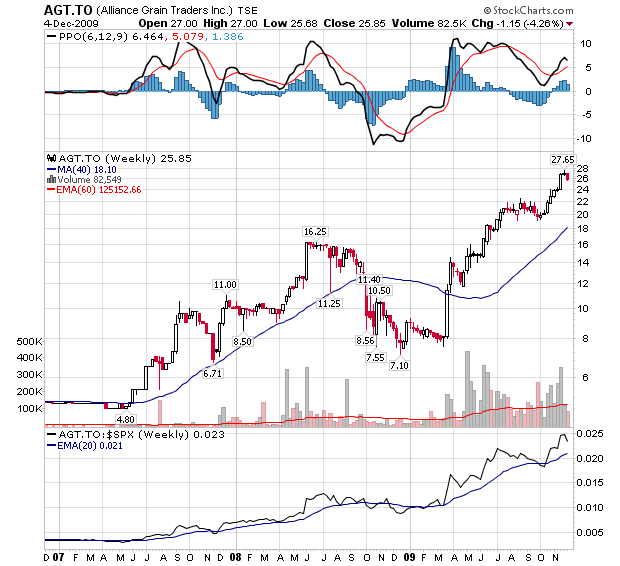
Alliance Grain is what we would classify as a great, well-run company which displayed tremendous growth financially, as well as in its stock price over the past year. But, with its shares up 290 per cent since our originally recommendation and 225 per cent since March of this year, as revenues and earnings have tracked down in consecutive quarters; we do not want to get too greedy. A great company – yes, but in the near term, it is no longer as cheap as it once was, so one might be prudent to take a careful look at their current entry points on many companies at present.
Given the market’s strong move in the face of some less than impressive raw data, our universe of Small-Cap GARP stocks – in this case the “G” or growth can be substituted for “great companies” at a reasonable price – is shrinking. Yes, we can find great companies, but do they continue to trade at reasonable prices?
In many cases, no.
Looniversity – Market Cap vs. Enterprise Value
Market cap or capitalization and enterprise value (EV) are two different methods of “valuing” a company. To identify the differences between the two, we start by defining Market Cap. Essentially, it is the dollar market value of all of a company’s outstanding shares. Market cap is calculated by multiplying a company’s shares outstanding by the current market price of one share. If a company has 25 million shares outstanding, each with a market value of $100, the company’s market capitalization is $2.5 billion (35,000,000 x $100 per share). The investment community uses this figure to determining a company’s size, as opposed to sales or total asset figures.
Enterprise value is more of a measurement of a company’s value. It is calculated as market cap plus debt, minority interest and preferred shares, minus total cash and cash equivalents. Think of enterprise value as a theoretical takeover price. In the event of a buyout, an acquirer would have to take on the company’s debt, but would pocket its cash. EV differs significantly from simple market capitalization in several ways and many consider it to be a more accurate representation of a firm’s value. The value of a firm’s debt, for example, would need to be paid by the buyer when taking over a company, thus EV provides a much more accurate takeover valuation because it includes debt in its value calculation.
Put it to Us?
Q. What are the top three things that a bank will look at when I apply for a loan?
– Riley Morgan; Calgary, Alberta
A. In the end, most banks are not going to advance you a cent if you do not have the means to pay it back. There are three main things about your financial situation a bank will typically consider.
1) Collateral – What major assets do you have that the bank can seize if you default on your loan? Typical collateral includes your home or your car. This will also take into consideration what you are using the borrowed funds for, such as a house, which would be collateral to the loan.
2) Credit – Your credit worthiness or rating comes into play when you apply for a loan. If you have bad credit, getting a loan is going to be difficult unless you are willing to accept less attractive loan terms (like higher interest rates and lowered limits).
3) Income – Your lender is going to want to make sure that you can afford to make payments on your loan. Higher income translates to lenders being more comfortable with letting you borrow money.
KeyStone -Why Subscribe?

“Hu Xiaolian, the vice-governor of the central bank, said Beijing would not buy gold indiscriminately.”
“However, officials in Beijing are aware that China’s $2.3 trillion reserves are now so enormous that the central bank cannot buy much gold without distorting the price, so they have adopted a de facto policy of buying in a calibrated fashion each time prices fall back to their rising trend line – “buying the dips” in trading parlance. Experts say that China is putting a floor under the gold price but does not chase rallies once they are under way.”
….read more HERE.
-
I know Mike is a very solid investor and respect his opinions very much. So if he says pay attention to this or that - I will.
~ Dale G.
-
I've started managing my own investments so view Michael's site as a one-stop shop from which to get information and perspectives.
~ Dave E.
-
Michael offers easy reading, honest, common sense information that anyone can use in a practical manner.
~ der_al.
-
A sane voice in a scrambled investment world.
~ Ed R.
Inside Edge Pro Contributors

Greg Weldon

Josef Schachter

Tyler Bollhorn

Ryan Irvine

Paul Beattie

Martin Straith

Patrick Ceresna

Mark Leibovit

James Thorne

Victor Adair