
Daily Updates
…. Equities Not Too Shabby Either; Inflation Concerns Remain
John Paulson… super bull? Goodness. To some degree I find “whale watching” a bit overrated, but after being the most obvious winner of the mortgage meltdown (Ed Note: John Paulson is famous for scoring about $20 billion of profits between 2007 and early 2009 wagering against the housing market and financial companies), and then piling into gold ahead of a huge run (read the Nov. 19th/09 Wall Street Journal article that position HERE. ) … Paulson’s moves are watched by the investment world very closely. One of the hottest investors on the planet is now chock full of bonds – especially the moral hazard kind (i.e. backstopped by US government). And has his highest net long exposure in “a long time”.
No one will be correct forever, but it does make you stand notice…especially since his success is based on actually making big macro calls rather than building an army of computers co-located as close as possible to a stock exchange, so he can surge ahead of your order by 4/1000ths of a second to make mad money.
…..read more HERE
I’d love to rattleoff a great long piece dissecting the Pre-Budget Report for you this morning, but I’m afraid there’s not much to say.
Absolutely nothing of consequence will be tackled until after the election. At that point, assuming things stay the same, we’ll all pay more tax. We’ll probably end up with worse public services (unions are unlikely to take the proposed pay cuts sitting down, for one thing). And our pensions will be primary targets for yet more government pillaging.
That’s the short version – I’ll leave it to my colleague David Stevenson to go into more detail on our blogs page: Darling ignores Britain’s biggest problem – debt. But for now, let’s look at what else was going on in the world while Alistair Darling was making his party political broadcast from the Pre-Budget pulpit…
Fear returns to global markets
While Britain was gamely ignoring its own nasty-looking budget deficit, global jitters continued over more obviously troubled countries.
Stock markets across Europe ended the day lower, after Spain had its credit rating outlook downgraded from ‘stable’ to ‘negative’ by ratings agency Standard & Poor’s. In other words, the agency didn’t actually slash Spain’s credit rating, but it’s getting closer to doing so. S&P reckons that Spain’s government hasn’t yet done enough to tackle the state of its finances or the economy, and so both will deteriorate further than expected.
Meanwhile, Greece – which is in a far worse state – is under heavy pressure to deal with its deficits (you can read more on Greece’s problems here: The biggest threat for 2010 – countries going bust). And while Darling was trying to distract the electorate with taxes on bankers’ bonuses, his counterpart over in Ireland was outlining one of the most brutal budgets his beleaguered country has ever seen.
In his second emergency budget in eight months, Irish finance minister Brian Lenihan cut public sector pay by up to 6%. Benefits were also cut. And there was even a 20% pay cut for the Taoiseach. (Although the fact that the head of the Irish government is among the best paid leaders in the free world, does give you some idea of why Ireland needs to cut public sector pay so sharply now). Ireland’s economy is set to shrink by 7.5% this year, but Lenihan hopes that the cuts should prevent the budget deficit from rising above 12% of GDP – the EU has given Ireland until 2014 to get its deficit back below 3%.
Dubai’s problems aren’t going away
….read more HERE.
Investors in oil, metals and grains shouldn’t worry too much about selloffs in these markets as the vast sums of money being printed around the world will take prices higher, commodities bull Jim Rogers said.
“If the world economy gets better, commodities are very good place to be in,” Rogers told the Reuters Investment Summit in New York on Wednesday.
“Even if the world economy does not improve, commodities are still a fabulous place to be because every government is printing money now. Throughout history, when countries printed money, commodity prices rose,” Rogers said.
Commodity markets have stumbled since the start of December after debt woes in Dubai and Europe rekindled global financial fears and drove up the U.S. dollar, whose weakness in recent months had contributed sharply to prices.
U.S. crude oil has lost about 10 percent of its value since the month began.

Wheat futures have fallen about 10 percent
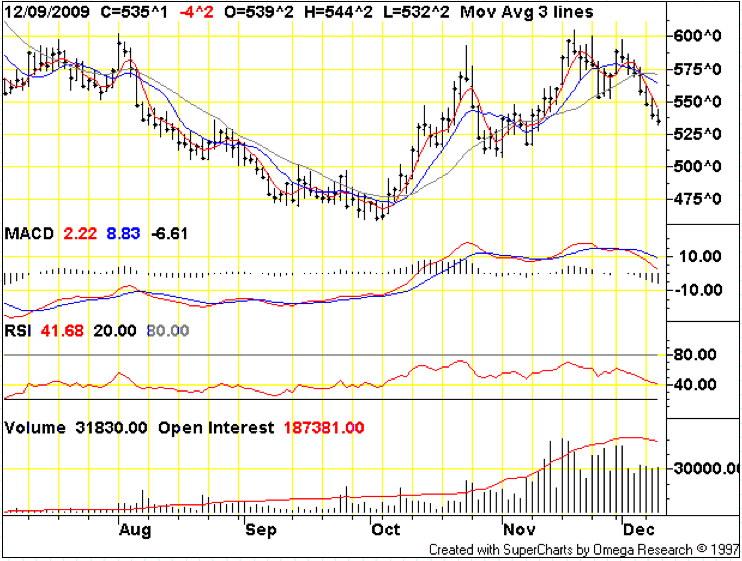
while gold futures have shed about 5 percent.
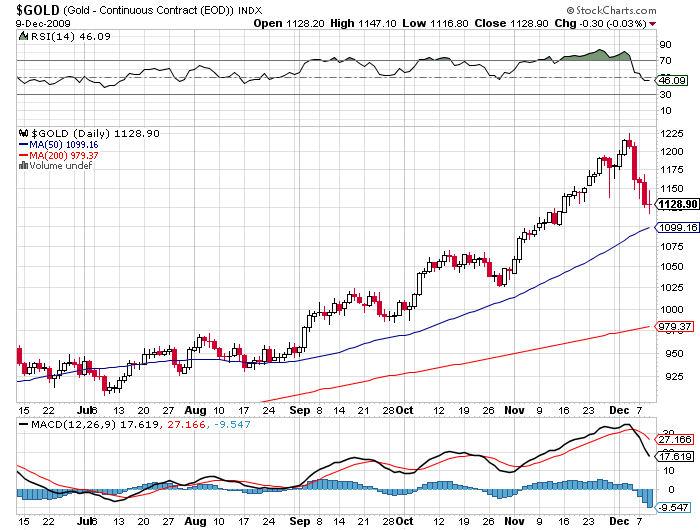
Analysts said the selloff may continue into the year-end as markets react to burgeoning stockpiles of raw materials that indicate lagging demand and traders resort to book squaring before the year is over.
But Rogers, a long-term investor in commodities, said market corrections come and go and another major upward cycle was probably underway in commodities.
“I have learned the hard way not to sell something short in a cyclical bull market. I’m not buying anything now, but if I am buying, I’ll be buying agriculture, silver, natural gas, palladium and all things that are very depressed,” he said.
“I wouldn’t buy gold at these prices but I also wouldn’t sell the gold I own”, he said. Despite their recent correction, gold futures haven’t fallen too far below record highs of nearly $1,230 an ounce.
U.S. gold futures settled just above $1,120 on Wednesday.
While many investors were surprised by the forceful rebound seen in commodities seen just months after the recession, Rogers said he was more surprised with last year’s plunge, which he described as an “artificial reaction” to the collapse of Lehman Brothers and the financial distress at AIG.
“Prices may have come up too much and too fast and there may be a need for a correction. But is that the end of the bull market? Hardly. Oil has gone down 40 or 50 percent four times since 1999. It did not end the bull market in oil.”
As an example, he cited the stock market crash of 1987 when equity prices around the world fell between 40 and 80 percent. “Those who didn’t sell out later witnessed some markets rising a 1,000 percent.”
While his approach to investing was almost always long-term, Rogers showed he could also have a shorter view on an asset if needed, and singled out the dollar as one.
“I’m still very pessimistic on the dollar but decided to accumulate some dollars over the last few months because there were too many dollar bears. When there are too many bears and you can expect some kind a rally in the dollar.”
Although he describes himself as a “horrible market timer”, the Rogers Commodity Index .RICIX set up by Rogers is up almost 30 percent this year, outperforming the more high-profile Reuters-Jefferies CRB commodities index .CRB, which is up about 17 percent.
Ed Note: Chris Vermulen saw the correction in Gold coming in the posting “Exhaustion – a breather is due” commenting “Don’t get me wrong, I don’t think gold is going to crash, I just think we could get a 10% correction before moving much higher”. Full article HERE.
ETF trading has made it so easy for traders and investors to get maximum exposure to the entire market without the high fees of mutual funds and manager. There are now etfs covering almost every investment type whether it’s stocks, indexes, sectors, commodities, bonds, real estate, currencies etc…
In this short report I will quickly show a few charts on what is happening for precious metals and energy.
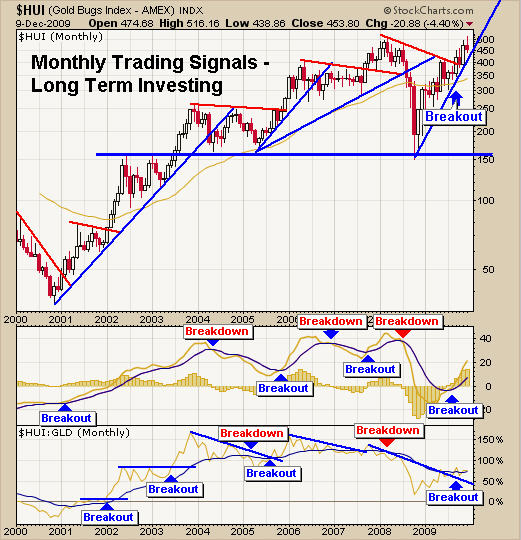
HUI – Gold Stock
This monthly chart of the gold stocks index you can see how easy it is to trade the market and avoid large sell offs when using technical analysis. Currently gold stocks are in a bull market, testing the 2008 highs. Until we are proven wrong buying stocks after a pullback is a winning strategy.
Trading the GLD ETF
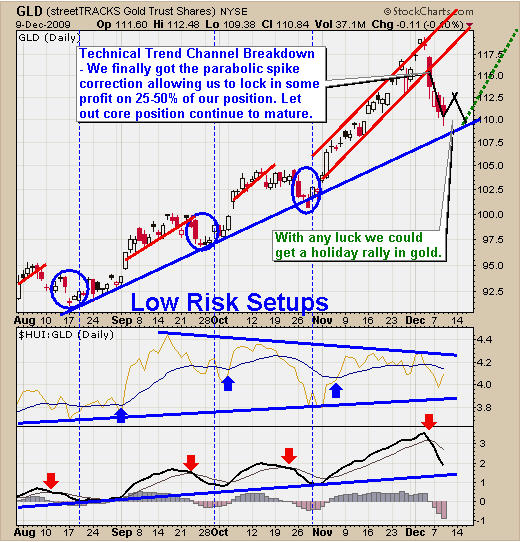
We have been in the GLD etf for a few months as we ride this bull to new highs. This chart clearly shows how buying dips in a bull market can really pay off. I do have certain criteria which must be met before buying dips so I know the odds are in my favor.
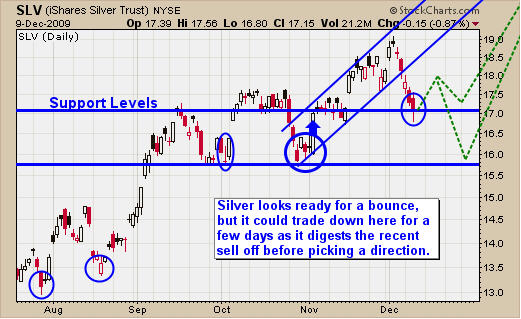
ETF Trade Silver
Silver along with gold and oil are looking ready for an oversold bounce. I don’t think prices will jump and rally higher right out of the gate but eventually I feel the will head higher.
Crude Oil Fund Trade
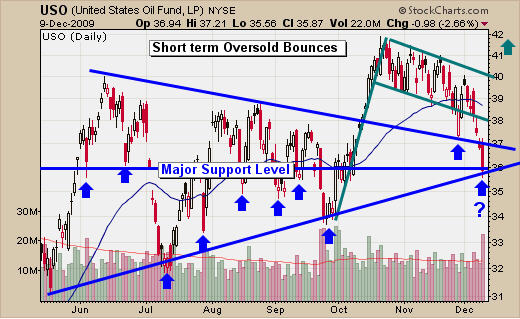
Crude oil looks prime for the picking. It is currently oversold and testing 2 support levels. The downside momentum is still strong so this selling could last another 1-2 days but I’m expecting it to soon.
This is not a low risk setup. This is more of a short term aggressive contrarian play. For those of you who like heart pounding plays.
Natural Gas Fund Chart
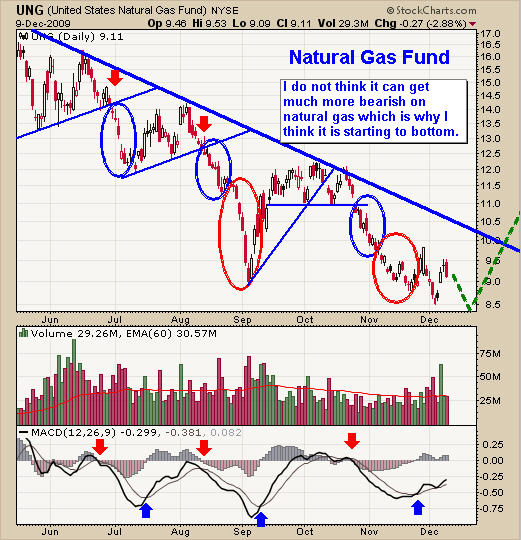
Natural gas has been taking its time to bottom. Virtually every bottom picker has been burned this year. I am starting to hear everyone get more bearish on it again which is great! It should bottom any day then! LOL….
Seriously it cannot get much more bearish for gas. We don’t have enough space to store it and companies are finding more natural gas in the ground every day. Because it sounds like a terrible investment it must be getting close to a bottom. If this is the start of a flat basing pattern, then I expect it could drag out for a few months before actually making a nice move up.
Dow Jones DIA ETF
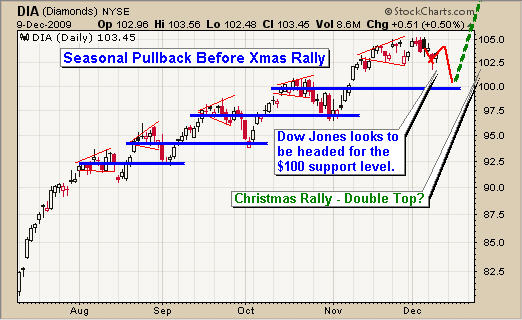
The Dow looks similar to gold and silver. I feel we are ready for a 1-2 day bounce then we go a little lower to shake traders out of the market before heading higher.
ETF Trading Conclusion:
Gold stocks and the broad market are in a bull market. The recent pullback has many traders worried. I think this an opportunity to bet into some positions before the next rally. Buying the dips in a bull market is a low risk trade until proven wrong. I think we still have more of a pullback yet but then we could have a very profitable year end Xmas rally.
Natural Gas is just bumping along bottom I think. Not expecting any trade for a few weeks anyways.
Crude Oil looks like its ready for a move whether it is a 1-2 day bounce or the start of a new leg higher. If you loot at late Sept you can see USO broke down on heavy volume shaking most traders out of their positions just before the next leg higher, and this is what I feel it is doing now. Only time will tell.
Let’s see how the second half of this week unfolds.
Sign Up & Get FREE Technical Trading Charts HERE.
My name is Chris Vermeulen, founder of TheGoldAndOilGuy newsletter. I provide you with unparalleled trading newsletter with charts, signals and email support. Unlike other investing newsletters, I’m a one man show. That’s because I don’t want some hired hand giving you advice while I take it easy on a beach somewhere. You ALWAYS get precise, valuable information DIRECTLY from ME.
Interview: Trading Expert Helps Investors Learn the Ropes
Testimonial: Chris, Your reports are technical and thoughtful and above all you are cautious. I learn something from every report. WH Toronto.
I believe this is the perfect trading service for active traders who want a conservative yet highly profitable trading strategy and signals. The GLD Gold exchange traded fund allows for very accurate signals when used along with the price of gold, HUI, USD, bullish percent charts and gold stocks. I also focus on USO, UNG, XLE, and XEG.TO energy funds. When these factors are used together with technical analysis and my proven trading strategy, trades become very CLEAR and SIMPLE to execute. My strategy makes your trades extremely accurate with very little downside risk.
“Americans are in a distinctly foul mood these days” – “And who do I blame? I blame the Fed and its creation of “ever-more fiat money,” and I blame particularly Alan Greenspan and his professorial understudy, Ben. S. Bernanke, both of whom know better.” – Richard Russell 12/08/09
Last week, we witnessed Ben Bernanke’s Senate confirmation hearings for a second term as Fed Chairman. The air was thick with hypocrisy, as Senators vied with each other to cast blame on the Fed Chairman for the fiscal mistakes of the Congress. As an overtly politicized figure who has looked to bolster the poll numbers of successive Administrations, Bernanke certainly should shoulder a large share of the blame for steering the United States towards the brink of bankruptcy; however, he did not act alone. Ironically, many of his co-conspirators are currently his harshest critics.
The truth is that if there were no debt from Congressional deficit spending, there would be nothing for the Fed to ‘monetize’ with the printing press. By behaving as the voters’ ‘best friend,’ delivering both low taxes and generous entitlements, Congress forced the Fed to play the disciplinarian. Except, not wanting to spoil the party, it didn’t. Ben Bernanke, like his predecessor Alan Greenspan, is an intelligent man who knows exactly where reckless spending will lead the country. Yet he refused to hit the brakes.
When former President Nixon broke the last ties between the U.S. dollar and gold, he opened the floodgates to Congressional abuse. Before the ‘gold window’ was closed, if the federal government ran up too much debt, other countries would start trading their reserves for our gold. Afterward, these creditors were left in something of a pickle: they held huge dollar reserves (built up on the belief that it was ‘as good as gold’) which now had a value dependent on being able to trade with Americans. This translated into a huge subsidy for America – quickly eaten up by a guns-and-butter spending philosophy directed by Congress.
Recently, under pressure from Wall Street, Congress repealed key provisions of the Glass-Steagall Act. Glass-Steagall created bank deposit insurance through the FDIC, while putting in place safeguards to prevent these now risk-free deposits from being used in speculative investments. Repealing Glass-Steagall without repealing deposit insurance created an environment of private gains and taxpayer losses.
Moreover, in an effort to sell an ‘American dream’ based on homeownership, Congress subsidized and guaranteed residential mortgages through Fannie Mae, Freddie Mac, and the FHA. This created a perfect speculative play for the combined investment/commercial bank behemoths emerging from the ashes of Glass-Steagall.
These major transgressions of government lie at the heart of the economic decline and financial crisis that now face America. They were the direct fault of Congress, not the Fed.
The main charge against the Fed is that it has ignored its vital independence. This began under the stewardship of Chairman Alan Greenspan and continued under his protégé, Ben Bernanke. Both Greenspan and Bernanke could fairly be labeled as ‘inflationists,’ in that they favor inflation over recession.
Thanks to Nixon, the Fed can create paper money out of thin air by means of book entries in the accounts of Fed member banks. Over the turn of the century, Greenspan, assisted by Bernanke, used this power to finance the greatest asset boom in world history. Today, Bernanke is financing a second great financial inflation, but this time in the face of an economic recession. This will fuel the worst of all worlds: massive stagflation.
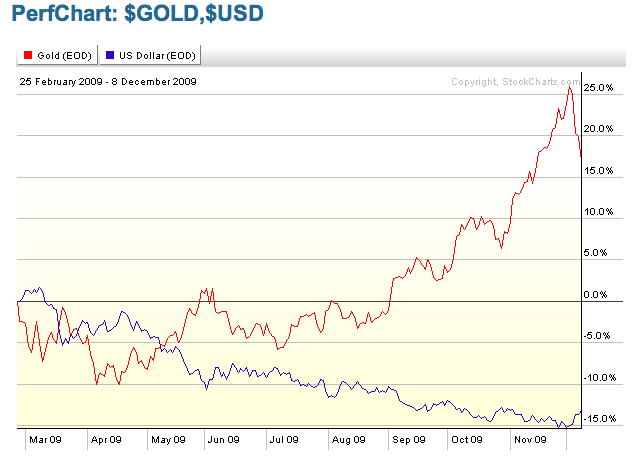
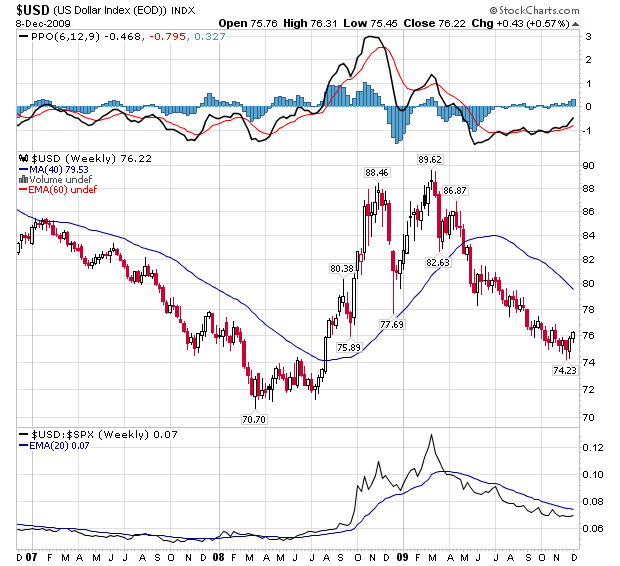
Already, total American government debt, including off-balance sheet IOU’s to the Social Security Administration, stands at between $56 and $110 trillion. Based on a gross domestic product of some $13 trillion, it is most unlikely that the debt will be repaid. Increasingly, it is being described as the biggest Ponzi scheme in history. This Rake’s Progress is not lost on the markets. The U.S. dollar has declined precipitously, both in terms of gold and against foreign currencies, sapping the confidence vital for an economic recovery.
Regardless of who is to blame, Bernanke faces a decision. He may either continue to debase the currency or raise interest rates, likely forcing the Treasury into default. The latter may sound like a political impossibility, but consider carefully the alternative. In our present situation, many countries throughout history have simply revalued their currencies, wiping out a huge chunk of their debt, and started again. But the U.S. dollar has no fixed value, except the external fix of China’s currency peg. Since China is our largest creditor, they could theoretically revalue our currency by adjusting the peg. This would have a tremendous impact on the American economy, and we don’t get a vote!
The Fed did not create this crisis, but it did abdicate its responsibility to stop it. In doing so, it has essentially exported our major monetary powers to China. We’re partying in a house that China owns. If we don’t keep ourselves under control, they will wake up and impose some harsh discipline.
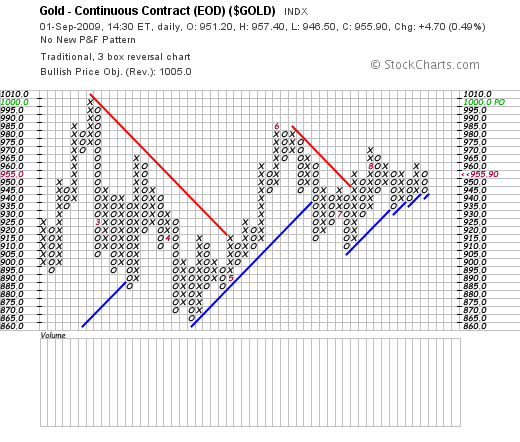
As they say, forewarned is forearmed, making gold possibly more attractive than even its present price indicates.
Ed Note: I’ve added the charts below:
WEEKLY Chart below:
John Browne is the Senior Market Strategist for Euro Pacific Capital, Inc. Mr. Browne is a distinguished former member of Britain’s Parliament who served on the Treasury Select Committee, as Chairman of the Conservative Small Business Committee, and as a close associate of then-Prime Minister Margaret Thatcher. Among his many notable assignments, John served as a principal advisor to Mrs. Thatcher’s government on issues related to the Soviet Union, and was the first to convince Thatcher of the growing stature of then Agriculture Minister Mikhail Gorbachev. As a partial result of Browne’s advocacy, Thatcher famously pronounced that Gorbachev was a man the West “could do business with.” A graduate of the Royal Military Academy Sandhurst, Britain’s version of West Point and retired British army major, John served as a pilot, parachutist, and communications specialist in the elite Grenadiers of the Royal Guard.
In addition to careers in British politics and the military, John has a significant background, spanning some 37 years, in finance and business. After graduating from the Harvard Business School, John joined the New York firm of Morgan Stanley & Co as an investment banker. He has also worked with such firms as Barclays Bank and Citigroup. During his career he has served on the boards of numerous banks and international corporations, with a special interest in venture capital. He is a frequent guest on CNBC’s Kudlow & Co. and a former contributing editor and columnist of NewsMax Media’s Financial Intelligence Report and Moneynews.com. He holds FINRA series 7 license.
EURO PACIFIC CAPITAL
Founded in 1980 and headquartered in Westport, Connecticut, Euro Pacific is a full service, FINRA-registered broker/dealer that has historically been recognized for its expertise in foreign markets and securities. Through its direct relationships with countless foreign trading desks, the firm’s clients are able to avoid the large spreads often imposed by domestic market makers of foreign securities, thereby substantially reducing overall transaction costs. See The Euro Pacific Advantage
Though we offer access to all U.S. stocks and bonds, and are certainly knowledgeable in domestic investments, we specialize in international securities. By trading foreign stocks and bonds through Euro Pacific Capital, individual investors can benefit from our extensive experience in this highly specialized area. Euro Pacific Capital’s clients gain access to foreign markets which are out of reach for most individual investors trading through traditional brokerage firms. With Euro Pacific’s guidance, buying foreign stocks and bonds, and building a truly global portfolio, has never been easier. Let us put our experience to work for you.
Euro Pacific Capital does not engage in any market making activities, thus the firm’s individual and corporate clients can be assured that any recommendations given are free from the various conflicts of interest so prevalent among Wall Street brokerage firms.
Peter Schiff, the firm’s president, and a renowned pioneer in the field of international investing for individual investors, leads a team of investment professionals and support staff dedicated to the highest levels of customer service, a team literally searching the world over for valuable investment opportunities.
-
I know Mike is a very solid investor and respect his opinions very much. So if he says pay attention to this or that - I will.
~ Dale G.
-
I've started managing my own investments so view Michael's site as a one-stop shop from which to get information and perspectives.
~ Dave E.
-
Michael offers easy reading, honest, common sense information that anyone can use in a practical manner.
~ der_al.
-
A sane voice in a scrambled investment world.
~ Ed R.
Inside Edge Pro Contributors

Greg Weldon

Josef Schachter

Tyler Bollhorn

Ryan Irvine

Paul Beattie

Martin Straith

Patrick Ceresna

Mark Leibovit

James Thorne

Victor Adair