
Daily Updates
“Coal has an image problem. Casual observers of energy markets view coal as an anachronism more at home in a 19th century factory than in modern developed economies.”
“Bottom line: Even assuming a significant cost attached to carbon emissions, coal plants will remain a relatively low-cost source of power for decades to come. Further, coal plants represent a reliable source of baseload power.
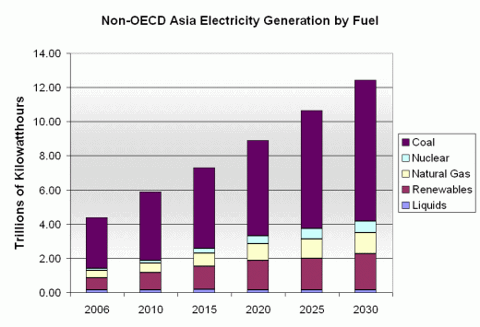
While the US coal market is far from dead, the international coal market is positively booming. Coal accounts for 42 percent of global electricity generation and that share should grow over the next two decades. The developing world is the primary driver of this growth; China and India produce 80 and 70 percent of their power from coal, respectively.
Asian countries outside the Organization for Economic Cooperation and Development (OECD) currently generate roughly 70 percent of their power from coal. Coal-fired generation in the region is expected to soar more than 176 percent by 2030.”
…..read more HERE.
Editor Note: Money Talks highly recommends that you make a regular trip to this monday morning site to this Don Vailoux monday report where he analyses an astonishing 40 to 50 Stocks, Commodities and Index charts and, provides a “Bottom Line” and some very interesting commentary.
– a few of the 40+ charts and commentary below. Full site HERE
(Ed Note: Don’s Bottom line below charts)
Look for lots of positive economic news this week!
November Producer Prices to be reported on Tuesday at 8:30 AM EST are expected to increase 0.2% versus a decline of 0.6% in October. Core PPI is expected to increase 0.8% versus 0.3% in October.
The December New York Empire Manufacturing Index to be reported on Tuesday at 8:30 AM is expected to improve to 24.00 from 23.51 in October.
November Capacity Utilization to be reported on Tuesday at 9:15 AM EST is expected to improve to 71.1% from 70.7% in October.
November Industrial Production to be reported on Tuesday at 9:15 AM EST is expected to improve by 0.5% versus an increase of 0.1% in October.
November Housing Starts to be reported on Wednesday at 8:30 AM EST is expected to increase to 578,000 from 529,000 in October.
November Consumer Prices to be reported on Wednesday at 8:30 AM EST are expected to increase 0.4% versus a gain of 0.2% in October. Core CPI is expected to increase 0.1% versus 0.3% in October.
Results of the Federal Open Market Committee Meeting are to be released on Wednesday at 2:15 PM EST. The Fed Fund rate is expected to remain the same at 0.25%.
November Leading Economic Indicators to be released at 10:00 AM EST on Thursday are expected to increase by 0.7% versus 0.3% in October.
The December Philadelphia Fed report to be released at 10:00 AM EST on Thursday is expected to slip to 16.0 from 16.7 in November.
Earnings News This Week
Monday sees Carnival
Tuesday sees Best Buy and Transcontinental
Thursday sees Fedex, General Mills, Nike, Oracle and Research in Motion
Equity Index Trends
The ratio of S&P 500 stocks in an uptrend to a downtrend (i.e. Up/Down ratio) improved last week from 2.94 to (320/108=) 2.96. The ratio remains intermediate overbought.
Bullish Percent Index for S&P 500 stocks slipped from 74.60% to 72.80% last week. The Index remains below its 15 day moving average and remains intermediate overbought.
The S&P 500 Index added 0.43 (0.04%) last week despite strength in the U.S. Dollar, an encouraging technical sign. Intermediate trend remains up. The Index once again bounced from near its 50 day moving average. Short term momentum indictors currently are neutral. Support is indicated at 1,029.38. Seasonal influences currently are positive

The TSX Composite Index slipped 86.87 points (0.75%) last week. Intermediate trend remains up. The Index remains above its 50 and 200 day moving averages. Support is indicated at 10,745.25. Strength relative to the S&P 500 Index has returned to negative. MACD and RSI have declined to a neutral level. Stochastics have declined to an oversold level. Short term momentum indicators have yet to show signs of bottoming. Seasonal influences remain positive.
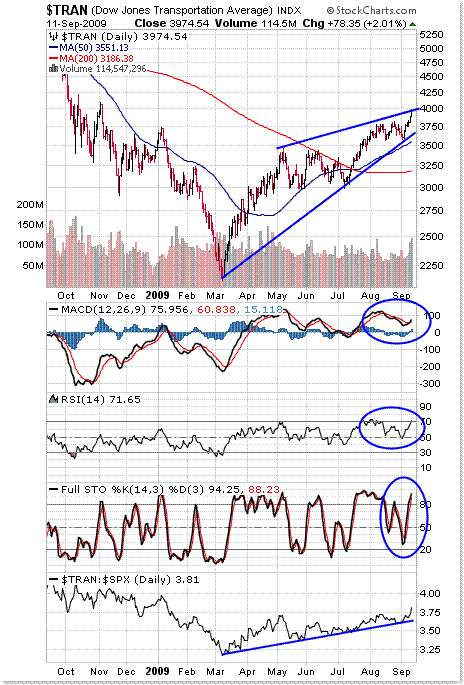
The U.S. Dollar added 0.73 last week and tested resistance at 76.82. Next resistance is at 77.47.The push above its 50 day moving average on Friday December 4th proved to be a significant technical event. Despite strength, the U.S. Dollar remains in an intermediate downtrend. MACD and RSI have recovered from short term oversold levels. Stochastics already are short term overbought. Short term momentum indicators have yet to show significant signs of peaking. Seasonal influences are negative until the end of December. Thereafter, they turn positive. The U.S. Dollar responded favourably last week to better than expected economic news (e.g. retail sales). Most likely scenario between now and yearend is a flat to slightly lower Dollar (Possible head and shoulders reversal?). Stay tuned!

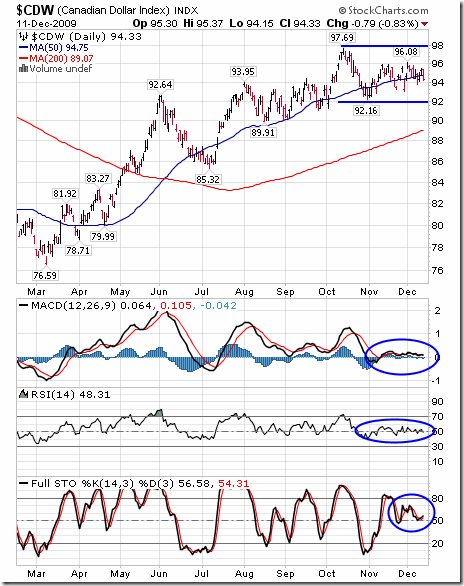
The Canadian Dollar slipped 0.19 last week. Intermediate trend remains up. The Canuck Buck remains in a three month trading range between 92.16 and 97.69. Short term momentum indicators are neutral.
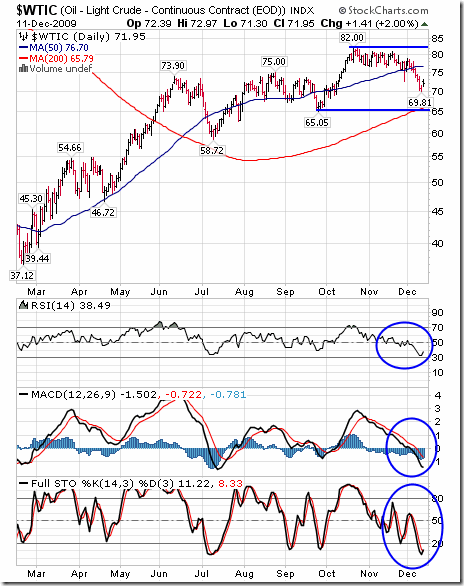
Crude oil fell $3.52 (4.66%) per barrel last week. Support is at $65.05. Its 200 day moving average at $65.79 also is likely a support level. Resistance is at $82.00. Short term momentum indicators are oversold. Stochastics and RSI may be trying to bottom. Crude oil has a history of bottoming in mid December, forming a base and entering into a period of seasonal strength near the end of February. History is about to repeat.

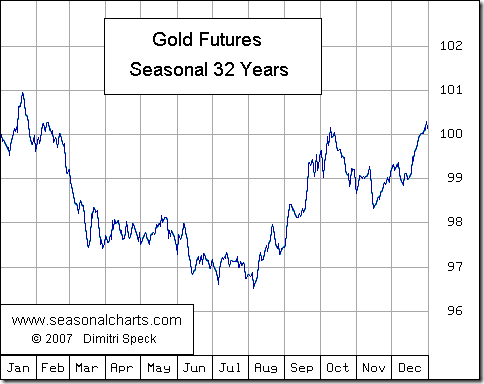
Gold fell another $47.20 U.S. per ounce last week in response to strength in the U.S. Dollar. Stochastics are short term oversold, but continue to trend lower.

Gold has a history of reaching a seasonal peak in mid January.
The Bottom Line
‘Tis the season for equity markets to move higher until early January! Look for history to repeat.
Don Vialoux has 37 years of experience in the Investment Industry. He is a past president of the Canadian Society of Technical Analysts (www.csta.org) and a former technical analyst at RBC Investments. Now he is the author of a daily letter on equity markets available free on the internet. The reports can be accessed daily right here at www.dvtechtalk.com.
Impossible! That’s what institutional investors say about “Timing the Market”. Mr. Vialoux will explain that, indeed, it can be done with the appropriate analysis. He also will explain why timing the market will be important during the next decade. Buy and Hold strategies are not working anymore; Investors are looking for alternatives. Mr. Vialoux will demonstrate four techniques that can be used to time intermediate stock market swings lasting 5-15 months. The preferred investment vehicles for investing in intermediate stock market swings are Exchange Traded Funds.
Comments in Tech Talk reports are the opinion of Mr. Vialoux. They are based on technical, fundamental and/or seasonal data that is believed to be accurate. The comments are free. Mr. Vialoux receives no remuneration from any source for these services. Comments should not be considered as advice to buy or to sell a security. Investors, who respond to comments in Tech Talk, are financially responsible for their own transactions.
Avoid the Pitfalls of Losing Traders
Stockscores.com Perspectives for the week beginning Dec 13th, 2009

Trading is simple, but not easy. Despite its simplicity, most people who try to trade have a hard time finding consistent profitability. Trading well is as much about doing certain things right as it is about avoiding the common mistakes. Here is a list of the common causes of trader failure.
1. Lack of Knowledge
Trading does not have to be complex or involve a sophisticated understanding of capital markets. In one day, I can teach a person the skills that I use as a trader. However, like riding a bicycle, being good at applying those skills takes practice and usually involves some painful mistakes through the learning process. You probably were pretty wobbly the first time you pedaled a bicycle but, with time, you found your balance and got good at it. Trading is no different.
However, unlike riding a bike, there are thousands of ways to trade. You have a choice in what you trade, the hold period for your trades and the strategies you apply.
There are many options for people looking to learn trading. You can take classes, study online, read books or try to figure it out on your own. Each approach to learning has a cost; don’t underestimate the price for how you intend to learn.
With so many approaches to acquiring the knowledge you need to trade, there is not necessarily just right and wrong ways to learn. It becomes a question of what is right for you, what best fits your learning style. What is most important is that you get educated before you risk a penny of your money in the market. Most people can’t beat the market because they don’t know what they are doing. Don’t let a lack of knowledge ensure your failure.
- Get the $3,600 StockSchool Pro Free by just opening an account at:

- DisnatDirect named the number one Canadian brokerage for Traders by Surviscor! Open and Fund a brokerage account with DisnatDirect and receive the StockSchool Pro home study course free, including special Pro level access through the DisnatDirect client website. Offer only available to Canadian residents. For information, click here
2. Poor Risk Management
The focuses for most aspiring traders are the decisions to enter and exit the trade. They spend a lot of time trying to find the right stock to buy and then try to make a good decision on when to enter. They miss out on the most important component of the trading process.
Risk management is that often forgotten piece of the trading puzzle. Without capital to trade with, you have nothing to do. Protect your capital first and never try to get rich overnight. Some might get lucky in the short term but those who fail to manage risk over the longer term will go broke. That is guaranteed.
For every trade, you need to know your downside. Being wrong is part of trading so you must have a plan for what to do when you are wrong.
3. Insufficient Capital
Since being wrong is part of a profitable trading strategy, you need to allow for drawdowns of your capital base. There will be times when market conditions will not be great for the strategies you are applying.
When planning your trading business, you must allow for this potential deterioration of capital. You may make five steps backward before you start to go forward, make sure you have the capital to ride out these losing periods.
4. Trading Without Proven Strategies
I have seen a lot of people trade without a strategy that they have tested. They think that they can beat the market by doing things that make sense. This is often the biggest problem with people who are successful in other areas of life.
It is a bad idea to think that you can beat the market by being smart. The markets rarely do what makes sense, at least in the context of the information that we have. This is because the market often moves on information that most of us just don’t have.
For that reason, it is smart to have a set of trading rules that you first test exhaustively before you trade. Your testing must determine whether the rules yield a positive expected value. Over a large number of trades, your rules should make a profit. What happens on any individual trade really does not matter.
5. Failure to Follow Rules
The rules you define and test are only effective if you follow them. While this is easy for all of us to understand, it is a very hard thing to actually do. We break rules because we are afraid of losing money. Emotion is a hard thing to overcome.
To minimize the impact of emotion requires a comfort with the risk you are taking. Most traders find that paper trading, simulated trading without using real money, is not too hard. It is only when they have their capital at risk that they start to make mistakes.
The solution to this problem is to not take more risk than you are comfortable with. The best traders are those who don’t care about the money. The more you can do to take out emotion, the better your chances will be to follow the trading rules.
6. Lack of Determination
Doing anything well requires the determination to learn and gain expertise. This is very much the case for trading because it is such an emotional pursuit. There will be times when the novice trader will feel overwhelmed with emotion and ready to give up.
I don’t think trading is something that can be done well by someone who does not like it. Having a passion for trading is what will get you through the hard times and ensure that you stick with it when your heart may tell you otherwise.
7. Poor Focus
The shorter the time frame you trade, the more focused you need to be. Position trading (hold period measured in weeks or months) is not that demanding mentally because you have a lot of time to make your trading decisions. Swing trading (hold period measured in days) requires you make quicker decisions but is not as demanding as day trading. The day trader (hold periods measured in hours or minutes) has to make decisions in only seconds and work hard to not miss out on good trading opportunities.
It is hard to trade if you have a lot of distractions while you are trading. You have to do what is necessary to avoid letting outside factors have an effect on your trading decisions.
8. Inability to Adapt
The market is constantly changing and you need to be able to adapt with it. That means applying trading strategies that are appropriate for the present conditions; you may not want to apply a buying strategy in a market with strong downward momentum.
Avoiding chasing the market with your rules is a challenge that many traders have trouble with. You should have a set of trading principles that do not change over time, these based on source of opportunity that you are pursuing. Do not constantly change the rules of your tested and proven strategies.
However, how and when you apply your strategies will change as the market evolves. I keep a stable of trading strategies that I apply as conditions warrant.

A position trade is one where the expected hold period is measured in weeks or months and I like to use a very simple strategy for most of my position trades. Look for breakouts on abnormal volume from predictive chart patterns. I usually use the Stockscores Simple or Abnormal Up Market Scans on Stockscores to find these.
I could not find any new candidates from Friday’s trading but a few stocks came up through the week. Here are two that I featured in the daily newsletter, which can be subscribed to from the Products, Newsletter menu on Stockscores.com.

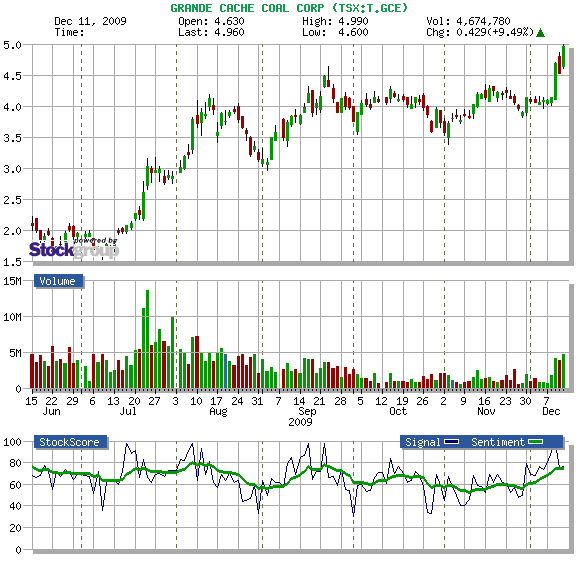
1. T.GCE
T.GCE broke out on Wednesday, pulled back a little bit on Thursday and then made a 9.5% gain on Friday. I featured the stock on Wednesday so an entry here is a little bit late but I think it is still valid because the risk reward relationship is still good enough. Support at $3.95.
2. CLW
CLW broke out from an ascending triangle pattern on Tuesday, the day that I featured it. The stock has pulled back since then, I would watch for a green candle on the daily chart as a signal that it has potential to go higher from here. Make sure that support at $47.53 is not broken first.

Click HERE for the Speaker Lineup and click HERE if you want to learn from some of the timeless advice from some of worlds best traders including the very successful Tyler Bollhorn.

Tyler Bollhorn started trading the stock market with $3,000 in capital, some borrowed from his credit card, when he was just 19 years old. As he worked through the Business program at the University of Calgary, he constantly followed the market and traded stocks. Upon graduation, he could not shake his addiction to the market, and so he continued to trade and study the market by day, while working as a DJ at night. From his 600 square foot basement suite that he shared with his brother, Mr. Bollhorn pursued his dream of making his living buying and selling stocks.
Slowly, he began to learn how the market works, and more importantly, how to consistently make money from it. He realized that the stock market is not fair, and that a small group of people make most of the money while the general public suffers. Eventually, he found some of the key ingredients to success, and turned $30,000 in to half a million dollars in only 3 months. His career as a stock trader had finally flourished.
Much of Mr Bollhorn’s work was pioneering, so he had to create his own tools to identify opportunities. With a vision of making the research process simpler and more effective, he created the Stockscores Approach to trading, and partnered with Stockgroup in the creation of the Stockscores.com web site. He found that he enjoyed teaching others how the market works almost as much as trading it, and he has since taught hundreds of traders how to apply the Stockscores Approach to the market.
References
Get the Stockscore on any of over 20,000 North American stocks.
Background on the theories used by Stockscores.
Strategies that can help you find new opportunities.
Scan the market using extensive filter criteria.
Build a portfolio of stocks and view a slide show of their charts.
See which sectors are leading the market, and their components.
Disclaimer
This is not an investment advisory, and should not be used to make investment decisions. Information in Stockscores Perspectives is often opinionated and should be considered for information purposes only. No stock exchange anywhere has approved or disapproved of the information contained herein. There is no express or implied solicitation to buy or sell securities. The writers and editors of Perspectives may have positions in the stocks discussed above and may trade in the stocks mentioned. Don’t consider buying or selling any stock without conducting your own due diligence.
Ed Note: Below is a small excerpt from Mark Leibovit’s 12 page The VR Gold Letter

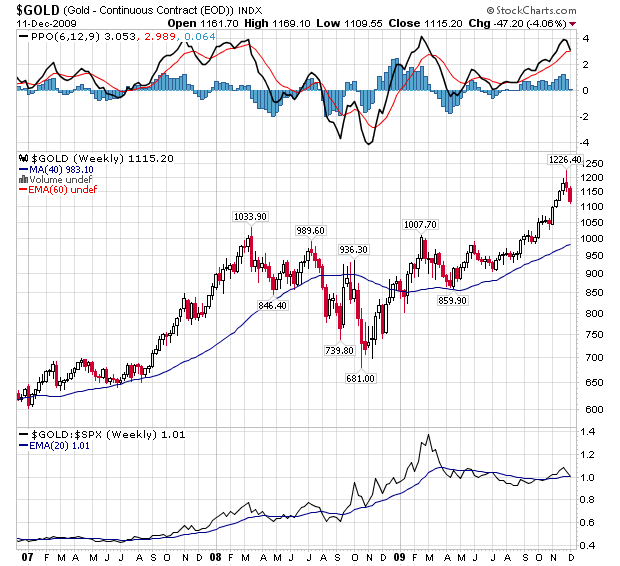
Last weekend I sent a Bulletin reminding you of the previous weeks ‘Sell’ signal for Gold. This was, of course, a trading recommendation, not a long- term recommendation. The ‘Sell’ signal came three trading days ahead of the top which occurred on December 3, but you are still well ahead if you acted on that signal. That signal was generated because of the formation of a Negative Volume Reversal ™, my proprietary indicator. A Negative Volume Reversal ™ is a sign of market distribution which has the potential of defining important market highs.
We are at an interesting crossroad. Though I am still on that ‘Sell’ signal, things can change real quickly around here. A Positive Volume Reversal ™ is certainly one of those things. Stepping back, I can’t help but observe that the sharp and vicious break we saw in Gold and Gold shares since December 3 is quite characteristic of corrections in BULL markets. Bulls who may have been quickly frightened into bears is just what the doctor ordered. It is entirely possible that we begin to rally NOW and either retest or breakout above the December 3 highs. Remarkably, my Annual Forecast Model (Ed. Note: subscribers only) had predicted months and months ago that December 9 might be a low point in the Gold market and sure enough it was a bulls eye call.
The bottom line, folks, is that the party is only beginning for Gold
(Ed Note: specific targets and trading recommendations in Mark’s 12 page VR Gold Letter)
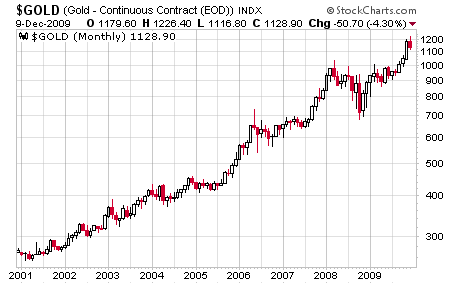
Monthly chart of Gold below.
Weekly Chart Below:
This small excerpt was from Mark Leibovit’s 12 page The VR Gold LetterThe VR Letter is published WEEKLY and Mark Leibvit has been the Awarded #1 Gold Timer by Timers Digest in 2007, 2008 and is in postition to win 2009 with his fine Gold forecasts throughout the year so far including Gold zooming to another new High of $1,131 in tonights overnight trading. Money Talks highly recommends subscribing to Mark’s Gold
The weekly VR Gold Letter focuses on Gold and Gold shares. The letter is available to Platinum subscribers for only an additional $50 per month and to Silver subscribers for only $70 per month. Email me at mark.vrtrader@gmail.com.
Marks VRTrader Silver Newletter covers Stock, TSE Stocks, Bonds, Gold, Base Metals, Uranium, Oil and the US Dollar.
More kudos – Mark Leibovit was named the #1 Intermediate Market Timer for the 10 year period ending in 2007; the #1 Intermediate Market Timer for the 3 year period ending in 2007; the #1 Intermediate Market Timer for the 8 year period ending in 2007; and the #8 Intermediate Market Timer for the 5 year period ending in 2007. NO OTHER ANALYST SURVEYED APPEARED IN ALL FOUR CATEGORIES FOR INTERMEDIATE MARKET TIMING AS PUBLISHED IN TIMER DIGEST JANUARY 28, 2008!
For a trial Subscription of The VR Silver Newsletter covering Stocks, Bonds, Gold, US Dollar, Oil CLICK HERE
The VR Gold Letter is available to Platinum subscribers for only an additional $20 per month, while for Silver subscribers the price is only an additional $70.00 per month. Prices are going up very shortl, so act now! Separately, the VR Gold Letter retails for $1500 a year! The VR Gold Letter is published WEEKLY. It is 10 to 16 pages jam-packed with commentary and charts. Please call or email us right away. Tel: 928-282-1275. Email: mark.vrtrader@gmail.com .
Jack Lifton: Safeguarding Our Future Supply of Rare Earths
“Price may not be as important as security of supply,” says Jack Lifton, an independent consultant with more than 45 years of experience in sourcing nonferrous strategic metals. In the U.S., our dependence on rare metals is undermined by the simple fact that we’re not producing any. Given that China now controls 95% of these ‘technology metals’ and the world is projected to eat 200,000 tons of rare earth metals near 2015, Jack tells The Gold Report we need to jumpstart our own domestic supply chain and, more importantly, build the refineries to process them—rather than sending them to China for refining, which is our only option currently.
The Gold Report: Jack, we hear you’re starting on a documentary, “On the Green Road.” Tell us a bit about it, and what you mean by “Green Road.”
Jack Lifton: I came up with that title because no matter what the attitude of the individual is towards being “green,” there really isn’t any other path for us now. My proposed documentary “On the Green Road” will follow the path that a rare earth metal takes from the mine to the market, so that the consumer can see the necessary steps required to make the technological devices upon which our quality of life depends. If the Green Road is the path to the future we need to get on it and stay on it right now.
Six hundred million people in the Western world are enjoying a life increasingly dominated by technology that we don’t understand. In particular, we don’t understand how it is made. What I see in America is a reluctance to admit that the green road starts in the black earth. We have to mine and refine the minerals and metals into forms which can then be fabricated into forms which can then be made into parts which can then be assembled into the technology devices we use to conserve energy. Everything starts at the mine or at the oil or gas well.
In the West, electronic devices using electricity produced by a huge network of generating devices control our transportation, communication, and our environment. We’ve got a grid that we talk about as if we understand it, but it’s an extremely complicated system. We ignore the fact that we produce and distribute oil and its by-products, metals and their compounds and alloys. Nobody pays attention to that. All we do is say we’ve got to stop doing this and stop doing that. We have to start educating everyone as to how a metal becomes a radio or how a metal becomes a battery, how a battery propels a car.
TGR: I heard you speak recently at the Hard Assets Conference about supply issues in terms of expanding wind and solar technologies. Can you explain some of those supply constraints?
JL: Yes. In the United States, Canada, and Western Europe we are consuming most of the supplies of the technology metals. Now we’re facing six billion people in the rest of the world whose standard of living is growing rapidly and we do not have ten times the amount of materials used to create the good life in the West to create the same standard of living for the entire world.
I don’t mean to be a doomsayer, but if the Chinese government wants its own people to have the standard of living that people in Los Angeles have today, it’s going to mean that China must use all of its own natural resources to improve its standard of living and its quality of life, which will mean that our standard of living will have to decline. Why? Because there are some materials—for example, the rare earths—that China controls 100% of the supply of today. And as China’s economy is growing, China is requiring more and more of these materials for its own domestic economy.
Ten years ago China exported 75% of its production of rare earth metals to the rest of the world. Today it exports less than 25%, even though the production in the last 10 years has more than doubled. So that should tell you what’s going on here. This is not a conflict. This is economic reality.
Now I’m using the rare earths as an example of something I think is very much misunderstood in the West. The rare earth metals were originally discovered in Europe and originally produced commercially en masse in California. The largest rare earth deposit in the world of its kind was discovered in California in 1947. It was put into production and by 1984 that site, Mountain Pass, California, near the Nevada border on M-15, was producing 35% of the world’s rare earth metals and 100% of the domestic needs of those metals here in the U.S. That was 25 years ago. Today that mine is producing nothing and approximately 95% of the rare earth metals are today produced in the People’s Republic of China. The United States imports all its rare earth metals from the People’s Republic of China.
Why? Because between 1984 and 2009, Chinese production of those metals ramped up to the point where the Chinese decided to lower the price so that they could sell more metals so they could mine more metal and employ more people. They basically were able to sell these metals into the market, including to the United States, at a price less than the cost of producing it in California. Well, if you believe in a global economy, then you say, that’s how capitalism works.
There are now other issues arising besides price, which is what shut down the Mountain Pass mines. Price may not be as important as security of supply. Do we really need rare earth metals to maintain our style of life? We cannot force the Chinese to sell them to us. The Chinese have an internal priority to develop their domestic economy. China’s issue is the need of the Chinese economy to grow and to improve the quality and style of life of the Chinese people. We have become so dependent on rare metals in general and rare earth metals in particular in our technological economy and at the same time we’ve simply ignored the fact that we are not producing them in the West.
TGR: Doesn’t the U.S. have plenty of metals? Why aren’t we supplying more of what we need?
…..read more HERE.
-
I know Mike is a very solid investor and respect his opinions very much. So if he says pay attention to this or that - I will.
~ Dale G.
-
I've started managing my own investments so view Michael's site as a one-stop shop from which to get information and perspectives.
~ Dave E.
-
Michael offers easy reading, honest, common sense information that anyone can use in a practical manner.
~ der_al.
-
A sane voice in a scrambled investment world.
~ Ed R.
Inside Edge Pro Contributors

Greg Weldon

Josef Schachter

Tyler Bollhorn

Ryan Irvine

Paul Beattie

Martin Straith

Patrick Ceresna

Mark Leibovit

James Thorne

Victor Adair