
Daily Updates
Last December, the yield on the 10-year Treasury bond fell to 2 percent, the lowest level in 40 years. The financial and economic crisis had investors heading for a safe harbor … and Fed members panicked. Deflation was the buzz word of the time.
If market forces had been allowed to take over and purge the system of all the imbalances, malinvestments, and excesses that characterized the bubble years, a deflationary wave would have swept the world. And after this sharp and deep cleansing process, a new healthy recovery would have begun.
But Washington politicians, the Fed and their international peers did not want a painful, although effective, market solution. They thought they could do better.
They believed they had better information than markets. They thought their judgment was superior. And they still think they are the masters of the universe.
For now, they may have prevented a quick and severe deflationary crisis. But we’ll all pay a huge price for our policymakers’ arrogance with the next surge of inflation …
Most modern economists think of inflation as “the change in the level of prices of a basket of goods and services.” However, this definition tells us nothing about the causes of these price changes.
But here is an older definition that does: “Inflation is a rise of money and credit.”
According to this traditional definition, changes in the level of certain prices are a symptom of more money and easy credit … a causal inflationary policy.
I stick with this classical definition because I like to know the reasons behind observable data. It’s very helpful in understanding what has been going on during the last few years. And it enables me to make some forecasts about what will happen next.
Two Historical Observations of Inflation …
Every time we’ve had a big jump in inflation — and there have been many occasions, especially during the 20th century — two common characteristics appeared:
First, there was fiat money … money that can be endlessly proliferated by the government.
Second, there were huge public budget deficits that were largely financed by money creation.
We’re experiencing both characteristics today …
In fact, governments around the world are built on discretionary paper money regimes. And their answer to the Great Recession has been a debt and spending binge, at least partially financed by money creation. They even created a fancy and hard-to-understand term for this policy: Quantitative easing.
So it’s probably not too far-fetched to come to the conclusion that we have an inflationary monster in the rearview mirror, and it’s quickly gaining ground on us each day.
Finally, the Bond Market
Will Tell Us the Truth …
Times of strongly rising prices are always accompanied by rising interest rates — at least as long as free markets are allowed to operate. If we are entering a time when the current inflationary policy leads to rising prices of goods and services, bond yields will have to start rising, too.
As I said at the beginning, and you can see it on the chart below, the yield of the 10-year Treasury bond hit a low of 2 percent in December 2008. By June, it had doubled to about 4 percent. Then it retreated somewhat.
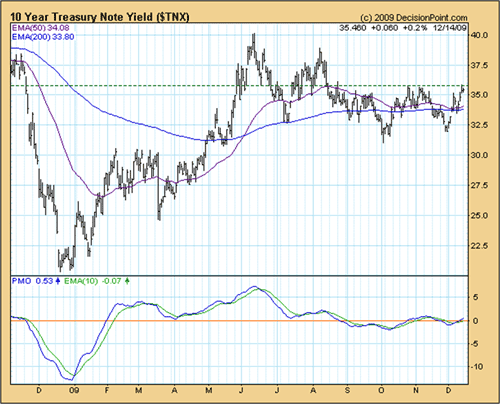
And now it looks like this correction may be over. All that’s needed to confirm this assessment is a small continuation of the uptrend of the past two weeks. If yields can rise above the October-high of 3.58 percent, they’ll signal the end of this consolidation and a continuation of the medium-term uptrend that began in December 2008.
The Long-Term Chart
Shows a Very Old Trend …
Have a look at the chart below showing the yield of the 30-year Treasury bond since 1980. Here you can see the long-term downtrend in yields that boosted financial assets and the banking industry from 1981 until 2008.
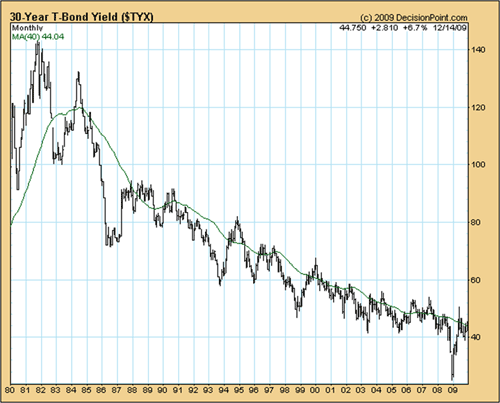
The spike lower in December 2008 may well turn out to have been the low point in this 28-year long trend. However, we haven’t seen a clear trend reversal yet or the establishment of a new secular up trend.
In the past, interest rates rose as an answer to unsound fiscal and monetary policies. The last time was from the early 1960s until 1981. And the possibility of this happening again relatively soon is obvious.
Best wishes,
Claus
This investment news is brought to you by Money and Markets. Money and Markets is a free daily investment newsletter from Martin D. Weiss and Weiss Research analysts offering the latest investing news and financial insights for the stock market, including tips and advice on investing in gold, energy and oil. Dr. Weiss is a leader in the fields of investing, interest rates, financial safety and economic forecasting. To view archives or subscribe, visit http://www.moneyandmarkets.com.
Quotable
“People such as George Soros and Michael Moore certainly talk a good game, but the next Mother Teresa they are not. Mother Teresa never criticized the free-market system; wealth just wasn’t for her. Soros and Moore are quite the opposite. They will never take a vow of poverty and dedicate themselves to helping the poor. They just want our civilization to take a vow of poverty and become poor.
This has caused many to wonder: How can someone preach socialism while being the most rapacious “capitalist” imaginable?”
Selwyn Duke, The Pathology of the Rich Socialist
FX Trading – Monetary Policy and Emerging European Currencies
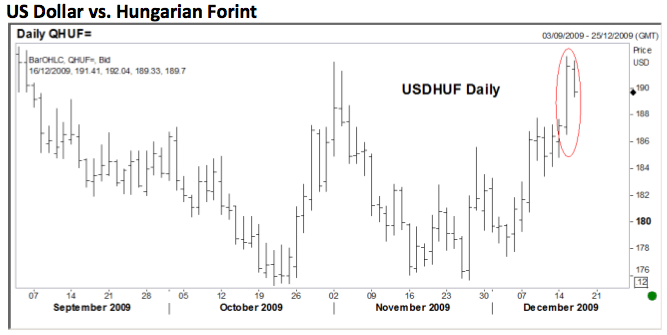
So we’ve been harping on the rising concerns in Europe and what they may ultimately mean for the euro. But it’s clear that the worries are not confined to the EMU. Yesterday traders put a hurting on the Hungarian forint, the Polish zloty and the Czech koruna.
…..read more HERE.
Michael Berry: Discovery Investing’s Stellar Potential
Discovery Investing pioneer Dr. Michael Berry’s number-one hedging strategy against the struggling U.S. dollar is to simply own currencies of the commodity countries—of which Canada is his favorite. When Michael grew up in Canada, he recalls its currency— now fondly known as the loonie because of the image of the loon used on the die for the back of the C$1 coin—always being worth more than the U.S. dollar. We’ll be revisiting those good ol’ days within the next year, he predicts, as the Canadian dollar reaches parity with the greenback and then goes beyond. In addition to holding loonies and their C$2 counterparts, the toonies, Michael tells The Gold Report, in this exclusive interview that he believes in “some exposure to the physical” in every investor’s portfolio, maybe as little as 1%. He’s also a staunch believer in keeping a place in the portfolio for discovery investments, ideally in a mixture of incubator, mature and legacy companies, to partake in the bonanzas that can come when promising discoveries make it to the world-class stage.
The Gold Report: Gold is in the news. You’ve been talking about investing in gold for years, and now all of the investment programs are talking about it. In one of your recent Morning Notes, you said, “Today, you must own and hold gold bullion or coins.” But how much more can an investor expect on the heels of a 215% increase in the gold price over the past four years?
Michael Berry: In the first place, I said “coins and bullion” to differentiate from buying shares in the gold companies. I think it’s important for discovery investors, in particular, to hold the physical gold. And I said “you must hold it” because I think bad things are going to happen to our currency, even though right now we’re having a covering of the short dollar position and commodities are getting hit a little bit.
I am not suggesting that they necessarily need to buy a lot more of the physical metals. I am certainly very happy that gold came off $66 the first week in December and another $66 or so during the following week. So this is correction great; this is wonderful.
TGR: A pullback is wonderful?
MB: Yes. Gold was overbought; I kept watching it ascend and began to realize, “Hey, wait a minute, there’s too much froth here.” We knew we had to have a correction; there was a bit of a bubble forming. This correction is very good for gold, and it will allow people to come back in at a lower level. We will find the bottom—this is just a correction. It is not the beginning of a bear market in gold.
TGR: And when you say, “hold bullion or coins,” would you include ETFs, GoldMoney and so on, or do you want people actually hold the physical items?
MB: To answer your question directly, I exclude ETFs from the “bullion and coins” category. But I am not saying you shouldn’t also own an ETF, nor am I saying you shouldn’t also own a discovery company such as Goldcorp (TSX:G) (NYSE:GG). I am talking about having physical gold in your possession, however. As far as I am concerned, you need some exposure to the physical in your portfolio and at your disposal.
TGR: Given the turmoil in the markets and the economy, what percentage in physical silver or gold would you suggest people own?
MB: A relatively small portion, depending on your proclivity for risk and your view of the marketplace—maybe 1% to 5% of your portfolio. For some people that would be quite a bit, but not 10% or 15% or 20%. You always must feel comfortable with your position, so allocations toward the physical metals are going to be different for everyone.
TGR: In another one of your recent Morning Notes, you wrote that investors who are U.S. dollar based MUST (in all capital letters) develop an active investment-in-hedging strategy. Can you suggest some ways for our readers to look at hedging against the dollar?
MB: Hedging is a very specific term that usually connotes the use of options or futures contracts, where you can implement “delta hedging” to dynamically change your position over time. There’s always that, but I think you can also hedge by buying currencies; you can buy access to other currencies such as the Canadian dollar or the Aussie dollar that have more upside relative to the U.S. dollar.
My main hedging vehicle for the past six or seven years, when the Canadian dollar was at 62 cents, has always been to buy Canada. I like Canada because not only was I raised there and know the country very well, but it’s tied to the U.S. geographically and culturally and I think the Canadian dollar will benefit relative to the U.S. dollar. My number-one hedging strategy is to simply own those currencies of the commodity countries, basically, and Canada would be my recommended currency.
…..read more HERE ( quite a bit more actually)
Mission Not Accomplished
Although Barack Obama has refrained, at least for now, from delivering triumphant speeches in a naval flight suit, there is nevertheless a strong tone of accomplishment emanating from the President and his deputies. Over the weekend, top White House economic adviser Lawrence Summers even pronounced that the recession is now over. Without hedging his bets, Summers declared that thanks to the Obama Administration’s wise stewardship, economic stimuli, and emergency bailouts, another Great Depression, set up by the prior Administration, had been narrowly averted. Summers saw no impediments to the return of sustainable growth. He may as well have delivered these remarks from the deck of an aircraft carrier.
I hate to shoot down these high-flying expectations, but the economy is not improving. All that has changed is that we are now more indebted to foreign creditors, with even less to show for it. Washington’s current policies have once again deferred the fundamental, market-driven reforms needed to redirect us onto a sustainable path. Instead, through aggressive monetary and fiscal stimuli, we are trying to re-inflate a balloon that is full of holes. This was the Bush Administration’s exact response to the 2002 recession. It’s shocking how few observers note the repeating pattern, especially the fact that each crash is worse than the last.
Obama’s claim of success largely derives from the slowing tally of job losses, the seemingly renewed strength in the financial system, the pickup in home sales and home prices, and the positive GDP figures. But these ‘achievements’ fall apart under close examination.
First, a closer look at the jobs numbers shows that employment improved in sectors that benefited most directly from monetary or fiscal stimulus: government, healthcare, financial services, education and retail sales. Meanwhile, sectors such as manufacturing continued to shed jobs at an alarming rate. These dynamics actually exacerbate our economic imbalances. Recent trade deficit figures (in which the deficit-reduction trend of early 2009 has sharply reversed) show how this employment growth is preventing needed rebalancing. Essentially, the Administration is nurturing firms that cannot survive without subsidies and support.
Once stimulus is removed, the “saved” jobs will be among the first to go. If the President has not figured this out yet, I am sure Fed Chairman Bernanke has. As a result, the market should discount as pure bluff any claims from the Fed about an eventual “exit strategy” from current stimuli. Such an “exit” would bring about Bernanke’s greatest fear – spiking unemployment.
Second, major investment and commercial banks are not back on their feet, but remain fundamentally insolvent. Their current business model of risk-free speculation depends upon the maintenance of government backstops, the continued availability of cheap money from the Fed, and the use of accounting gimmicks that allow them to conceal losses behind phony assumptions.
Third, while it is true that home prices have stopped falling, this represents failure, not victory. True success would be a drop in home prices to a level that homebuyers could actually afford. Instead, we have maintained artificially high prices with tax credits, subsidized mortgage rates, low down payments, and foreclosure relief. With 96% of new mortgages now insured by federal agencies, market forces have been completely removed from the housing equation. With so many government programs specifically designed to maintain artificially high home prices, devastating long-term consequences for our economy are inevitable.
Finally, it is true that the GDP yardstick shows an economy returning to growth. However, as I have often repeated, this measure has deep flaws that render it almost useless for judging the soundness of an economy. Currently, the figures are merely reporting increasing indebtedness as growth. Using GDP as the main financial indicator is equivalent to judging a man’s success by the cost of his house, car, and wristwatch. Rather than gauging income, these figures merely indicate a level of spending and have nothing to do with earning power.
Paul Volcker, the only independent voice in the Administration, has not been deceived by his colleagues’ sunny claims. He recently noted that our economy still evidences “too much consumption, too much spending relative to our capacity to invest and export” and that the problem is “involved with the financial crisis but in a way [is] more difficult than the financial crisis because it reflects the basic structure of the economy.” Yet, President Obama has chosen not to address these concerns.
As Summers and Obama like to point out, the vast majority of economists take it on faith that, with the right finesse, the stimulus can be withdrawn without pushing the economy back into recession. But based on the distortive effects of stimuli and bailouts, our economy has adapted to a climate where cheap credit is not only plentiful but critical.
Eventually, the cheap credit will dry up. Not because the Fed decides it should, but because our foreign creditors stop lending. When that happens, this Administration will look as clueless about economics as the last one was about the pitfalls of nation-building.
But for now, the chattering classes believe strong government action has delivered us from calamity. For them, at least, it’s “mission accomplished!”
Today I am speaking at a local conference here in Dallas for my friends Charles and Louis Gave of GaveKal along with George Friedman of Stratfor, and get to finally meet Anatole Kaletsky. They graciously allowed me to send their latest Five Corners report as this week’s Outside the Box. I find their research to be very thought-provoking as they are one of the main sources of optimism in my ususal readings (except for their very correct and profitable views on the European debt of the PIGS (Portugal, Italy, [Ireland?], Greece and Spain).
The GaveKal team is scattered all over the globe (and based in Hong Kong), and make my paripatetic travel schedule seem small change, not only being in scores of countries but talking to the movers and shakers in both finance and politics. This is an amazing advantage in information gathering. Thus they have a very global view of the world and tend to spot trends before most analysts have picked up on them.
This week’s Five Corners touches on China, the possible change in investment trends as we go into 2010, currencies, thoughts on styles of investing and more, with contributions from a number of their team. I know you will find it interesting. I will see if I can talk them into letting me use their material a little more. While their material is a tad pricey for individual investors, those interested can contact them at sales@gavekal.com.
Have a great week as we go into the Holiday season (and can you believe the prices on electronic stuff this year?).
John Mauldin, Editor Outside the Box
Will The Three Trends of 2009 Prevail in 2010?
Looking back at the past year, we can conclude that three inter-related trends have dominated financial markets: 1) an impressive weakness in the US$, 2) a significant rally in commodities, and 3) a pronounced out-performance of emerging markets, including Asia. Today, these three trends appear to be running out of steam: the US$ has been rallying, commodities have rolled over and, in November, for the first time in what feels like an eternity, the US MSCI actually out-performed all other countries in the World MSCI index. For us, this begs the question of whether the trends of 2010 will prove different to those of 2009? And the answer to that question may be found in the most unlikely of places, namely the Middle-East.
The news that a Dubai World unit would be suspending payments to creditors, was promptly followed by the rumor that two defaulted Saudi groups (the Saad group and the Ahab group) were treating their domestic creditors differently than foreign banks. From our standpoint in Hong Kong, all these bleak headlines lead us to ponder how the Middle East could find itself in this tight spot? After all, who, a decade ago, would have bet on Dubai (soon to be followed by Venezuela?) going bust with oil at US$80/bbl?
Of course, the apparent squeeze may be nothing more than a few bad apples that blatantly mismanaged their liabilities and blew up their balance sheets. But we have to admit that we are also intrigued by the recent announcements that some of the region’s sovereign wealth funds (Qatar, Kuwait…) have lately been selling the large stakes they acquired in Western financials at the beginning of last year’s financial crisis. Of course, these disposals may be the result of a deep relief that the banks are back above their purchase price and, like a money manager who has just been on a gut-wrenching ride, the SWF are happy to turn the page and put this episode behind them. Or perhaps, the sales are an indication that the Middle East needs US$ right now and that we are now confronting some kind of squeeze on the US$.
Thus, the recent strength in the US$ may be highlighting that we are experiencing an important change in the investment environment. Indeed, at the risk of making a mountain out of sand-dune, we believe that one thing is for sure: recent developments in Saudi and Dubai will most likely give pause to foreign banks looking to expand their lending operations in that region. And if financing for projects becomes more challenging, then this raises the question of whether the Middle East will look to pump more oil in a bid to generate the revenue necessary to keep the wheels churning? Could an unfolding financial squeeze in the Middle-East lead to the kind of massive cheating on OPEC quotas that we witnessed in the 1980s?
Of course, a proper financial squeeze in the Middle-East, one that triggered a US$ rally and lower oil prices, would de facto justify the Fed’s decision to keep interest rates low for a long time. With lower oil would come lower inflation expectations, while a higher US$ would help keep the US economy from overheating under the twin stimulus of lower oil and low interest rates. But where would all this leave other emerging markets, most specifically Asian equities which have soared in the past year?
Historically, Asian equities tend to struggle when the Dollar rallies as a strong US$ forces Asian central banks, who typically run pegs or managed floats, to print less aggressively. But at the same time, most Asian economies would likely welcome the extra liquidity that lower oil prices would provide, not to say anything about an environment of continued low interest rates. More importantly, a possible environment of higher US$/weaker commodities would likely lead to a massive rotation within the markets away from commodity producers and property developers (the key beneficiaries of an ever falling US$ and big components of Chinese indices), and towards manufacturers and exporters (whose margins have been caught between the rock of weak US demand and the hard place of rising materials costs). In other words, a reversal in the weak US$/strong commodity trend would likely trigger a rotation away from ‘price monetizers’ towards ‘volume monetizers’.
Ricardo, Schumpeter or Malthus?
by Charles Gave
We are today very fortunate in having a very broad, highly diversified client base with readers in over 40 countries and in all sorts of businesses, from property developers to mining companies, and of course hedge funds, mutual fund companies and pension funds. We are not bringing this up to brag but because, over the years, we have noticed that, regardless of their locations and underlying businesses, investors tend to fall into one of three categories:
….read more HERE.
-
I know Mike is a very solid investor and respect his opinions very much. So if he says pay attention to this or that - I will.
~ Dale G.
-
I've started managing my own investments so view Michael's site as a one-stop shop from which to get information and perspectives.
~ Dave E.
-
Michael offers easy reading, honest, common sense information that anyone can use in a practical manner.
~ der_al.
-
A sane voice in a scrambled investment world.
~ Ed R.
Inside Edge Pro Contributors

Greg Weldon

Josef Schachter

Tyler Bollhorn

Ryan Irvine

Paul Beattie

Martin Straith

Patrick Ceresna

Mark Leibovit

James Thorne

Victor Adair