
Daily Updates
I write from Zurich Switzerland this AM where I am Chairing a symposium on energy metals and the possibility, given new metals and new technologies, to electrify the world.
Would that something as simple as global electrification was the pressing issue? More to the point, this AM, the European Union seems intent on self destructing. Apparently no one saw the iceberg, reversed this Titans course in time, adopted austere fiscal measures or agreed to agree amongst EU members. Those remedies are too late and there are not enough lifeboats.
Every day it is becoming clear that this Union could never propser without a singular fiscal policy – one that would have had to be dominated by German productivity and austerity. To survive the EU countries would have had to look something like the states in the United States of America or the Canadian Provinces in the Dominion of Canada. In Europe, wracked by three major continental wars in the past 150 years, that sort of union could never happen.
Yesterday Germany’s leader, Angela Merkel moved to declare naked short selling of EU bonds illegal in an effort to protect the banks. In response, the Euro continued to fall finding lower levels. It is being vigorously defended this AM by persons unknown. The global capital, credit and currency markets are in full control of this situation now and they are dictating the demise of the European Union, its vaunted currency and the topping out of the US equity markets. France’s President Sarkozy recently slammed the table in a confrontation with Chancellor Merkel over the Greek rescue plan. He threatened to withdraw France from the EU. This AM the new British Prime Minister(s) will have to face the music as to whether the British people will ante up to save the European Union.
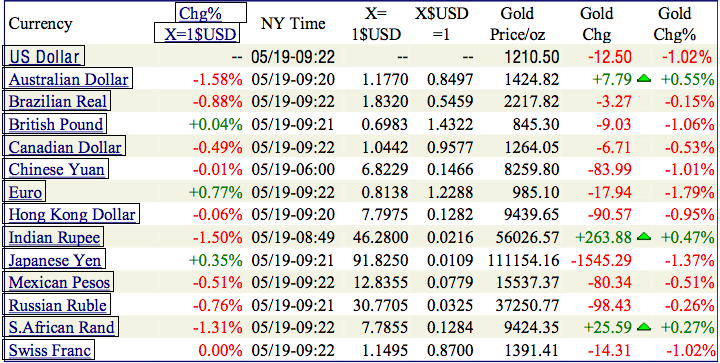
We think this course of action is unlikely as it is in Germany. In the table above you can see the Dollar, Yen and Euro are stronger. The Euro is being defended. It cannot prevail.
Governments seem to think that they can, by fiat, control the capital and debt markets. President Obama and the US Congress, please take note as you craft your new regulatory system for the American capital markets.
Here in Europe, and indeed around the world, citizens of every country are voting with their feet. The Euro is generally weaker and the US dollar stronger. Deleveraging goes on. Gold and silver have both taken it on the chin. But that setback is temporary. More concerns arise from the increased potential for significant sovereign debt restructuring in Europe (eventually in Britain and possibly the United States).
Even here in Switzerland, with its own stable currency, its significant backing of gold and its traditional conservatism in fiscal affairs, the man on the street is worried. It is the unknown that worries Europeans. After three mega wars over the past century or so, several crises and a hyperinflation of huge impact the unknown quickly becomes dominant. It is becoming evident that the European Union is an experiment that is failing badly. Only months ago, the Chinese and the IMF were suggesting that the Euro could become part of a new fiat currency reserve system to supplant the US dollar. You won’t hear that siren song again.
This will have ramifications around the world. The equity markets are on queue as well. The US equity markets have turned down decisively in response to an overvalued world and the scenario that slow growth and deflationary forces are upon us for the next 5 to 7 years. I wish there was a silver lining in this mess but the only suggestion I have this AM is to stick to good discovery stocks, with strong balance sheets and focus on gold, silver and energy metals. With the exception of our long held discovery stocks we are headed to the sidelines.
The Energy Metals seminar is excellent. Severn companies have presented and I shall write on that tomorrow as we all head for round two in Geneva. There is so much information on lithium, vanadium, rare earth metals, tungsten and electric cars to present. The companies presenting on this trip are Avalon Rare Metals, Western Lithium, Stans Energy, Dajin (Lithium In Argentina), Malago (Tungsten), Sino Vanadium and Great Western Minerals (rare earths in South Africa).
In addition we were fortunate to have Jon Hykawy, analyst from Byron capital markets who spoke with authority on “The Electric Car” potential in the United States. John Kaiser closed the session with a very complete review of “Metal Security and Supply Issues.”
And yes the US can electrify its economy. It will require 30 years but there needs to be a will and a new awareness in Washington that the country is almost bankrupt as the debt to GDP ratio now tops 87%. The country sends overseas close to $400 billion a year for oil and another $3 to $5 billion each year for uranium. What is it that Washington doesn’t understand about debt? Greece and the EU is just the tip of the Iceberg. Nota bena!
Sign Up for Michael Berry’s free daily letter HERE
The material herein is for informational purposes only and is not intended to and does not constitute the rendering of investment advice or the solicitation of an offer to buy securities. The foregoing discussion contains forward-looking statements within the meaning of the Private Securities Litigation Reform Act of 1995 (The Act). In particular when used in the preceding discussion the words “plan,” confident that, believe, scheduled, expect, or intend to, and similar conditional expressions are intended to identify forward-looking statements subject to the safe harbor created by the ACT. Such statements are subject to certain risks and uncertainties and actual results could differ materially from those expressed in any of the forward looking statements. Such risks and uncertainties include, but are not limited to future events and financial performance of the company which are inherently uncertain and actual events and / or results may differ materially. In addition Dr. Berry may review investments that are not registered in the U.S. He owns shares and in Goldcorp, Senesco Technologies, Natural Blue Resources, Horseshoe Gold, Derek Oil and Gas, Terraco Gold, Neuralstem, Piedmont Mining, MegaWest Energy, CGX Energy, Solares Lithium and Quaterra Resources. Dr. Berry is a paid advisor to Revett Minerals. We cannot attest to nor certify the correctness of any information in this note. Please consult your financial advisor and perform your own due diligence before considering any companies mentioned in this informational bulletin.
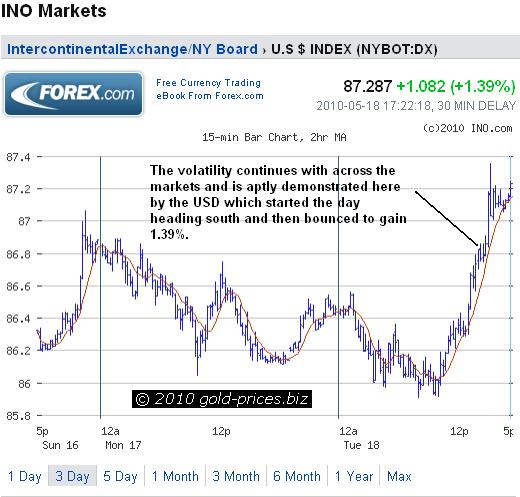
The volatility continues across the markets and is aptly demonstrated here by the USD which started the day heading south and then bounced to gain 1.39%. Gold prices drifted lower in Hong Kong and in London before heading higher in New York as the chart shows. We have warned about volatility increasing and becoming the order of the day, so hang on to your hard hats and your position in the gold and silver sector as they will reward you in time.
….read more HERE
Euro In Freefall, Volatility Picks Up
The euro is still in freefall hitting new lows of $1.2143 so far this evening. German Chancellor Angela Merkel announced today a ban of naked short-selling on the stocks of 10 major financial institutions and a ban of credit default swaps purchases on German government debt by speculators until March 31, 2011. This action is seemingly unneeded as the German DAX is up 0.8% year-to-date and yields on 10-year sovereign bonds are a mild 2.33%. Naked shorting of equities should be illegal to begin with; it’s against regulations in the United States and many other markets. The CDS ban is on transactions by traders that do not own the underlying and therefore do not qualify as hedgers. Yet, most of the speculative CDS purchases occur in London and fall outside the jurisdiction of the German government so the ban is largely ineffective. (WSJ) The move seems very misguided and I do not see how it will help the situation in Europe, it may even cause a great deal of harm with many analysts seeing it as a sign of “desperation”.
Chart via Money Talks (WOW – 2.84 cent drop yesterday)

…..read more HERE
The Hits Just Keep Coming…
The hit songs just keep coming for the euro… As often as the Beatles put them out from 1963 to 1970, or Elton John put them out in the 70’s…
Well… It’s the same for the euro… Just when it looked as though the euro might survive a day without being taken to the woodshed… The Eurozone officials just couldn’t stand the prosperity! ( and I use that word loosely!) German Chancellor Angela Merkel made some proposals to gain control over “destructive” financial markets… Her first move was to place a ban on naked short-selling…
Now… On the outside that sounds like it would help, right? Well… If history proves anything to us, and I truly believe that it does every single day, this would be a bad move… On September 8th 2008, the U.S. banned naked short-selling… Need I tell you how badly stocks performed from that date to March of 2009? I don’t think so… You know, if you were in stocks at that time, the collateral damage that ban on short-selling did…
The news “rocked” the euro, and European stocks… Then that news was followed up by an announcement by the Bank of Italy, that BANKS WILL NO LONGER NEED TO ACCOUNT FOR CAPITAL LOSSES ON EU GOV’T BONDS… Hmmm… Where have I heard that type of talk before? Oh! That’s right, I’ve heard it right here in this country, when it was announced over a year ago, that banks would no longer have to “mark-to-market” their bond positions…
The euro is back below 1.22 this morning, touching on 4-year lows again… The problem with the Big Dog euro having such a rough row to hoe these days, is that on the crosses, the other currencies get dragged through the mud, whether they are fundamentally sound or not!
As a son of a truck driver, I look at these things and shake my head… The European Central Bank has lost its top of the house credibility in my book… Things are what they are… That’s something my dad used to tell me all the time… And, so it is that I look at all the negativity in the euro right now, and say… It is what it is… And there’s nothing I can do to change that…
But I’m going to go out on a big fat limb here, and tell you that I think that the euro is nearing its low point… The big fat limb tells me that 1.21 might just be the figure… I remember in 2008, when I was out on the road with the FX University people, and there was a guy that kept telling people that the euro was going to collapse… And I would then get up and tell them that was bunk, and that I the euro would probably reach a low of 1.25 (it had fallen from 1.60 to 1.35 at that point)… And, by golly, that’s about the level that the euro turned around…
So, once again, here I am… The water is rising with people saying the euro is going to collapse again… And just like a spring time flood, the waters will eventually return to the banks…
The good thing about the euro’s weakness that nobody’s talking about, except me, (I mentioned it last week) is that as an exporting machine like the Eurozone, a weaker currency is like manna from heaven for the exporters… I saw a report that said the weaker euro would allow manufacturers to recover and add 1% to GDP this year… Germany’s economy is 50% larger than all the so-called peripheral countries (PIIGS or GIIPS if you want to be kind to pigs) combined, and it’s witnessing a strong manufacturing rebound…
As I said though, the bad thing is that it doesn’t just affect one currency, the euro in this case. Take fundamentally sound countries like Norway, Canada, and Australia… They have seen far too much damage to their currencies as a result of the euro bashing… I’ve got to think that this is just temporary for such fundamentally sound countries, and in a few months, we’ll look back at May’s levels and thank our lucky stars we took advantage of the cheaper buying levels!
OK… Enough on all that!
The other day, a long time reader sent me a forward to a story about the “Bond Vigilantes”, and how they had forced Greek bond yields so high that Germany had to step in to calm the markets… It was a great story about the “Bond Vigilantes”…
I responded to the long time reader, and said, “So… I keep wondering to myself… when the bond vigilantes demand a higher yield on Treasuries?”
And then yesterday, another reader sends me a forward on a story with economist Nouriel Roubini, talking about the Bond Vigilantes… Mr. Roubini said that the Bond Vigilantes will demand higher yields on U.S. Treasuries within 3 years…
I actually believe that it will be in the earlier part of that 3-year period…
Well, Japanese yen is the dance partner to the belle of the ball, dollar these days… And so it goes… The two most indebted countries in the universe, are considered to be better to own than fundamentally sound countries of Norway, Canada, and Australia… Makes no sense to me folks…
Of course, as I say that about Australia, they print a bad Consumer Confidence report that fell by 7% this month… Normally I think these Consumer Confidence reports are subject to so many things that they are skewered… But the Reserve Bank of Australia (RBA) has mentioned in the past that they follow the Confidence reports as it gives them a good idea of what to expect in the business cycle…
In another report from Australia… Wages grew at the fastest pace in the 1st QTR… Wage inflation is on the rise in Australia, which gives the RBA a nice feather in their caps for raising rates during the quarter!
This doesn’t change a thing that I told you yesterday about when I expect the RBA to come back to the rate hike table… But it sure did smack the Aussie dollar right between the eyes last night… OUCH! Now, that’s going to leave a mark! Hey! It’s not a laughing matter, but it certainly is a buying opportunity matter!
Today’s docket has the stupid CPI printing… And the Fed’s FOMC meeting minutes printing this afternoon. The markets will be looking for any change, be it minor or major, in the “extended period” language that follows the timeline for keeping interest rates a near zero… I don’t believe there will be any change in the language.
I say that the CPI is stupid for a number of reasons folks, and if you’ve been a long time reader you know them all by heart, just like the words to the Beatles song Michelle… One of the most glaring things about CPI is how stupid the number looks, and that the Gov’t truly believes that we think there’s no inflation… For instance, today’s number is supposed to show inflation is contained, at 2.4%… And the media will point to the X-food and energy number of just 1%… Lies! And more Lies!
Well… I take a deep sigh… Gold is getting sold again this morning, taking another $19 off its price, all the way down to $1,206! This is getting a little out of hand… This selling… But… It is what it is… What will you do about it?
I’ll be back in a minute, my fave song by Chicago is on and I have to stop and sing along…
Ok… I’m back now… You should do that each day… Stop and sing along with a song, you’ll see how much better it makes you feel!
Then there was this… Did you know that the it wasn’t just the Eurozone announcing measures to stop “destructive markets”? The U.S. was at it too, but that didn’t get in the way of dollar buying… The Securities and Exchange Commission announced new measures Tuesday to avoid a repeat of the dramatic market swoon earlier this month, saying trading should be halted in any stock if its value dives more than 10 percent in 5 minutes. The new measures were taken because existing circuit breakers were outdated and didn’t work on May 6, when the Dow Jones Industrial Average fell 1,000 points in minutes.
Good luck with that… I think those new circuit breakers are going to get tested quite often very soon…
To recap… The euro got deep sixed yesterday by German Chancellor Angela Merkel when she announced a ban on naked short-selling… The weak euro is dragging fundamentally sound currencies from Norway, Canada and Australia, down too… The weak euro is helping manufacturing in Germany and the exporters of the Eurozone, and could add as much as 1% to GDP. And Chuck goes out on a big fat limb with a thought on the low point on the euro…
Currencies today 5/19/10: American Style: A$ .8440, kiwi .6780, C$ .9535, euro 1.2210, sterling 1.4275, Swiss .8720, … European Style: rand 7.8205, krone 6.3970, SEK 7.8580, forint 230, zloty 3.3460, koruna 21.08, RUB 30.90, yen 91.25, sing 1.3990, HKD 7.8025, INR 46.36, China 6.8275, pesos 12.92, BRL 1.8215, dollar index $87.21, Oil $68.25, 10-year 3.35%, Silver $18.51, and Gold… $1,205.50
That’s it for today… I had a nice night sitting outside listening to the ball game with my old neighbor, and good friend, Kevin… Just like we used to all the time… Both Kathy and I miss the Yankers as our neighbors… The Cardinals pulled one out of the fire last night, but remain in second place. Next Monday will be the final and I mean final 24 episode… It has kept me company on Monday nights for 8 years… Chin up Wilber! Little Delaney Grace was so confused the other day… Her mom was sick, and vomiting… Delaney kept telling her mom to not “throw herself away”… She is so darn cute! OK… Gotta go… I hope your Wednesday is Wonderful!
Chuck Butler
President
EverBank World Markets
1-800-926-4922
1-314-647-3837
www.everbank.com
Every week I tell you about exchange traded funds (ETFs) that you can use for various investment purposes. You could be wondering, though, what’s the best way to buy them. So in today’s column I’ll give you some practical information that will help you implement whatever ETF investment strategy you might want to pursue.
Professional investors make a distinction between portfolio management and trade execution. You might not be a professional, but you can still use the same thought process …
Portfolio management is when you make the decision to buy or sell a particular security. Normally there will be limits on the decision. For example, maybe you only want to buy the shares as long as the price is less than $50. Or perhaps you want to sell all of your shares and be completely out by the end of the month.
Trade execution comes after the portfolio decision. You’ve already decided what you’re going to do; now you want to do it as cost-effectively as possible. Maybe you’re willing to pay $50 a share, but you’d be even happier if you can get in at $49. Good execution helps make this happen.
The importance of execution is directly related to your time horizon. If you’re planning to hold an ETF position for years, a few pennies on the entry and exit may not seem so important. However, those same pennies can add up quickly if you’re moving in and out every week.
With that in mind, here are five suggestions to help improve your ETF trading results …
Trading Tip #1:
Shop Around for Lower Commissions
Years ago, the only way to get into the stock market was through a broker, who charged dearly for his trouble. Now the story is different. You can bypass the smooth-talking salesman and buy stocks, mutual funds, and (best of all) ETFs online for a very small fee.
If you deal with a full-service broker, he’ll probably try to justify his exorbitant paycheck by telling you his firm really “works” your orders to get the best price. If you’re throwing around millions of dollars at a time, this may be true.
For the rest of us, you probably aren’t getting any better execution than you would at a discount broker. In fact, you may do better at a discount broker that doesn’t have a proprietary trading desk working against you.
These days it’s not hard to find reputable discount brokerage firms with rates of $7-$8 for a typical small trade. And there’s really no reason to pay any more.
Trading Tip #2:
Get Inside the Spread
If you look at an ETF quote during market hours, you’ll probably see some numbers called “bid” and “ask.” They may be quite different from the “last” trade price.
Bid and ask are the current market prices. The bid is the highest advertised price that you can get if you’re selling right now. The ask is the lowest advertised price you’ll pay if you’re buying right now. The “spread” between these numbers is how market makers earn a profit.
The key word here is “advertised.” Often you can buy for less than the ask, or sell for more than the bid. That’s why it is usually a good idea to try for a price somewhere between the bid and ask.
For instance, if you want to buy an ETF that has a bid/ask of $25.50/$25.80, try placing a limit order at $25.65. Wait a couple of minutes and see if anyone takes the bait. If they do, you just saved yourself fifteen cents a share.
Also keep in mind that the bid and ask aren’t unlimited. They apply only to a certain share quantity. A bid of $25, for instance, may be good only for 100 shares. Sell any more than that and you’ll get a lower price — and it could be a lot lower!
Trading Tip #3:
Use Limit Orders
Notice that I said in the above example to enter a “limit” order. This is simply an instruction to your broker not to process the trade unless the price is at or better than the limit you define.
If you enter a “market” order, you might not get the best price. What you will get is the best available price at that moment. And it could be substantially higher or lower than you thought you’d get.
I’ve found that it’s almost always better to use a limit order when trading ETFs, even if it means your order isn’t filled right away. The odds are that you’ll get a better price by waiting.
The only exception is a handful of mega-ETFs like SPDR S&P 500 (SPY) and PowerShares QQQ (QQQQ). These big, actively-traded ETFs normally have very tight spreads and ample liquidity. Small orders are filled instantly at the quoted bid or ask price.
Trading Tip #4:
Watch the Underlying Market
Several factors define an ETF’s liquidity. One of the most important is the depth of the underlying market. This is the basket of stocks that compose the ETF. Institutional trading desks often try to pick up some quick profits by moving back and forth between ETF shares and baskets of the corresponding index.
If the index is composed of large, actively-traded stocks, the ETF will probably have an efficient market as well. Likewise, when the index consists of low-volume stocks, any ETF designed to reflect it will also reflect the lack of liquidity.
It also helps for the underlying market to be open when you’re trying to trade an ETF. For instance, if you’re trading an international ETF composed of European stocks, you may do better in the morning. That’s because there’s a few hours in the morning when the European and the U.S. exchanges are open. This means more depth and, usually, better prices.
Trading Tip #5:
Be Aware of the Crowd
On a normal day the stock market tends to have a lot of volume in the first half-hour or so, less action in mid-day, and furious trading just before the close. The same is true of ETFs.
This pattern can work either for you or against you. If you’re trying to move a big quantity of shares, you probably want to take advantage of the depth present in the last hour. If you want to trade against someone who may not have thought ahead, you might find some good prices at lunchtime.
The point is that you must be aware of your surroundings. Market conditions are constantly changing. Just as you don’t go out in the rain unless you want to get wet, you shouldn’t go into a thin market unless you’re ready to turn it in your favor.
Follow these five trading tips and you’ll be surprised how much your results can improve. Are they magic? No, not at all.
You’ll still have plenty of ups and downs. But good trade execution is still a very important step for more active investors.
Best wishes,
Ron
Ron Rowland is president and a founder of Capital Cities Asset Management. Mr. Rowland is widely regarded as a leading ETF and mutual fund advisor as well as a sector rotation strategist. In addition to his roles of President and Chief Investment Officer of CCAM, he is Executive Editor and Publisher of the All Star Fund Trader, a highly regarded investment newsletter in its 18th year of publication.
You may have read about Mr. Rowland and his strategies in publications such as The Wall Street Journal, The New York Times, Investor’s Business Daily, Forbes.com, Barron’s, Hulbert Financial Digest and many more. Outside of CCAM, Mr. Rowland served on the Executive Committee of Austin’s American Association of Individuals Investors (AAII) and led the mutual fund special interest group for numerous years.
As a former mutual fund manager from 2000 to 2002, Ron was a pioneer in using ETFs inside of mutual funds. He also served as the manager of a hedge fund from Aug. ‘93 to Dec. ‘94. His formal education includes a BS in Electrical and Computer Engineering from the University of Cincinnati in 1978 with additional studies in the same field at the University of Texas from 1978-1981.
This investment news is brought to you by Money and Markets. Money and Markets is a free daily investment newsletter from Martin D. Weiss and Weiss Research analysts offering the latest investing news and financial insights for the stock market, including tips and advice on investing in gold, energy and oil. Dr. Weiss is a leader in the fields of investing, interest rates, financial safety and economic forecasting. To view archives or subscribe, visit http://www.moneyandmarkets.com.
Martin Weiss: Just days ago, the cradle of Western democracy — Greece — was in flames! Rioters attacked banks, businesses and government buildings. The entire country plunged into chaos. Spain, Portugal, Italy and even the United Kingdom were reeling. The euro was crushed.
Then, as we have warned you consistently and persistently, the raging storm in Europe struck our shores … ripped through our corporate bond market … created chaos in our stock market … and threatened to derail our already-fragile economic recovery.
In response, Europe announced a trillion-dollar bailout while our own Federal Reserve issued a blank check to give Europe virtually any money it says it wants. And still the euro has plunged, while gold has soared to new highs! Still the crisis is not over!
All this is raising several urgent questions for investors.
First, does this new debt crisis mark the end of the big market rally since March of last year?
Second, how is the European debt crisis likely to impact your investments now and in the weeks ahead?
Third, when will this crisis hit Washington and what will they do next?
Fourth, how can you protect yourself no matter what Washington decides to do?
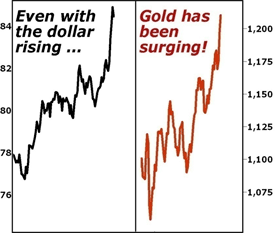
And fifth, gold! Gold has surged dramatically, even with the dollar rising.
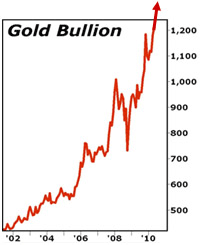
How high might gold go if the dollar falls? Should investors add to their gold holdings now or wait for a correction? What about gold shares and other natural resources?
Sovereign Debt Crisis is
Really a Currency Crisis!
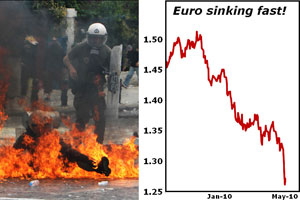
Larry Edelson: Hi Martin, I’m calling in from Asia, and every night, while you’ve been sleeping, I’ve been watching this crisis unfold in real time. So let me tell you what I see. The sovereign debt crisis is a currency crisis! And I’m worried it’s going to be a lot bigger than even I expected. The fact is Europe is sinking and the euro is crashing.
Martin: What about the trillion-dollar bailout of Europe?
Martin: What about the trillion-dollar bailout of Europe?
Larry: It changes nothing. It means massive money printing and even more spending by bankrupt economies. The plunge in the value of their currency — any currency for that matter is the pivotal financial consequence of a sovereign debt crisis — the major consequence that we have been warning you about. I repeat: This is a CURRENCY CRISIS. Currencies are cornerstones — the stock — of a country.
This is an explosive crisis that can wipe out people’s wealth without them even knowing it. But it can also provide them with the broadest opportunities for profit. My primary goal today is to guide you in this crisis, to protect your wealth and to finding nice opportunities to profit from it.
Martin: Yes! But let’s start with the impact on global stocks, especially U.S. stocks. Mike?
Mike Larson: First of all, if you’ve been reading our alerts or you subscribe to our newsletters, you should not be loaded up with stocks. We’ve been warning about the dangers all along. Our cash positions are high. Despite low yields on cash, our primary concern has always been about the return OF your money — over and beyond the return ON your money.
Second, we have not been playing the stock market overall. We have been very cautiously and selectively recommending the unique stock sectors and foreign countries that have the fundamental power to endure before, during and after this crisis.
Martin: But that doesn’t protect you from market crashes.
Mike: No, of course not. For that, we use hedges and inverse ETFs. We also take advantage of rallies to pare down our positions
Martin: Some folks writing in have apparently not followed that conservative approach. They are loaded up. And they want to know what to do.
Larry: I want to jump in here about gold. I want to make it clear; I don’t believe investors should unload gold shares.
Martin: OK. My question to Mike is: If you’re overloaded — except with gold shares as Larry interjected — what specific steps do you recommend to unload excess positions?
Mike: A good rule of thumb is to sell half of your excess holdings now and then revisit the balance when you get a good rally.
But I do have a word of warning: Even when you get the rally, it is very easy to forget the crisis. Things may appear to have quieted down, but it’s really going to be just the next calm before an even bigger storm that is coming.
Larry: For gold it is a very different strategy. Gold is going up right now despite a rising dollar. It will go up even more when the sovereign debt crisis hits the dollar, and the dollar starts plunging like the euro is. I expect it to hit $1,300, then $1,500 and then ultimately to at least $2,300 an ounce.
So core gold holdings should be held no matter what, in my opinion.
Martin: What about in the short term?
Larry: There are going to be wild zigs and zags like we are seeing in all markets. Just never forget the sheer enormity of the sovereign debt crisis, which, again, is ultimately a currency crisis.
Mike: For many years, a handful of observers have been warning with a simple message: We can’t borrow and spend forever and get away with it. We warned. Others warned. But no one in the political or financial capitals around the world paid any attention. They laughed at us. They ridiculed us. Now that day of reckoning is here.
Martin: What’s so utterly deceptive about these events is that they can indeed get away with it for such a long period of time.
Mike: Yes, and Greece is the perfect example. For years, we knew Greece’s government was going wild with its spending, and some analysts warned about it until they were blue in the face.
But even amidst all the warnings, Greek government officials would go on TV and say: “What’s the problem? If we really were doing something wrong, we’d have trouble borrowing money. But look! We have hoards of investors buying our bonds. We can borrow as much as we want for less than 3%. So where’s the crisis?”
That continued year after year, until one day the party ended. No one rang any bells to warn them. No one single event triggered it. The worries and warnings that had been percolating for years just reached a critical mass and blew up. Suddenly, bond investors declared a virtual buyer’s strike. Suddenly, Greek bond markets collapsed. Suddenly, their interest rates were doubling and then doubling again.
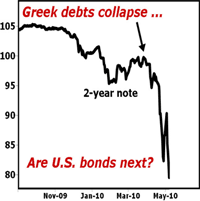
Larry: A collapsing bond market goes hand in hand with a collapsing currency. Both are driven by the same government spending, borrowing and reckless money printing. Both are driven by the same global investors. When they sell euro-zone bonds, they sell the euro. If they sell U.S. dollars in denominated bonds they are going to be selling the U.S. dollar.
Look at this plunge in the euro — in just two or three weeks; it got smacked down from 1.36 to 1.25. That’s a massive, 8% decline — in just three weeks.
Martin: Only 8% that doesn’t sound like that much?
Larry: 8% in a currency change? Are you kidding? For a major currency? Remember, this isn’t just a single stock or stock market. It is the foundation of the European Union. It is their currency. It represents, in essence, the equity value of the economies of 16 countries, almost an entire continent.
If the decline continues at this pace, everything Europe produces or owns will lose half its value in about five months.

Martin: So what’s the lesson you want to take out of these charts?
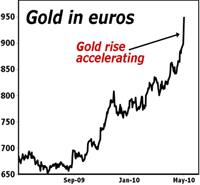
Larry: In the past when the euro was falling so was gold. That is not happening now. Now, you have a bull market in gold in terms of ALL major currencies. So the lesson is: It doesn’t matter which major currency is crashing. They are all losing purchasing power. The key: If gold is rising in response to the euro’s decline, imagine what it will do in response to a collapse in the world’s reserve currency — the dollar!
The Next Big Domino
Mike: The dollar is the next big domino in this debt crisis. Look. Most people see this as a new debt crisis that just began this year. But it’s not. It’s the same debt crisis that began over three years ago with the housing bust. Governments in the western world went hog wild spending trillions to bail out their banks, their economies. They bought up trillions in toxic assets. They took over the crisis. And now they OWN the crisis. So it should come as no surprise that governments themselves are now the next targets of investor revenge — the next institutions that need bailouts!
Martin: This is precisely the sovereign debt crisis we warned about in our white paper submitted to Congress …
Mike: … when they were voting on the TARP bill to bail out the banks in September of 2008.
Martin: Now it’s here. This is it!
Mike: In Europe, yes. In the U.S., not quite. In the U.S. we still see the same syndrome as we saw in Europe just a few months ago. We see virtual clones of the officials and pundits we saw in Greece — but this time from Wall Street and Washington. And they’re saying almost exactly the same thing the Greek officials were saying last year: “Look,” they say. “We have tons of investors rushing to buy our bonds … and we can borrow as much as we damn please for less than 4%! So what’s the problem? Where’s the fire?”
Martin: I see the parallels. But it still begs the question, if the United States is in such grave danger, how come we don’t see our government bond markets tanking like Greek bonds have tanked?
Mike: Because the Western world is like the Titanic … because the U.S. bond market and dollar market, are like the stern of the Titanic.
Martin: Before the Titanic sank, the stern section was pulled up by the sinking bow. The stern actually rose up high out of the water.
Mike: Yes! And when we see a global flight to quality, we see everyone rushing to the stern — to the dollar and the U.S. Treasury market. They have the illusion that’s where they can find higher ground, safety. That’s why you see U.S. bond prices temporarily rising while the euro-zone bonds sink.
Larry: And why you see the dollar rising while the euro plunges. But there is not going to be any safety found in the stern of the Titanic.
Mike: As you know, Larry, countries from both sides of the Atlantic are in the same boat. Both the U.S. and Europe have all been spending like crazy for years. Both got hit by the housing bust and debt crisis. Both spent massive sums on bailouts and economic rescues. So as a result, both are loaded with debts they cannot possibly pay. And here’s the key: Both are vulnerable to the same contagion that has struck Greece and much of Europe.
Larry: But I talk to a lot of American investors who, like Wall Street and Washington, are still in denial. They don’t believe that our country has racked up the debt that we are talking about.
Mike: OK. Let’s prove it right now. Five euro-zone countries have more debt than they can possibly manage and are in danger of defaulting. But what most people do not realize is that the United States is in the same category. It is not different. It is not special. It is ultimately equally … or even MORE vulnerable. Consider these facts:
Spain, which just got downgraded, has 59.2 cents in debt per dollar of GDP. But the U.S. has far more — a whopping 94.5 cents on the dollar!
Martin: Our debt load is worse than Spain’s!
Mike: Much worse! And look at Portugal, which also was downgraded. It’s running a deficit that chews up 8.3% of its GDP. That’s way out of line. But the U.S. federal deficit is significantly worse — gobbling up a whopping 10.6% of our GDP. Even compared to Greece, America’s deficit level is only slightly less bad — 10.6% of GDP in the U.S. vs. 12.2% in Greece.
Larry: The U.S. is the leader of the global borrowing and spending rampage. It was ground zero of all the fiscal insanity. The U.S. government has the most domestic debts of all nations in the world — $127 trillion, including what it owes to its citizens in the form of Social security and Medicare. The U.S. has the most foreign debts of all nations in the world. So this makes you wonder …
Martin: Greece, Portugal, Spain and the other PIIGS countries supposedly have the IMF to fall back on. The IMF has Washington to fall back on. But who’s going to bail out Washington?
Larry: The answer is that there’s nobody left to save America, and the American taxpayer is going to take the brunt of it. We are the world’s richest nation. We are the safety net of last resort. When America’s turn comes, Washington will have two and only two choices:
Choice #1: Simply walk away — default on the $12.6 trillion of national debt we owe to bond investors.
Martin: They’re not going to do that.
Larry: Of course not. But they will do it indirectly and that is Choice #2 — to print more money deliberately and devalue the dollar without coming out and saying they are doing it. They believe they can pay back their debts with a much cheaper currency.
Martin: Isn’t there also a third possibility — the possibility that they actually make massive, painful cuts in every major government program — including Social Security, Medicare and Medicaid — to bring the budget back into balance?
Larry: Can you imagine if Washington came out and said “We are going to cut Medicare and Social Security,” or “we are going to cut back on government pension guarantees”? Look at the riots in Greece!
Martin: One of our readers just wrote in saying the pundits have a hard time believing that this crisis will spread beyond the five PIIGS countries — Portugal, Ireland, Italy, Greece and Spain.
Mike: That’s the same b.s. we heard in the subprime mortgage crisis. Remember: That crisis did not start with the biggest dominos — Citigroup or Bank of America. It started with a core of small subprime lenders that were the highest risk offenders, and they ALSO said it could be “CONTAINED.”
Then, it spread outward from there, and at each step of the way, they AGAIN said it would be “contained.” Now, something similar is happening here. It started with the worst offender — Greece — and they said that could be contained. But you can see what the market judgment is — it has already started spreading to Spain’s bond market, to Portugal’s bond market and others, and they’re STILL saying it can be contained!?
If the UK and U.S. and other major countries were in great financial shape, sure. But they’re not. In many respects, especially in terms of our debts to China, Japan and others, we are actually in worse shape.
Larry: My view is that Bernanke is blinded by his theories of history. Geithner won’t listen. Obama is mute on the subject. They see, hear and speak no trouble. But I don’t care what they say about the differences between the U.S. and Europe. A broke government is a broke government. Period.
Martin: You’ve made your point, Larry. And so far you’ve been right. So let Mike and me ask you some tough questions we’re getting from readers. First, what’s next in your scenario?
Larry: A temporary rally in the euro is possible, followed by another collapse. Up until now, compared to our Federal Reserve, the European Central Bank has been pretty conservative. But now it’s going to have to get aggressive and follow the lead of the Fed. So it’s going to start printing money like crazy to fund the bailout for Greece and try to stop the contagion from rolling through the rest of Europe.
It already made a decision about a week ago to accept junk bonds as collateral on its debt, and it’s already printing more money. But all this is to no avail because Europe’s currency — the euro — has some unique, fatal flaws that are going to exasperate this crisis.
First of all, the euro is a rookie currency. It is an experiment that’s only 12 years old. In my opinion, the currency was created ass backwards. It was put in place without a unified constitution behind it.
Martin: The euro crumbles. Then what?
Larry: Next, the Federal Reserve will print more money to fund the money they’ve promised. It’s a desperate last-ditch stand to help defend the euro.
Martin: The Fed is now printing money to buy European bonds.
Larry: Yes. And as the crisis strikes our shores, the Fed will print even more money!
Martin: What happens in the end?
Larry: In the end, just like the euro currency plunged dramatically, the U.S. dollar will plunge dramatically. Both currencies will go down, although in different ways: The euro will fail as a currency or at least lose many of its members. And the dollar will lose its status as the world’s reserve currency.
Mike: A subscriber to your Real Wealth Report is asking:
“The dollar is the world’s ultimate safe haven,
the world’s main currency. Doesn’t that protect it?”
Larry: It did when everything was going fine for the world. But in bad times, it’s likely to be terrible for the U.S., putting a huge, additional burden on our government and our people.
Look, I travel a lot and I can tell you that, in every corner of the globe, investors blame the U.S. for this whole crisis. The outcome is that everyone also looks at the U.S. to SOLVE the whole crisis. That means that a huge portion of the entire burden of the global debt crisis will ultimately fall on the U.S.
Martin: Can you sum up what’s driving gold higher?
Larry: Sovereign governments are broke. The public and investors are finally realizing it and acting on it. So governments are responding by printing money and by gutting their currencies.
Martin: One reader has asked:
“I heard somewhere that Larry recommended investors put only about 10% of their money in gold and then I’ve heard him say that the value of gold bullion could double or more. If gold is going that high, why only 10% in gold?”
Larry: I’m not sure where that 10% figure came from, because my standing position in my Real Wealth Report has been 25% of your total investable funds in gold.
Martin: In gold bullion?
Larry: No, not all in gold bullion. About half of the 25% — 12.5% — in gold bullion and gold bullion equivalents — like the SPDR Gold Trust ETF (GLD) — or other gold bullion ETFs.
Martin: How do you buy bullion?
Larry: First let me tell you how not to buy bullion. Two gold investments I recommend people avoid with a ten-foot pole are rare (1) coins and (2) commemorative coins which are being advertised in practically every newspaper and on every TV channel.
Martin: So what is the best way to buy gold bullion — other than an ETF?
Larry: The best way to buy bullion is in 1-ounce, 5-ounce and 10-ounce ingots plus kilo bars. You don’t have to pay the premiums you are paying on American Eagles or Canadian Mapleleafs.
Martin: That covers the first half of the 25%. What about the other 12.5%?
Larry: In mining shares!
Martin: Name three.
Larry: I actually have four I want to name today. And they are all cream-of-the-crop gold shares.
Goldcorp (GG) — one of my favorites — is the world’s second-largest gold producer, with nearly 49 million ounces in proven and probable gold reserves, which it’s producing at a cash cost of $295 an ounce.
Agnico-Eagle Mines (AEM) is a Canadian-based gold producer with just over 18 million ounces of gold — a fantastic company.
I have a mid-sized miner, Golden Star Resources (GSS), with just over 2.3 million ounces. It is not a very big player but it knows how to hunt down and add to its reserves.
Plus, one of my big favorites is Seabridge Gold (SA), an exploration company with just over 30 million ounces of gold in proven reserves. Golden Start reminds me of Royal Gold, which is up over 800% in the last nine years. Royal Gold did something unique, cutting royalty deals with miners to mine the property, and taking a royalty off the top.
Silver, Platinum and Palladium
Mike: Can we talk about silver? Many of my readers — and yours I presume as well — are saying they follow analysts who believe silver will outperform gold going forward. Can you throw some light on this?
Larry: I like silver. I am bullish on silver over the long haul. But I do not believe it will outperform gold. Silver is not a monetary metal; it’s an industrial metal. And this crisis is fundamentally, a monetary crisis. That’s the chief reason I’m not as bullish on silver.
Martin: What about platinum and palladium?
Larry: I prefer them over silver. They are far more in demand and in shorter supply.
Martin: You can buy GLD for gold, how can you play platinum and palladium?
Larry: The best way to play platinum is with the UBS E-TRACS Long Platinum Total Return ETN (PTM), which tracks the future prices of platinum. And the best way for palladium is the Physical Palladium Shares ETF (PALL), which tracks the futures price of palladium.
Martin: Do you recommend buying them right now?
Larry: No. Platinum was recently at a record high and same with palladium. I’d wait for a correction. Those markets have been on fire and are likely to pull back. You want to buy them near the end correction. Same thing for gold, if you are not in the gold market right now I would recommend holding for a little bit and waiting for the next correction.
Gold Stocks in a Crash?
Martin: Here’s another frequent question from readers:
“I understand how gold can be a good investment if paper currencies are getting clobbered. But if the scenario you are forecasting pans out, could it also have a negative impact on stocks? Why would mining stocks, or for that matter energy and other natural resource stocks, not be negatively impacted?”
Larry: I never said they wouldn’t be. In the initial panic of a crisis, investors dump everything. But that will not last. You need to hold your core position in gold during this monetary crisis as the value of paper money is getting destroyed.
Martin: What are your favorite energy plays?
Larry: Oil is not as pure as gold, but it’s similar in that it’s also a contra-dollar play. My forecast for oil is that it will go over $100 by next year and move higher as the dollar goes down.
As with gold, I like the big blue-chip energy companies: Chevron, Sinopec, ExxonMobil. These are going to be good investments and they’re going to be revalued higher when the dollar goes lower. Meanwhile, China’s first quarter oil demand was up some 9.6% over last year.
Martin: How else would you tell us to play the Chinese economy?
Larry: You need to be aware that although the U.S. and China economies have almost decoupled, the American and Chinese stock markets have not. When people panic, they tend to do it all over the world. If the U.S. market falls, so will China’s — but only temporarily.
My favorite China plays: Sinopec (SHI), which I mentioned earlier, one of the leading oil and energy companies in China.
There is the FTSE/Xhinhua China 25 (FXI) should be held to take advantage of a very long-term bull market in China.
And a very interesting company doing well with copper is Jiangxi (JIXAY). China is the world’s largest importer of copper.
Two Basic Strategies
Martin: Overall, what is your strategy going forward right now?
Larry: I have two strategies:
I have a core portfolio strategy with cream-of-the-crop natural resource companies, cream-of-the-crop contra-dollar real wealth tangible asset type companies — precious metals and energy — to be held in the next five years. I expect them to be substantially higher in the next five years.
Plus, I have a shorter term trading strategy for trading the swings in both directions — with more leverage and in a short burst of time.
Martin: Talk about swings! The price of oil went from $10 a barrel to $147 a barrel, a fifteen-fold increase, and then plunged to around the 30s and then back to mid $80 area. Is this a good thing or bad thing?
Larry: From a trader’s point of view, it’s fantastic — big moving swings can be great for making money.
Martin: And if you don’t like big swings?
Larry: If you don’t like the big swings, there are other natural resource assets that are also contra-dollar plays that are good for this kind of crisis. I’m talking about food and water — basic, essential consumer staples.
Martin: Larry, you’ve generously given us some very specific recommendations today. May I end this session with a warning? Risk is not a four-letter word that you can never ignore. The only way to totally avoid investment risk is not to invest at all. But then you face other, potentially greater risks — to your income and to your wealth.
Larry: You’re absolutely right. The number one lesson of this crisis is: If you do nothing you are going to get mugged of your wealth. No matter where you go, risk is unavoidable and no one can ever guarantee profits. But I think the opportunities here are enormous, provided you have the right guidance and you act with prudence. That’s what I do with my money. That’s how I want to help you with yours as well.
This investment news is brought to you by Uncommon Wisdom. Uncommon Wisdom is a free daily investment newsletter from Weiss Research analysts offering the latest investing news and financial insights for the stock market, precious metals, natural resources, Asian and South American markets. From time to time, the authors of Uncommon Wisdom also cover other topics they feel can contribute to making you healthy, wealthy and wise. To view archives or subscribe, visit http://www.uncommonwisdomdaily.com.
Technical Action Yesterday
Technical action by S&P 500 stocks was quiet yesterday despite extreme volatility. One S&P 500 stock broke resistance (Pactiv) and none broke support. The Up/Down ratio was unchanged at (242/158=) 1.53.
Technical action by TSX Composite stocks was bearish. No TSX stocks broke resistance and five stocks broke support (Celtic Exploration, Labrador Iron Ore, Major Drilling, Quebecor and Toromont). The Up/Down ratio slipped from 1.16 to (86/81=) 1.06.
Interesting Charts
Currencies are leading equity markets. Yesterday morning, the Euro fell to another 4 year low. The U.S. Dollar moved higher and equity markets quickly moved lower. Yesterday afternoon, the Euro recovered. The U.S. Dollar moved lower and equity markets recovered.
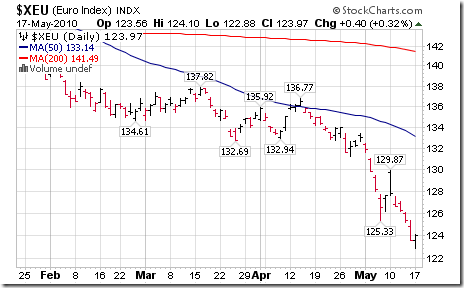

Gold came under pressure with the recovery in the Euro.
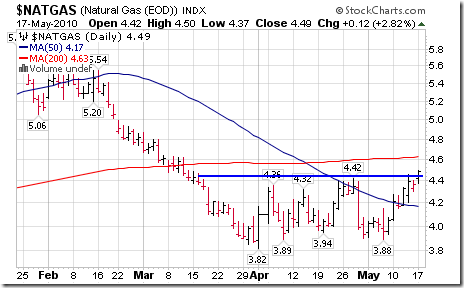
Nice breakout by natural gas yesterday!
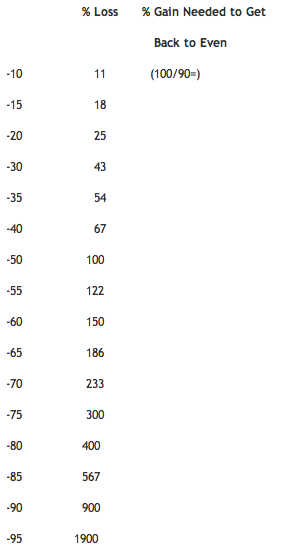
Dennis Gartman wrote an interesting article recently that explains the “viciousness of percentages”. The article was entitled, “The cost of getting even”. The article explains why liquidating an investment with a loss when losses are relatively small is am important strategy. He noted that a loss of 50% requires a gain of 100% in order to break even. He offered a table showing Percent Loss versus Percent Gain Needed to Get Back to Even. Here is the table:
ETF Update
…..read more HERE
-
I know Mike is a very solid investor and respect his opinions very much. So if he says pay attention to this or that - I will.
~ Dale G.
-
I've started managing my own investments so view Michael's site as a one-stop shop from which to get information and perspectives.
~ Dave E.
-
Michael offers easy reading, honest, common sense information that anyone can use in a practical manner.
~ der_al.
-
A sane voice in a scrambled investment world.
~ Ed R.
Inside Edge Pro Contributors

Greg Weldon

Josef Schachter

Tyler Bollhorn

Ryan Irvine

Paul Beattie

Martin Straith

Patrick Ceresna

Mark Leibovit

James Thorne

Victor Adair