
Daily Updates
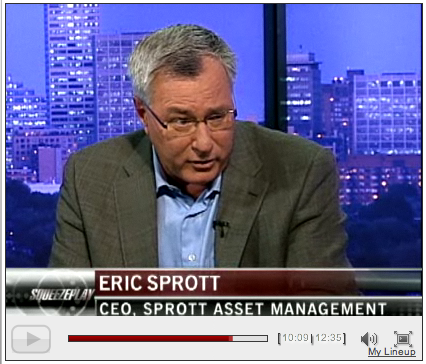
He’s one of Canada’s best-known gold bulls. And with gold charging ahead, Eric Sprott, chairman and CEO, Sprott Asset Management, tells BNN what he thinks about the economy, government debt in Europe, and where investors should put their money.
Quotable
“Do not worry if you have built your castles in the air. They are where they should be. Now put the foundations under them.” – Henry David Thoreau
FX Trading – A lot to worry about
The stock market of late seems to be noticing them. But commentators seem to be looking right past them—systemic risks. Why do I say that? Well, it seems every time I flip on the TV to a financial show, one mutual fund manager after another is trotted out to tell me this is a great buying opportunity. They do it with such confidence. They are dressed so well. They are usually fairly good looking, trim and fit—not dumpy and ruffled like me. All part of the sales package is my conclusion.
Granted, I think a lot of these managers do actually believe what they say. But they really do lack perspective. I would prefer if they said something like this:
“It may be a good buying opportunity if this is a correction, but the reality is that we human beings never really know if a correction is a correction or a major change in trend. I don’t care how good you say your technical indicators are—you never know until the gift of hindsight is handed to you.”
So Mr. Fund manager, a little more humility might be in order given what we do know as potential systemic risks lingering out there; they aren’t insignificant:
1. The potential demise of the Europe monetary union
2. China deceleration in growth linked with credit bubble woes
3. War between North and South Korea
4. War between Israel and Iran
5. US job market deterioration
6. Civil war in Thailand
7. Eurozone demand falls off the cliff on austerity measures
8. The US consumer goes back into his shell scared by stock market
9. Global deflation becomes the new norm; corporate pricing power tanks
…..read pages 2-4 HERE
The New Truth About Natural Gas Could Shock the Market
Investor sentiment is changing – to the positive – on natural gas. Despite record or near record injection levels into storage in the US most weeks, gas prices have remained steady or even risen. The number of drill rigs actively drilling for gas has barely budged, though it has been down in the US three of the last four weeks.
But the market believes slightly increased demand and slightly lower rig counts is enough to move the natural gas price in the US up between 10-15% in the last week. (Canadian gas prices are up 1-2%)
The US gas market could really get a boost this week as early estimates for injection are between 60 bcf (billion cubic feet) and 100 bcf. Last year’s injection was 100 bcf.
But there are a couple other ideas that the market is grappling with. Bill Powers, editor of Powers Energy Investor, has been one of the loudest voices proclaiming the current glut in gas will be short-lived as many conventional basins are declining rapidly. One thing to remember is that when a market is bearish, it doesn’t want to look at good news (and vice versa). So Powers’ idea – supported by a slew of facts he has put together and is now writing a book on – isn’t mainstream enough to yet affect the price.
The other idea is that the total recoverable amount of gas in these new shale plays is not what the market believes.
Art Berman began giving a presentation as early as last December that the EUR (Estimated Ultimate Recovery) on these wells was much below the 20 years plus he was hearing from the industry. He plotted several graphs which he says shows that 63%-95% of the economic value in a shale gas well is used by year the end of Year 5 – and should be shut in.
His data shows that 3.5‐5.0 Bcf is the highest average EUR for any Haynesville operator, and most are far lower, and yet a 5‐6 Bcf EUR is threshold for break‐even economics because of high well cost ($7‐10.5 million).
You can read his blog here: http://petroleumtruthreport.blogspot.com/
This theory is gaining increasing credibility in the market, despite the impressive sales job the industry has been able to do in convincing the market otherwise.
Another shale gas sceptic is Financial Times writer John Dizard. He has written a series of articles this spring that outline the great sales job he believes the natural gas producers have done convincing investors that shale gas can be economic at these price levels. You can read one of his several stories here: http://tinyurl.com/2cn4ox7
For over a year now analysts in the US like Benjamin Dell have been saying that investors should not believe shale gas producers when they say, in their corporate presentations, that they can make money under $5/mcf gas. He suggested their financials showed otherwise.
And of course, even the natural gas CEO’s have thrown in the towel, with both Chesapeake and EOG Resources saying they must get more oily, and less gassy.
All this has now got the market believing that rig counts will continue to decline, weekly injection levels will soon start moving below the five year average, and natural gas prices and stocks will move up.
Other factors include hurricanes in the Gulf of Mexico (GOM). The 2003-2008 years had lots of hurricanes, with Katrina being the most famous. Large amounts of natural gas production in the GOM was shut in for months at a time. I still believe the amount of water that shale gas uses could end up causing a stir in the market.
I have stayed away from natural gas weighted stocks for over a year – unless they were part of the Cardium craze in Alberta earlier this year, and is one reason why the subscriber portfolio returned 146% in 2009.
But last year I also dedicated one issue to a few natural gas stocks that investors could consider on their own if they were determined to play. In one of my next two issues I’m going to briefly update those stocks, and introduce a couple new ones that have developed into intriguing OGIB portfolio prospects.
The timing on this upward move in gas could be perfect, as I have thought most gas stocks overvalued for a long time. But they now have gone lower as part of the downdraft in oil prices. If you’re a believer in gas, this issue will give you some great ideas on stocks that already have a big growth engine built in, and have great leverage to a rising natural gas prices.
Hello, this is Keith Schaefer, editor and publisher of The Oil & Gas Investments Bulletin. I started my subscription service in mid-2009 because I could see there was no place where retail investors could go to easily find which oil and gas companies were creating huge shareholder wealth by using exciting new technologies, such as horizontal drilling, fracing and 3D seismic.
These companies are increasing cash flows – and stock prices – by finding ways to get more oil and gas out of the ground. And junior and intermediate producers – $2-$20 stocks – are leading the way.
You may have noticed that crude oil prices plunged over the last few weeks. On May 3, the June crude oil futures peaked at more than $87. Then on Monday, May 17 the same contract slipped below $70. That’s a decline of about 20 percent in only ten market days!
Of course we could go back in history and point to some periods when oil prices went up just as quickly. What this illustrates is that — like many commodities — crude oil can be very volatile.
For a trader, volatility spells opportunity. Unfortunately, very few people are able to make consistent profits trading in the futures market. The leverage is just too much for most individual investors.
Once again, ETFs to the rescue!
Several exchange-traded products allow you to bet on crude oil prices without the hassle of opening a futures account. You buy and sell them just like you would any other stock or ETF.
Here are five you can choose from:
- iPath S&P GSCI Crude Oil Total Return ETN (OIL)
- PowerShares DB Oil Fund (DBO)
- PowerShares DB Crude Oil Long ETN (OLO)
- United States 12 Month Oil Fund (USL)
- United States Oil Fund (USO)
There are also several leveraged and inverse oil funds. But for now we’ll stick with these five since they are roughly comparable. All use derivatives to track various crude oil benchmarks. Unfortunately this is not a perfect science — and that sometimes leads to disappointment for investors.
For instance, consider the two-week stretch I mentioned above when oil futures fell about 20 percent. Here’s how each of the unleveraged oil-tracking ETFs and ETNs did during that period …
- OIL: Down 19.6 percent
- DBO: Down 17.4 percent
- OLO: Down 17.5 percent
- USL: Down 15.5 percent
- USO: Down 18.3 percent
As you can see, the general downtrend hit all these funds, but by no means equally. The best of the four, USL, outpaced the worst, OIL, by more than four percentage points. Again, this happened over just two weeks.
What about longer time periods? Let’s look at one-year performance for 5/18/09 through 5/17/10 …
- OIL: Down 2.5 percent
- DBO: Up 10.6 percent
- OLO: Up 10.4 percent
- USL: Up 13 percent
- USO: Down 3.6 percent
Clearly not all oil ETFs are the same. So it can make a big difference then which one you pick!
But Isn’t All Oil the Same?
Similar, yes. The same, no.
Oil is classified into various grades according to density (heavy vs. light) and sulphur content (sour vs. sweet). The delivery date also matters, since storing large volumes of oil is expensive. This is why oil is traded via futures contracts, which allow buyers and sellers to go with their own schedules.
Each of the oil-tracking products listed above faces a problem called “roll risk.” Say you have $100 million to invest in oil. Every time you “roll” your contracts forward to another month, you have to sell some futures contracts and buy new ones to replace them.
You may have heard the word ‘contango’ in reference to the futures market. Contango happens when the contract price for the following month (the one you are buying) is higher than the price for the current month (the one you are selling).
In other words, when the market is in contango, you’re losing money on every roll. And the longer you stay in, the more you can lose.
Depending on many different factors, the rolling activity can be costly. This is even truer if you have a large amount of money and want to maintain a constant exposure level — which is exactly what the oil ETFs and ETNs need to do.
One of the funds I named, United States 12 Month Oil Fund (USL), is explicitly designed to reduce this problem. Instead of concentrating its assets in one particular contract, it spreads them out over a 12-month period (hence the name). This helps but doesn’t completely eliminate the quandary.
I find that many investors have a hard time understanding all this. They don’t see why it is so hard to just buy crude oil and hold it for a long time …
The reality is that bulky commodities like crude oil are more than just entries in a computerized ledger. Ultimately they represent actual oil that must be produced, stored, moved around, refined, and eventually be sold to an end-user.
Unlike many of the gold ETFs, that actually buy and store gold bars in a vault, it is too costly and impractical for a crude oil ETF to do the same thing.
So what’s the answer?
I Have Three Tips For You …
First, realize that whatever oil proxy you buy will likely not be a precise match for the crude oil movements you hear about in the media. Other factors are at work. So be satisfied if you can just match the general direction and magnitude of the world oil markets.
Second, keep in mind that oil is not a buy-and-hold investment. I don’t know where it’s going in the years to come — and neither does anyone else! It can make sense as a tiny slice of a diversified portfolio, but even then you have to have a plan of action for the periods when oil prices are declining or when the roll risk is too large.
Third, take a realistic look at your own skills and objectives. Commodity trading, even with ETFs, may be tempting but it’s not for everyone. Be honest with yourself. There is no dishonor in sticking with what you know.
Best wishes,
Ron
Ron Rowland is president and a founder of Capital Cities Asset Management. Mr. Rowland is widely regarded as a leading ETF and mutual fund advisor as well as a sector rotation strategist. In addition to his roles of President and Chief Investment Officer of CCAM, he is Executive Editor and Publisher of the All Star Fund Trader, a highly regarded investment newsletter in its 18th year of publication.
This investment news is brought to you by Money and Markets. Money and Markets is a free daily investment newsletter from Martin D. Weiss and Weiss Research analysts offering the latest investing news and financial insights for the stock market, including tips and advice on investing in gold, energy and oil. Dr. Weiss is a leader in the fields of investing, interest rates, financial safety and economic forecasting. To view archives or subscribe, visit http://www.moneyandmarkets.com.
May 21st Letter: I’ve been computing my PTI on a daily basis since the early 1960s. In 50 YEARS THIS IS THE MOST DECISIVE TOP I can ever remember….
May 19th Letter – “If the May 7 lows are violated by the Industrials and Transports, I expect some severe downside action by the stock market. If that occurs, I would expect traders and investors to panic.
I believe it will affect the sentiment of not only investors, but the sentiment of the whole nation. The current rosy optimism could fade and reverse in a week. It could fade because it is built on BS propaganda from the government and hopes on the part of the populace. The 14-month stock market rally has served to brain-wash the nation. So question — isn’t the long 14-month rally “a prediction of better times ahead?” My answer is, “It could be — unless it’s a bear market rally.”
I’ve been asking, pleading, cajoling, even threatening my subscribers to get OUT of the stock market. What if you haven’t moved? In this business, it’s never too late to do the right thing. Get out and stay out.”
‘Major Crash’ Likely If Stocks Break May 7 Lows, Russell Says
May 18 (Bloomberg) – Investors should sell U.S. stocks because the market is at risk of a “major crash,” Richard Russell, editor of the Dow Theory Letters newsletter, said in a note to subscribers today.
The decline would follow should the Dow Jones Industrial Average and Dow Jones Industrial Average fall below their May 7 levels, he said. They have risen 1.3 percent and 2.8 percent versus their closing levels that day.
“If I read the stock market correctly, it’s telling me that there is a surprise ahead,” Russell wrote. “And that surprise will be a reversal to the downside for the economy, plus a collection of other troubles ahead.”
……read more HERE
-
I know Mike is a very solid investor and respect his opinions very much. So if he says pay attention to this or that - I will.
~ Dale G.
-
I've started managing my own investments so view Michael's site as a one-stop shop from which to get information and perspectives.
~ Dave E.
-
Michael offers easy reading, honest, common sense information that anyone can use in a practical manner.
~ der_al.
-
A sane voice in a scrambled investment world.
~ Ed R.
Inside Edge Pro Contributors

Greg Weldon

Josef Schachter

Tyler Bollhorn

Ryan Irvine

Paul Beattie

Martin Straith

Patrick Ceresna

Mark Leibovit

James Thorne

Victor Adair