
Daily Updates
Money Morning Editor’s Note: If the recent thousand-point drop in U.S. stocks tells us anything, it’s that we’re now living in post-financial-crisis “new world order” in which the old profit rules no longer apply. As scary as that sounds, Money Morning contributor Jon D. Markman tells investors that now is no time to sit on the sidelines.
Stock Market Strategies for the Post-Financial-Crisis ‘New World Order’
For many investors, the recent thousand-point plunge by the U.S. stock market was probably the proverbial last straw.
So let me be perfectly clear about the point that I want to make here: Sitting on the sidelines could be the investment mistake of a lifetime. The post-financial-crisis “new world order” that’s emerged from the speculative excesses, recessionary realities and regulatory breakdowns of recent years has created a world of lucrative new profit opportunities – governed by a new set of profit rules.
Let me explain…
…..read more HERE (start reading at When Negative News Fosters Positive Prospects)
From the Legendary Trader Dennis Gartman. For subscription information for the 5 page plus Daily Gartman Letter L.C. contact – Tel: 757 238 9346 Fax: 757 238 9546 or E-mail: dennis@thegartmanletter.com or HERE to subscribe at his website
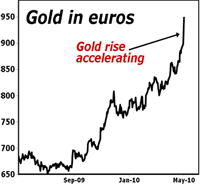
GOLD IN EUR TERMS: ‘Tis Gone “Parabolic” and We Want Out!: This trade has gone “parabolic” and hit the “obscene number” yesterday at EUR 1000. Having done so, and with the public now heavily involved, we want out and are heading for the sidelines.
Chart via Uncommon Wisdom
Dennis Gartman’s Trading Rules
1. Never, Ever, Ever, Under Any Circumstance, Add To A Losing Position… Ever! Adding to losing positions will lead to ruin. You can count on it. Ask the Nobel Laureates in Economics at Long Term Capital!
2. Trade Like A Mercenary Soldier: As Jesse Livermore said, it is not ours to be bullish or bearish, but to be right.
3. Mental Capital Trumps Real Capital: Capital comes in two types; mental and real. Holding losing positions costs measurable real capital, but immeasurable mental capital.
4. We Are Not A Business Of Buying Low And Selling High; We are, however, a business of buying high and selling higher. Strength begets strength, and weakness further weakness almost always.
5. In Bull Markets One Can Only Be Long or Neutral, and in bear markets, one can only be short or neutral. This may seem self-evident, but very few understand it, and fewer still embrace it.
6. “Markets Can Remain Illogical Far Longer Than You Or I Can Remain Solvent.” J.M. Keynes. Illogic does often reign, and it is our duty to learn to handle it as best we might.
7. Buy Markets That Show The Greatest Strength; Sell Markets That Show The Greatest Weakness: Metaphorically, when bearish we need to throw rocks into the wettest paper sacks, for they break most easily. When bullish we need to sail the strongest winds, for they carry the farthest.
8. Think Like A Fundamentalist; Trade Like A Chartist: The fundamentals may drive a market and need to be understood, but if the chart is not bullish, why be bullish? Trade when the technicals and fundamentals, as you understand them, run in concert, one with the other.
9. Trading Runs in Cycles; Some Good; Most Bad: In “good times,” even errors turn to profits; in “bad times,” the most well researched trade will go awry. This is the nature of trading; accept it and move on.
10. Keep Your Technical Systems Simple: Complicated systems breed confusion; simplicity breeds elegance. The great traders we’ve known have the simplest methods of trading. There is a correlation here!
11: In Trading/Investing, An Understanding Of Mass Psychology is Often More Important Than An Understanding of Economics: Simply put, “When they are cryin’, you should be buyin’! and when they are yellin’, you should be sellin’!” This is psychology at work and its most elegant.
12. It Takes Buying And Lots Of It To Put A Market Up; It Takes Only A Lack Of Buying To Put Any Market Down: Gravity is an amazing force of nature; it is even more amazing in the world of investing.
13. There Is Never Just One Cockroach: The lesson of most markets is that bad news follows bad… usually hard upon and always with detrimental effect upon price, until such time as panic prevails and the weakest hands finally exit their positions.
14. Be Patient With Winning Trades; Be Enormously Impatient with Losing Trades: The older we get,the more small losses we take each year… and our profits grow accordingly.
15. Fear Turns To Greed At Break Even… And Vice Versa: Know this; understand this; accept this and deal with it.
16. Do More Of That Which Is Working and Less Of That Which Is Not: This works in life as well as trading. Do the things that have been proven of merit. Add to winning trades; Cut or eliminate losing ones. If there is a “secret” to trading (and of life), this is it.
17. All Rules Are Meant To Be Broken…. but only very, very infrequently. Genius comes in knowing how truly infrequently one can do so and still prosper, but when one must, one must!
Remember Latvia?
Austerity – there’s a word you don’t hear everyday … errrrrrr?
So can the approach taken by Latvia teach other countries, say, uhhh, Greece, a lesson about swallowing the pill and trimming down on government spending? Maybe. It may not be the answer in all cases, but it sure can’t hurt …
Jack and JR
Quotable
“Do not be too moral. You may cheat yourself out of much life. Aim above morality. Be not simply good; be good for something.” – Henry David Thoreau
FX Trading – Remember Latvia?
Latvia: they were a big deal about a year ago, and maybe even before that, when the lending practices among Eurozone banks, EU countries and CEE countries posed a huge risk to growth across the region.
Latvia, as did the other Baltic States, watched its GDP crater. Those lenders exposed to such a dramatic decline in Latvian growth certainly felt similar pain. Here’s a snapshot of Latvian GDP, percent change year-over-year:
……read pages 2 – 4 HERE
Markets Update 8:30AM EST
As we begin the week, please allow me to make a short update.
U.S. Stock Market -This week’s trading should go a long way in telling us if this was yet just another correction/consolidation in this bear market rally or they indeed rang a bell. Because I’ve thankfully not mistaken just noise as a bell for well over a year now, my bear suit remains in the closet (but I do visit it from time to time and remind it how much I still love it).
Gold – I’ve stated over and over again for years that we’re experiencing the “mother” of all secular gold bull markets. But into every mega bull market comes periods of corrections (often short but sharp) and consolidations (new base-building at new higher levels). I noted late last Wednesday evening with gold at $1,236, my technical work was suggesting a minimum consolidation period due to a significant overbought condition.
The end of last week’s trading suggested we could be putting in a fairly significant “outside day” pattern whereupon Friday’s high was higher than Thursday and its low Friday was lower than Thursday’s low. Any significant sell-off today should confirm it was indeed an outside day and could bring in some technical selling. This in no way changes my long-term view and is actually very healthy for it. My target for 2010 remains $1,300 – $1,500
U.S. Dollar – While overbought, it now has all the makings for a run to as high as 92. I remain a bull for now but know despite the current glow in Uncle Sam’s face, he remains long-term terminally ill.
U.S. Bonds – The bulls continue to win the battle, but the bears shall eventually win the war.
Oil and Gas – Oil is starting to look interesting again and around $65 could become a compelling buy. Natural gas has a record short position and that may actually be its main support for now, but I think the shorts win the battle and natural gas is under $3 this summer.
Lets get ready to rumble!
More commentary at Peter’s site HERE
On Major Moves, Peter Grandich has been very right and not only saved many investors fortunes, but expanded them dramatically. On November 3, 2007 at the MoneyTalks Survival Conference, Peter Grandich of the Grandich Letter warned that “an unprecedented economic tsunami will hit American beginning in 2008”. Peter advised publicly to short the US market two days from the top in October, 2007 and stayed short until the last week of October, 2008. He began to buy stocks in March 7th, 2009. He also bought oil and oil related investments near the lows after the dive from $147.
….go to visit Peter’s Website
To HERE Peter speak and others speak on Trading go HERE: 
Never Do These …
Stockscores.com Perspectives for the week ending May 15, 2010
In this week’s issue:
Weekly Commentary
Strategy of the Week
Stocks That Meet The Featured Strategy

Trading successfully requires winning the constant battle against your emotions. Normal people have a hard time beating the stock market because their emotional responses to fear and greed get the better of them. To help win these battles, there are some rules that should never be broken. Here are ten rules that I think are important, break them at your own peril:
1. Never Average Down
Averaging down is the practice of increasing your position in a stock when your initial position is losing money. Some misguided traders think that they can trade their way out of a loser by buying more at cheaper prices, allowing their average cost to go down so that their break even point is lower. Admittedly, this practice will work a lot of the time. The problem is that when it does not work, it can completely wipe you out. Without capital, you can not trade.
2. Never Believe in Dreams
Dreams are for Disneyland, they have no place in your trading. The stock market does not serve free lunch, there is no easy money and fast and easy profits in the market are just short term loans. If you do not have a well tested and thought out trading plan then you will lose eventually. I have seen many people make large sums of money because they got lucky but eventually gave it all back.
3. Never Take Trades with a Negative Expected Value
I have seen many traders make money on trades that they should not have. They think they are smart trades but they are really only lucky trades. If you make $1000 on a trade where you risk losing $5000, is that really a good trade? Good trades are those where the upside potential outweighs the downside risk, a trade that will make you money if you do it many times. To understand the expected value of a trade, you have to know the probability of success and the potential profitability if you succeed. A trade that has a 90% chance of making $1 and a 10% chance of losing $10 is not better a trade worth taking. A trade with a 20% chance of making $10 and a 90% chance of losing $1 is worth taking.
- Get the StockSchool Pro Free

DisnatDirect named the number one Canadian brokerage for Traders by Surviscor! Open and Fund a brokerage account with DisnatDirect and receive the StockSchool Pro home study course free, including special Pro level access through the DisnatDirect client website. Offer only available to Canadian residents. For information, click HERE
- Get the StockSchool Pro Free
4. Never Trade on Public Information
The stock market is efficient most of the time. That means it does a good job of pricing in all available information. A stock that is worth more because they announce a major breakthrough in their business will see its stock price go up to reflect that new information. Once the market has priced in that new information, there is no reason to base a trading decision on it.
5. Don’t Listen to Biased Sources
There are a lot of people telling investors what they should do and most of them have a bias. Company insiders, stock promoters, newsletter writers, message board posters, media reporters, financiers, brokers, friends and shareowners all have the potential to be biased. I will never understand why people phone the investor relations department at companies to ask about the business. Do they expect company staff to tell them bad things? The market itself is the only source you can count on to be truthful, listen to what the market says through the stock chart.
6. Don’t Ignore Your Portfolio
People don’t like pain and when they fear losses in their portfolio they often choose to ignore it. Putting your head in the sand does not make the problem go away, you are better to face the truth and do something about it. If your stocks are going down too much, sell them.
7. Don’t Trade to Make Back Losses
Since we don’t like pain we will often do whatever we can to make the pain go away. A dangerous time to trade is right after a big loss because we are desperate to make the pain go away. As a result, we take marginal trades, we trade like gamblers. This usually leads to more losses.
8. Don’t Be Patient With Losers
No one is right all of the time in the stock market. That means losing trades are part of trading. What is important is to not let your losers grow in to big losers because big losers require many wins to pay them off. When the market tells you that you are wrong, get out of the trade and take the loss.
9. Don’t Think You are Smarter than the Market
The stock market is the combined opinion of millions of investors, many of them very smart and very well capitalized. Do you think you are smarter than that? When you look at a stock chart you are looking at the outcome of the many opinions cast by investors. Learn to read a stock chart so you can understand what the market is telling you.
10. Never Stop Learning
I have been trading for 20 years and I am still constantly learning new things about how the markets work. The basic principles and methods that I use have not changed a lot, but how I apply the basics is constantly evolving. Keep your approach simple but always adapt to the changing market.

The market is volatile, that is good because you need volatility to make money. The problem is that the market is also lacking a trend. It goes up for a few days and then down for a few days. It is difficult to predict for anything more than a few days.
That means it is a good market to swing trade. Without a sustained trend, position trading will result in whip saws that take you in and out of positions with out putting any cash in the bank. You have to trade moves that don’t last for more than few days.
Right now, I think it is best to swing trade the liquid and volatile ETFs, here are a few to watch next week. Watch them for good pattern set ups on the intraday, 15 or 60 minute charts for entry signals.
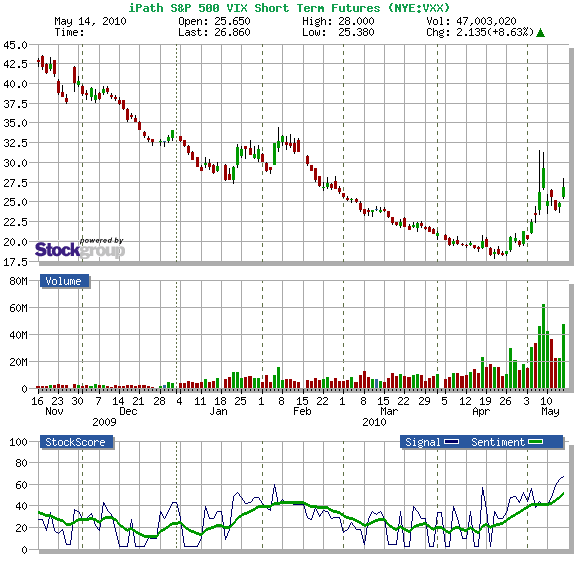
1. VXX
On Thursday, the price volatility had fallen in to a narrow trading range. It then broke out from that narrow volatility in the last hour. That led to a good move on Friday. Look for this kind of set up on the VXX next week
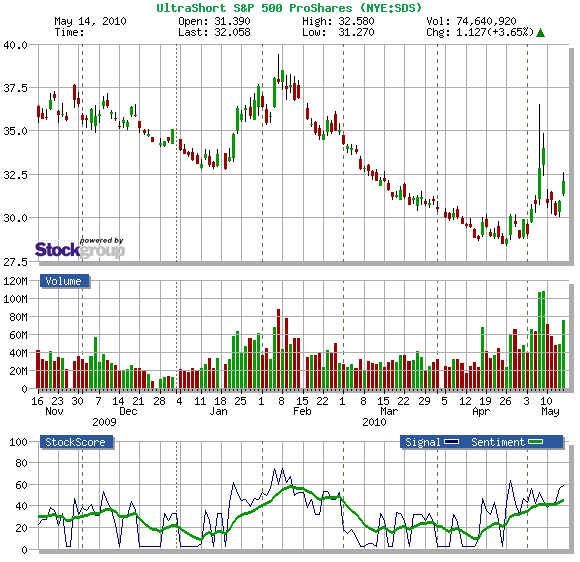
2. SDS
I like to watch for SDS to go in to a narrow trading range and then break from that range. Buy the break from low volatility.
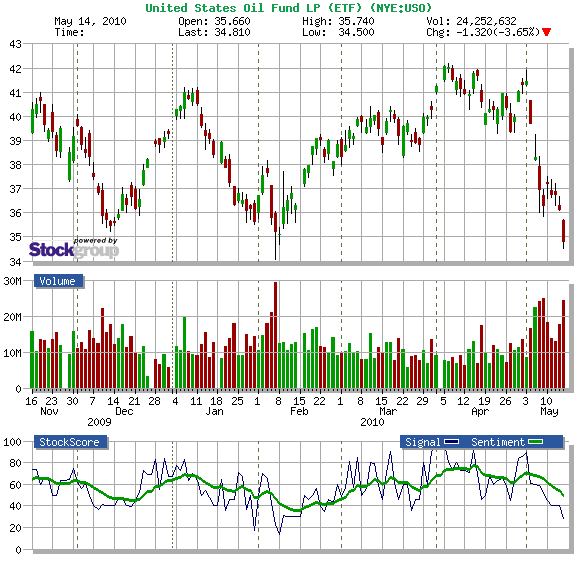
3. USO
USO has been hammered lower but is nearing the price point where it should bounce. Watch the 60 minute chart for a consolidation at a rising bottom and then a break from that rising bottom.
References
Get the Stockscore on any of over 20,000 North American stocks.
Background on the theories used by Stockscores.
Strategies that can help you find new opportunities.
Scan the market using extensive filter criteria.
Build a portfolio of stocks and view a slide show of their charts.
See which sectors are leading the market, and their components.
Click HERE for the Speaker Lineup and to Purchase the video if you want to learn from some of the worlds best traders including Tyler Bollhorn.
Tyler Bollhorn started trading the stock market with $3,000 in capital, some borrowed from his credit card, when he was just 19 years old. As he worked through the Business program at the University of Calgary, he constantly followed the market and traded stocks. Upon graduation, he could not shake his addiction to the market, and so he continued to trade and study the market by day, while working as a DJ at night. From his 600 square foot basement suite that he shared with his brother, Mr. Bollhorn pursued his dream of making his living buying and selling stocks.
Slowly, he began to learn how the market works, and more importantly, how to consistently make money from it. He realized that the stock market is not fair, and that a small group of people make most of the money while the general public suffers. Eventually, he found some of the key ingredients to success, and turned $30,000 in to half a million dollars in only 3 months. His career as a stock trader had finally flourished.
Much of Mr Bollhorn’s work was pioneering, so he had to create his own tools to identify opportunities. With a vision of making the research process simpler and more effective, he created the Stockscores Approach to trading, and partnered with Stockgroup in the creation of the Stockscores.com web site. He found that he enjoyed teaching others how the market works almost as much as trading it, and he has since taught hundreds of traders how to apply the Stockscores Approach to the market.
Disclaimer
This is not an investment advisory, and should not be used to make investment decisions. Information in Stockscores Perspectives is often opinionated and should be considered for information purposes only. No stock exchange anywhere has approved or disapproved of the information contained herein. There is no express or implied solicitation to buy or sell securities. The writers and editors of Perspectives may have positions in the stocks discussed above and may trade in the stocks mentioned. Don’t consider buying or selling any stock without conducting your own due diligence.
-
I know Mike is a very solid investor and respect his opinions very much. So if he says pay attention to this or that - I will.
~ Dale G.
-
I've started managing my own investments so view Michael's site as a one-stop shop from which to get information and perspectives.
~ Dave E.
-
Michael offers easy reading, honest, common sense information that anyone can use in a practical manner.
~ der_al.
-
A sane voice in a scrambled investment world.
~ Ed R.
Inside Edge Pro Contributors

Greg Weldon

Josef Schachter

Tyler Bollhorn

Ryan Irvine

Paul Beattie

Martin Straith

Patrick Ceresna

Mark Leibovit

James Thorne

Victor Adair