
Daily Updates
Kingston, Jamaica, is in a state of emergency: the police are attempting to arrest an alleged leader of a drug and guns cartel. There have been gun battles off and on for a week. But here seems to be some confusion about who are the good guys and who are the bad guys. Some Jamaican immigrants claim that the Jamaican police are corrupt, sometimes using their power to extort money from ordinary citizens. And that most accept bribes from organized crime. The press is hinting that some Jamaicans portray this alleged gang leader as a modern-day Robin Hood, selling drugs and guns to rich Americans and giving some of the money to poor people who live in his home neighbourhood.
In Canada, we automatically assume the police are the good guys and the alleged gang leaders are the bad guys. We assume the establishment has integrity. No so in Jamaica. They live in a different world.
Spectrum of Trust
We Canadians trust our institutions implicitly: we believe what the authorities tell us. Jamaicans implicitly distrust authority figures. If there were some way to measure the trust inherent in a society, Canadians would rank very high. We just trust people; it’s our nature. And Jamaicans would be at the other end of the spectrum. Their society doesn’t trust anyone; it’s their nature.
In my book, Beyond the Bull, I discuss how our human nature helps us or hinders us in the investment world. Which is more useful: trusting the system or distrusting the system? Acting ‘Canadian’ or acting ‘Jamaican’?
Let’s look more closely at Canadians’ propensity to trust the system. The danger is that we trust too much. Too much trust becomes naiveté. The famous 19th-century American showman P.T. Barnum had a saying about those who trust too much: “There’s a sucker born every minute.” Are we suckers in the investment world if we trust too much in the establishment?
Do we trust our government too much? When they bail out the banks and auto makers with our money, will it work? When they introduce a new tax, will that work?
Do we trust economists and bankers too much? When they tell us it’s safe to borrow money and buy a bigger house or a new car, should we believe them? When they tell us mortgage interest rates will go up, is it true?
Do we trust our investment advisors too much? When they tell us it’s safe to invest in the stock market, is it really safe? When they tell us stocks are better investments than bonds, is that accurate?
Too Much of a Good Thing
Regular readers will know this writer’s view: every Canadian investor needs a little Jamaican spark in them. We would all benefit from a little disbelief in the system. The American system broke down in 2008/09 when the biggest blue-chip bank, insurance company, mortgage company, stock broker, and car manufacturer in the U.S.A. had to be rescued by the government. This year, the European common market is breaking down because they trusted the Greeks, the Spaniards, the Portuguese, the Irish, and the Italians too much. One reason the world’s economies are breaking down is that we all trusted too much. The hallmark of 21st-century investing is naiveté. Naïve investors ― from the most sophisticated banks and institutions right down to ordinary individuals trying to save for their retirement ― all trusted too much.
The Cure
What’s the cure for naiveté? Should we all take a lesson from down-trodden Jamaicans who are trying to protect their modern-day Robin Hood? Or are those poor souls just as naïve as yesterday’s bankrupt bankers?
The ‘cure’ for naiveté is responsibility. Trust yourself. Take responsibility for yourself. Keep yourself in a state of alertness about what can go wrong in your world and react to it. The cure for naïve Canadian investors and unbelieving Jamaicans is the same: “To thine own self be true.”
In a few weeks or months, peace will return to the poor side of Kingston, Jamaica. The police will still be the police and the drug business will still be the drug business. And the poor will still be poor.
Over the next few weeks or months (or years), the financial markets will do whatever they do. But for millions of investors, things could be quite different. If the stock market goes down the way it did in 2008, their retirement could be less comfortable than they had expected. The key for Canadian and American investors is to preserve capital in risky times. Poor Jamaicans have little hope of escaping poverty. But Canadian and American investors do have a hope of holding on to their lifestyles. To do so, we must take responsibility, figure out who are the good guys and who are the bad guys, and protect what we have.
In economic terms, we live in high-risk times. Dinosaur capitalism is dying. Don’t trust big government or big business: those who used to be good guys are no longer so good. Sell your higher-risk investments and keep your capital safe. To thine own self be true.
To order your copy of Beyond the Bull and the Five Levels of Investor Consciousness CD, or to sign up for Ken’s free monthly webinar, visit www.gobeyondthebull.com (Bullmanship Code = SS32)
This article and others by Ken are available at http://kennorquay.blogspot.com.
Contact Ken directly at ken@castlemoore.com
Old Approach ― The Salesman’s Model:
There are customers with financial needs, investment firms that offer financial products to meet those needs, and licensed salesmen to sell those financial products. It’s all about persuading people to buy something.
New Approach ― The Financial Warrior Model:
In the investment world, there are winners and there are losers. We can learn to be winners. There are 5 Keys to winning the financial wars.
I introduced this concept in the mid-1990s when I published the first edition of the CD, The 5 Levels of Investor Consciousness. My book, Beyond The Bull, expands on the CD and offers more detail on how you can adopt the new approach, move towards becoming a Financial Warrior, and improve your investing success.
.
FX Trading – Sooner or later it all comes out in the wash
Politicos impose their will and create huge market inefficiencies, by basically buying votes with artificially low interest rates, then turn around and have the gall to say “the market failed us.” What a joke! And they wonder why voters are lining up all over the world to throw their so-called “leaders” out of office.
……view charts and read more HERE
A large part of Canada’s massive oil sands deposits could become one of the most “green” energies on the planet, by using electricity to heat up and break down the heavy oil. EEOR, or Electrically Enhanced Oil RecoverySM is a new technology being field tested in Saskatchewan by a Canadian junior producer, Deloro Resources.
EEOR uses little water, emits no greenhouses gases on site, and uses electricity from local utilities to a conventional heavy oil well, says Phil Bell, President and CEO of Electro-Petroleum Inc., (EPI) the Pennsylvania company which developed the technology.
He adds that EEOR also greatly increases production, which means that both capital and operating costs will be a fraction of current technologies, like SAGD (Steam Assisted Gravity Drainage).
EEOR is simple technology which passes direct current between electrodes at the surface and at the bottom of a well (it can also be passed between the bottom of two wells). This electrical current creates several changes in the oil formation sands.
One is that the heavy oil breaks down by a process known as “cold cracking”. So the heavy minerals and asphalt-like products that make heavy oil “heavy” are cracked, and the oil becomes lighter, increasing the API gravity, which is more valuable. This also makes the oil flow more easily (the industry calls this reducing viscosity).
Bell says that fine sands and other sands are also affected by the current. The electrical field helps to create more permeability, which is the ability of the rock or sand to allow oil to pass through it. So both the new, lighter oil flows more freely in the sands and has more permeability, providing a double bonus.
Bell says that in a California field test, EEOR increased production from five to 50 bopd of heavy oil, increased the API from 8.1 to 10.7, lowered the amount of water coming up the well and lowered the amount of sour gas being produced.
The electrical current itself, going from the surface to the bottom of the well bore, acts as a driver for oil flow to the well.
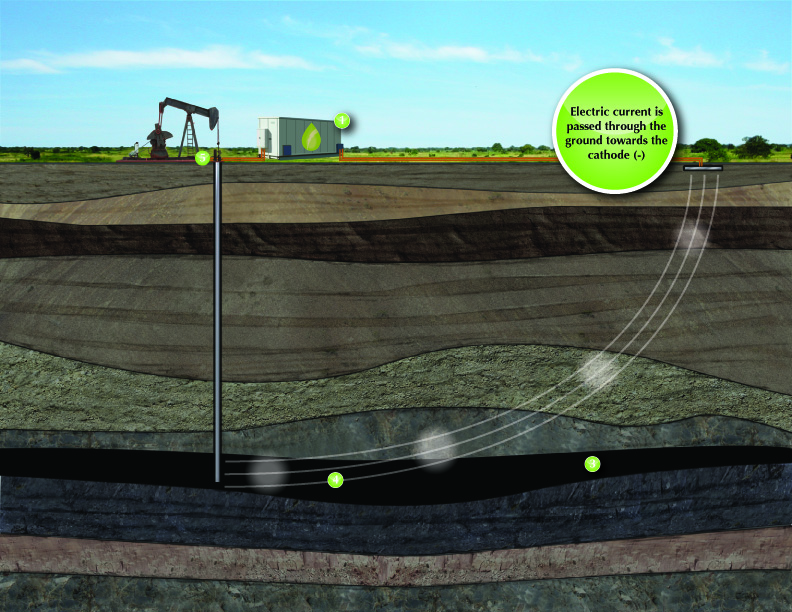
The electricity also heats up the formation near the well bore itself, allowing the heavy oil to flow better. Once at surface it can be transported via heated lines and put in heated storage tanks onsite.
Conventional technologies must also heat up the oil to get it to flow, usually by drilling two long well bores deep into the formation. Producers must then wait for the upper steam well to heat up the surrounding oil formation before oil starts to flow from the lower well.
Bell says that energy costs for EEOR are less than $4/barrel, and capital costs are less than $10/barrel on only a 20 bopd well. Another positive for EEOR is that it works at depths greater than 2500 feet, or 800 metres, while conventional SAGD only works above 2500 feet.
“The technology is not fully commercial yet”, says Bell. He doesn’t want to get into details but says they are now working on several projects.
“We found Deloro via our partners at Yet2.com. They didn’t have capital to do a steam project” and the reservoir characteristics were such that Bell thought it was a good fit.
“Capital costs will be a fraction of what they would pay for a steam operation and opex (operating costs) will be less,” Bell says.
EPI and Deloro have made one heavy oil well at Wilkie produce up to 19-25 bopd, and a second well has now been permitted. EPI is paying 50% of the well and will receive 50% of the proceeds until payout, and then goes to a 10% working interest.
EPI plans to use the success at Wilkie and its other projects to extend the use of the EEOR technology into bigger fields with larger working interests.
by Keith Schaefer, editor and publisher of The Oil & Gas Investments. Sign up HERE (60 day, money back guarantee, no questions asked)
Hello, this is Keith Schaefer, editor and publisher of The Oil & Gas Investments Bulletin. I started my subscription service in mid-2009 because I could see there was no place where retail investors could go to easily find which oil and gas companies were creating huge shareholder wealth by using exciting new technologies, such as horizontal drilling, fracing and 3D seismic.
These companies are increasing cash flows – and stock prices – by finding ways to get more oil and gas out of the ground. And junior and intermediate producers – $2-$20 stocks – are leading the way.
I find the leaders in the new plays that are using these technologies. My research is finding higher and higher flow rates from new wells in old formations as management teams fine tune their use of these new technologies.
It’s amazing how technology is lowering operating costs – and increasing profits – for many publicly traded energy companies.
I find the ones who have the capital and the knowledge to be the fastest growing in their area – this usually means they have a large undeveloped land position in an area where either production costs are very low or production rates can be very high. They are covered by several research analysts, so there is research support and institutional money flow behind them.
And my subscribers and myself are making money from my research. I eat my own cooking and buy all the stocks I research for subscribers.
I read MANY research reports, and I do a lot of original research – call management teams, talking to my contacts in the oil patch, scour company financials – to find the companies with the best chance to provide investor profits.
But these reports also give me many great story ideas for the blog, that haven’t hit the mainstream media yet. That’s why you should sign up at the blog to get notified of new stories.
I write the blog and the subscription service so everyone can understand the story. I keep it simple.
Subscribers get a minimum 10 issues a year, and there is often more than one stock presented.
The Oil and Gas Investments Bulletin is a completely independent service, written to build subscriber loyalty. No company ever pays in any way to be profiled.
I am so confident you will find value in my service I offer a 60 day, money back guarantee, no questions asked, for annual subscription purchases. Please read the sample report I have posted on the website to get an idea of how I profile these fast growing stocks.
Email me with any questions at editor@oilandgas-investments.com
Keith Schaefer
Publisher
The Oil Sands – “There is no chance of a rig blowout here, or a deepwater oil spill like the one from the BP well that is now fouling the Gulf of Mexico.”
The BP Gulf Spill – “This singular event, perhaps yet to be acknowledged, is so scarred on the psyche of Americans, that it has signaled the end of oil.” –
…..read more HERE
Canadian dollar:
The US dollar is recording an outside down day against the Canadian dollar. That is, it has traded on both sides of yesterday’s range and the US dollar looks likely to finish the New York session below yesterday’s low of ~CAD1.0420. The BOC hiked rates as was widely expected and traders searched high and low for all sorts of reasons for its weakness. Today’s gains lend credence to our idea that yesterday’s disappointing price action had to do more with the general market conditions and the unwinding of risk. The US dollar is breaking below the 20-day moving average, something that has not happened since May 13th, which was a one-day wonder. The dollar has not closed below its 20-day moving average since April 26th. The break below CAD1.04, which is the 50% retracement of the USD rally. The next objective comes in near CAD1.0280. We look for a test on parity again toward the middle of Q3.
….read about Sterling and the Euro HERE
Marc Chandler joined Brown Brothers Harriman (http://www.bbh.com/) in October 2005 as the global head of currency strategy. Previously he was the chief currency strategist for HSBC Bank USA and Mellon Bank. Marc is a prolific writer and speaker. In addition to being frequently called up to by… More
-
I know Mike is a very solid investor and respect his opinions very much. So if he says pay attention to this or that - I will.
~ Dale G.
-
I've started managing my own investments so view Michael's site as a one-stop shop from which to get information and perspectives.
~ Dave E.
-
Michael offers easy reading, honest, common sense information that anyone can use in a practical manner.
~ der_al.
-
A sane voice in a scrambled investment world.
~ Ed R.
Inside Edge Pro Contributors

Greg Weldon

Josef Schachter

Tyler Bollhorn

Ryan Irvine

Paul Beattie

Martin Straith

Patrick Ceresna

Mark Leibovit

James Thorne

Victor Adair