
Daily Updates
6/02/10 Dubai, UAE – Those who decided to ‘Sell in May and go away’ have been well rewarded in the worst May for the Dow since 1940. The Dow Jones Index fell by 7.9 per cent in May and the more broadly based S&P 500 by 9.9 per cent, its worst May performance since 1962.
Is this a red light flashing danger ahead, or should investors buy on this dip? Investment gurus are all over the place. Is this a falter on the ‘Road to Recovery’ or the end of a long bear market rally?
ArabianMoney thinks fiscal and monetary tightening suggest a far bigger stock market decline is in prospect, and these things tend to happen rather suddenly, although the warning signs are always pretty clear if you care to look.
Contracting money supply
….read more HERE

This Excerpt from Mark Leibovit’s VR Silver Newsletter covering Stocks, Bonds, Gold, US Dollar, Oil CLICK HERE
VRTrader has called every twist and turn in the market over the past few days. Yesterday morning, we again took profits on our short index ETF positions. I added that we could possibly experience a short-term ‘change of direction’ and that the market could take out Tuesday’s highs. Both of those occurred yesterday, but only after we took our profits. Now that we’ve taken out Tuesday’s highs, the market could very well rally further. Yes, there is lots of overhead resistance, but it looks like the market has found a base to work from. A break under Tuesday’s lows (e.g. 1069.90 in the SPX) reaffirms the bear case, but at the moment that does not appear likely to occur. We did not experience broad-based positive upside volume yesterday, but the VTI (Total Stock Market Index) and the Nasdaq Composite did post Positive Volume Reversals ™ yesterday – a little encouraging the Nasdaq Composite took out last week’s high. Ideally, I’d like to see the market rally and then repurchase the inverse ETFs at higher levels. Yes, I still feel we are in a bear market, but recognize a ‘summer rally’ is likely.
Mark’s previous calls – May 16th – Has Gold Become Too Popular? Time for a Correction?”
May 25th – BOMBS AWAY? We’re Most Short and Liking It!
Marks VRTrader Silver Newletter covers Stock, TSE Stocks, Bonds, Gold, Base Metals, Uranium, Oil and the US Dollar.
More kudos – Mark Leibovit was named the #1 Intermediate Market Timer for the 10 year period ending in 2007; the #1 Intermediate Market Timer for the 3 year period ending in 2007; the #1 Intermediate Market Timer for the 8 year period ending in 2007; and the #8 Intermediate Market Timer for the 5 year period ending in 2007. NO OTHER ANALYST SURVEYED APPEARED IN ALL FOUR CATEGORIES FOR INTERMEDIATE MARKET TIMING AS PUBLISHED IN TIMER DIGEST JANUARY 28, 2008!
For a trial Subscription of The VR Silver Newsletter covering Stocks, Bonds, Gold, US Dollar, Oil CLICK HERE
The VR Gold Letter is available to Platinum subscribers for only an additional $20 per month, while for Silver subscribers the price is only an additional $70.00 per month. Prices are going up very shortl, so act now! Separately, the VR Gold Letter retails for $1500 a year! The VR Gold Letter is published WEEKLY. It is 10 to 16 pages jam-packed with commentary and charts. Please call or email us right away. Tel: 928-282-1275. Email: mark.vrtrader@gmail.com .
This is about the worst action in the stock market I’ve seen in years. And it’s particularly ominous because nobody seems to know how to read the stock market except for my old buddy, Joey Granville — who’s talking Dow 3300. – Richard Russell Dow Theory Letters
Get out of vulnerable stocks IMMEDIATELY!
via Money and Markets
You don’t have much time.
A Dow meltdown is imminent, and if you want to protect yourself from losses, it’s time to get out of the vulnerable stocks in your portfolio — now, immediately. In this special edition, I will explain why and how.
I will show you three debt crisis warnings I’ve just received, telling me that global debt crisis is ALREADY beginning to impact our markets …
I will explain how Bank of America, Citibank, SunTrust and other major U.S. banks could be among the most vulnerable …
And I will show you how you could turn this impending disaster into a veritable profit bonanza.
I want to stress from the outset, however, that this is more than a mere forecast. It’s a solemn warning:
The U.S. stock market is showing the kind of extreme volatility and severe strains that typically precede major implosions.
There is very little time left to get your money to safety. The collapse could come at literally any moment now.
If you ignore this warning, you do so at your own peril. The price for allowing temporary rallies to lull you into a false sense of security could be sudden and could result in massive losses.
The red flashing lights are everywhere. Just three short weeks ago, an initial bout of panic selling reached such a feverish pitch, it set off some of the market’s automatic “circuit breakers” that shut down trading in key stocks.
But instead of breaking the market’s decline, the crash merely accelerated, driving the Dow down 1,000 points in a matter of minutes.
That fateful day is now called the “Flash Crash.” But make no mistake: It is NOT a flash in the pan. Indeed …
The crisis that triggered the Flash Crash
— the European debt disaster —
is just beginning.
Why? The reason is obvious: The European debt crisis has investors more nervous than a long-tailed cat in a roomful of rocking chairs. And it is now spreading …
* Spain is on the brink right now: If you thought the debt crisis in Greece was bad, wait till you see what’s coming next! The New York Times reports that “the focus of Europe’s problem is rapidly shifting from Greece to Spain, one of the world’s largest economies.”
In fact, Spanish authorities have just seized a major bank there and forced the merger of four others in trouble. Even more Spanish bank failures are on the way as a result of Spain’s own real estate meltdown.
How much could this hurt our markets? Consider the facts:
Until now, yes, Greece was the great nemesis that caused nearly all of the panic. But Greece has only $236 billion in external debts. Spain has $1.1 trillion, or FIVE times more.
Greece owes money almost entirely to European banks, impacting U.S. banks only INDIRECTLY. Spain owes a big chunk of its debts to U.S. banks, impacting them DIRECTLY.
* European “Blacklist” growing rapidly: Portugal, Italy, and Ireland are so close on the heels of Greece and Spain, they are already on the Blacklist of virtually every lender and investor in the world.
These countries can’t borrow money for their huge spending programs. They can’t even roll over their old debts coming due without paying exorbitant interest rates. They have little choice but to slash their government spending — all in a last-ditch attempt to reassure their lenders. Italy proposes to lop off $31 billion in spending. Spain is contemplating the deepest budget cuts in three decades.
But that will not be nearly enough to reassure lenders … and yet it will gut their economies even more. Result: Rising unemployment, slumping corporate profits and still GREATER danger of debt defaults.
* Like several Lehmans all failing at the same time: When Lehman Brothers went under 20 months ago, it instantly froze up global markets, shut down short-term lending, sent the economy into a nosedive, and helped drive the Dow down nearly 5,000 points.
But by any measure, a default by a country like Spain would be far bigger than that of any single corporation, with the potential to wreck even greater havoc in financial markets.
And right now, we already have three debt crisis warning signs, each flashing red …
Debt crisis warning #1
The single most important interest rate
in the entire world is now on the rise!
I’m talking about the London Interbank Offered Rate — LIBOR. This is the rate that’s behind virtually every short-term loan in the United States.
When LIBOR goes up, it promptly drives up the rates in the $2.3 trillion market for adjustable-rate mortgages, the $7.2 trillion market for corporate loans — and more all right here in the U.S. And right now, that’s precisely what LIBOR is doing — GOING UP!
That alone can be a shock to the global economy. But what is especially shocking is the fact that there’s virtually nothing the Federal Reserve or even the European Central Bank (ECB) can do about it.
LIBOR is an interest rate that’s determined by the supply and demand for money in the global market. The Fed and the ECB have never been able to control it — and probably never will. And yet, as I said, LIBOR impacts the rates on trillions of dollars of mortgages and other loans right here in the United States.
This has earth-shattering implications. It not only means the global debt crisis is heating up. It also means that the Fed and central banks around the world are losing their power to STOP the global debt crisis from getting a lot worse!
Debt crisis warning #2
The debt crisis IS already striking our shores!
How do we know? Because one of the world’s most important measure of the debt crisis is already surging! (It’s the two-year swap spread — essentially reflecting what banks charge for managing the risk on two-year loans over and above equivalent Treasury yields.)
Last year, when Washington spent trillions of dollars to rescue nearly every major U.S. bank in trouble, this crisis indicator fell sharply, signaling — at least temporarily — that the worst of the crisis had passed.
But now, it’s surging again, up SEVEN-FOLD from its lows. The clear message: A new, potentially BIGGER debt crisis is in the offing.
Debt crisis warning #3
The cost of insuring against big corporate defaults
has nearly DOUBLED in just the past few months!

That means investors believe the risk that corporate bonds will default has also nearly doubled!
And I am NOT talking about just junk companies that everyone knew were risky to begin with. Heck no! I’m talking about INVESTMENT-grade companies, the ones meriting some of the highest ratings handed out by S&P, Moody’s, or Fitch.
The big question: If even supposedly “safe” corporate BONDS are growing riskier almost by the day …
Imagine the massive risk investors are taking with STOCKS issued by those same corporations!
These debt crisis warnings
tipped us off to the Dow’s
7000-point-plus collapse
of 2007-2009 …
Now, they’re warning
of an equally massive
bloodletting directly ahead!
Yes, that’s right: These are exactly the same indicators that told us that a Great Debt Crisis would soon crush the U.S. stock market beginning back in late 2007.
They are the tools we used to warn our Safe Money subscribers of the last big market bust well ahead of time.
Now, they are telling us that we are living on borrowed time, with an equally — or more — painful stock market implosion just ahead.
Here’s why this could be …
Another Big Blow to Bank of America …
Citibank … SunTrust … and
Hundreds More U.S. Banks
This is NOT rocket science.
We know that virtually ALL of the recovery in the stock market since March of 2009 was based largely on the assumption that “the CREDIT crisis was over.” But the explosion of this new debt crisis in Europe is a stark reminder that the most severe economic catastrophe since the Great Depression is NOT over. It has merely taken on a different form.
The big dilemma: Despite the recent recovery, many of the nation’s banks are STILL vulnerable. That’s according to the latest ratings just released by Weiss Ratings, the only ratings that consistently warned investors, well ahead of time, of nearly every major banking failure in recent years.
* Bank of America merits a Weiss Financial Strength Rating of D (weak). It still has huge amounts of bad loans on its books, with close to one third of its capital tied up bad loans alone. It’s taking massive risks with derivatives. It’s definitely not yet out of the woods.
* Citibank gets a D- for similar reasons.
* SunTrust Bank also gets a D-. Its bad loans make up an even bigger share of its capital than BofA’s.
* Overall, there are 2,259 banks and thrifts in the U.S. meriting a weak Weiss Rating, with only 962 getting a strong rating. The bigger problem: The strong banks control only 3.7% of the banking industry’s assets. The weak banks control 43.8%.
And this is BEFORE they feel the inevitable impacts of the European debt crisis on global markets or our economy!
Here’s the key:
It was mostly the recovery in our nation’s largest banks — bought and paid for by Washington — that created the illusion that a real, sustainable economic recovery was beginning.
That illusion triggered a recovery in the Dow.
But now, with thousands of U.S. banks barely able to fog a mirror … and with European borrowers in danger of defaulting, these banks are now facing a new peril that they did not anticipate.
In any debt crisis, banks and other financial companies are inevitably the first to take the biggest hits. And if they’re still loaded with bad loans — like the big banks I just told you about — they’re bound to suffer massive losses.
My forecast:
Do NOT be surprised to see major financial stocks plunge back toward their lows of March 2009, taking most of the rest of the entire stock market with them!
The ONLY Stocks Worth Considering Now
Companies that produce gold, silver, platinum and other crisis hedges typically see their earnings soar in times like these. Investors are increasingly suspicious of paper money — eager for the security and peace of mind that these precious metals have historically provided in dangerous times.
As a result, they are bound to be among the shares have the shallowest corrections in a broad market decline and enjoy the sharpest recovery soon thereafter.
Also: Last time around, stocks that pay you to own them — select dividend-paying stocks — helped protect investors who owned them. Today, for example, with the S&P still down by over 20% from its 2007 peak, many dividend paying stocks are up significantly.
But for the rest of the stocks in your portfolio, my recommendation is clear:
Sell some of your stocks now. Then, if the Dow rallies a few hundred points, sell some more! Use any opportunity you can to get OUT of the way of this impending stock market meltdown!
How to Turn This Disaster Into
Your Personal Profit Bonanza
On Friday of THIS week — the day after tomorrow — I will be releasing my next gala issue of Weiss Research’s Safe Money Report — which I am dedicating especially to investors who need help right now, BEFORE this crisis gets any worse.
In it, I begin by leading you through some basic steps:
Your first step is what I call the “extreme portfolio makeover” — making sure you own exclusively investments that will NOT be hurt by the stock market decline, or better yet, will actually make you money.
Most people think that, if you want to exit the stock market, all you have to do is pick up the phone or click on your mouse with one, simple four-letter instruction: “sell.”
But it’s not that easy. If your timing is bad, you could wind up losing still more. In the Safe Money Report I’m releasing next week, I’ll show you how to get out with the maximum retention of your profits and the smoothest transition to investments that can make you a fortune during the crash.
Step #2 is to find a truly safe place for your cash. This is a no-brainer — I give you the names and phone numbers. But a lot of investors will wind up jumping from the frying pan into the fire. Don’t be among them.
Step #3 is to buy two exchange-traded funds (ETFs) that I’ve picked out which are designed to surge when stocks fall. You never have to go short. And you never have to borrow money. The goal is simply to buy these ETFs low and sell them high — just like any other standard investment.
One of these ETFs gives you an opportunity to profit from a decline in the market as a whole. The other targets profits from declines in precisely the sector that I think will be hit the hardest — big financial companies like the ones I told you about a moment ago.
Just in the last few weeks, while the Dow has tanked these ETFs have surged. While nearly everyone else in the market was losing money, anyone holding just these two investments could have made out like a bandit. But everything tells me this trend is just BEGINNING!
Mike Larson
Editor, Safe Money
This investment news is brought to you by Money and Markets. Money and Markets is a free daily investment newsletter from Martin D. Weiss and Weiss Research analysts offering the latest investing news and financial insights for the stock market, including tips and advice on investing in gold, energy and oil. Dr. Weiss is a leader in the fields of investing, interest rates, financial safety and economic forecasting. To view archives or subscribe, visit http://www.moneyandmarkets.com.
Gold added another $11.30 Tuesday to hit $1,226 an ounce, and although the yellow metal is still well off its nominal all-time high of about $1,240 set just a few weeks ago, you don’t have to be a member of the build-a-bunker-in-Montana crowd to believe gold could hit $2,500 in the next couple of years.
David Rosenberg, chief economist and strategist at Canada’s Gluskin Sheff, tends to be pretty bearish, but he’s also about as dispassionate and data-driven a guy as you can find. In other words, he’s hardly some kooky gold bug. And if past relationships among data sets hold up, gold fever is just getting started, Rosenberg says.
….read more HERE
The Euro Is Washed Up — But the Dollar Is No Better
Greece has made it obvious: The euro is doomed. This fact had been obvious to all the euro critics from the very beginning. All the arguments against the possibility of a common currency for very disparate countries had been raised, but brushed away by overzealous politicians.
They’ll learn their monetary lesson the hard way in the coming years.
Unfortunately the current discussion about Greece, Spain and all the other PIIGS countries is very superficial … Greece is everywhere!
In fact, the whole western world and Japan are over indebted …
You’ve likely read in the press about debt to GDP figures like 200 percent for Japan, 115 percent for Italy, 113 percent for Greece, 85 percent for the U.S., 76 percent for France, 73 percent for Germany, or 70 percent for the UK.
These are dangerous levels, although not outrageous ones. But government officials don’t tell the whole story; they sugarcoat the real dimension of the over indebtedness.
That’s why you need to understand …
Explicit Versus Implicit Debt Levels
Explicit debt leaves out important obligations like pensions and social security. If you add these in, you get what economists call the implicit government debt.
And if you use the implicit government debt to GDP ratio, the picture is much bleaker. Look for yourself:
Germany: 255 percent
France: 255 percent
UK: 530 percent
U.S.: 570 percent
This is frightening, indeed. These obligations are unbearable. Which means governments all over the world will have to break many of the promises their predecessors have made to get elected.
There are ways to get out of too much debt. The first is by …
Default
When you default, you sit down with your creditors, and restructure the debt. Creditors have to take the losses, and rightly so. They consciously took on this risk to earn a profit. Yes, they made bad decisions. But that’s the way capital markets function.
And tinkering with this process leads to bad capital allocation, an inefficient economy and less growth.
Another way out is to …
Crank Up the Printing Press!
Most modern governments have a trump card many ancient governments would have died for. They reign over fiat currencies, which can be created by the stroke of a computer key. As Ben Bernanke once said so famously:
“But the U.S. government has a technology, called a printing press (or, today, its electronic equivalent), that allows it to produce as many U.S. dollars as it wishes at essentially no cost.”
Therefore, modern governments with a printing press can bail themselves out of all debt problems. And I believe they can and probably will inflate their way out of today’s debt problem. They’ll pay back their debts nominally, with money that’s worth less. But they will not have to default.
Unfortunately, at the end of this road, the bond market and the currency will be destroyed. I don’t know how far our politicians will go in the coming years. Although I fear they will go this bitter way to its very end.
They Will Inflate in Lockstep
What I am nearly sure of is that the U.S. with its Fed and the EU with its ECB will inflate more or less in lockstep — like they have in the past.
Now euro bashing is all the rage. A short six months ago dollar bashing was en vogue. Have a look at a long-term dollar/euro chart below.
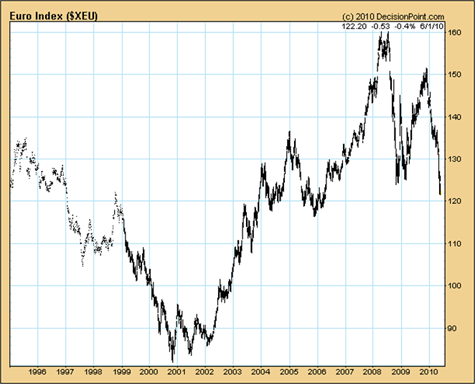
If you take this perspective, it really looks like not much has happened during the last few months. Yes, the euro is down to levels seen in 2004-2006 or 1995-1997 (when the euro was not yet an official currency). But at the same time the euro is much higher than it was in 1999-2003. So it has a long way to fall.
Sure, the euro is doomed. But so is the dollar! Both fiat currencies have lost massively against gold in the last few years. And as long as the bad fiscal and monetary policies prevail, gold will keep rising.
Best wishes,
Claus
This investment news is brought to you by Money and Markets. Money and Markets is a free daily investment newsletter from Martin D. Weiss and Weiss Research analysts offering the latest investing news and financial insights for the stock market, including tips and advice on investing in gold, energy and oil. Dr. Weiss is a leader in the fields of investing, interest rates, financial safety and economic forecasting. To view archives or subscribe, visit http://www.moneyandmarkets.com.
-
I know Mike is a very solid investor and respect his opinions very much. So if he says pay attention to this or that - I will.
~ Dale G.
-
I've started managing my own investments so view Michael's site as a one-stop shop from which to get information and perspectives.
~ Dave E.
-
Michael offers easy reading, honest, common sense information that anyone can use in a practical manner.
~ der_al.
-
A sane voice in a scrambled investment world.
~ Ed R.
Inside Edge Pro Contributors

Greg Weldon

Josef Schachter

Tyler Bollhorn

Ryan Irvine

Paul Beattie

Martin Straith

Patrick Ceresna

Mark Leibovit

James Thorne

Victor Adair