
Daily Updates
China’s Currency Manipulation: About to Cause a Global Explosion?
Tim Geithner, Hillary Clinton and 200 other American bigwigs visited China this week.
First on the agenda: China’s position on the rising tensions between North and South Korea.
With the rest of the major economic powers of the world standing against the actions of North Korea — a nuclear threat run by an oppressive regime — a neutral standing China poses a reasonable concern for future global stability.
Another significant topic Geithner was hoping to make headway on was China’s currency policy. But China had little to say on the matter.
China’s currency continues to be a subject the U.S. is willing to tap dance around diplomatically. Because when the gloves eventually do come off, U.S./China relations could rapidly collapse.
That’s why China’s alignment on the Korean peninsula tensions is of particular significance …
It puts the catalysts in place for potential fallout between China and the Western world, which could mean economic war and perhaps military war ahead.
I think China’s currency policy represents too big a risk to global economic recovery and global stability for Washington to continue granting a stay. So today I want to revisit two of the arguments I’ve laid out in past Money and Markets columns to explain why we should worry about China, despite the headlines about it being an engine of global growth.
The first is …
China’s Currency Manipulation Poses a Roadblock to Sustainable Global Economic Growth
The G-20, the IMF, the OECD — all of the major institutions and central banks of the world have been harping on the importance of repairing global imbalances over the past year … and for good reason. When they do this, they’re talking specifically to China.
Over the last 14 years, China’s economy has grown a whopping eight-fold, to $4.9 trillion, and it has quickly soared to become the world’s third-largest economy.
During the same period, the U.S. economy has only doubled in size.
As far as currencies are concerned, the dramatic outperformance of the Chinese economy relative to the U.S. economy would normally be reflected in a much stronger Chinese currency.
But China controls the value of its currency. They allowed it to strengthen only 18 percent during those 14 years — a mere drop in the bucket, keeping the advantage squarely in China’s court.
Moreover, since the financial crisis and global recession kicked in two years ago, China has returned to a peg against the dollar, artificially keeping its goods cheap for a weaker U.S. consumer and undercutting its export-centric competitors.
Here’s the problem: The global trade imbalance driven by China’s cheap currency is a recipe for more frequent boom and bust cycles. So this issue has to be addressed.
Then there is the …
Threat of Protectionism
Ultimately, the rest of the world will have to choose action over diplomacy. That means imposing sanctions on China and trade restrictions on Chinese goods.
But the problem with protectionist activity is that it tends to bring about retaliation, and it becomes contagious. That’s exactly what happened in the Great Depression. And it’s what brought global trade to a standstill.
Today, with unemployment sustaining high levels, the political support to act is there. Many would think that “standing up to China, is standing up for us.”
You see, when jobs are tight the perception by most workers towards globalization becomes more negative. And studies show that during these times, the number of people who favor the idea of higher tariffs on imported goods increases considerably. As it becomes increasingly evident that China will not play ball on allowing its currency to appreciate to a fair value, geopolitical tensions are bound to elevate, and protectionism will likely follow.
And given the sovereign debt crisis that’s already underway, protectionism is yet another risk to the global economy that increases the probability of another bout with recession.
In fact, protectionism has historically put fragile economies in a deeper and more prolonged crisis …
I want to show you a chart of the S&P 500 from the Great Depression years. This gives you a clear understanding of why protectionism is so dangerous.
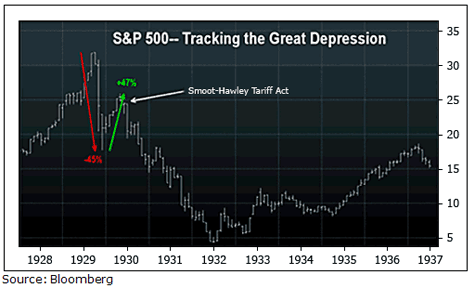
As you can see, the stock market topped in 1929 and fell 45 percent in just three months. Then, it had a sharp correction, recovering 47 percent from the November ‘29 low.
In June 1930, two U.S. Congressmen, Smoot and Hawley, championed a bill to slap a tariff on virtually every foreign good. And that was the catalyst for the second leg down … a massive plunge in the stock market and arguably the catalyst for the Great Depression.
Since April 15, Treasury Secretary Geithner has been “on the clock.” He’s past due on a currency report he owes Congress. In it he is expected, under recently adopted more stringent rules, to publicly name China a currency manipulator. And with that, a can of worms would be opened.
As an investor, it’s always important that you anticipate plausible scenarios. Because if a China conflict scenario plays out, you can expect the outcome to be bad for global growth, bad for global stocks, bad for commodity demand and likely good for the continued safe haven appeal of the U.S. dollar.
Regards,
Bryan
Bryan Rich is an accomplished currency specialist with more than 12-years of experience in trading, research, and consulting in the global foreign exchange markets. He is President of Logic Fund Management, a currency management and consulting firm.
Bryan began his career as a trader for a $600 million family office hedge fund in London. The macro-oriented fund managed assets for a prominent European family, and was one of the largest players in global currency markets in the 1990s. Later, he was a senior trader for a $750 million leading global macro hedge fund located in South Florida. There, he helped manage and trade a multi-billion dollar foreign exchange options portfolio.
His consulting resume includes work for a boutique currency fund in New York, where he developed trading models and strategy for the core investment program of the company. He later joined the company as a partner, based in their Wall Street office.
Bryan has also served for several years in a management and consulting role for the Weiss Group, performing in a variety of analytical areas across its economic research, money management, ratings, and institutional research divisions.
He has a BA from the University of North Florida and an MBA from Rollins College.
This investment news is brought to you by Money and Markets. Money and Markets is a free daily investment newsletter from Martin D. Weiss and Weiss Research analysts offering the latest investing news and financial insights for the stock market, including tips and advice on investing in gold, energy and oil. Dr. Weiss is a leader in the fields of investing, interest rates, financial safety and economic forecasting. To view archives or subscribe, visit http://www.moneyandmarkets.com.
Stockscores.com Perspectives for the week ending June 5, 2010
In this week’s issue:
Weekly Commentary
Strategy of the Week
Stocks That Meet The Featured Strategy

Trading decisions are often made in the blink of an eye, the result of a sometimes emotional thought process. Maybe you want to find a stock that will go up to pay for the loss you just suffered on a previous trade or you enter a trade because you are tired of watching it go up without you. These impulse decisions often lead to losses and show why it is important to have a well thought out plan when making a trade.
Planning your trades means you will likely trade less, leaving many marginal opportunities for those that have the best profit potential. When you make a plan you establish a series of criteria for entering and holding a position. You write down those criteria and check to see how your stock is trading relative to your plan. If it is behaving the way you expect then you have understood the stock correctly. If not, it may be better to get out of the position.
The best trades are those that you have the most confidence in. Confidence comes from being proven right, from having the market live up to your expectations. You are probably not too sure of whether you are right or not if you find yourself monitoring your positions every possible moment.
A key to having a good trading plan is to have a good method. You need a good method for entering a stock and managing risk. You need a good method for exiting a stock. You need a good method for managing your emotions through the process. Once you have a method that works and is one you can believe in, you can write the plan. Plan the trade and then trade the plan.
A plan should at least answer the following:
What is my strategy for entry?
What is my risk tolerance?
What do I expect to happen after I enter the trade?
What has to happen for me to consider my decision to enter the trade wrong?
What are my criteria for exiting the trade at a profit?
What are the emotional obstacles that I will face and how will I overcome them?
How will I judge my success?
How will I learn from my mistakes?
Is all this worth the effort? The little bit of time that it takes to make and follow a trading plan should improve your performance in the market. Is it worth it to make a plan when building a house? Is it worth it to make a plan when starting a business? Most of us answer yes to these questions but fail to plan our trades. Why?
The answer lies in emotion. Too many traders treat the stock market like a casino. They make trades with the hope that they will make money just like a gambler puts down money on the hope their number will come up. Hope should not be part of your plan. If you are a trader who believes your success in the market is a matter of luck then you should probably close your brokerage account and head to Las Vegas. At least there they give you free drinks when you gamble.
Think when you trade. Impulsive decisions are not likely to succeed. Well thought out trades may not always succeed either but at least you will have a means to judge when you are wrong. When a trade ceases to go according to plan, it is time to get out.

The Sentiment Stockscore indicator was designed to help position traders determine whether a stock or market is worth considering. As an indicator, it is based on the characteristics of the chart. Points are awarded for technically positive things and taken away for negative. If a stock is breaking out through resistance, points are earned. If it has an abnormal day to the downside, points are lost. Continued below….
- Get the StockSchool Pro Free

DisnatDirect named the number one Canadian brokerage for Traders by Surviscor! Open and Fund a brokerage account with DisnatDirect and receive the StockSchool Pro home study course free, including special Pro level access through the DisnatDirect client website. Offer only available to Canadian residents. For information, click HERE
- Get the StockSchool Pro Free
There are two reasons for using the Sentiment Stockscore to help you with your investment picks. First, it is a quick and easy way to determine whether a stock is worth considering. I don’t consider the longer term position trades on stocks with a Sentiment Stockscore of less than 60 (for swing and day trading, I don’t consider the Sentiment Stockscore as it is not designed for short term trades). So, if I look at the chart of Research in Motion and see that it has a Sentiment Stockscore of 31, I know it is not worth buying.
The second reason for the Sentiment Stockscore is that it allows the computer to do a lot of the work for us. With the Stockscores Market Scan, we can filter the market using the Sentiment Stockscore combined with other technical indicators to find stocks that are worth our consideration. It is a way to build a short list of stocks to check in to futher.
You can also apply the Sentiment Stockscore to market indexes to determine whether the market is suitable for buying, short selling or sitting on the fence. I do this by looking at a few Exchange Traded Funds which give me an overview of North American markets.

1. SPY
The US market is best represented by the S&P 500 ETF, symbol SPY. As of Friday, the Stockscores could not get much worse with a Sentiment Stockscore in the red at 36 and a Signal Stockscore of 2. After trying to bounce, it looks like the SPY (and the US market in general) is likely to go lower. The downside to support is about 2% so we may not see a major continuation of the downtrend, but for now I would not be a buyer of US stocks in general.

2. T.XIU
The TSX ETF is T.XIU. It has a Sentiment Stockscore of 47 which is neutral. Its chart is stuck in a trading range with a slight upward bias over the last year. It does not look very bad, but there is nothing great there either. Based on that, I would only be a buyer of Canadian stocks that are trading abnormally because they will likely be trading on their own story and able to overcome the general market complacency among Canadian investors. However, unlike the US, the Canadian market should provide a few position trading opportunities from the buy side.

References
Get the Stockscore on any of over 20,000 North American stocks.
Background on the theories used by Stockscores.
Strategies that can help you find new opportunities.
Scan the market using extensive filter criteria.
Build a portfolio of stocks and view a slide show of their charts.
See which sectors are leading the market, and their components.
Click HERE for the Speaker Lineup and to Purchase the video if you want to learn from some of the worlds best traders including Tyler Bollhorn.

Tyler Bollhorn started trading the stock market with $3,000 in capital, some borrowed from his credit card, when he was just 19 years old. As he worked through the Business program at the University of Calgary, he constantly followed the market and traded stocks. Upon graduation, he could not shake his addiction to the market, and so he continued to trade and study the market by day, while working as a DJ at night. From his 600 square foot basement suite that he shared with his brother, Mr. Bollhorn pursued his dream of making his living buying and selling stocks.
Slowly, he began to learn how the market works, and more importantly, how to consistently make money from it. He realized that the stock market is not fair, and that a small group of people make most of the money while the general public suffers. Eventually, he found some of the key ingredients to success, and turned $30,000 in to half a million dollars in only 3 months. His career as a stock trader had finally flourished.
Much of Mr Bollhorn’s work was pioneering, so he had to create his own tools to identify opportunities. With a vision of making the research process simpler and more effective, he created the Stockscores Approach to trading, and partnered with Stockgroup in the creation of the Stockscores.com web site. He found that he enjoyed teaching others how the market works almost as much as trading it, and he has since taught hundreds of traders how to apply the Stockscores Approach to the market.
Disclaimer
This is not an investment advisory, and should not be used to make investment decisions. Information in Stockscores Perspectives is often opinionated and should be considered for information purposes only. No stock exchange anywhere has approved or disapproved of the information contained herein. There is no express or implied solicitation to buy or sell securities. The writers and editors of Perspectives may have positions in the stocks discussed above and may trade in the stocks mentioned. Don’t consider buying or selling any stock without conducting your own due diligence.
SUGAR could well be white gold, if veteran investor Jim Rogers turns out to be right.
Mr Rogers singled out sugar as poised for a bull run at the Asia Pacific Sugar Conference where he gave a keynote address yesterday.
…..read more HERE
Chart via Money Talks
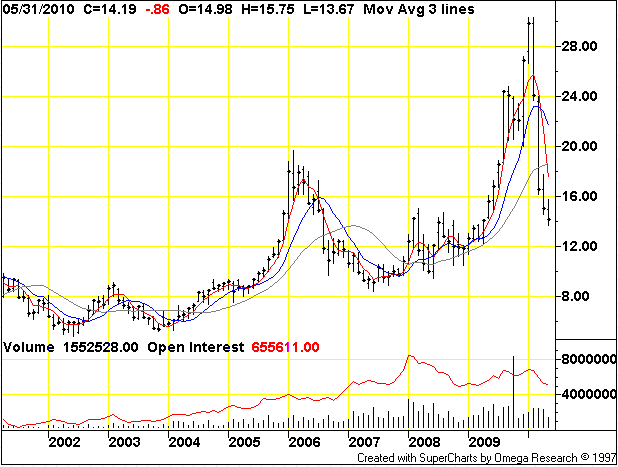
The biggest slump in commodities since Lehman Brothers Holdings Inc. collapsed is undermining Wall Street forecasts for accelerating economic growth and higher prices for everything from copper to crude oil.
….read more HERE
Mark Leibovit – “Despite my overall bullish bias for Gold and still bigger picture unfulfilled upside objectives from 1300 to 2000+, I must issue a caution……”

Marks VRTrader Silver Newletter covers Stock, TSE Stocks, Bonds, Gold, Base Metals, Uranium, Oil and the US Dollar.
More kudos – Mark Leibovit was named the #1 Intermediate Market Timer for the 10 year period ending in 2007; the #1 Intermediate Market Timer for the 3 year period ending in 2007; the #1 Intermediate Market Timer for the 8 year period ending in 2007; and the #8 Intermediate Market Timer for the 5 year period ending in 2007. NO OTHER ANALYST SURVEYED APPEARED IN ALL FOUR CATEGORIES FOR INTERMEDIATE MARKET TIMING AS PUBLISHED IN TIMER DIGEST JANUARY 28, 2008!
For a trial Subscription of The VR Silver Newsletter covering Stocks, Bonds, Gold, US Dollar, Oil CLICK HERE
The VR Gold Letter is available to Platinum subscribers for only an additional $20 per month, while for Silver subscribers the price is only an additional $70.00 per month. Prices are going up very shortl, so act now! Separately, the VR Gold Letter retails for $1500 a year! The VR Gold Letter is published WEEKLY. It is 10 to 16 pages jam-packed with commentary and charts. Please call or email us right away. Tel: 928-282-1275. Email: mark.vrtrader@gmail.com .
Brief excerpt from Richard Russell – Dow Theory Letters. Richard has made his subscribers fortunes. One of the best values anywhere in the financial world at only a $300 subscription to get his DAILY report for a year. HERE to subscribe. Amongst his achievements Richard was in cash before the 2008/2009 Crash and he has been Bullish Gold since below $300
Very Basic Lessons in Real Estate – My dad was a very smart fellow. His formula was that if you bought a house, it will ALWAYS cost you 10% of the purchase price to carry that house, and this includes, repairs, loss of interest on the money you invested, taxes, depreciation, general upkeep. One way or another, it will always end up costing you 10% of the buying price. A lot of buyers don’t believe that, but then are shocked to find out that 10% is correct.
My dad’s formula, if you buy a house — then after that 10% expense, if you can rent the house and make a profit, you’ve probably got a reasonably good deal. To illustrate, if I buy a house for $500,000 in expensive La Jolla, then after figuring $50,000 to carry that house, if I can rent the house for at least $50,000 or better I have a good deal.
There’s no way in the world I can buy a house here for $500,000 and rent it for $50,000 or better. To me, this means that houses in La Jolla are selling for at least twice what they are actually worth.
Times change. A few days I was talking to an older-lady real estate agent. She had moved to La Jolla from Colorado in 1961, She told me that in 1961 you could “buy” a house in La Jolla simply by taking over the monthly payments. A friend of hers who had some capital bought 22 houses by taking over the payments. Since then this friend has paid off the mortgages on all 22 houses and now owns them free and clear. Of course her friend is now a multimillionaire with a fat income.
Russell Comment — Money is made in the BUYING, and that also applies to the stock market. If I buy anything cheap enough, I’ll make money. But if I overpay, I’m buying a guaranteed loss. In the stock market, the time-proven best test of values is still price/earnings and dividends. Buy ’em rightl and “All comes to he or she who waits.”
The key to profits — buy great values, and then sit on your keyster.. The key to losses, overpay for items and sit on them. If you do that, then in time, you’ll be wearing patched pants and shoes with holes in them.
Memories — My grandmother owned a cute little house in Far Rockaway, New York, not for from the ocean. I remember grandma had a cherry tree in her garden. That tree was her pride and joy and when the cherries appeared each spring, we were invited out to pick and feast on those delicious cherries. Grandma died during the Great Depression, and my parents had the task of disposing with grandma’s “estate.” Grannie’s entire estate consisted of that Far Rockaway house. My parents advertised the house for weeks. The best offer they received was $2,500. Finally they sold the house for two thousand, five hundred. Those were the days! Nobody wanted to part with a dollar.
During the Depression my father zeroed in on one NYC hotel. The price to buy that hotel was $120,000. The bar alone at the hotel was making $120,000. The whole package was a terrific bargain. My dad went to a number of wealthy New Yorkers and presented the picture. Not one was willing to put up the money. I’ll never forget my dad’s frustration and disappointment.
-
I know Mike is a very solid investor and respect his opinions very much. So if he says pay attention to this or that - I will.
~ Dale G.
-
I've started managing my own investments so view Michael's site as a one-stop shop from which to get information and perspectives.
~ Dave E.
-
Michael offers easy reading, honest, common sense information that anyone can use in a practical manner.
~ der_al.
-
A sane voice in a scrambled investment world.
~ Ed R.
Inside Edge Pro Contributors

Greg Weldon

Josef Schachter

Tyler Bollhorn

Ryan Irvine

Paul Beattie

Martin Straith

Patrick Ceresna

Mark Leibovit

James Thorne

Victor Adair