
Daily Updates
The long-term story for a gold and a gold mining stocks bull market is clear and easy to grasp: Dubious monetary policy and irresponsible fiscal policy with government debt rising all over the world are a surefire recipe for a surging demand in gold.
Toss in stagnant or even declining supply, and you have all the ingredients for much higher gold prices.
But …
I Don’t Like
Being a Gold Bull
That’s because rising gold prices are a byproduct of lousy economic and political conditions.
Indeed, gold does not create wealth. Yet it can help conserve your capital in complicated times. Then when the economy finally hits bottom and a new long-term up trend emerges, you’ll be in the ideal position to take advantage of the turn around.
However, now is not the time to dream of the next long-term up swing. Instead, it’s the time to prepare for the next cyclical slump while the …
Recession Warning
Is Getting Stronger
That’s the signal the Economic Research Institute’s leading economic indicator is sending us. Last week I drew your attention to this important indicator when it declined to minus 5.7 percent, a reading low enough to be interpreted as a recession warning.
Now … it’s down to minus 6.9 percent, strongly amplifying the message of a coming recession.
With this background the behavior of the bond markets starts to make some sense …
You see, longer-term government bonds would normally be considered extremely risky whenever there are inflationary implications of high and rising government debts, which would send interest rates soaring. And that is indeed our situation today.
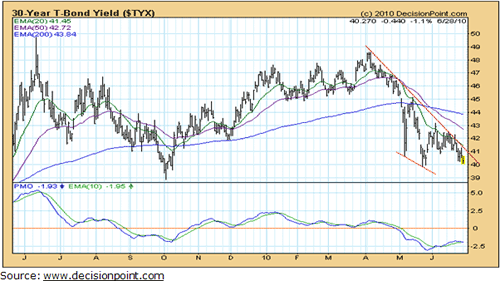
But interest rates haven’t risen this year; instead they’ve been falling! Take a look in the chart below.
So why aren’t interest rates rising?
During times of uncertainty, short- to medium-term buying pressure for safe haven investments, including long-term Treasuries, can trump longer-term inflation fears. And that is exactly what has been going on during the past months, which tells me the economy is headed for a recession.
Gold Bugs Index On the
Verge of a Breakout
At the same time Treasury yields have been dropping, gold and gold mining stocks have been rising. How is this possible?
Well,
- Maybe the gold market is considering the short- to medium-term potential of a double dip recession.
- Maybe the gold market is already reacting to the longer-term inflationary implications of the above mentioned monetary and fiscal policies.
- Maybe the two markets — Treasury bonds and gold — are currently playing different time frames. And maybe this decoupling will continue.
At least one thing is crystal clear: On the chart below you can see the Gold Bugs Index is at a very important juncture. It has crept back up towards major technical resistance at the 500 to 520 area.
A breakout above this massive resistance would send a very strong bullish message for the gold market.
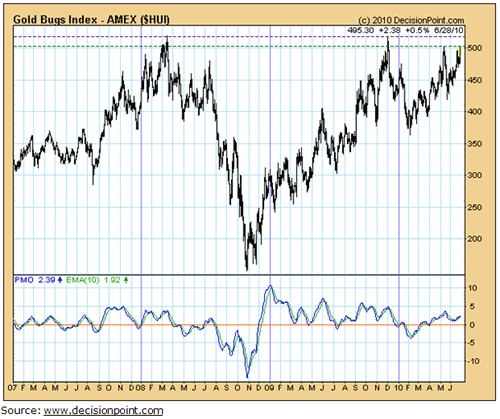
Classical chart analysis tells us that the breakout scenario has a high probability. Price action since December 2009 looks like a triangle. And triangles are trend continuation formations.
In the bigger picture, the price movements since March 2007 looks like a huge cyclical correction ready to break out to new, all time highs.
Bellwether Newmont Mining
Looks Ready for a Breakout, Too!
The bullish chart pattern of the Gold Bugs Index gets support from bellwether Newmont Mining (NEM). As you can see on following chart, it’s zooming upward.
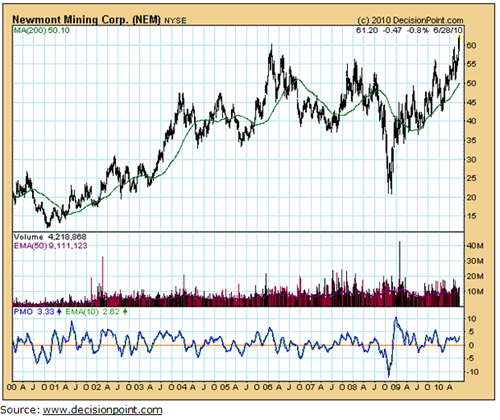
My suggestion: Keep a close eye on NEM. On Monday it hit a new high of $62.62. If this stock gets enough interest to establish itself above this level, it’ll probably signal the next strong up leg in the gold bull market.
Best wishes,
Claus
Claus Vogt is the editor of Sicheres Geld, the first and largest-circulation contrarian investment letter in Europe.
Mr. Vogt is the co-author of the German bestseller, Das Greenspan Dossier, where he predicted, well ahead of time, the sequence of events that have unfolded since, including the U.S. housing bust, the U.S. recession, the demise of Fannie Mae and Freddie Mac, as well as the financial system crisis.
He is also the editor of the German edition of Weiss Research’s International ETF Trader, which has delivered overall gains (including losers) in the high double digits even while the U.S. stock market suffered its worst year since 1932.
In addition to being the editor of Million-Dollar Contrarian Portfolio, his analysis and insights appear regularly in Money and Markets.
This investment news is brought to you by Money and Markets. Money and Markets is a free daily investment newsletter from Martin D. Weiss and Weiss Research analysts offering the latest investing news and financial insights for the stock market, including tips and advice on investing in gold, energy and oil. Dr. Weiss is a leader in the fields of investing, interest rates, financial safety and economic forecasting. To view archives or subscribe, visit http://www.moneyandmarkets.com.
“According to my calculations it is impossible that the American government can fulfill its obligations because the current deficit is over one trillion, this year 1.6 trillion , and that will not come under one trillion and that increase the national debt .The Total debt is already 375% of the GDP , but that does not still include the not yet covered debts of medicaid medicare and social security, if you would include it then the national debt is already 600% of the GDP. So they have to massively print money in the future that will lead to an inflation and recession in the same time, so they might get into a depression and synchronized an inflation as they have in Zimbabwe. The result will be that they will intervene in a war – and the americans are good in finding enemies around the world, That will end in a big conflict and the whole system will collapse” This scenario won’t happen tomorrow but in the next 5-10 years guaranteed Marc Faber added.
Why you should invest in precious metals
Marc Faber : there are different economic schools. We have the Austrian school, the school of rational expectations, monetary schools and so on and so forth. In The US we have a totally new school that is called the Zimbabwe school and it was founded by one of the great leaders of this world mister Robert Mugabe that has managed to totally impoverish his own country and that is the monetary policy the US is pursuing. If something goes wrong : print if it does not get fixed print more …..
When paper money is devalued what will you have to trade for goods or services. Trust in Gold, silver, platinum, palladium, copper, nickel, aluminum, brass, lead. Faber advises to avoid industrial commodities copper, nickel, and zinc, for the time being. Faber believes China’s economy will slow down and likely crash in 9-12 months. He suggests avoiding industrial commodities, like copper, nickel, and zinc, for the time being and avoiding companies exposed to Chinese economic growth. Faber finds wheat, corn, and soybeans attractive and believes these agricultural commodities are in the process of making major lows.
The Gold Report: Peter, you accurately forecast the market crash of 1987, the peaks of 2000 and 2007 and the bottom in 2009. Where is this volatile market headed now?
Peter Grandich: I’ve been looking for over a year for a countertrend bear market rally to end in the June–July period around 11,000. I think we are getting very close to that. Update June 29th/2010 at 8:56 PM “The nonsense bull market many claimed was born in March, 2009 died June 29, 2010” – Peter Grandich
(Please note the interview took place on June 21, 2010) There’s still an argument to make that the market could rally a bit longer into late summer, early fall. But after that, the next part of my forecast was that the U.S. stock market would enter a long period—several years if not a decade or longer—similar to Japanese market trading after it peaked in 1989; and for 20 years, literally, went nowhere but had major bear market rallies and declines. That’s what I’m looking for in the U.S. stock market.
TGR: How long do you think that could last?
PG: Years. It could be many years. I clearly believe that the U.S. equity market will underperform most other Western world markets. In other words, both could go down—but the U.S. market will go down more. After this summer and early fall, one of the last places people would want to invest will be the U.S. market. As much as it used to be the world’s leading market, I think it’s quickly becoming the market you least want to be involved with.
TGR: Is another market poised as an attractive alternative?
PG: I don’t know if we’ll have real bull markets in major markets in the coming years because, while acute in the U.S., the debt problem, obviously, exists in many other parts of the world, including Europe. We’re living through that now. In the end, look at who the creditors are. Which economies are still able to lend to all these indebted areas of the world? They are likely the economies that also will do well.
TGR: Such as China?
PG: Yes, places like China, and to a lesser extent, Brazil. But I also want to point out that, while the U.S. and Canada are still somewhat joined at the hip as the world’s two largest trading partners, Canada is fiscally light years ahead in terms of its balance sheet. Canada remains a very favorable place of mine and has a strong currency. It’s the one currency outside of gold that I would have no problems holding.
TGR: And the Russians just bought some loonies.
PG: That’s correct. Russia has diversified. I think we’re going to see more of that. It’s interesting about Canada; Canada was really a basket case in the early ’80s. It was looked upon poorly in the Western world at that time. Now, of all the Western world economies, none is in as remotely good shape as Canada from a federal level. They’ll suffer a little bit because they’ll still be big trading partners with the U.S., but Canada will stand out. Its natural resources will continue to do well and there’s no denying the fact that Canada has been far more fiscally responsible than the U.S. I certainly would be invested in Canada markets before I’d be invested in the U.S. market.
TGR: So you’re pretty bearish on the U.S.
PG: Actually, since January, many people have emailed and sometimes called to say I’ve made an error by not turning outright bearish again as I did at the top of 2007. I parted ways with the bearish camp on what turned out to be, literally, one day before the bottom in March of 2009. Unlike many bears who stood in the way of this tremendous countertrend bear rally, I did not suggest putting my bear suit back on yet.
I have noted certain support levels. If they were broken I would put my bear suit back on but we haven’t reached that. As we speak, a formation is starting to take place technically on the Dow, a head-and-shoulders pattern. If you can envision a picture of someone’s head and their two shoulders, we’ve had the left shoulder drawn. We’ve had the head. Now, we would form the right shoulder if we rally back to that 10,800–11,000. I would be much more comfortable turning bearish not only because fundamentally I’m bearish, but also get because of what I believe would be a very bearish technical signal. That’s what this reverse head and shoulders would be in my mind. So I wanted to alert my readers to watch for this potential formation.
People always think you have to bet either on a major decline or a big rally. Since the bottom in March of 2009, my argument has been that the market would enjoy the eye of the storm, during which we would have a tremendous countertrend bear market rally. Those who are bullish are bullish because they think the 2009 bottom signaled a new bull market. My argument has never changed. This is what’s known technically as a “countertrend rally” in an overall cyclical bear market—a bear market that actually began back in 2007.
So all I’ve been looking for is a countertrend rally tied into a fundamental argument that we will go back into a double dip recession, etc., being lead fundamentally by two factors. 1) What’s going to happen politically come November?; and 2) What’s taking place and developing in the Middle East?
TGR: So you did not turn from a bear to a bull?
PG: I would never say that I’ve been a bull. I just removed my bear suit. I wasn’t one of those people who made gains in the decline only to see them given back by staying short during the rally. I don’t consider myself a bear until I actually say: “It’s time to sell the market again.” I haven’t done that yet.
TGR: When do you think you will?
PG: I don’t believe it will go past late summer or early fall. This time last year, I was in a very small camp to argue—and now and it’s becoming more popular—that as we approach mid-term elections, there would be a revolt against incumbents in general—and Democrats, in particular. That will create a political nightmare in Washington, with what many will perceive after the election a lame duck one-term president who was swept into power and within two years turned out to be one of the least popular presidents. I think whatever political processes that might have been in place to take care of America’s numerous problems will grind to a complete halt after the election. That will just add a log to the fire of how the world perceives the U.S. as a country totally in a mess. So that’s been my argument and I still see that developing.
TGR: With that in mind, do you believe that now is a good time to get into the market?
PG: First of all, I don’t believe in trading. I don’t believe there’s any reason to try to trade a few percentage point gains in the Dow or the S&P. I also have to say that Wall Street developed “speculating” as a replacement word so it wouldn’t have to use the word “gambling.” Those who trade might as well go to a casino because so much is up against you these days.
What’s more important, and what we spoke about earlier, is the longer-term bigger picture for a bunch of reasons. You probably don’t have time enough to write them all down; the U.S. is deep in serious fundamental problems—economic, social, even spiritual. It’s going to be one of the least attractive places, globally, that people would want to be seriously invested in.
TGR: Having said that, the 200-day moving average seems to be one of the tools you put a lot of stock in to determine where the market is going. What appeals to you about it?
PG: First, let me clarify that I think of technical analysis as a good accessory. I don’t believe in using it strictly as the only thing on which to base a decision. I have a lot of respect for some great technicians out there. But in my opinion, at the end of the day, fundamental analysis overrides technical analysis. I like technical analysis when I’m uncertain or not absolutely clear on a fundamental direction. If I’m leaning one way or another and my technical analysis supports that argument, the combination of the two determines my decision. Within technical analysis, moving averages are important.
Very short-term moving averages have no real significance to me because, as I said earlier, I don’t believe in trading. But the 200-day moving average—the granddaddy of all moving averages—is something I look at. I also know it’s important to look at, because the world at large looks at it. A lot of things that happen in the markets are borne out as self-fulfilling prophecies. If enough people report and comment on something and it starts to develop, it begins to feed on itself. So it’s a very important technical tool and one of the few that I rely on a lot.
TGR: Is that primarily what you used to determine the crash in ’87 and the peak in ’07?
PG: No, it was always fundamental argument, but the technicals always supported it. Technical analysis has come a long way since the ’87 crash. Back then, there weren’t many people using it. I really didn’t use it much either, but it helped in 2000 and, of course, getting out. Also when we took off our so-called bear suit on March 8, 2009, the main reason was because we’d become so oversold. All of the technical indicators I was using suggested that at the bare minimum, it was going to be a major relief rally. So I think technical analysis is a good aid, but I don’t believe in using it as my sole compass.
TGR: You talked about gold hitting $1,300 an ounce in what you’ve called the “mother of all gold bull markets.”
PG: The foundation of my bullishness on gold has been a few key points I’ve hammered home. Two of the main ones used to be big negatives for gold. It wasn’t that many years ago that central banks were net sellers of gold. After the Washington Agreement, they started to measure their sales, and they’ve actually become net buyers in recent years. So one key bullish factor was the fact that a group that had been a major seller no longer was.
TGR: What else shifted from a negative to a positive?
PG: I used to argue that the mining industry was cutting off its nose to spite its face by hedging so much of future production. But the same hedging that had been so widespread has become like a four-letter word for mining executives. Even the mere thought of speaking about it brings the ire of institutional and retail investors. That’s the second key point, and the second bearish factor that’s become bullish.
The third thing that’s accelerated the gold price beyond $1,000 is the realization that gold is simply the best alternative to paper currencies. About 6 or 12 months ago, I said the U.S. dollar was going to rally and that gold would rally in the face of that. Even gold bugs questioned that; they’d been weaned on the theory that a rising dollar was bearish for gold. My argument simply was that, for a while, the Dow would rally just because the world would concentrate on other bad currencies until coming back to the USD. I said the fact is that no one currency anywhere in the world—euro, USD, what have you—would do anywhere near as well as gold itself; therefore, look for gold to rise in most major currencies. That’s exactly what’s happening now.
None of those three bullish factors are even remotely close to changing direction. We don’t see any sign of a central bank pickup in net sales. We certainly don’t see the industry hedging. We definitely see the money flows into gold, and we see more and more counties and people of influence noting that gold is the only true money. That’s why I still call this the mother of all bull markets.
TGR: Are you willing to put a timeframe on a price higher than $1,300?
PG: Our target for 2010 was $1,300 as a low end, and it could go as high as $1,500 if certain events unfold in the Middle East—which, realistically, are closer today than ever before. So even though we haven’t printed it yet, $1,300 is a “gimme,” and there’s still the potential to run as high as $1,500.
Gold will never shine or look positive to many investors because to support it and to believe in it would be detrimental to the financial assets the world revolves around. The mistake people make is in waiting for world confirmation that everybody’s on board on gold. It’s never going to happen. And in my opinion, and that’s a good thing.
TGR: A good thing?
PG: Yes. The day that it even remotely looks as though everyone’s on board, we’ll know we’re very, very close to whatever the run is on the gold market. But my personal opinion is that the gold run won’t end until at least it has a “two handle.”
TGR: A two handle?
PG: That means gold will get to $2,000+ before this great bull market ends. That time is not yet in sight.
TGR: You’ve been a big believer in gold equities and hold a number of them. Could you give us updates on some of the companies you mentioned in your last Gold Report interview?
PG: Well, as I’ve said before, Evolving Gold Corp. (TSX.V:EVG; Fkft:EV7) is the most perplexing junior I’ve ever dealt with. Failure is the norm in the junior resource business; for each company that finds a significant deposit and is able to develop or sell it for a handsome profit, nine others don’t. So it’s impressive enough when a junior finds one world-class potential deposit. Evolving Gold has managed to find two. Yet the stock has been hammered and beaten up. The company has not done a great job on the corporate communication side in recent months, and it’s depressed the price of the stock to a level that doesn’t represent the real potential of these two projects. Either could be world-class and as things look now, both are still moving towards that. Given my prejudices and the fact that 99% of Evolving Gold’s peer group would kill to have just one of those projects, I deemed it an extremely undervalued situation and personally bought 1.3 million shares.
TGR: Any other junior golds you’d like to talk about?
PG: Yes. Crocodile Gold Corp. (TSX:CRK; OTCQX:CROCF) and Timmins Gold Corp. (TSX.V:TMM) are two clients of mine, as well. People love the excitement of drilling and hoping an explorer finds something; they somehow lose sight once the company goes into production, and then miss out when these emerging producers still have a lot of exploration potential. That fits both Crocodile Gold and Timmins Gold. They’re emerging producers. I think one of the areas that retail investors don’t concentrate on enough would be in emerging producers; probably if they did they would have fewer losses. Both Crocodile Gold and Timmins Gold are going to produce 80,000–100,000 ounces a year, and those figures can increase. Yet they still have enormous upside potential as explorers. Their share prices don’t seem to be reflecting that at the moment.
TGR: Are there any other juniors you’re following?
PG: I’m looking in some areas that have been cast aside. One in particular is the uranium market. As exciting as it was a few years ago when many so-called experts were hammering home triple-digit uranium prices, a lot of those forecasters seem to have selective amnesia and forgot about that. I fell on my face and thought that uranium prices would have gone much higher and stayed there, too. They didn’t, and the market continues to beat down anything related to uranium.
However, I think some companies in that space will be more than survivors. One is Strathmore Minerals Corp. (TSX.V:STM;OTC.PK SHEETS:STHJF)—again, a client—which is developing some key assets. One in particular in the U.S. looks more and more like it’s going to be a producer. Another is Crosshair Exploration & Mining Corp. (TSX:CXX; NYSE.A:CXZ). I think you have to look at uranium now. It’s pretty well at its bottom. The market looks like it’s groping for a bottom.
TGR: What else has been cast aside?
PG: One segment in the rare metals that doesn’t get much attention because not many are involved in it is cobalt, which is also demonstrating a real need for strategic investing. Cobalt is among the minerals that the European Commission recently identified as having high supply risks, with potential shortages resulting from limited production and high demand. Cobalt is a component of our renewable and sustainable energies, from batteries to solar elements to powering turbines for wind generation. The U.S. consumes about 60% of the world’s cobalt, yet produces none of it. Formation Metals Inc. (TSX:FCO), based in Idaho, is really developing the only pure-cobalt play in North America. Like many have in these tough times, Formation Metals has struggled to bring the mine into production—but they keep taking steps forward.
TGR: Speaking of batteries, you’re no stranger to the lithium space. I see you’ve just signed on to help Lithium One Inc. (TSX.V:LI) with communications and investor and public relations—congratulations. You’ve also been close to Rodinia Minerals Inc. (TSX.V:RM; OTCQX: RDNAF).
PG: Thank you. I’m looking forward to working with Lithium One. It’s a great company with two major lithium projects at this time: the brownfields Sal de Vida lithium brine project in Argentina and the James Bay bulk tonnage spodumene project in Quebec. As for Rodinia, I bought into that company primarily because lithium has all the markings to be a major part of the budding world revolution in rare metals and alternative energy. Rodinia is an exploration and development company with two projects, either of which could become very substantial.
TGR: Shareholders just approved a name change to Rodinia Lithium, right?
PG: They did. The change reflects the company’s singular focus on developing its flagship lithium projects in North and South America. Its Clayton Valley project in Nevada surrounds the only lithium-brine producer in North America, and it’s exploring four properties in Argentina. Three of them are in Salta Province, where the Salar de Diablillos is significant because Rodinia does not share that salar with any other operators or developer. This spring, the company completed the first tranche of a private placement to continue work on these projects and brought in Farhad Abasov as executive chairman. His expertise in the potash business should prove useful as Rodinia develops its lithium brine projects, because potash will be a substantial economic byproduct of extraction. All things considered, I believe that, based on the end-use market for lithium and what we now know from Rodinia’s sampling initiatives in Nevada and Argentina, the stock is cheaper today than before this team got involved.
TGR: Do you have an eye on any more hidden treasures?
PG: Sometimes you’ll find opportunities in the junior market by following people who’ve been successful and watching them when they set up shop again in something similar. In this particular case, Alderon Resource Corp. (TSX.V:ADV) is an iron ore play with many from the management team that was behind Consolidated Thompson Iron Mines Ltd. (TSX:CLM), which was a tremendous winner in Canada. Alderon Resource is currently drilling an iron ore project in Newfoundland and Labrador. When you see management people like that who have been very successful in one deal setting up shop down the road a piece, you really should be alert to that and take interest in it.
TGR: Any other juniors that appeal to you?
PG: Another large personal holding is Silver Quest Resources Ltd. (TSX.V:SQI), a gold and silver exploration company that became one of the largest land holders in the Dawson Range last year. That makes Silver Quest a key player in the big, budding gold rush—we haven’t had one in years—in the Yukon. Kinross Gold Corporation (TSX:K; NYSE:KGC) now owns the majority of Underworld Resources Ltd. (TSX.V:UW), whose White Gold property is in an area where significant placer gold has been mined. Kaminak Gold Corporation (TSX.V:KAM) made a nice discovery.
As we speak, Silver Quest is drilling a very, very attractive project in the Yukon; that’s its Boulevard Project, just 10 km. southwest of Kaminak’s recent Coffee property discovery. But unlike a lot of the other Yukon players, Silver Quest it has real resources in other projects. I believe the share price doesn’t even reflect that, let alone the potential for their Yukon play.
TGR: So you like Canada’s currency and fiscal responsibility, as you said earlier, but also a lot of the projects you see there. Quite a number of the companies you’ve mentioned have a strong presence in Canada.
PG: It’s funny. When I started in this business, you could count on one hand the countries that people in exploration and mining avoided because they could present problems. Now 20, 30 years later—people count on their hands the places to go without having a problem and Canada is one of them. The one area people could take exception to that statement would have been British Columbia; but, in recent years, the somewhat anti-mining stance there has changed. So there’s a lot of focus now on Canada’s natural resources, as well as the fact that Canada isn’t facing some of political and social issues that are in other areas of the world now.
TGR: Such as those we’re facing south of the Canadian border?
PG: People have been searching for the solution to the United States’ problem. It may sound too simplistic, but it really is simple. Americans have too much stuff. You can’t drive many roads in America without running into a public-storage facility. Our parents and grandparents never needed public storage. Until America realizes it has too much stuff and has to lower its living standard—and that it can’t borrow against what it can’t afford—all these other arguments and bailouts and so on will never get to the root of the problem.
It’s like putting on too much weight; you can’t take it off in six months. You can’t take decades of overspending and being unproductive and fix it in six months, either. Unfortunately, I still see a very dark period ahead in the U.S. because there really isn’t any movement yet to take those steps. Until America changes its attitude, nothing can be fixed.
Proud of his humble beginnings, Financial Adviser and Market Analyst Peter Grandich started publishing The Grandich Letter without either a high school diploma or even a day’s worth of formal training. His widely read investment newsletter, in which Peter analyzed the metals and mining sectors within global stock and bond markets, morphed into a blog about 18 months ago. Peter’s ability to interpret and forecast financial happenings—which earned him the moniker “Wall Street Whiz Kid” back in the day—has led to hundreds of media interviews including Good Morning America, The Kudlow Report, Fox News’ “Your World with Neil Cavuto,” BNN, The Wall Street Journal, Barron’s, The New York Times, MarketWatch and dozens more. He’s spoken at investment conferences around the globe and is regarded as one of the world’s foremost market strategists. Gold, Energy & Technology Stocks newsletter publisher Jay Taylor considers Peter “most remarkable for a successful Wall Street pro. . .unashamedly independent and outspoken about his views, which frequently are anything but politically correct.”
Want to read more exclusive Gold Report interviews like this? Sign up for our free e-newsletter, and you’ll learn when new articles have been published. To see a list of recent interviews with industry analysts and commentators, visit our Expert Insights page.
Jim Puplava: Stocks roared from the March lows of last year, and now we’ve seen a nice correction since the April high. Is it just an interim correction as the bulls would argue, or does something worse lie ahead? Joining us on the program is Bob Prechter, author and head of Elliott Wave International. Bob, I want to pick up from last September. Since then we’ve had several quarters of positive economic growth. Asset classes rose substantially, CPI turned positive, gold has hit a new record, oil is close to $80 a barrel. I guess a lot of our listeners would like to know, have these events altered your views on deflation?
Robert Prechter: No, because we forecasted these events, and we forecasted them at the bottom in March and April of 2009. On February 23 in the Elliott Wave Theorist, I said that we were almost at the bottom; that ideally the S&P should get down in the 600s before turning up; and that the Dow was going to rally from that low up to about 10,000. We put that target out a few days after the low. The main thing we said at the time was that it was going to be only a partial retracement, in other words a bear market rally. By the end of it, we said people would be bullish on the economy, there would be positive economic numbers, investors would think we have made the turn, the Fed would take credit for having saved the financial system, and there would be optimism across the board. All of this has happened. And going into April 2010, few people in the fundamentalist or technical camp were looking for a downturn.
The final thing I said was that Obama’s popularity would rise into that peak, and on that one I was wrong. His ratings couldn’t even bounce during that period, which I found very surprising. But both Obama and George Bush’s popularity trends followed the real value of stocks, not the inflated dollar price of the stock market, which I find interesting.
As far as inflation and deflation go, we had deflation during the down cycle in 2008. Commodities fell hard, the stock market fell hard and real estate fell hard. But the recovery that we were looking for in the first quarter of 2009 was expected to be a reflationary, and it was. You saw a decline in credit spreads. You saw a rise from the lows in commodity prices and stock prices. All of that is perfectly normal. These are just waves ebbing and flowing. But the long-term trend is still down, and as this cycle matures we are going to see more and more evidence of deflation.
JP: I want to come back to government spending, but first I want to move onto the stock market. In your last two Elliott Wave Theorist issues, you laid out a scenario that would put the Dow and S&P, which in your opinion may have peaked on April 26, as the top from here. You feel that this top is the biggest top formation of all time, a multi-century top and we could head straight down in a six-year collapse that would end in 2016 that could see a substantial portion of the S&P and the Dow wiped out in a similar way that we saw between 1929 and 1933. Let’s talk about that and the reasoning behind it.
RP: Yes, you’re exactly right. I did a lot of work on technical forms, cycle forms and Elliott wave forms in April and May and put them in a double issue. Let’s talk about the cycles first.
The 7¼-year cycle has been quite regular since the first bottom in 1980. The next bottom was at the crash in October 1987. The next one was November 1994, which is when the economy went through four years with lots of layoffs; it was a recessionary period throughout until that cycle bottomed. The next one was between September 2001, which was the 9/11 attack, and the October 2002 bottom. And the latest one was at the low in March 2009. All those periods are 7¼ years apart, so we are in the uptrend portion of the 7¼-year cycle.
However, notice for example that in 1987, the market went up until August of that year and then bottomed in October, just a couple of months later. So the decline occurred very, very late in the cycle. This time it occurred a little bit earlier in the cycle, topping in ‘07 and bottoming in ‘09. In the current cycle, prices should peak the earliest of all of them. It’s what we in the cycle prediction business call “left-hand translation.” The market’s already gone up for about a year, and I think that’s just about enough. I think we’re going to spend most of the cycle going down. But the important thing to note is that the next bottom is due in 2016. That means I think we’re going to have a repeat of what happened between 1930—which was the top of the rally following the 1929 crash—and the July 1932 low. Instead of taking two years, it’s going to take about six years.
It’s going to be a very long decline. It’s going to be interrupted by many, many rallies, just as the decline from 1930 to 1932 was. And every time it bottoms and rallies, people are going to say “OK, that’s enough; it’s over.” But it won’t be over. It’s just going to be a long, long process. I think you and I will probably be talking a few times during this period. One of the interesting aspects of this process is that optimism should actually remain dominant through the first three years of the cycle. That will carry us into 2012. Even though prices will be edging lower, most people are going to think it’s a buy, and you shouldn’t get out of your stocks, and recovery is just around the corner, probably for the next three years. And then, for the final half of the cycle, the final three years, that’s when you’ll get the capitulation phase when everyone finally gives up.
JP: I want to take two well-known investors who would take the opposing view of a declining market. One is Dr. Marc Faber, who believes the S&P low of 666 will stand and that the government will simply inflate, because its debt is denominated in its own currency, unlike let’s say what we saw in Mexico where Mexico experienced some problems as a result of devaluation, they saw an increase in their stock market from the lows in nominal terms. So Marc believes because the U.S. debt is denominated in its own currency, the government will simply print, print, print. To add to Marc’s views I want to take famed investor Felix Zulauf. In a recent interview in Barron’s he also said one day the world’s financial system will reach a financial reckoning day where the Fed’s balance sheet will expand not by just a trillion or two, but by multiples of that, five, six, seven trillion, which would negate the deflation scenario. How would you argue against Faber and Zulauf’s views?
RP: I don’t think I have to. These are political predictions that may or may not come true. In other words, why does it have to go that way? Someone else could say just as easily, “Well, it’s also possible that the voters will all become Tea Partiers, they’ll throw all these people out, and they’ll elect conservative guys who will balance the budget and eliminate the Fed.” How would you argue against that? You can’t. It’s just a scenario. It’s not an argument, just a possible scenario.
Still, I don’t think it’s likely because of what I already said. I think the change in social mood towards the negative is already showing results. Here we are in a positive rebound, yet you’re still seeing Tea Parties and you’re still seeing incumbents pushed out of office. I think by the time the trend really turns down again and breaks those 2009 lows, you’re going to see the public so angry at their representatives that they’re going to start forcing a difference in behavior. Congress is not going to be spending like it was before. They’ll probably be drawn and quartered if they try to bail out another giant bank or certainly if they try to bail out the European banks as they did in the AIG disaster. All of this spendthrift behavior people are cluing into, and it’s spreading on the Internet, and it’s spreading through word of mouth.
You have this scenario that politicians are just going to monetize and they’re going to go crazy. But it’s not a given. It requires that politicians are somehow untouchable by politics. But in a democracy, they’re very subject to politics. Even in Greece, the leaders of that country wanted nothing more than to keep spending and borrowing and spending and borrowing. The creditors finally came in and said, “Enough. You can’t continue or you’re going to be literally out of power and bankrupt tomorrow.” So they agreed to some austerity programs, some creditors came to the door; some European governments, for example, came to the door. It’s always the creditors who are in control—these bond vigilantes. Even Clinton was upset when he found out they existed. The U.S. government depends on these people for all of its borrowings. The Fed hardly has any U.S. Treasury bonds anymore; its portfolio is full of mortgages and all sorts of junk. The private market and other governments have sopped up all these Treasury bonds. The government could decide to “print, print, print,” but the only thing it can print are bonds. It can’t print Fed notes; it can only print bonds. If the creditors shut down and say we’re not taking any more of Treasury bonds, there’s going to be a real disaster. They’re going to have to raise interest rates to double digits, maybe 80 percent or 100 percent or some crazy amount. That’s going to suck money from every other corner of the earth, and the economy is going to crash one way or another.
A crashing economy is going to be deflationary, because it means the debt that exists won’t be paid off. It’s the collapse in existing debt that’s the problem. Now the Fed and the Treasury are trying to shore up some of this debt. The Treasury said, “Look, we’re going to guarantee Fannie Mae and Freddie Mac,” and the Fed gave money to help bail out Greece. The IMF did the same thing, which is mostly funded through the American taxpayer. But relative to the amount of outstanding credit, these are actually small moves, even though they’re unprecedentedly large. That’s because the amount of credit that has been building up for 70 years dwarfs the amount of money that we have in circulation. I think the problem is too big for them to solve. It’s too late. The only thing they have to offer is more credit, more credit, more credit. So far, they really haven’t offered much more money. Credit is the problem, so printing more bonds in my view is not going to solve the problem. The government has already been borrowing at a mad pace. Wouldn’t you agree that the last year or two has seen the greatest government borrowing ever? And yet you certainly don’t have runaway inflation according to the commodity indexes. What is it going to take to create inflation? It’s going to require that they create something like 100 trillion dollars worth of new money, and I don’t think Congress is going to be able to stand up to the people and do that.
These scenarios are matters of social analysis, political analysis and opinion. What I’m saying is, let’s look at present conditions in the U.S. We can also look at Japan, which had quantitative easing like crazy, and they still ended up deflating: Stock prices are down, and real estate prices are way down in Japan. And the same thing is going to happen here. And that’s the best scenario. The Japanese economy kept going because the rest of the world was still expanding. Now the whole world is basically on the edge of depression. Nobody’s going to be able to bail out the world, because we’re the only people in it.
I think it’s a one way road to the nearly complete collapse of outstanding credit. And if you count all the derivatives, all the domestic and foreign debt that exists, you’ve got about a quadrillion dollars worth of IOUs out there and already written. I just don’t think central banks can or will replace all of that debt with money. It would mean their own self-destruction. And not only that, there’s this thing called moral hazard. As I said in a recent issue, the Fed is not a moral institution; it does not care about morality. But if it were to announce that it was literally going to monetize all the bad debt that anybody can create, the first thing that would happen is everybody would be out there creating new debt as best as they possibly could and selling it to the Fed. The scenario is not realistic. It comes from people who think the Fed and the government are machines. They don’t realize that they’re run by people who are going to have to survive politically. I don’t think they’re going to be allowed to do it. But time will tell.
JP: I want to move on to the topic of gold. It’s gone up for ten consecutive years, including this year so far. I know at times you’ve recommended gold after severe pullbacks, but you’ve been generally bearish towards the metal. Has its relentless rise surprised you?
RP: Yes. It went higher than I originally thought. I actually put out a very bullish comment on gold the day of the bottom in February 2001. Barron’s had run an article that day showing that nobody was bullish; even the industry was bearish, and they were putting out hedges. I said this is a real good buy. But I only rode it up for about a year, year and a half, and it’s gone much higher than I originally thought. However, I also think that it’s very much a situation such as we had in the oil market, or in the real estate market, or in the stock market, or now in the muni market. It’s an area where people have focused particularly in the last two years at the expense of other areas. And that means it’s going to probably pay the price and have a serious correction. There are two things that make me feel that way. First are the non-confirmations against other metals and the gold stocks. The XAU topped in 2008, platinum topped in 2008, and silver topped in 2008, so gold has gone to new highs in the last two years all by itself. The second thing that I think is important is the fact that at a recent peak in gold we had a reading from the Daily Sentiment Index put out by MBH Commodities that showed 98% of futures traders in the gold market were bullish. That’s the same reading we had on the euro when it topped out and the dollar bottomed. It’s not a good time to be betting that gold is going to keep going up.
I’m very patient. I think we’re going to have a buying opportunity in gold sometime in the next few years. I certainly wouldn’t want to be overly leveraged in gold right now. It’s stretched about as far as it’s going to go. I also realize that I’ve said that a couple of times. We’ll just have to see how it turns out. I think people in gold stocks have been very disappointed for the last two years; they’ve actually lost money even though gold has made new highs. It’s definitely not a monolithic market. It’s the single market that’s doing well. I’ll also point out that most of the people who believe in hyperinflation do not talk about those other markets very much. They point to the gold markets, but they don’t point to the silver market, which is still 60 percent below where it was in 1980, or platinum, which is way under its old high. I think they’re being selective in pointing one finger, and it’s better to look not only at gold but also at these other precious metals, the gold stock index, and especially the CRB index of commodities, which includes oil and agricultural commodities and everything else.
In a hyperinflationary environment, such as Germany in the 1920s or Zimbabwe in the last decade, everything went up; prices were soaring all the time. And now, very few commodities are moving on the upside, most of them are very stagnant. They’re down 50 percent from their 2008 highs and don’t seem ready to go anywhere. That could change. But so far, I think people who are saying gold is making new highs because inflation is a threat aren’t looking at the rest of the indicators of inflation.
JP: If I were to summarize your views: The greatest part of the economic and market downturn lies ahead of us. On the economic side, you see an economic depression unfolding. From a stock market perspective, you see a near 90 percent downturn unfolding over a six-year period. And most bonds will fall in a major wave of deflation. Have I left anything out?
RP: You’ve nailed it.
Pragmatic Capitalism: This website was founded to provide investors with a totally unbiased professional perspective on Wall Street. We provide research, indicators, and news that the mainstream media leaves entirely unnoticed. We have just one agenda at Pragmatic Capitalism: helping investors decipher information in a way that helps them create an investment plan that produces superior market returns. We don’t care for the bull side or the bear side – only the right side. Unlike most financial websites we only post commentary and research that we ourselves find useful and informative. Part of an investor’s job is to decipher and break down the enormous amount of data available. We hope to aggregate that data into one place where investors can easily obtain and decipher only the most pertinent information.
The content on this site is provided as general information only and should not be taken as investment advice. All site content shall not be construed as a recommendation to buy or sell any security or financial product, or to participate in any particular trading or investment strategy. The ideas expressed on this site are solely the opinions of the author(s) and do not necessarily represent the opinions of firms affiliated with the author(s). The author(s) may or may not have a position in any security referenced herein. Any action that you take as a result of information or analysis on this site is ultimately your responsibility. Consult your investment adviser before making any investment decisions.
Matthews’s Gao Picks Noodles in Top China Fund Bet on Consumers
Tingyi Cayman Islands Holding Corp., the fund’s fourth- biggest stake as of March 31, is the world’s largest instant- noodle maker and has a 43 percent share of China’s market. The Tianjin-based company also sells water and teas.
The firm’s noodle sales rose 22 percent in the first quarter, aided by a distribution network that allows Tingyi to sell its products throughout China, Gao said. Living standards in the nation’s interior “are catching up to the coastal big cities,” he said.
….read more Pick Noodles as Top Bet on China’s Consumers
-
I know Mike is a very solid investor and respect his opinions very much. So if he says pay attention to this or that - I will.
~ Dale G.
-
I've started managing my own investments so view Michael's site as a one-stop shop from which to get information and perspectives.
~ Dave E.
-
Michael offers easy reading, honest, common sense information that anyone can use in a practical manner.
~ der_al.
-
A sane voice in a scrambled investment world.
~ Ed R.
Inside Edge Pro Contributors

Greg Weldon

Josef Schachter

Tyler Bollhorn

Ryan Irvine

Paul Beattie

Martin Straith

Patrick Ceresna

Mark Leibovit

James Thorne

Victor Adair