
Daily Updates
June 30 (Bloomberg):
Biggs said bullish bets make up about 70 percent of his investments and isn’t selling because he expects the S&P 500 to finish the year 10 percent to 15 percent above its level now. He favors property developers, oil service companies and technology suppliers in the U.S. and emerging-market equities.
July 2 (Bloomberg):
Biggs, 77, said yesterday he cut bullish bets by about half since June 29, when they made up 70 percent of his fund.
…..read more From Permabull To Bear in 48 Hours
JAMES GRANT: What have we learned? Nothing. Oh, people are chastened, but the chastisement fades with the opportunities for a new cycle of improvement and of profit. That’s the way it is and always has been, and by the way, always will be, notwithstanding the fatuous promises of Washington that we will find the reforms to save us from ourselves. No, no. And I think that there’s a lot of talk about like the new normal. There isn’t any new. This is cycle upon cycle. It is always a little different, otherwise historians would have the money and otherwise, they have so little of it. It’s always different but it’s always essentially the same. We go from extreme to extreme. And there’s a wonderful book called Where Are the Customers’ Yachts ? by Fred Schwed Jr. It came out first in 1940. Schwed, a very funny man, wrote how to get rich. Are you listening?
CONSUELO MACK: I’m listening.
JAMES GRANT: What you do is you buy stocks when people say that there is no more hope for equities. Okay. You hold them. Then when people say the new upswing, that it’s a new era you sell them, don’t worry they’ll go higher, but don’t you pay attention. When they go back down again, repurchase them, repeat and you will die rich. Now that is glib, but essentially true.
I think for individual investors to remember is that Wall Street is not their friend. Wall Street will invite you to suspend common sense. It will invite you to believe there was no housing bubble and it will invite you to believe that Cisco Systems in March of 2000 was going to compound at 20% a year for the rest of time. I think for individuals it’s so important to retain common sense, to buy things when they do seem cheap, not to buy when you feel good.
One of my rules is never to buy. I have been accumulating gold for years. It’s my hobby horse and obsession I guess to a degree. I don’t own that much of it, but I’ve been buying consistently. And one of my rules was never to buy it when I really like it, but always to buy it when I begin to doubt the efficacy of the idea. Which pulls back- there’s no price earnings ratio, right? So I’ve trained myself to buy it when I’m worried about it and not when I’m happy about it. That’s a little homely example I think of what individuals might consider in their own lives too. The best professionals buy when they’re frightened and they’re convinced on the idea, but still it’s hard to implement because the world is against them. They’re human too, right? So–
CONSUELO MACK: And they sell when they’re optimistic?
JAMES GRANT: Yeah. And one final thing, so important. One of the best investors I know treats cash not as a thing that you do as an afterthought, but it’s a steady state. Cash gives you flexibility, gives you the means to exploit an opportunity that is presented to you through some discordant event in the world. You know, there’s a calamity overnight in Pakistan, in the cash that you have an opportunity. If you are living in the country and you have some cash and your neighbor has to sell an adjoining piece of land, then you have the flexibility. I think it’s an important thing always to have enough liquidity to seize the opportunities that Fred Schwed alluded to in his very funny way. The world is cyclical, that will never change, never mind these fake reforms instituted. It will be forever cyclical. And people with flexibility, with cash will be able to exploit those opportunities.
ABOUT GRANT’S INTEREST RATE OBERVER
Grant’s Interest Rate Observer is an independent, value-oriented and contrary-minded journal of the financial markets. We publish 24 times a year. Our mission is to identify investment opportunities in a range of markets at both extremes of valuation, high and low alike. A typical 12-page issue is likely to contain a long idea, a short idea, a macroeconomic comment and a monetary or credit analysis (and, of course, one of our famous cartoons). Without bragging, we like to think that we are the financial-information medium that least resembles CNBC.
Bob Moriarty in this exclusive Gold Report interview keeping an eye out for the few-and-far-between juniors that manage to get things exactly right.
Ed Note: for the whole interview including Economic and Gulf Spill comments go to: Bob Moriarty: Due for End-of-Empire Do-Over?
7 Junior Gold Companies “getting it exactly right”
TGR: In our last interview, when you were talking about juniors, you said, “The more projects I go to, the more cynical I tend to get. I don’t believe for a minute that every scam artist in the world is in Washington or New York City. There are tons of them in Toronto and in Vancouver, too. The basic business model of most juniors is flawed.” Can you explain what about it is flawed?
BM: The most common business model is to raise a lot of money, spend it, raise a lot more money, spend it, raise a lot more money and spend it. If you don’t run out of people willing to invest, eventually you’ll have 1 Moz., 2 Moz. or 50 Moz. of gold and sell out to a major.
TGR: Doesn’t sound so bad.
BM: The problem is that 2,000 juniors believe they’re going to do this; there have been maybe 15 or 20 deals in the last five years. Mathematically, the odds are about 100-to-1. If the business model is to develop a resource, raise money to put it into production and put it into production at a profit, that’s a business model that works.
But 60% or 70% of these companies exist for the benefit of management. People with no experience whatsoever go in raise a bunch of money and have a good time with it. They have no intention or ability to actually produce anything at a profit. There is so much demand for resources, and the price for resources is so high it’s created the illusion that a lot of these guys who have no sense, no cents and no experience in running companies can succeed. They only succeed in running these companies right into the ground.
An ideal environment would be a company that pays its president or CEO say, $100,000 a year with a boatload of options—not a quarter million dollars a year plus unlimited expense accounts plus a boatload of options, where they make out no matter how much money they destroy for others.
TGR: So when you invest in juniors, you choose from among the 40% that have decent people trying to do something effective.
BM: Here’s the deal. The mistake most people make, myself included, is focusing on the projects. It’s easy to do, because you can see good ones, so-so ones and bad ones. The most money you’ll lose is on the very best projects because you start to believe that nobody could screw up such a great project. But they can and they do.
TGR: So you say investors need to focus more on management.
BM: 100%. That’s the only thing I’ve learned in the last 10 years. You have to go in and ask, “Is there any chance whatsoever that these guys actually will succeed?”
TGR: If your only focus on is management, why fly around to all these sites instead of just hanging out in Vancouver, Toronto and New York?
BM: Because I want to see these people in their environment, and I want to see what they’re doing. I want to see if they have any chance of actually accomplishing something. I get to see some really good management teams and some really good projects, too.
TGR: In a recent 321Gold report, you wrote what a great pleasure it is on your site visits “to see those companies that get it exactly right. They are few and far between.” Can you tell us what some of these companies are getting exactly right, and what makes them stand out?
BM: A company that gets it exactly right is a 1-in-100 company. When I first started dealing with NovaGold Resources Inc. (NYSE.A:NG;TSX.V:NG), it was just making incredible progress back when no one else was doing anything. But NovaGold had five people then. The company still has some extraordinary projects but they got bigger and fatter. They probably have hundreds of people working for them now. It’s really easy for a five-man company to get it exactly right, and NovaGold had it exactly right for a long time. It’s really hard for a 200- or 300-man company to get it exactly right.
TGR: Who would you say is getting it exactly right nowadays?
BM: One example is Premium Exploration Inc. (TSX.V:PEM). Del Steiner, who runs the company, comes from Idaho. He spent 50 years thinking about creating something to exploit this one district, and he’s pretty much controlling the whole district now. There’s more damn gold there than I’ve ever seen in one particular area. We drove for about 20 miles and saw indications of placer workings. The mountains on both sides were loaded with gold. He has a really good team. They’re being very conservative with their money. They’re coming up with extraordinary results. It’s so far under the radarscope, it’s absolutely amazing; over time he will get credit.
TGR: Any others you see that have it exactly right?
BM: Rio Alto Mining Limited (TSX.V:RIO;BVL:RIO;DB:Fkft:MS2;A0MSLE) is close. I really like this company. They have the ability, if they do it right—and again, this is a work in progress—to pick up a 10 Moz. gold deposit essentially for free. They did a better job of taking advantage of the 2008 crash than anybody else I know. They negotiated really fabulous terms. If they actually do what they say they’re going to do, they’re going to make a lot of money for their shareholders. They’re about $0.65 to $0.70 a share now. I know they turned down $2 in February because I was the one who took the offer to them.
TGR: How quickly can they make up that $2?
BM: Very quickly. They’re starting work on pads now. They’ve got the money to get into production, and should be in production in December. If they don’t screw it up, they’ll do very well.
TGR: Who else comes to mind?
BM: Another company that is in a little bit earlier-stage work-in-progress than Rio Alto is Kiska Metals Corporation (TSX.V:KSK). It has some potential for being one of those companies to get it exactly right. Kiska has a big district in Alaska that probably has the potential of a Northern Dynasty Minerals Ltd. (NYSE.A:NAK; TSX:NDM). I’m going to go see them in mid-July. Kiska is very cheap and management appears to be very good. Kennecott Exploration Inc.—a subsidiary of Rio Tinto Ltd. (LSE:RIO; NYSE:RTP; AUS:RIO)—has back-in rights to the Island Mountain Discovery in Kiska’s Whistler Project. If Kennecott exercises these rights, it would be financially very lucrative for Kiska. If they don’t, it would remove the uncertainty. Investors hate uncertainty. It doesn’t matter if Kennecott backs in or not, there is uncertainty.
TGR: They’re just finishing some assays on that?
BM: Yeah. They have a major program underway. And again, they’ve tied up an entire district. It’s going to be a very big, high-grade project.
TGR: How does Kiska’s property compare to the district that Del Steiner’s tied up in Idaho?
BM: Kiska has the potential of being a NovaGold or a Northern Dynasty with up to 40 Moz. of gold. Del Steiner’s is a lot smaller. Del’s might be 5 Moz., but he has the ability to put it into production really cheaply. He has to do a lot of things right to get it going, but it should be a very profitable. It’s a nice size district with lots of potential.
TGR: What about costs for Kiska?
BM: Kiska’s is going to be an expensive project; it will be one of those projects that costs $1 billion to get into production. I don’t remember for sure, but I think NovaGold spent $9 million just on its earn-in and has easily spent $50M–$100M at Donlin Creek. It’s like Northern Dynasty, where hundreds of millions of dollars have been spent. When you’re dealing resources worth between $10 billion and $30 billion, you have to spend the money in exploration.
TGR: That should be an interesting trip for you. Are there other companies that are getting it close if not exactly right?
BM: I simply do not understand the market right now. It’s brutal and very difficult to make money. Stock goes up, they release good results and the stock get hammered and cut by two-thirds. That’s happened to Evolving Gold Corp. (TSX.V:EVG; Fkft:EV7), Revett Minerals, Inc. (TSX:RVM;OTCBB:RVMIF) and Richfield Ventures Corp. (TSX.V:RVC), which has a big project in northern BC, where they’ve come up with some extraordinary drill results. Richfield is very cheap now, and their results have been very good.
Revett is another company that’s very close to getting it exactly right. It’s a small but potentially very profitable company, with excellent management and a really good work force. They understand exactly what they’re doing, have things under control. They’re awaiting a judicial decision on their Troy property in Montana, where they anticipate annual production of 1.4 Moz. of silver and 12.6 million pounds (Mlbs.) copper concentrate. If they get that into production, they would be a major.
TGR: Speaking of silver. . .what’s your view of silver vis-à-vis gold as we face a deeper depression, oil rain and the financial devastation you see on the horizon?
BM: Funny you should ask. I know of no other commodity where the experts—and I use the word “experts” in big quotation marks—are so full of crap. They’ve been touting the stuff for 10 years, talking about some shortage of silver, saying silver is going to go 10x faster than gold. It’s never happened and they’ve never changed their tune.
Silver is a commodity. It is not money. Gold is money, as well as being a commodity. Silver will go up relative to everything else only when it becomes a monetary metal. My belief, my opinion, is that we will go back to a silver and gold standard. When we do, silver will go up relative to gold. But these guys who say silver will go from 70:1 to 16:1 have always been wrong and always will be wrong. Silver’s not going to change relative to gold until something changes in supply and demand. That something is using silver as money.
TGR: Your investments are primarily in gold and platinum?
BM: Pretty much gold. Platinum’s a really tough area. Interestingly enough, Del Steiner has a platinum project in Montana, near Stillwater. I would love to see that advanced. Really big potential there.
TGR: In terms of price points, can he develop that project at current platinum prices?
BM: Oh, yeah. $1,500 or $1,600 platinum is a lot of money. $1,230 gold is a lot of money. $19 silver is a lot of money. For all the guys who are running around saying, “Oh it’s a catastrophe. It’s controlled,” those are pretty good prices. Anybody with a silver, platinum or gold deposit who can’t make money at these prices is running a scam. I’m serious. If you can’t make money at $1,230 gold what are you doing? Wait until it hits $10,000?
….read more Bob Moriarty: Due for End-of-Empire Do-Over?
Convinced that gold and silver were at a bottom and wanting to give others a foundation for investing in resource stocks, Bob and Barb Moriarty brought 321gold.com to the Internet almost 10 years ago, and later added 321energy.com to cover oil, natural gas, gasoline, coal, solar, wind and nuclear energy. Both sites feature articles, editorial opinions, pricing figures and updates on the current events affecting both sectors. Before his Internet career, Bob was a Marine F-4B and O-1 pilot with more than 820 missions in Vietnam. A Captain at age 22, he was one of the most highly decorated pilots in the war and the youngest Naval Aviator in Vietnam. He holds 14 international aviation records, and once flew an airplane through the Eiffel Tower’s pillars “just for fun.”
Want to read more exclusive Gold Report interviews like this? Sign up for our free e-newsletter, and you’ll learn when new articles have been published. To see a list of recent interviews with industry analysts and commentators, visit our Expert Insights page.
.
Quotable
“The hottest places in hell are reserved for those who in times of great moral crises maintain their neutrality” – Dante Alighieri
Swissie on a tear for sure against the US dollar…hesitating at the 61.8% retrace from Nov ’09 low today, as speculators take the SNB seriously it seems, especially after this move…
…read more I think this Picture is Clear
1. DOUBLE DIP: THE SURVIVAL STOOL
I have been writing Morning Notes for 7 years now. Every July 1st through 4th I try to write on the obvious. That is the celebration of Canada Day north of the border and on Independence Day of Canada’s southern neighbor. Having been born in Colombia, raised and schooled in Canada and now residing in the U.S., I have a uniquely “pro-America’s” view of the world. There is no doubt in my mind that we will resurrect ourselves from the perilous economic shoals on which we have run aground. But it will take time, and cohesive non partisan action.
This week most observers believed we would see equity window dressing for 2nd quarter end. By that I mean that we should have seen a stock market rally. But as you know by now equity markets in the U.S. (and I might add around the world) have broken down. Luminaries such as Richard Russell believe we are now beginning a dark journey to much lower equity levels. 9800 on the Dow Industrials and 4400 on the Transports was crucial. Yesterday those market unraveled lower.
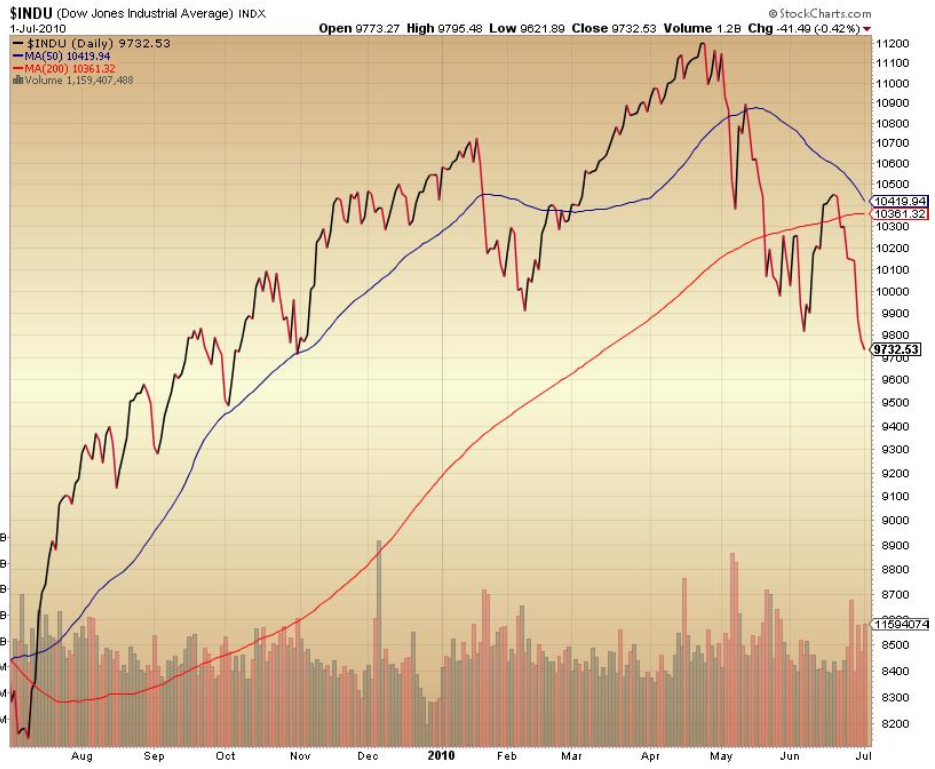
….read pages 2 and 3 HERE
-
I know Mike is a very solid investor and respect his opinions very much. So if he says pay attention to this or that - I will.
~ Dale G.
-
I've started managing my own investments so view Michael's site as a one-stop shop from which to get information and perspectives.
~ Dave E.
-
Michael offers easy reading, honest, common sense information that anyone can use in a practical manner.
~ der_al.
-
A sane voice in a scrambled investment world.
~ Ed R.
Inside Edge Pro Contributors

Greg Weldon

Josef Schachter

Tyler Bollhorn

Ryan Irvine

Paul Beattie

Martin Straith

Patrick Ceresna

Mark Leibovit

James Thorne

Victor Adair