
Daily Updates
At 54, I feel time is flying by and my mortality becomes more evident. They say that memory is the second thing to go. I feel like many things are going or already gone. Dizzy Dean once said, “I ain’t what I used to be, but who the hell is?” Amen, Dizzy!
One of the first things they teach you in driving school is never to go forward without first looking back. In order to “prophesy” (make a good guess), I’d like to first look back at what I’ve said and try to honestly self-evaluate my performance. No matter what grade I give myself, I put my pant legs on one leg at a time, too (and more slowly as each year passes).
As the year 2007 progressed, I continued to talk about how America was robbing Peter to pay Paul, but Peter was tapped out. I was waiting for the Fed to make one more easing move that I believed would be the last silver bullet in their arsenal to hold up a house of cards built on insane mortgage lending and borrowing beyond our means. I went so far as to point out that singer Shania Twain was bang on in her assessment made in her song “Ka-Ching.”
Finally, on October 14th, I issued a commentary entitled “Man Your Battle Stations.” I dare suggest just a couple of days after the U.S. Stock Market made an all-time high that one should sell everything except precious metals-related investments and even dared suggest shorting the stock market. I think it’s just as important to look at what was the general thinking at the time when such a forecast was made as to the actual forecast. The crisis about to unfold was not a widely-held belief nor was how close the world would come to find itself facing the abyss.
It wasn’t long before the house of cards came crumbling down. I didn’t completely escape, as I held junior resource stocks that got crushed and also suffered serious illness to the point it became truly life-threatening (we’ll discuss this in detail when I finish the book I’ve been writing).
By early 2009, the world seemed on the brink of economic Armageddon. Thankfully, my illness would leave me almost as quickly as it came. By early March, the stock market became so oversold that my technical work suggested we could see one of the biggest bear market rallies of all time. While I bid farewell to the bearish camp, I by no means was embracing the “Obama Mystique” that was engulfing the nation at the time. In fact, I openly stated (to much criticism via email and other means) he would prove to be the worst President ever. On March 6th, I left the bear camp. The market would end up bottoming just one day later.
As 2009 progressed and the market began to seriously rebound, I began to focus on a couple of numbers and time frame. I said my work suggested a run to 10,500 – 11,000 on the DJIA and both a market an economic peak by June/July 2010. Again, keep in mind what the current thinking was at the time.
Throughout the rally, I continued to say that while not in the bear camp (betting on a decline), I was in no way suggesting a new bull market was born such as the “Don’t Worry, Be Happy” crowd on Wall Street was peddling. My argument throughout 2009 and up until most recently was that we were in an eye of a storm, and at best that eye could last until June/July 2010 before the second part of the worst-ever economic, social, political and spiritual storm to hit America took hold again. It was my belief throughout this time period that the U.S. stock market was going to trade similar to that of the Japanese market from 1989 on.
As noted about a zillion times over the last couple of decades, I believe the vast majority of people who work in the financial industry are heavily tilted in their views to the “always positive” side of things. I truly believe you could toss them off the top of the Empire State Building and all the way down they would say the same thing: “so far so good!”
Per my June 29th commentary,whatever delusion of grandeur the “Happy” people had been able to muster to the sheep that always seem to follow them, died on this date. With that, my belief stated for months (if not a year or more) that the highs made earlier this year and the low made on March 9, 2009, could prove to be the top and bottom of the market for years to come (aka the Japanese market 20-year trading range).
Bottomline – It may seem too simple to some (and in this business many seem to need a long, drawn-out commentary in order for it to be a satisfactory conclusion), but at the end of the day America has lived way behind its means, has too much stuff and can never truly make any real headway until it comes to grip with this. The fact that our problems have grown acute during a period when we moved away from who our forefathers placed their trust in is no coincidence.
The list of troubles is a mile long and while I will discuss some key factors in a moment, I once again state that we can’t and won’t solve decade’s worth of economic, social, political and spiritual problems in a week, month or year. There’s no quick fix (Obama’s misguided bailouts have and/or will prove that).
When it comes to the U.S. stock market, I feel pretty darn good about soothsaying its direction over the years and in particular the last two or three.
Go HERE and scroll down below the above to read Peter’s Rorecast on these specific Markets
Stockscores.com Perspectives for the week ending July 4, 2010
Remember This
In this week’s issue:
Weekly Commentary
Strategy of the Week

There are little tidbits of wisdom that I have picked up over my years as a trader; here is a list of some things that all traders should take to heart:
Don’t apply logic to the stock market
So often I see people make decisions in the market on what makes sense to them. It makes sense to buy stocks when the company insiders are buying. It makes sense to buy stocks that are making positive announcements. It makes sense to listen to what the President has to say about the company’s prospects. However, all that matters is what the market thinks of the company and whether the buyers are more motivated than the sellers. So often, the market does things that do not make any sense until we later learn of what motivated the market to do what it did. Remember, the market is forward looking, most times, what makes sense is judged on what has happened in the past.
Never average down on a losing position
Buying more of a bad thing is not much different than continually betting on a losing horse. Winners win for a reason, and until your stock starts to show that it is a winner, don’t add more to a bad situation. If you like a company whose stock is losing you money, sell it. You can always buy it back later when the market starts to like it again.
Successful investing is not about being right, it is about making money
Most good traders are usually wrong. They will lose small amounts often and make big amounts occasionally. What matters is how much they make over a large number of trades. Don’t try to always be right, simply work to make money.
Resist doing what feels comfortable
We have a tendency to look for the market to prove our decision is a correct one before we make our move. The problem is that this often means we are too late to capitalize on the opportunity. We have to move before the crowd, and that often feels like a dangerous thing to do. (continued below)
- Get the StockSchool Pro Free

Open and Fund a brokerage account with DisnatDirect and receive the StockSchool Pro home study course free, including special Pro level access through the DisnatDirect client website. Offer only available to Canadian residents. For information, click HERE
Anyone can get lucky in the short term, only good traders succeed in the long term
Don’t confuse making money in the stock market with knowing what you are doing. It is easy to get lucky on a stock or on a sector and enjoy gains that give credence to your analysis method. However, short term winners often give back all of their gains because they fail to recognize their success as luck.
Be patient with your winners, not with your losers
The natural tendency is to sell your winners too early and hold on to your losers, hoping for a turnaround. A simple, but not easy, thing to do is reverse this tendency. When the market proves you right, wait to sell on a signal that indicates the stock is likely to go lower. When the market proves you are wrong, let the trade go and take the loss.
Publicly available information is priced in to the stock, don’t rely on it to make decisions
Once information, no matter how good, is made public, it loses its usefulness to you. Public information is priced in to the stock by the market of investors. Information only has value to you if the market has not priced it in.
Make sure your trading strategy has an edge
A trading strategy is only worth trading if it can be shown that it consistently makes money. Establish your trading rules and test them over a variety of market conditions so you know that it is effective. Time spent testing a strategy to prove it is a money maker can save you a lot of money in the market.
People lie, markets don’t
I have learned the hard way to never trust what people say, their actions say much more. Learn to read the market and understand it’s message. No matter how much insight a person may have, recognize that they have a bias based on their own emotional attachment to money.
It is easier to trade with the trend than against it
Understand the mood of the market and trade with it. Don’t chase euphoria, but seek to buy stocks that are in the control of the buyers. Don’t sell on fear, but seek to sell stocks that are under seller control.

The sellers have control of this market but the recent price drops makes shorting stocks here risky. I think we could see a few more down days but a short term bounce back is likely as buyers bargain hunt stocks.
Right now, I would sit on the sidelines unless you are a short term trader who can take advantage of the volatility. Being in cash in this kind of market condition is a winning strategy because stocks are difficult to predict right now, at least beyond a few days.
Tough trading conditions like this come and go, we must play defense and protect past profits so we don’t give them all back. Nothing wrong with sitting on cash right now.
References
Get the Stockscore on any of over 20,000 North American stocks.
Background on the theories used by Stockscores.
Strategies that can help you find new opportunities.
Scan the market using extensive filter criteria.
Build a portfolio of stocks and view a slide show of their charts.
See which sectors are leading the market, and their components.
Click HERE for the Speaker Lineup and to Purchase the video if you want to learn from some of the worlds best traders including Tyler Bollhorn.

Tyler Bollhorn started trading the stock market with $3,000 in capital, some borrowed from his credit card, when he was just 19 years old. As he worked through the Business program at the University of Calgary, he constantly followed the market and traded stocks. Upon graduation, he could not shake his addiction to the market, and so he continued to trade and study the market by day, while working as a DJ at night. From his 600 square foot basement suite that he shared with his brother, Mr. Bollhorn pursued his dream of making his living buying and selling stocks.
Slowly, he began to learn how the market works, and more importantly, how to consistently make money from it. He realized that the stock market is not fair, and that a small group of people make most of the money while the general public suffers. Eventually, he found some of the key ingredients to success, and turned $30,000 in to half a million dollars in only 3 months. His career as a stock trader had finally flourished.
Much of Mr Bollhorn’s work was pioneering, so he had to create his own tools to identify opportunities. With a vision of making the research process simpler and more effective, he created the Stockscores Approach to trading, and partnered with Stockgroup in the creation of the Stockscores.com web site. He found that he enjoyed teaching others how the market works almost as much as trading it, and he has since taught hundreds of traders how to apply the Stockscores Approach to the market.
Disclaimer
This is not an investment advisory, and should not be used to make investment decisions. Information in Stockscores Perspectives is often opinionated and should be considered for information purposes only. No stock exchange anywhere has approved or disapproved of the information contained herein. There is no express or implied solicitation to buy or sell securities. The writers and editors of Perspectives may have positions in the stocks discussed above and may trade in the stocks mentioned. Don’t consider buying or selling any stock without conducting your own due diligence.
….no longer a financial event but rather an economic event.
Read full article HERE
Read summary HERE
In this issue
- The U.S. is now 234 years old and yet over half the nation’s money supply was created since Helicopter Ben took over the flight controls four years ago
- European bourses are slightly lower, ditto for most of Asia except in Japan and South Korea; bonds are rallying; economic data in Euroland and China coming in weaker than expected
- The week that was: the Dow is now down seven sessions in a row — a streak not seen since early October 2008; what we have on our hands is no longer a financial event but rather an economic event
- Hard landing risks in the U.S. rise further, according to the ECRI weekly leading index
- Where will the positive shock come from? Every single low in an equity market selloff occurred because of some major exogenous positive shock
- The Fed was pushing on a string, fiscal policy was pushing on a string, and now the bond market is pushing on a string too
- The problems with U.S. housing and mortgage market linger on
- A bullish Gene
- Do we have anything positive to say?
THE WEEK THAT WAS
The Dow is coming off seven losing sessions in a row, a streak not seen since
early October 2008 when we had a post-Lehman financial panic on our hands.
What we have today is something completely different. Rather than a series of cataclysmic declines, which one would like to see in order to hit a true capitulation bottom, what we have now is a slow bleed that must truly be painful for the bulls. It’s almost like the sort of market we had coming off the peak in August 1987 that ultimately morphed into something big, and those that were prepared to take advantage of the eventual plunge profited handsomely. Back then, of course, we had a ripping economy — the problem was one of Fed tightening and constricted liquidity conditions. But when the plunge did come, the Fed had plenty of ammunition to kickstart the bull market.
What we have on our hands today is much more complicated. This is not a financial event any longer. It is an economic event. The macro landscape is looking bleak and the leading economic indicators are rolling over, but this time around the Fed and the federal government have few options to restimulate the economy. It’s not just equities but anything with a cyclical feel to it is sliding in price — oil fell 8.5% last week too and was down for five days running and is now bordering on $72/bbl.
The massive rally in the U.S. Treasury market is a signpost that bond investors see the prospect of another hard landing rising by the day, and at a time when underlying consumer price trends are already running below 1%. The chance that we head into either outright deflation or a prolonged stretch of price stability is also very high right now. And, deflation in a period of debt deleveraging is a disastrous development since it drives up defaults. Indeed, solvency issues are a lingering concern, not so much with the financial or corporate sector, but at the State and local government sector — this is 13% of GDP and as such, the retrenchment to deal with the fiscal challenges is posing an ongoing drag on domestic demand. All eyes are now on Jefferson County’s $3.2 billion in sewer debt — talk about a stinky situation — which is on the precipice of becoming the largest municipal default in U.S. history (see page B11 of the weekend WSJ).
The Morning After: An Extreme New World
Right now, if you feel like you’ve awakened in a strange new world, you’re not alone.
The investment environment has changed over the past few years — and the change has been radical.
Today, we are in the midst of a massive global revolution — the East, reaping the benefits of its industry and thrift; the West, paying the price for its sloth and extravagance.
Former “Third World” countries are resource-rich, virtually debt-free and have vast cash reserves. And the so-called “advanced” nations — in Europe and the United States — are nearly bankrupt, drowning in debt; most available cash, borrowed or printed.
As happens every half-millennium or so, the economic sun is setting in the West and is rising in the East.
The New Reality
Moral lessons aside, the reality is that a revolution of this magnitude — the historic changing of the planet’s leadership — can be expected to impact the value of every conceivable store of wealth. And it’s only natural that these changes be as extreme as the events that drive them.
We’ve seen similar extremes in stocks as well:
Thirty-four months ago — in October of 2007 — the Dow was over 14,093. Just a year and a half later — by March of last year — it had plunged to 6,627, a 53% decline.
Then, in March of last year, the Dow changed course, ultimately rising to 11,019, posting a 66% gain in 13 months … only to change course AGAIN in April of this year, sinking to the 9,700 zone in just the last three months.
Moreover, judging from the rapidly deteriorating economic news, this is likely to be just the beginning of a far deeper decline — one that could take the Dow down all the way back to last year’s lows.
If that forecast proves to be correct, the Dow will have swung a total of more than 15,000 points since October of 2007.
And as you might expect, similar scenarios have been playing out in every other major investment market on the planet:
- The U.S. dollar crashed to all-time lows in 2008. Then, the European debt crisis took center stage. And for the past seven months or so, investors have been buying dollars and dragging the euro through the dirt. In the next phase, if those same investors realize that America’s sovereign debt crisis dwarfs that in Europe — and that the U.S. Fed has been counterfeiting dollars like there’s no tomorrow — it could be the dollar’s turn at the whipping post.
- The U.S. bond market is a huge bubble. Market interest rates — not just those dictated by the Fed but also those set in the bond market by real investors — have cratered as bond prices soared. But with our deficits bulging and our economy sinking, global investors may soon decide to flee from dollar-denominated bonds, much as they fled from European bonds this spring. If so, our bond bubble could also burst.
Why the Old Rules No Longer Apply
In this kind of environment, the old rules of investing are out the door.
Most buy-and-hold investors are subjected to the roller coaster rides of their lives; and, in the end, go nowhere (if they’re among the lucky ones who can avoid big losses.)
Look. After all the sleepless nights — and fanfare — of the past three years, the Dow is STILL down 32% from its October, 2007 highs.
After nearly three years of nail-biting volatility, most buy-and-hold investors have managed to wind up with far less money than they started with.
Worse: There’s no end in sight. Nothing on the horizon that even suggests a return to normalcy at any point in the foreseeable future.
Given these new facts of life, most inexperienced investors are frozen — unable to budge. And they often lose a lot of money.
Martin D. Weiss, Ph.D.
This investment news is brought to you by Money and Markets. Money and Markets is a free daily investment newsletter from Martin D. Weiss and Weiss Research analysts offering the latest investing news and financial insights for the stock market, including tips and advice on investing in gold, energy and oil. Dr. Weiss is a leader in the fields of investing, interest rates, financial safety and economic forecasting. To view archives or subscribe, visit http://www.moneyandmarkets.com.
This brief comment from the Legendary Trader Dennis Gartman. For subscription information for the 5 page plus Daily Gartman Letter L.C. contact – Tel: 757 238 9346 Fax: 757 238 9546 or For a Trial Subscription go to The Gartman Letter
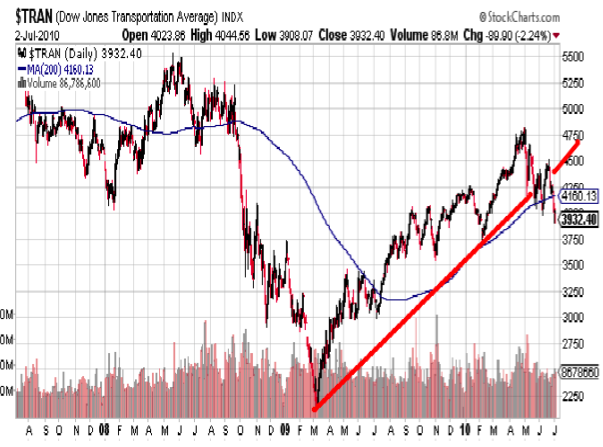
THE DOW(N) TRANSPORATION INDEX: Cast any trend line you wish to cast from the lows in March of ’09 and that trend line has been broken. We are bearish of stocks generally and this chart serves only to make that bearishness more readily acceptable.
Brief Excerpts from Richard Russell’s Dow Theory Letters. One of the best values anywhere in the financial world at only a $300 subscription to get his DAILY report for a year. HERE to subscribe. Amongst his achievements Richard was in cash before the 2008/2009 Crash and he has been Bullish Gold since below $300 Ed Note: Richard Russell is bullish Silver and holds one of the largest single positions he has held since the 1950’s in the precious metals.
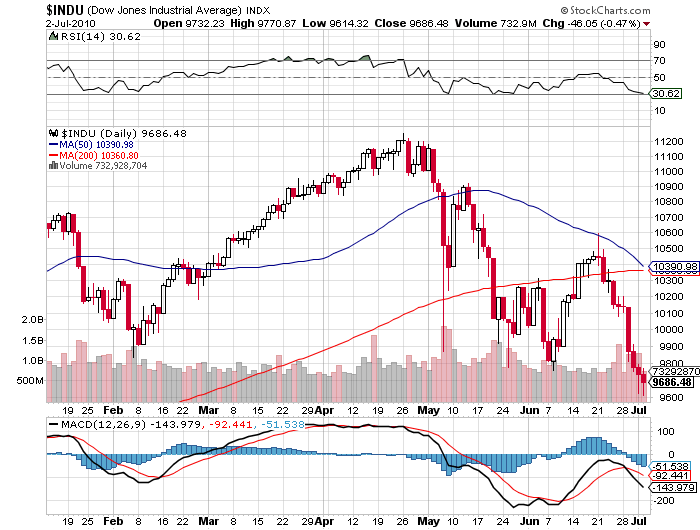
I do know this — yesterday the following broke below their June lows — the Dow, the Transports, the NYSE Composite (which includes ALL NYSE stocks), the S&P Composite, the NASDAQ and the Russell 2000. Any way you look at it, that’s bad action.
HOPE: It’s human nature to be optimistic. It’s human nature to hope. Furthermore, hope is a component of a healthy state of mind. Hope is the opposite of negativity. Negativity in life can lead to anger, disappointment and depression. After all, if the world is a negative place, what’s the point of living in it? To be negative is to be anti-life.
Ironically, it doesn’t work that way in the stock market. In the stock market hope is a hindrence, not a help. Once you take a position in a stock, you obviously want that stock to advance. But if the stock that you bought is a real value, and you bought it right — you should be content to sit with that stock in the knowledge that over time its value will out without your help, without your hoping.
So in the case of this stock, you have value on your side — and all you need is patience. In the end, your patience will pay off with a higher price for your stock. Hope shouldn’t play any part in this process. You don’t need hope, because you bought the stock when it was a great value, and you bought it at the right time.
Any time you find yourself hoping in this business, the odds are that you are on the wrong path — or that you did something stupid that should be corrected.
Unfortuneately hope is a money-loser in the investment business. This is counter-intuitive but true. Hope will keep you riding a stock that is headed down. Hope will keep you from taking a small loss and instead, allowing that small loss to develop into a large loss.
In the stock market hope get in the way of reality, hope gets in the way of common sense. One of the first rules in investing is “Don’t take the big loss.” In order to do that, you’ve got to be willing to take a small loss.
If the stock market turns bearish, and you’re staying put with your whole position. and you’re HOPING that what you see is not really happening – then welcome to poverty city. In this situation, all your hoping isn’t going to save you or make you a penny. In fact, in this situation hoping is the devil that bids you to sit — while your portfolio of stocks goes down the drain.
In the investing business my suggestion is that you avoid hope. Forget the siren, hope — instead embrace cold, clear reality.
-
I know Mike is a very solid investor and respect his opinions very much. So if he says pay attention to this or that - I will.
~ Dale G.
-
I've started managing my own investments so view Michael's site as a one-stop shop from which to get information and perspectives.
~ Dave E.
-
Michael offers easy reading, honest, common sense information that anyone can use in a practical manner.
~ der_al.
-
A sane voice in a scrambled investment world.
~ Ed R.
Inside Edge Pro Contributors

Greg Weldon

Josef Schachter

Tyler Bollhorn

Ryan Irvine

Paul Beattie

Martin Straith

Patrick Ceresna

Mark Leibovit

James Thorne

Victor Adair