
Daily Updates
In one week the markets have declined steadily from being overbought against the 2.5% moving average band, the Bollinger Band (20, 2) and the lower end of the anticipated $1130 to $1155 resistance (basis S&P 500). Seasonally, we are entering another buoyant period similar to Memorial Day where a holiday occurs around month end (and in this case the end of the calendar quarter). The seven midterm years we compare to 2010 (1934, ‘46, ‘62, ’66, ’90, ’94 & ’98) saw recovery rallies from June 26-30 through July 10-18. Any RSI(9) around 60 in the first half of July should be viewed as an optimum level to sell equities before a drop into August. The ‘median’ decline from the March-May highs has been 23%, targeting 940 on the S&P for August.
In today’s issue of Breakfast with Dave
….read the summary HERE….read the Full Article HERE
• While you were sleeping: European bourses starting off the week on a positive note, but mixed action in Asia; government bonds are getting whacked pretty hard in Europe, but U.S. Treasuries are stable
• Not much out of G20 but the key takeaway is the acknowledgement for fiscal restraint
• The Third Depression, this is the title of Paul Krugman’s article in today’s NYT; his view on the current cycle is on the market: a deflationary depression
• A look back in time … no happy returns for the equity market
• Oh Canada! The opposite direction that Canada and the U.S.A. are going is rather striking
• Is Britain the poster boy for fiscal renewal? Only time will tell
• Deflation is the primary risk ahead
• Deleveraging at its penultimate
• Double dip in the U.S.? What flavour?
• U.S. housing still in disarray
• Diminishing returns and dealing with pension changes in the U.S.
Ed Note:
A million seconds is 12 days.
A billion seconds is 31 years.
A trillion seconds is 31,688 years.
Derivative Monster – Alive and Kicking
Anyone who thinks the new financial reform law will save us from the next debt disaster must be dreaming. Here are the facts …
Fact: The U.S. derivatives that helped cause the last debt crisis are merely being shifted around like deck chairs on the Titanic.
Fact: Nothing whatsoever is being done about the derivatives monster overseas, which is more than TWICE as big.
Fact: Most important, despite months of debate and thousands of pages of legislation, the two biggest risk-mongers of all — the Treasury and the Fed — didn’t even get a slap on the wrist. They got more power.
Little has been done to address the huge derivatives risks that the Government Accountability Office (GAO) warned about 16 years ago in its landmark study, Financial Derivatives, Actions Needed to Protect the Financial System.
And nothing has been done to address the risks we warned Congress about 15 months ago in our white paper, “Dangerous Unintended Consequences.”
Need proof? Then read on …
Fact #1
Derivatives at U.S. Banks to Be Shifted
Like Deck Chairs on the Titanic
In its latest update, the Comptroller of the Currency (OCC) reports that the national value of derivatives held by U.S. commercial banks is $216.5 trillion, or nearly FIFTEEN times the nation’s Gross Domestic Product.
Moreover, instead of diminishing, they’re getting larger, up by $3.6 trillion — the equivalent of one full quarter of GDP — in just the most recent three-month period.
Yes, regulatory reform takes some steps in the right direction, such as getting a piece of this monster off the street and under the roof of exchanges. But how far is that going to go toward protecting investors if the beast keeps growing bigger?
Despite the new reforms, derivatives will continue to grow in size. And they will continue to be highly leveraged investments that put financial institutions, their trading partners, individual investors, and the entire financial system at risk.
Congress knows — or should know — what these risks are; the GAO explicitly warned about them 16 years ago, long before the 2008 debt crisis began. Derivatives create massive exposure to:
(a) credit risk, defined as “the possibility of loss resulting from a counter party’s failure to meet its financial obligations”;
(b) market risk, “adverse movements in the price of a financial asset or commodity”;
(c) legal risk, “an action by a court or by a regulatory or legislative body that could invalidate a financial contract”;
(d) operations risk, “inadequate controls, deficient procedures, human error, system failure, or fraud”; and
(e) system risk, a chain reaction of financial failures that could threaten the national or global banking system.
Are these risks addressed in financial reform? Only marginally.
Moreover, the GAO warned that a handful of big players accounted for the overwhelming bulk of the derivatives trading — a dangerous concentration of risk.
Has this risk diminished since then? No, it is even more deeply entrenched today: The latest OCC tally of the largest 25 banks (Table 1, pdf page 23) shows that …
- Just FOUR of the largest commercial banks — JPMorgan Chase, Bank of America, Citibank, and Goldman Sachs — control $205.3 trillion in derivatives, or 94.9 percent of the total held by all U.S. banks.
- Only 25 of the top banks control $216.1 trillion in derivatives, or 99.82 percent of the total. In other words, for every $100 of derivatives, the big banks hold $99.82; while all the rest of the banks hold a meager 18 cents’ worth.
Does the new regulatory reform address this intense concentration of risk? Hardly. In fact, I fear it could have precisely the opposite effect, tacitly giving the government’s rubber stamp of approval to this dangerous oligopoly.
Fact #2
The Derivatives Monster Overseas Is Twice as Big.
But Nothing Whatsoever Is Being Done to Tame It.
The Bank of International Settlements (BIS) reports that, at year-end 2009, the total notional amount of derivatives traded on the over-the-counter market globally was $614.7 trillion.
In addition, the total traded on organized exchanges was $21.7 trillion in futures contracts and another $51.4 trillion in options.
Grand total globally: $687.8 trillion.
Problem: At this juncture, strictly the portion held by U.S. banks (the $216.5 trillion tabulated by the OCC) has anything to do with the new legislation. The balance of $471.3 trillion — TWICE as much — remains outside the realm of any reforms.
Fact #3
Financial Reform Does Nothing to Curb
The Two Biggest Risk-Mongers of All:
The Treasury and the Fed
The financial reform bill grants both the U.S. Treasury Department and the Federal Reserve new powers and responsibilities to control and monitor the risk-taking of large financial institutions.
What’s ironic, however, is that these are precisely the agencies that have created — and continue to create — the greatest systemic risks of all:
- The Treasury, by running the largest federal deficits of all time, exposes the U.S. bond market to the same kind of contagion risk that recently struck Greece, Spain, Portugal, and Hungary. And …
- The Federal Reserve, by massively increasing the U.S. monetary base, helps create the same kind of speculative bubbles that caused the debt crisis in the first place.
Clearly, Congress has done little more than tinker — fighting the last war, even as it sits on the powder keg of the next one.
My recommendation: Stay safe. And if you have speculative fund available, start now to stake out positions that stand to profit from the consequences of our government’s failure to act decisively — higher interest rates and lower equity prices.
Good luck and God bless!
Martin
This investment news is brought to you by Money and Markets. Money and Markets is a free daily investment newsletter from Martin D. Weiss and Weiss Research analysts offering the latest investing news and financial insights for the stock market, including tips and advice on investing in gold, energy and oil. Dr. Weiss is a leader in the fields of investing, interest rates, financial safety and economic forecasting. To view archives or subscribe, visit http://www.moneyandmarkets.com.
The S&P 500 Index fell 40.75 points (3.65%) last week. Intermediate trend remains down. Support is at 1,040.78. Short term momentum indictors have rolled over: Stochastics rolled over from an overbought level. The Index found resistance at its 50 day moving average currently at 1,127.96 and subsequently fell below its 200 day moving average. A test of support appears imminent.

The TSX Composite Index gave up 219.74 points (1.84%) last week. Support is at 11,179.97. The Index briefly moved above its 50 day moving average, but quickly faded and is now testing its 200 day moving average. Short term momentum indicators have rolled over. Stochastics rolled over from an overbought level. Strength relative to the S&P 500 Index remains positive.
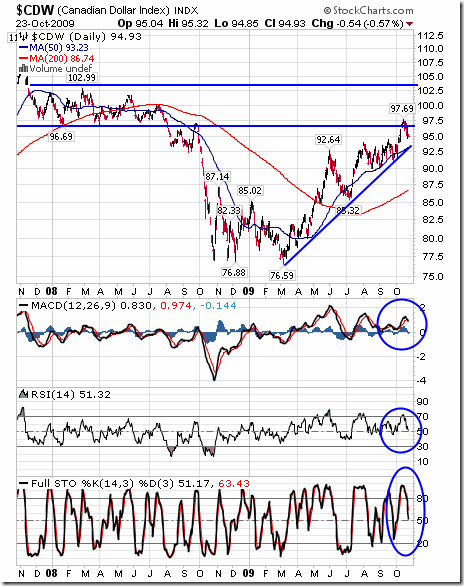
The Canadian Dollar fell 2.26 cents U.S. last week. Long term support is near 93 cents. Resistance is at 100.51. Short term momentum indicators have rolled over. Stochastics rolled over from a short term overbought level.
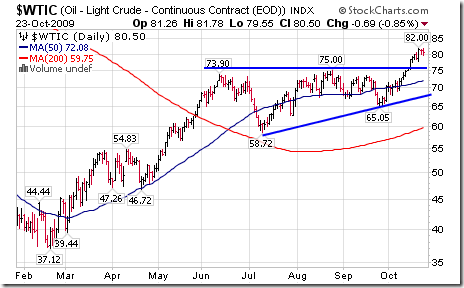
Crude Oil gained $0.95 U.S. per barrel last week. All of the gains occurred on Friday on concerns that a tropical storm heading to the Gulf could shut down energy production. Concerns lessened over the weekend. Stochastics are short term overbought and show signs of rolling over. For those who believe in a bearish “Death Cross” (i.e. the 50 day moving average moving below the 200 day moving average, it happened on Friday.
Natural gas prices historically reach a seasonal peak in the middle of June and move significantly lower until near the end of August. History is repeating. .HHi Gas Futures (NG) Seasonal Chart

Gold, Silver and many more charts HERE
The Bottom Line
A cautious equity strategy is recommended. Some special situations exist (e.g. medical devices and biotech) and several special situations possibly could surface this summer (e.g. gold, agriculture, health care, consumer staples). Stay tuned for further developments.
Quotable
“The charm of history and its enigmatic lesson consist in the fact that, from age to age, nothing changes and yet everything is completely different.” – Aldous Huxley
FX Trading – US/China Symbiotic relationship back in play?
You may remember that the US dollar soared in value in the midst of the worst fears during the credit crunch. It peaked in March of 2009; which not coincidently is when global stock markets and risk assets began to soar in value. It was the big quantitative easing moment from the Fed and an explicit signal the US policy was to use US dollar—dollar based credit— to liquefy global credit markets, i.e. a weak dollar policy indeed. We have to be open to the idea we may revisit that period if US policymakers are cranking up the China/US Symbiotic relationship again.
….read more US/China Symbiotic relationship
-
I know Mike is a very solid investor and respect his opinions very much. So if he says pay attention to this or that - I will.
~ Dale G.
-
I've started managing my own investments so view Michael's site as a one-stop shop from which to get information and perspectives.
~ Dave E.
-
Michael offers easy reading, honest, common sense information that anyone can use in a practical manner.
~ der_al.
-
A sane voice in a scrambled investment world.
~ Ed R.
Inside Edge Pro Contributors

Greg Weldon

Josef Schachter

Tyler Bollhorn

Ryan Irvine

Paul Beattie

Martin Straith

Patrick Ceresna

Mark Leibovit

James Thorne

Victor Adair