
Daily Updates
Market Buzz – Risk Aversion Trade Will Provide Opportunities Long-Term
Just ahead of Toronto’s Group of 20 nation’s summit, the TSX ended up in another volatile session. For the week however, four of the five sessions ended down as worries about the fragility of the global economic recovery hit financial markets.
Again, investors pulled back a bit from riskier assets this week as evidence builds that economic growth, particularly in the United States, may be slowing. This has combined with fears that the spending cuts and tax raises being promulgated by European governments to cut debt will hurt the recovery.
Today, the G8 leaders meeting in Toronto — turning into the G20 on Saturday – gets set to grapple with this issue with Washington warning against cutting too far and too fast.
At some point however, the slumps have to be taken and a period of zero to minimal growth with austerity should be observed and is likely needed. Whether the politics of the day will allow this (or our leaders will be strong enough to go forward with this type of policy, particularly in the U.S.) remains to be seen.
With the acceleration of the European debt crisis worries, a renewed focus on U.S. debt, concerns about the removal of government stimulus over the next several months and the risk aversion trade has produced jittery markets over the past two months. For a number of Toronto-listed China-based stocks we cover, including big names like forestry plantation giant, Sino-Forest Corporation (TRE:TSX) (a company we have recommended since 2002 when it traded at $1.15), these jitters have been compounded by questions of a home grown housing bubble and slack export demand.
The combination has produced a sell-off in this segment with Sino-Forest dropping from its 52-week high in April of $21.75 to recently hit $16.00.
The concerns are not without merit. But, we have heard similar criticism and skepticism on China since we began looking at the region (via North American listed companies) as a viable segment to uncover growth stocks just over a decade ago. Each time, over the long term, the skeptics have been proven wrong and we have been very pleased with our returns from buying a basket of profitable companies operating in this market (in combination with a diversified overall portfolio).
Looniversity – Your Options
With the markets continuing to follow a volatile downward trend, option investing (particularly in puts) has become a hot topic. As a result, we thought now would be an excellent time for a brief primer on options.
There are two basic types of options: calls and puts.
A call gives the holder the right to buy an asset (usually stocks or indices) at a certain price within a specific period of time. Calls are very similar to having a long position on a stock. Buyers of calls hope that the stock will increase substantially before the option expires, so that they can then buy and quickly resell the amount of stock specified in the contract, or merely be paid the difference in the stock price when they go to exercise the option.
A put gives the holder the right to sell an asset (usually stocks or indices) at a certain price within a specific period of time. Puts are very similar to having a short position on a stock. Buyers of puts are betting that the price of the stock will fall before the option expires, thus enabling them to sell it at a price higher than its current market value and reap an instant profit.
It should be noted that an option gives the holder the right to do something; you are not required to exercise if you do not want to or if the terms are not favourable.
Put it to Us?
Q. I am a recent viewer of BNN and just becoming familiar with the financial “lingo.” A couple terms have me scratching my head – “Big Board” and “Forward Earnings.” Please help.
– Harry Bell; Calgary, Alberta
A. While the popularity of networks such as CNBC and BNN have brought the “wacky” world of investing to the masses, we often find many commentators forget they are in most cases talking to a viewing audience that has yet to receive their Masters in Finance.
The term “Big Board” is simply a nickname for the New York Stock Exchange. Founded in 1792, the NYSE is the oldest exchange in the United States and more than 2,000 common and preferred stocks are traded on it. Back in 1792, the trading floor was under a buttonwood tree. Nowadays, this area is known as Wall Street.
“Forward Earnings” refers to analyst forecasts used in the context of a P/E ratio based on forward (expected) earnings rather than on the trailing earnings (latest 12 months), which is quoted more often. Remember, forward earnings are nothing more than predictions made by analysts and thus, are by no means guaranteed to be accurate.
KeyStone’s Latest Reports Section
- Diversified Mining & Environmental Drilling Company Posts Resilient Q1 2010, Solid Fundamentals Relative to Peers, Produces 70% Share Price Gain in Ten Months – Ratings Maintained (Flash Update)
- Under Appreciated Cash Rich Gold Producer Transitions from a Single to Multi-Mine Producer of Gold & Copper – Continue Buy Rating (Flash Update)
- IP Company’s Q4 EPS Exceed Expectations, Solid Fundamentals, Strong Cash Position & Yields 4.6% – Near-term Rating Upgrade (Flash Update)
- Western Based Financial Service Provider Posts Solid Start to 2010 – Near Term HOLD (Flash Update)
- Pure Play Chinese Construction Company Reports Strong Q3 2010, Solid Backlog, PE of under 6, Yet Shares Drop? – Update Rating (Flash Update)
Retail stocks are getting destroyed this week as market participants come around to the fact that the U.S. consumer hasn’t fully recovered from the Great Recession. Since its April peak the Retail Holders Index has been crushed -15%. Market pundits are furiously downgrading retail names and talking about “persistent weakness” in the U.S. consumer. That was not the case just two months ago when just about everyone was convinced that the consumer was back and healthy as ever.

On April 16th I posted a relatively controversial piece claiming that the market had become disconnected from reality. Exhibit A was the retail index which had executed an astounding v-shaped recovery despite almost no evidence that the U.S. consumer was healed. I wrote:
This is nowhere more apparent than it is in the consumer sector. The retail holders index (RTH) is back at its pre-recession highs. The retail holders index is one of the few indices that has experienced a full-blown v-shaped recovery. Just how wide is the disconnect between the consumer and retail stocks. Let’s compare and contrast 2007 and 2010:
- We have lost 7.8 million jobs since then.
- The unemployment rate is 9.7% versus 4.5%.
- Total unemployed workers are now 15.7 million versus 6.5 million.
- Real personal income less government transfers is lower by 6.5%, or $624 billion.
- Real retail sales have rebounded just 4% from their lows and are still down 9% from the 2007 peak.
- Consumer credit for February showed another sharp retrenchment of -5.6B.
- Consumer bankruptcies for March were the highest level since 2005.
- There is a glaring $1.5 TRILLION hole in the consumer balance sheet.
- Home foreclosures surged 19% last month and are at their highest level since 2005.
- The consumer’s largest asset (housing) is down 33% since 2007.
I do not point this out to toot my own horn, but rather, to show a real-time case of an extreme disconnect between reality and price. Careers have been built on the idea that the market is an efficient system. That it is a perfect discounting mechanism that is never wrong. I wholeheartedly disagree.
Any market is simply the summation of its participant’s decisions. Humans, by nature, are irrational creatures. The summation of irrational decisions by no means makes them all rational. This irrationality results in inefficiencies which creates opportunity for those who are able to look beyond the current price action and intelligently understand the underlying forces that are driving it. As simple as this story might sound, the rejection of the efficient market hypothesis might very well be the most important thing you ever do in achieving investment success.
Pragmatic Capitalism was founded to provide investors with a totally unbiased professional perspective on Wall Street. We provide research, indicators, and news that the mainstream media leaves entirely unnoticed. We have just one agenda at Pragmatic Capitalism: helping investors decipher information in a way that helps them create an investment plan that produces superior market returns. We don’t care for the bull side or the bear side – only the right side. Unlike most financial websites we only post commentary and research that we ourselves find useful and informative. Part of an investor’s job is to decipher and break down the enormous amount of data available. We hope to aggregate that data into one place where investors can easily obtain and decipher only the most pertinent information…..read more
Jim Rogers is holding the precious metal, not buying. Silver on the other hand is 60-70% below its all-time high – a great opportunity to buy.
Longer term on gold: Some day everybody will own gold, walking down the street checking gold prices in shop-front windows…
(YouTube of Rogers on June 23rd/2010)
There are a number of Arab media reports that have said that Saudi Arabia has permitted Israel Air Force choppers to land in its country.
The reports go on to claim that Saudi leaders have offered the IAF a logistical base in the northwest that would act as a stage for an aerial assault against Iran…
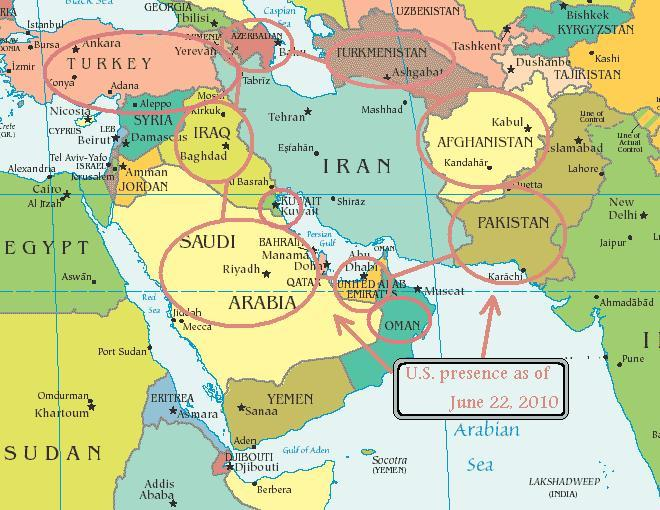
This is further backed by a report in the Times of London from two weeks ago; the story said the Saudi Royal Family has agreed to allow IAF jets in the country’s airspace.
Yet both the IDF and Saudi officials have denied these reports.
Here is a must-read on the change in the balance of power in the region due to a Turkey-Iran alliance.
Israel is the enemy
The Saudis do not officially recognize the State of Israel. They officially regard the country as an enemy.
That said, Riyadh isn’t happy about the possibility of an Iranian nuclear bomb. The Saudis opened an air corridor and leaked the story to show Iran that there are more options than economic sanctions.
U.S. makes nice with Azerbaijan
The Iranian press has reported a large amount of U.S. ground forces amassing in neighboring Azerbaijan.
The independent Azerbaijani news site Trend confirmed these reports:
Iran’s Revolutionary Guards Brigadier General Mehdi Moini said Tuesday that his forces are mobilized “due to the presence of American and Israeli forces on the western border.” The Guards reportedly have called in tanks and anti-aircraft units to the area in what amounts to a war alert.
Two weeks ago, according to Radio Free Europe, President Obama promised Azerbaijani President Aliyev that it would make its dispute with Armenia a top priority.
Fleet Week in the Persian Gulf
Earlier in the week, the Pentagon confirmed that an unusually large fleet of U.S. warships had indeed passed through Egypt’s Suez Canal en route to the Persian Gulf. At least one Israeli warship reportedly joined the American armada. There are also Israeli nuclear armed submarines.
According to PrisonPlanet.com:
Three German-built Israeli submarines equipped with nuclear cruise missiles are to be deployed in the Gulf near the Iranian coastline.
The first has been sent in response to Israeli fears that ballistic missiles developed by Iran, Syria and Hezbollah, a political and military organization in Lebanon, could hit sites in Israel, including air bases and missile launchers.
The submarines of Flotilla 7 — Dolphin, Tekuma and Leviathan — have visited the Gulf before. But the decision has now been taken to ensure a permanent presence of at least one of the vessels.
Ahmadinejad eggs them on
Turkish network Ahlul Bayt News Agency (ABNA.ir) reported that the Iranian president has said Tel Aviv is not capable or military action against Iran.
“The Zionist regime is too weak to launch aggression against Iran. They long to deal a blow to Iran, but wouldn’t dare even think about it,” said Mahmoud Ahmadinejad. “They all know that playing with Iran is like playing with a lion.”
In 1981, Israel bombed a Baghdad nuclear reactor
An attack by Israel is not unprecedented. In 1981, the Israelis bombed a nuclear plant which they believed was designed to make nuclear weapons that would destroy Israel.
The Israeli government said at the time: “The atomic bombs which that reactor was capable of producing whether from enriched uranium or from plutonium, would be of the Hiroshima size. Thus a mortal danger to the people of Israel progressively arose.”
The last oil price shock in the Middle East was in 1990 when the U.S. invaded Iraq for invading Kuwait. The price per barrel of oil went from $21 to $28 on August 6… to $46 by mid-October.
The Looming Iran War is not Priced in
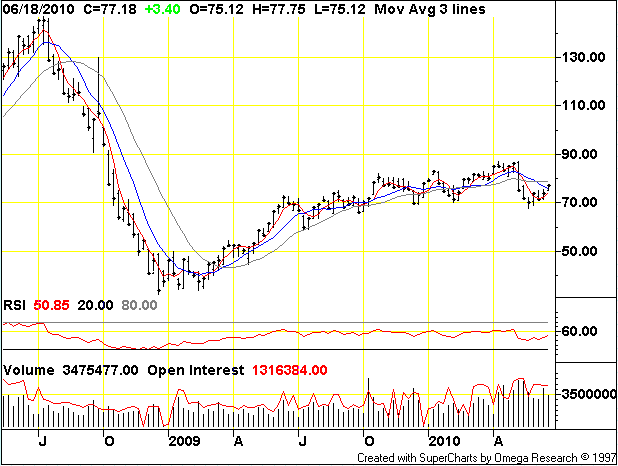
As you can tell by the crude oil price chart above, there is no fear premium as of yet.
The BP oil spill in the Gulf of Mexico has overshadowed every other oil story.
According to the U.S. Energy Information Administration, Iran has the third-highest oil reserves in the world (137 billion barrels) and is second only to Saudi Arabia in production (at 3.8 million barrels a day).
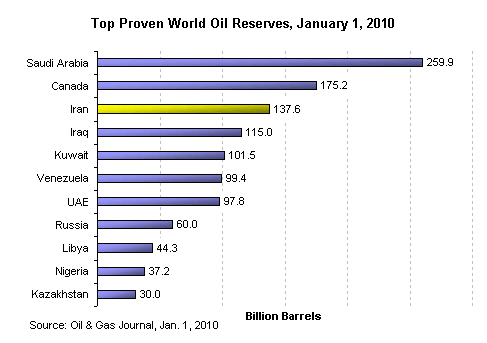
Iran exported 2.6 million bb/d a year in 2008. Most of this oil goes to Japan, China, India and South Korea.
That said, oil is a fungible commodity. If the countries that are accustomed to getting Iranian oil no longer do so, they must buy it on the open market.
And this will drive up the price.
Will the price of oil more than double, as it did in 1990?
Could it hit $150 a barrel?
No one knows… But it seems worth a hedge.
You could buy some December 25th calls on an oil EFT — like the iPath S&P GSCI Crude Oil Ttl Ret Idx ETN (OIL)
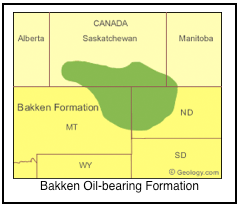
Or you could buy some small oil companies that have nothing to due with the U.S., the Middle East, or North Africa. I’ll give you one right here.
Chart posted by Money Talks of the incredible Bakken Formation Energy and Capital speaks about in (. I’ll give you one right here.)
Sincerely,
Christian DeHaemer
Editor, Energy & Capital
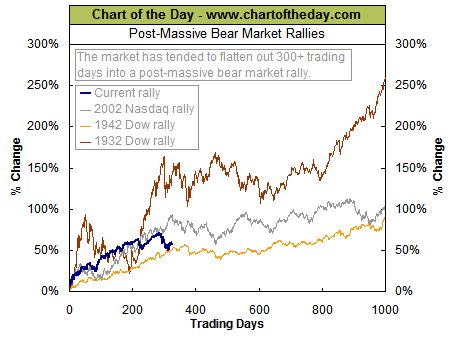
Today’s chart illustrates rallies that followed massive bear markets. For today’s chart, a ‘massive’ bear market is defined as a decline of greater than 50%. Since the Dow’s inception in 1896, there have been only three bear markets whereby the Dow declined more than 50% (early 1930s, late 1930s until early 1940s, and during the very recent financial crisis). Today’s chart also adds the rally that followed the dot-com bust during which the Nasdaq declined 78%. The current Dow rally has followed a path that is fairly similar to that of the Nasdaq rally that began in late 2002 as well as the Dow rally that began in 1942. It is worth noting that after 300 (plus or minus) trading days the market moved into a trading range/choppy phase that lasted for a year or more.
Dennis Gartman Comment: We find ourselves less and less enthusiastic about stock prices and we find ourselves more and more concerned about them for as we look at one broad market index after another we come away with the thought that a major top has been formed, globally and domestically, and this we find disconcerting. For a Trial Subscription go to The Gartman Letter
How do I get my free Chart of the Day?
Simply enter and submit your email address HERE (we won’t share it with anyone) and you will receive one free chart per week and instantly receive the latest free Chart of the Day.
-
I know Mike is a very solid investor and respect his opinions very much. So if he says pay attention to this or that - I will.
~ Dale G.
-
I've started managing my own investments so view Michael's site as a one-stop shop from which to get information and perspectives.
~ Dave E.
-
Michael offers easy reading, honest, common sense information that anyone can use in a practical manner.
~ der_al.
-
A sane voice in a scrambled investment world.
~ Ed R.
Inside Edge Pro Contributors

Greg Weldon

Josef Schachter

Tyler Bollhorn

Ryan Irvine

Paul Beattie

Martin Straith

Patrick Ceresna

Mark Leibovit

James Thorne

Victor Adair