
Daily Updates
U.S. Stock Market – The Obama aura has disappeared and the majority of Americans now realize the magic carpet some thought he came into power on was just an illusion. In fairness to him, many of the staggering economic, social, political and spiritual problems facing America began long before he took office. Unfortunately, those who thought he could chip away at some of them are now concluding he’s only piling on.
This in turn has IMHO limited any upside in the stock market. While we can still managed to trade in the upper end of the trading range we’ve been in for a few months, I do think as fall approaches the upcoming elections will grip the market’s attention and the pressure will be to the downside.
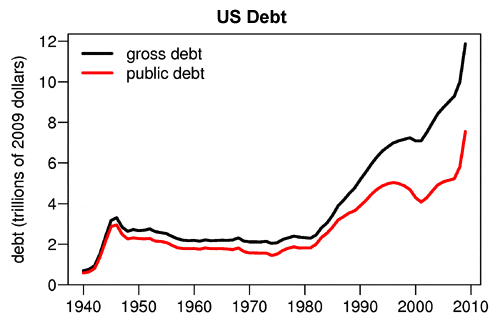
U.S. Bonds – There’s going to come a day when despite a very weak economy and no real signs of inflation, bonds are going to look unattractive due to the enormous debt America has taken on and concerns of its ability to service it will come every bit as much as it did to some European countries earlier in the year. However, I’m out of the guessing game of when exactly that’s going to take place.
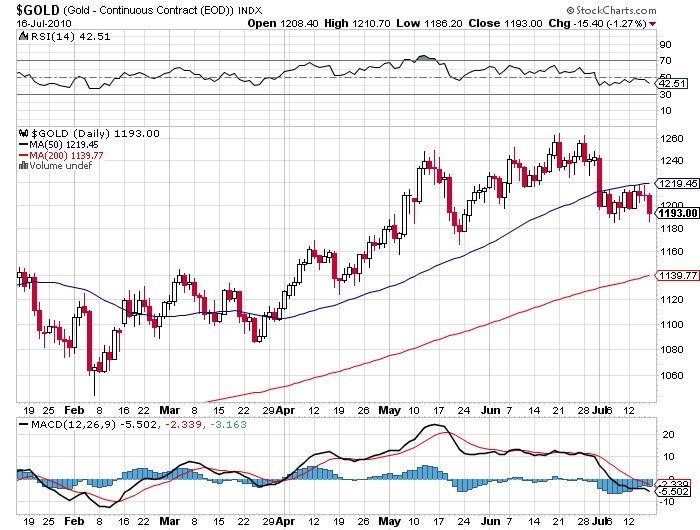
Gold – The July/August seasonally weak period for gold has played out this year and gold is just above some key support. There are likely numerous sell stops in the $1,180 – $1,185 area. A break below this level is likely to bring on a test of the 200-day M.A. around $1,140. While such an event would certainly give the gold perma bears some fodder to peddle to those who believe even a broken clock is right twice a day, I don’t believe it changes any long term objectives. In fact, if it occurs in a sharp wash out fashion, it could end up being a key intermediate bottom.
At the same time, if $1,185 holds, and the market then closes above $1,225 and especially $1,260, we would have put in a triple bottom and likely see acceleration to the upside.
I would sit on the sidelines for now and await either the $1,140 area or above $1,225 to buy.
U.S. Dollar – Where did all the dollar bulls go? The countertrend rally is over and the terminally ill Uncle Sam paper is resuming its death march.
Oil and Gas – No interest on either side.
Note – Tookie Angus took some serious change and picked up shares in Evolving Gold EVG is a client of Grandich Publications and I own 1.1 million shares as of today.
On Major Moves, Peter Grandich has been very right and not only saved many investors fortunes, but expanded them dramatically. On November 3, 2007 at the MoneyTalks Survival Conference, Peter Grandich of the Grandich Letter warned that “an unprecedented economic tsunami will hit American beginning in 2008”. Peter advised publicly to short the US market two days from the top in October, 2007 and stayed short until the last week of October, 2008. He began to buy stocks in March 7th, 2009. He also bought oil and oil related investments near the lows after the dive from $147.
….go to visit Peter’s Website
To HERE Peter speak and others speak on Trading go HERE:

Stockscores.com Perspectives for the week ending July 18, 2010
Scale in to Increase Profits
In this week’s issue:
Weekly Commentary
Strategy of the Week
Stocks That Meet The Featured Strategy

An important skill for traders to master is position scaling. This technique allows you to build a large position in a trade without having to take on a lot of extra risk. It gives you a way to take the most advantage of a trade that is working.
One of my cardinal rules is to never ever average down on a trade. If you buy a stock at $10 and it falls to $9, don’t buy more! Doing so is like betting more on the horse that is in last place mid way through a race.
What if your trade is working? That means that the stock is trading at a price that is higher than what you paid. When conditions are right, add to the position by buying more at higher prices. Averaging up is what scaling in to a position is all about.
Here is an example of how the economics of scaling in to a position work. Suppose you but a stock at $10 with a stop loss point of $9, giving you a risk of $1 a share. If you have a $1000 risk tolerance, you buy 1000 shares.
Soon after you enter the stock rallies to $11 and then trades sideways, building a base at $10.50. The stock breaks through $11 to $11.50, giving a new entry signal. Since support is now at $10.50, if you raise your stop on your first position to $10.50, you have locked in a profit of $500 (assuming the stock does not gap through your stop loss point and you are able to get out at $10.50).
Now, if you want to add to the position, you have a $500 profit to work with to mitigate your risk. If you buy another 1000 shares at $11.50 with a stop at $10.50, you have a second trade that has $1000 of risk. However, you have the $500 profit from the first trade to work with, so you risk is now only $500. Since you have doubled your position size, you have much more upside potential if the trade works.
You can continue to do this as the trade continues to work, building a larger and larger position. By doing so, you are using the money made on the early trades in the sequence to lower the risk of building a larger position.
Suppose you scale in to the position at $11.50, $12.50 and then again at $13.50. You now have 4000 shares without ever taking on any more risk. If you get a sell signal at $15, your total profit is as follows:
Original entry at $10, exit at $15 for $5000.
Second entry at $11.50, exit at $15 for $3500
Third entry at $12.50, exit at $15 for $2500
Fourth entry at $13.50, exit at $15 for $1500
Since the risk of the trade never exceeded $1000, the reward for risk ratio is 12.5 to 1. If we had only taken the original trade, the reward for risk would only be 5.
The downside is that we potentially forego a profit if the trend on the trade does not last long. If we scale in a few times and then get a rapid drop that moves against us, we may end up taking a small loss or breaking even when we could have had a small profit had we not scaled in.
What is important to remember is that traders make most of their money on a small number of their trades. To make the big profits, you have to trade for the big wins and grind through the small losses or break even trades.
Consider a trader who does not scale in versus one that does. Suppose the non scaling trader makes 10 trades with 3 out of 10 giving a loss of -1 reward for risk. 5 trades make a profit of +1 reward for risk, one trade makes a 2 and one makes a 7 reward for risk. Total profit over the 10 trades is -3 + 5 + 2 + 7 = 11. Pretty good, but contrast that with the trader who scales on the same trades.
(continued below)
- Get the StockSchool Pro Free

Open and Fund a brokerage account with DisnatDirect and receive the StockSchool Pro home study course free, including special Pro level access through the DisnatDirect client website. Offer only available to Canadian residents. For information, click HERE
The scaling trader may have 4 trades that lose -1, 4 trades that make +1, 1 trade that makes 3 and one trade that makes 15. Total reward for risk over the same 10 trades is 18. The stock picking skill is no better, but scaling had a dramatic effect on total profitability even though the success rate (the percentage of trades that were profitable) went down.
This past week, I have been discussing and encouraging scaling in the daily edition of my newsletter. Here is a comment that I received from one of my readers who has been trading the inverse ETF on the S&P 500 index, the SDS:
“All right, despite the last few weeks being a tough environment to learn to trade in, I get what you mean about only needing a few good trades to make money, even in lousy markets. In the last few days my confidence got a huge boost, especially today. These major turning points are lucrative.
Today alone I extracted $7200 from SDS, an additional couple thousand in previous days. And I never risked more than a few hundred. Jumping in at the end of the day yesterday was of course beneficial, but I scaled in as the day went on today, more than doubling my position. I chose to sell out at the end of the day, even though SDS is likely a long term position trade. I expect a correction in SDS Monday and if not, I only missed some profits. I’ll find another entry point. Couldn’t leave the profits from today on the table.”
He was right on the trade, but scaling in grew the total profit dramatically.

I have been a buyer of the SDS for the past few days as I think the market is going to drop from here. This ETF goes up twice as fast as the market goes down. Given the action on Friday, I think this trend is likely to continue. It is a bit late to get in to the trade here but I think the reward for risk is still sufficient to justify taking the trade. Check the chart below to see how this ETF fell down to its upward trend line and bounced, making a green candle on Friday as the market reverses direction. It should now rally for a few days, meaning the overall market should drop for a few days. These are the kind of swing trade set ups that I am focusing on in the daily edition of the newsletter right now because the overall market is outweighing the movement in individual stocks.

1. SDS

References
Get the Stockscore on any of over 20,000 North American stocks.
Background on the theories used by Stockscores.
Strategies that can help you find new opportunities.
Scan the market using extensive filter criteria.
Build a portfolio of stocks and view a slide show of their charts.
See which sectors are leading the market, and their components.
Click HERE for the Speaker Lineup and to Purchase the video if you want to learn from some of the worlds best traders including Tyler Bollhorn.
Tyler Bollhorn started trading the stock market with $3,000 in capital, some borrowed from his credit card, when he was just 19 years old. As he worked through the Business program at the University of Calgary, he constantly followed the market and traded stocks. Upon graduation, he could not shake his addiction to the market, and so he continued to trade and study the market by day, while working as a DJ at night. From his 600 square foot basement suite that he shared with his brother, Mr. Bollhorn pursued his dream of making his living buying and selling stocks.
Slowly, he began to learn how the market works, and more importantly, how to consistently make money from it. He realized that the stock market is not fair, and that a small group of people make most of the money while the general public suffers. Eventually, he found some of the key ingredients to success, and turned $30,000 in to half a million dollars in only 3 months. His career as a stock trader had finally flourished.
Much of Mr Bollhorn’s work was pioneering, so he had to create his own tools to identify opportunities. With a vision of making the research process simpler and more effective, he created the Stockscores Approach to trading, and partnered with Stockgroup in the creation of the Stockscores.com web site. He found that he enjoyed teaching others how the market works almost as much as trading it, and he has since taught hundreds of traders how to apply the Stockscores Approach to the market.
Disclaimer
This is not an investment advisory, and should not be used to make investment decisions. Information in Stockscores Perspectives is often opinionated and should be considered for information purposes only. No stock exchange anywhere has approved or disapproved of the information contained herein. There is no express or implied solicitation to buy or sell securities. The writers and editors of Perspectives may have positions in the stocks discussed above and may trade in the stocks mentioned. Don’t consider buying or selling any stock without conducting your own due diligence.
Marc Faber the Swiss fund manager and Gloom Boom & Doom editor said the US is so full of debt, stuck in a period of slow growth and high enemployment, that the Federal Reserve will soon have to revert back to crisis era policies.
Speaking to Bloomberg in a live interview Thursday, Faber said: ” I am conviced the Fed will soon implement further quantitative easing,” adding “and massively so”.
“It will probably happen in september, October,” Faber said, putting a timeline to his prediction.
Explaining his reasoning, he said: Marc Faber the Swiss fund manager and Gloom Boom & Doom editor said the US is so full of debt, stuck in a period of slow growth and high enemployment, that the Federal Reserve will soon have to revert back to crisis era policies.
Speaking to Bloomberg in a live interview Thursday, Faber said: ” I am conviced the Fed will soon implement further quantitative easing,” adding “and massively so”.
“It will probably happen in september, October,” Faber said, putting a timeline to his prediction.
Explaining his reasoning, he said: “The US economy is not robust”.
Not buying into the good news brigade of commentators who believe the worst is behind us and the US economy is on the mend, he said: “We have mixed signals, but in general the economy is still weak”.
Nor has the recent rise of the euro dampen his views on Europe. Faber said Europe does not have a shot at growth and is stuck in sideways movements in its economy, for years to come, as austerity and bailouts weigh on growth.
In his latest monthly market commentary the famed investor discloses a bit more about his investment philosophy.
“I feel that most investors take far too many risks – often with borrowed money – and fail to diversify sufficiently. They also have little patience, very short-term time horizons and no tolerance for losses,” Faber writes.
“Their expectations about investment returns are completely unrealistic… Most investors buy a stock or make an investment with the view that within a month the return should be between 10% and 20%,” he adds.
“If you can achieve an annual average real return of just 3% on all your assets (inflation adjusted), you will leave a huge fortune to your children”.
I prefer diversification and no leverage,” he adds explaining “I have seen time and again investors (including myself) be right about an asset class’ future performance but fail to convert those views into any capital gains…”
“The prime consideration should always be capital preservation and avoiding large losses,” he concludes.
.
Not buying into the good news brigade of commentators who believe the worst is behind us and the US economy is on the mend, he said: “We have mixed signals, but in general the economy is still weak”.
Nor has the recent rise of the euro dampen his views on Europe. Faber said Europe does not have a shot at growth and is stuck in sideways movements in its economy, for years to come, as austerity and bailouts weigh on growth.
In his latest monthly market commentary the famed investor discloses a bit more about his investment philosophy.
“I feel that most investors take far too many risks – often with borrowed money – and fail to diversify sufficiently. They also have little patience, very short-term time horizons and no tolerance for losses,” Faber writes.
“Their expectations about investment returns are completely unrealistic… Most investors buy a stock or make an investment with the view that within a month the return should be between 10% and 20%,” he adds.
“If you can achieve an annual average real return of just 3% on all your assets (inflation adjusted), you will leave a huge fortune to your children”.
I prefer diversification and no leverage,” he adds explaining “I have seen time and again investors (including myself) be right about an asset class’ future performance but fail to convert those views into any capital gains…”
“The prime consideration should always be capital preservation and avoiding large losses,” he concludes.
Market Buzz – Seacliff’s Big Pay Day!
Toronto’s main index took it on the chin this Friday, as weak U.S. economic data and earnings results heightened worries about a slow recovery and pushed down heavily weighted resource issues.
Toronto’s slide tracked a sharp decline by U.S. stocks, which tumbled in part after consumer sentiment nearly fell to a one-year low, highlighting the sluggishness of the economic recovery.
With the acceleration of the European debt crisis worries, a renewed focus on U.S. debt, and concerns about the removal of government stimulus over the next several months, the risk aversion trade has produced jittery markets over the past two months. For a number of Toronto-listed China-based stocks we cover including big names like forestry plantation giant, Sino-Forest Corporation (TRE:TSX) (a company we have recommended since 2002 when it traded at $1.15), these jitters have been compounded by questions of a home grown housing bubble and slack export demand.
The concerns are not without merit. While the government is slowly shifting its focus from an export-based economy to focus on domestic growth (which the company’s next five year plan to be released later this year should shed further light on), there is no question growth is impaired by weak global demand. Indeed, in certain segments and regions it appears China’s housing market has hit bubblicious levels.
But, we have heard similar criticism and skepticism on China since we began looking at the region (via North American listed companies) as a viable segment to uncover growth stocks just over a decade ago. Each time, over the long term, the skeptics have been proven wrong and we have been very pleased with our returns from buying a basket of profitable companies operating in this market.
From our Canadian Small-Cap Coverage Universe (www.keystocks.com), we are very happy to report that Seacliff Construction Corp. (SDC:TSX) announced this past week that Churchill Corp. (CUQ:TSX) had completed its previously announced acquisition of the company pursuant to an arrangement under the Business Corporations Act (British Columbia). Seacliff was recommended in April 2009 to our clients at $8.00.
Under the terms of the arrangement, Seacliff shareholders received $17.14 in cash for each Seacliff common share, for a return of 114.25 per cent (excluding dividends) in just over a year since our recommendation. The total purchase price for the acquisition was approximately $394 million, including the assumption of Seacliff’s indebtedness.
For its part, The Churchill Corporation provides building construction, commercial and industrial electrical contracting, heavy construction, and industrial insulation services to an array of public and private sector clients. Churchill operates 39 locations in British Columbia, Alberta, Saskatchewan, and Manitoba.
We are happy to take the cash payout and will deploy the funds in new value with growth related situations in the current pull-back over the next one to six months.
Looniversity – 5 Ways to Invest in Gold
With the price of bullion flying high over the past few years, we get a number of questions on how to invest in the little yellow metal. Below are five of the most common ways to do so.
Physical Gold – Bars
Taking physical delivery of your gold is a very safe way of investing in gold. Gold bars are one method of achieving this.
Physical Gold – Coins
Gold coins are often more convenient than bars and can often be bought for lower premiums than bars – weight for weight.
Gold Mining Shares
Essentially, this is an investment in a public company (stock) that mines and produces gold. There is a simple theory that, when gold bullion prices and demand increase, then gold mining share prices will follow. Some mines fully hedge their future production, however, so the theory does not always hold true for all producers. Most gold mining equities tend to be three to four times as volatile as the gold price.
Gold – ETFs
ETFs are funds whose units can be traded on the stock exchanges, just like the shares of companies. Through a gold ETF, an investor can own gold in the demat form, thereby eliminating the cost and risk associated with physical gold investments. In North America, there are a number of gold ETFs that trade at approximately one-tenth of the price of gold. The first, and the most actively traded gold ETF, is streetTRACKS Gold Trust shares (GLD:NYSE). Another U.S. listed gold ETF is iShares on Comex Gold Trust (IAU:AMEX). Comex Gold Trust units also trade on the Toronto Exchange in Canadian dollars under the symbol (IGT:TSX).
Gold Futures
This is a highly professional market, but is more for the speculator than the investor. Gold futures contracts are firm commitments to make or take delivery of a specified quantity and quality of gold on a prescribed date at an agreed price.
Bottom line – While it may be a “hot investment” right now, experts suggest you don’t go overboard; gold should only constitute a small part of your portfolio, say 10 per cent.
Put it to Us?
Q. My broker recently told me to “back up the truck” on a certain stock. This may sound a little naïve, but was he telling me to “load up” or ?
– Rachael Robert; Calgary, Alberta
A. In the wacky world of finance, “backing up the truck” is slang and refers to the purchase of a large position in a stock, or other financial asset, by an investor or trader. Typically, when someone is willing to back up the truck on a financial asset, this implies that they’re extremely bullish on that asset’s performance.
For example, if an analyst recommends that it is time to start backing up the truck on XYZ stock, this means that he or she is extremely confident and upbeat about how well XYZ stock will be doing in the foreseeable future.
The term refers to the imagery derived from a truck backing up to a warehouse or some other commercial building to load up goods.
KeyStone’s Latest Reports Section
- Hardware & Software Communications Micro-Cap With Strong Balance Sheet Posts Top-line Growth, Bottom Line Hit by Currency – Maintain Rating (Flash Update)
- China-based Forestry Company Posted Solid Q1 2010, Rating Upgraded on Price Decline (Flash Update)
- Diversified Mining & Environmental Drilling Company Posts Resilient Q1 2010, Solid Fundamentals Relative to Peers, Produces 70% Share Price Gain in Ten Months – Ratings Maintained (Flash Update)
- Under Appreciated Cash Rich Gold Producer Transitions from a Single to Multi-Mine Producer of Gold & Copper – Continue Buy Rating (Flash Update)
- IP Company’s Q4 EPS Exceed Expectations, Solid Fundamentals, Strong Cash Position & Yields 4.6% – Near-term Rating Upgrade (Flash Update)
Is the Gold Trade “Crowded”?
It’s true that GLD’s assets just passed the $50 billion mark, and that it’s the second largest U.S. ETF. Yes, mints had difficulty filling orders when the Greek crisis broke. And yes, the gold price is up nine years in a row.
But those who look at statistics like these are missing the other side of the equation. I think it’s less about how much money is already invested in gold and more about what’s available to invest. After all, one could be impressed that China, for example, invested $14.6 billion in gold over the past few years – until you realize they have $2.45 trillion sitting in reserves.
So, how much is invested in gold, and how much is available?
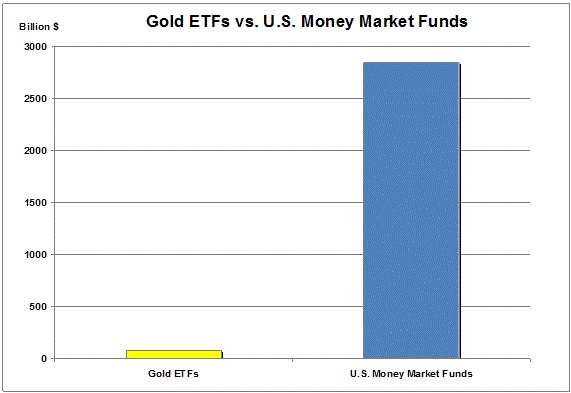
According to hedge fund Paulson & Co, if you added up all the money invested in gold ETFs, it would total $78.3 billion (at $1,200 gold). The amount of money currently sitting in U.S. money market funds, on the other hand, comes to $2.849 trillion.
In other words, all the money invested in gold ETFs represents just 2.7% of what is sitting in cash. Put another way, if just 5% of available money market funds ($142.4 billion) were to move into the gold ETFs, it would almost triple the current value.
But what if it’s 10%? And what if Doug Casey’s call for a modern-day gold rush comes to pass?
Those who claim the gold market is crowded will also point to Paulson’s extraordinary high percentage of funds sitting in yellow metal investments. Yes, he’s got a $3.4 billion stake in GLD – but the critics didn’t look under the hood. Most of those holdings are from the fund’s employees (including John himself), not outside investors. Not exactly an overheated trade.
To some, the amount of money invested in gold may “feel” high, but it’s a relative pittance compared to what’s sitting idly on the sidelines, waiting for a reason to move and a place to go. And when you consider that the vast majority of U.S. citizens don’t own any form of gold, this is a market that is the opposite of crowded. There is a lot of money that could hit our sector.
And it’s not just precious metal funds. I interviewed Andy Schectman of bullion dealer Miles Franklin, and Kevin Brekke, our Switzerland-based editor, told me it was the most informative interview we’ve published this year. Why? Because based on what Andy sees week after week regarding supply, he’s come to the conclusion that we’ll see a serious drought of bullion when the average citizen begins to buy gold. Meaning, if you wait to buy until everyone else does, you may find yourself out of luck. And the data I present this month backs up that claim; in fact, you may be surprised at some of the findings
-
I know Mike is a very solid investor and respect his opinions very much. So if he says pay attention to this or that - I will.
~ Dale G.
-
I've started managing my own investments so view Michael's site as a one-stop shop from which to get information and perspectives.
~ Dave E.
-
Michael offers easy reading, honest, common sense information that anyone can use in a practical manner.
~ der_al.
-
A sane voice in a scrambled investment world.
~ Ed R.
Inside Edge Pro Contributors

Greg Weldon

Josef Schachter

Tyler Bollhorn

Ryan Irvine

Paul Beattie

Martin Straith

Patrick Ceresna

Mark Leibovit

James Thorne

Victor Adair