
Daily Updates
Update July 27th 8:45PM EST
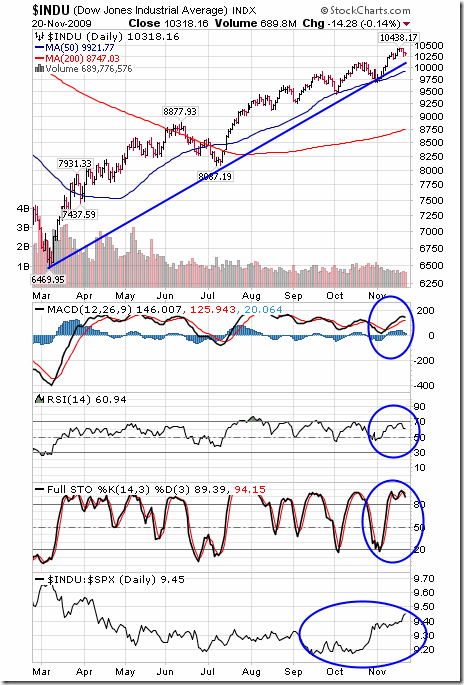
U.S. Stock Market – Throughout 2009 and at least twice this year, I received many inquiries on why I didn’t short the stock market and now I missed a big decline (the last two centered around the DJIA breaking below 10,000). My answer then and still now is I don’t see a sharp fall but rather a no where’s fast style trading pattern for the foreseeable future. I would consider some bearish call spreads if the DJIA somehow got near 11,000 before the November elections.
I’ve noted on several occasions there’s an either an always long or short mentality among many retail and even some professional traders. Not being either seems to be as tough for many as it is for a horse racing fan not to bet every race. You got to be in it to win it may be a good lottery ticket marketing ploy but isn’t to me for both gambling facilities; the racetrack and the stock market.
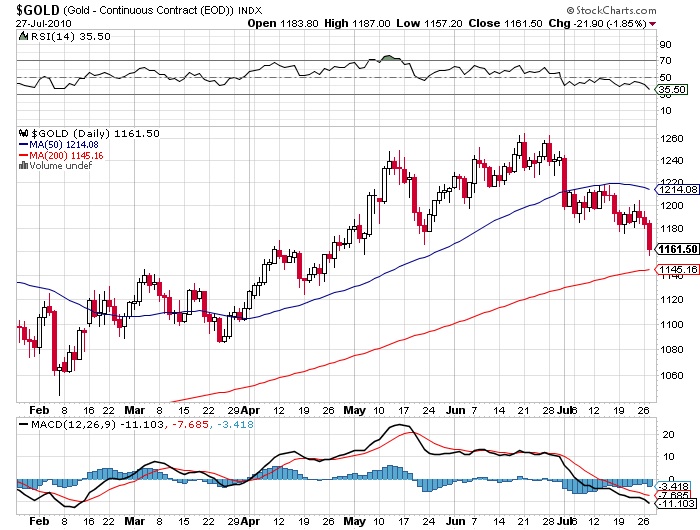
Gold – As noted earlier today, in recent days I suggested keeping any buying power dry until either a test around $1,140 or a break above $1,225. The many stops I spoke about between $1,180 and $1,185 were hit today. The fact that today was the typical monthly rape and pilferage known as option expiration didn’t help either.
Ideally, I would welcome a further sell-off straight down to the 200-day M.A. around $1,145 as it would be the washout one many times sees at intermediate bottoms. Even more desirable (although I doubt most reading this could stomach it) would be a break below the 200-day and then a reversal back above it. Unfortunately, the gloating by the gold perma bears and the media cries of the end of the gold bull market would likely be too much for some to handle.
We’ve another month or so of seasonally weakness in front of us. Please note this is also the “roll” week on the Comex. Anyone not intending or funded to take delivery of August Gold has to be out of their long positions by the end of the day Thursday.
The last great buying opportunity is near. If you’re very long-oriented (these days that’s someone who’s willing to look out past a day week or even a month), you can begin buying here. If you’re more of a timer and willing to miss a major move up in exchange for buying near or at the actual bottom, hold off for a test of the 200-Day M.A. Me? I’m just enjoying the thought that as I type this, Tokyo Rose is likely standing in front of his dimly lit mirror saying “This time is different, I will be right now.” Oh how I would love to be there later this year when he realizes his record remains intact – world’s worse (and please don’t send those emails saying that’s unchristian. I’m a sinner just like everybody else)!
U.S. Bonds – Debt, Debt and more debt. The mother of all bubbles is bonds. When will it burst? I’m no longer trying to time it. But when it comes, it could be the ugliest bust yet.
U.S. Dollar – The bear market rally is over but a sideways move for several weeks between key support around 80 and 85 to the upside is likely.
Oil and Natural Gas – No significant bullish or bearish reasons to get long or short.
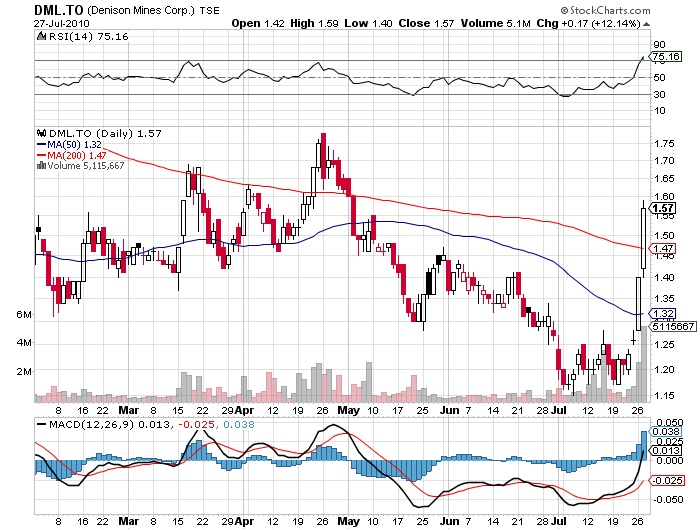
Model Portfolio stock Dennison Mines has turned bullish technically and is an aggressive speculative buy on any pullback under $1.50. Watch this very interesting commentary on the company.
Vancouver Sun article on Taseko Mines
On Major Moves, Peter Grandich has been very right and not only saved many investors fortunes, but expanded them dramatically. On November 3, 2007 at the MoneyTalks Survival Conference, Peter Grandich of the Grandich Letter warned that “an unprecedented economic tsunami will hit American beginning in 2008”. Peter advised publicly to short the US market two days from the top in October, 2007 and stayed short until the last week of October, 2008. He began to buy stocks in March 7th, 2009. He also bought oil and oil related investments near the lows after the dive from $147.
….go to visit Peter’s Website
To HERE Peter speak and others speak on Trading go HERE:

07/26/10 Pittsburgh, Pennsylvania – I just returned from the 2010 Agora Financial Investment Symposium in Vancouver, B.C. This year’s theme, “Assault on Enterprise,” provided a fascinating context for a wide range of investment insights and recommendations.
According to many of this year’s presenters, the assault on American enterprise is intensifying. Because the government has been overpromising, overcommitting and overspending for decades, it is hurtling toward a fiscal train wreck. The numbers have stopped adding up. Looking out, there’s NO WAY that most Western governments can ever pay their ongoing obligations or pay off past debt. But that doesn’t mean that governments won’t try to maintain their expensive and intrusive invasion of the private sector.
In fact, the odds point to rising taxation and tightening strictures on all aspects of capital formation. The effects will be to make you poorer, either by taking your money or by blocking you from pursuing your dreams.
On the first day of the Vancouver conference, for example, former US comptroller of the currency David Walker summed things up, saying, “Government has grown far too big, promised far too much and delivered far too little for far too long.”
Mr. Walker backed up his claim with slides showing how, over just the past nine years, unfunded liabilities on the government’s balance sheet – Social Security, Medicare, Medicaid, etc. – have tripled. For example, Medicare alone has a $38 trillion (“trillion,”)…..…
….read more HERE
Technical Action Yesterday
Technical action by S&P 500 stocks was bullish yesterday. Twenty six S&P 500 stocks broke resistance yesterday and none broke support. The list of stocks breaking resistance was too long to include in this report. The Up/Down ratio increased from 0.60 to (170/254=) 0.67.
Technical action by TSX Composite stocks also was bullish yesterday. Seven TSX stocks broke resistance (BCE, Brookfield Properties, CCL Industries, CI Financial, IGM Financial, Rogers Communications and Sherritt) and none broke support. The Up/Down ratio increased from1.06 to (92/81=) 1.14
Seasonality in the Gold Equity Sector
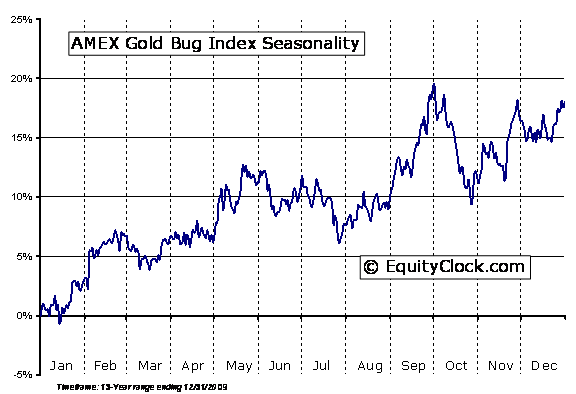
The gold equity sector has just entered its period of seasonal strength. Preferred strategy is to start purchasing gold equities and related ETF at current prices and to add to positions in weakness.Following is a series of seasonal studies on major gold producer equities.

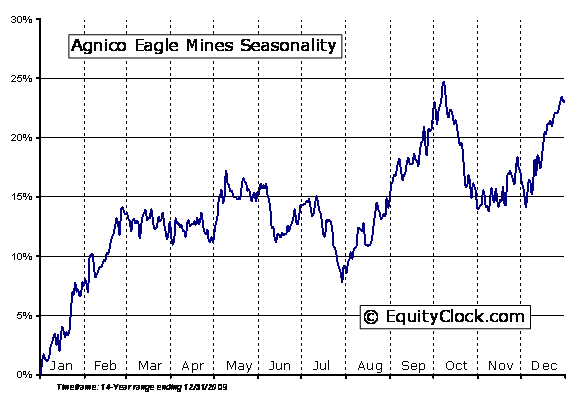
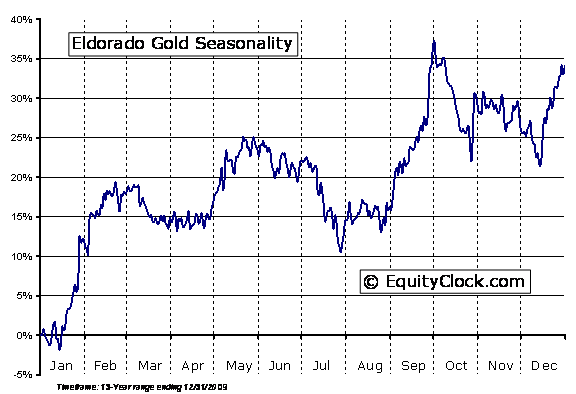
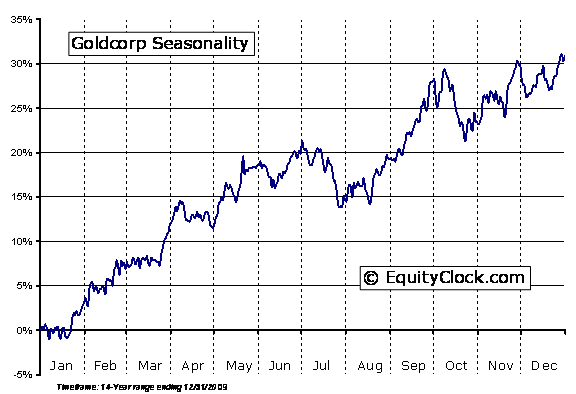
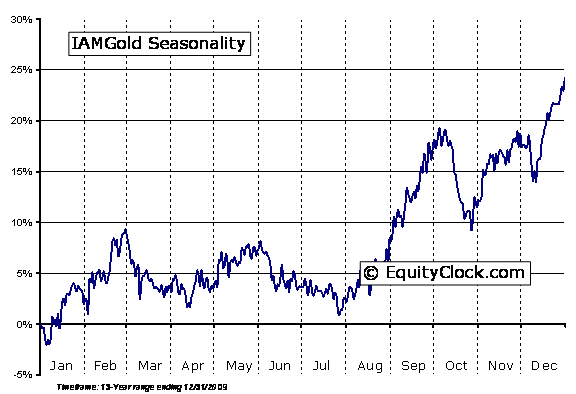
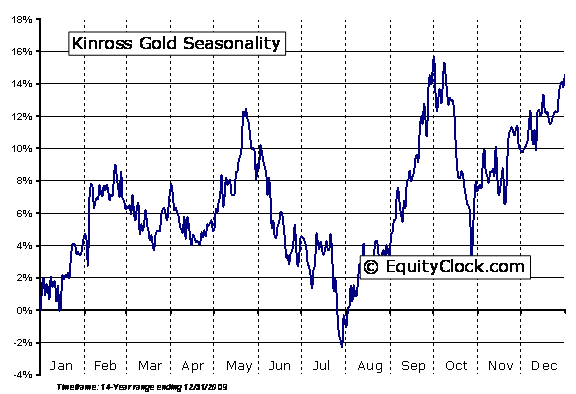
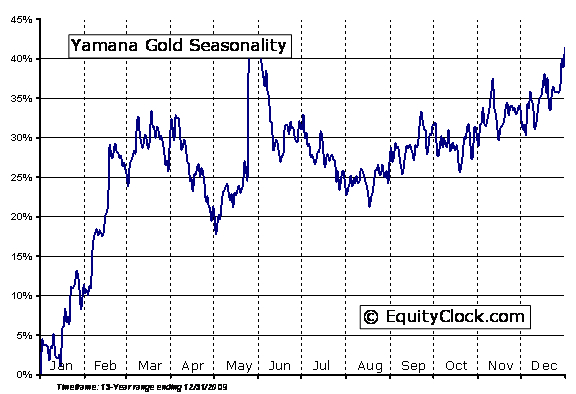
Gold equity indices show the same seasonal pattern
Junior gold equity ETFs recently started to outperform big cap gold equity ETFs. Short term momentum indicators on both are recovering from oversold levels.

Technical Analysis and comment by the highly respected Don Vialoux of Timing the Market CLICK HERE for his full Report every day incuding Charts.
Don Vialoux has 37 years of experience in the Investment Industry. He is a past president of the Canadian Society of Technical Analysts (www.csta.org) and a former technical analyst at RBC Investments. Don earned his Chartered Market Technician (CMT) designation from the Market Technician Association in 1995. His CMT paper entitled “Seasonality in Canadian Equity Markets” was published in the Spring-Summer 1996 edition of the MTA Journal. Don also has extensive experience with Exchange Traded Funds (also know as Index Participation Units) as well as conservative option strategies. In 1990 he wrote a report that was released in the International Federation of Technical Analyst Journal entitled “Profiting from a Combination of Technical and Fundamental Analysis”. The report introduced ” The Eight Phases of the Stock Market Cycle”, an investment concept that continues to identify profitable entry and exit points for North American equity markets. He is currently a member of the Toronto Society of Fundamental Analyst’s Derivatives Committee. Now he is the author of a daily letter on equity markets available free on the internet. The reports can be accessed daily right here at www.dvtechtalk.com.
Global X Lithium ETF (LIT) Hits The Market
Global X announced the latest addition to its ETF product lineup today, rolling out a fund designed to offer investors exposure to one of the world’s most important metals.
….read more HERE
Green Investing – A New Lithium ETF makes it easy to invest in the “New Oil”
Lithium has been touted by some media outlets as the “new oil” with its potential substitution of oil in the transportation industry.Lithium Batteries are considered as the standard components of Electric Vehicles despite some competition from other chemistries like Nickel Metal Hydride.However its superior energy density and weight makes it the ideal fit for use in Electric Vehicles.
….read more HERE
Marc Faber closed out this week’s Agora Financial Symposium with a speech that pretty much recapitulated the view that the end of the world is if not nigh, then surely tremendous dislocations to the existing socio-political and economic landscape are about to take place (with some very dire consequences for the US). His conclusive remarks pretty much summarize his sentiment best: “We’ve had a trend for most of the past 200 years: GDP of countries like China and India went down while the West surged. That’s now changed. Emerging economies will go up, and your children in the West will have a lower standard of living than you did. Absolutely. We won’t sink to the bottom of the sea. But other countries will grow much faster than us. The world is very competitive, and the odds are stacked against us. Americans, with their inborn arrogance, will not let it go that easily, so there will be lots of tension going forward.” While long-time fans of Faber will not be surprised by the gloom and doom (not much boom) here, anyone else who still holds a glimmer of hope that at the end of the day the CNBC spin may be right, is advised to steer clear of Faber’s most recent thoughts.
And while we do not have the full presentation yet, the salient points have been recreated below courtesy of the Motley Fool. For those who desire a far more in depth presentation from the inimitable Mr. Faber, we direct you to his June 2008 capstone presentation: “Where is the boom, and the doom” – link HERE.
On reality: My views are not all that negative. I think they’re just realistic. I want to face reality. You have people like Paul Krugman who thinks we should have another bubble to pull us out of this. He actually said that. But he said the same thing in 2001. And you know how that turned out.
On unintended consequences: The Fed doesn’t seem to have learned anything at all from its mistakes. Their current policy of cutting rates to zero is designed to create sustainable growth, but they’ve created larger and larger volatility in markets. There are many unintended consequences of their actions.
The oil bubble of 2008 is a good example. In 2008, the price of oil went ballistic, but the U.S. was already in a recession [it began in Dec. 2007]. There was no rational reason oil should have gone ballistic. The Fed’s easy money just fueled a bubble. It was like a $500 billion tax on consumers courtesy of the Fed. That’s the added amount that it cost you, and it helped push consumers over a cliff in late 2008.
On the Fed: The Fed doesn’t pay any attention to asset bubbles when they grow. That’s their official policy. But they flood the system with cash when bubbles burst. They only care about bubbles when they crash. It’s a very asymmetric response and it has many unintended consequences.
Letting bubbles inflate and then fighting them when they burst actually worked for a while. That’s what makes it dangerous. It worked in the ’90s. But you shouldn’t read too much into this: This period was assisted by unusually favorable conditions. From 1981 until early last decade, commodities were in a bear market after a bubble in the ’70s and early ’80s. And interest rates were falling throughout the ’80s and ’90s, too. They almost never stopped falling. That made Fed policy look like it was working.
Bubbles can still happen without expansionary monetary policy. In the 19th century, you had bubbles in railroads, for example. But today, the Fed has created a bubble in everything — in every single asset class. This is an achievement even for a central bank. Stocks. Commodities. Bonds. Real estate. Gold. Everything goes up when the Fed prints. The only asset that goes down is the U.S. dollar.
On deflation: I’m a believer that the stock market lows of March 2009 will not be revisited. You have people like Robert Prechter who think the Dow will collapse to 700 because of debt deleveraging. Debt deleveraging could happen, but the Dow will not fall because of monetary policy. The Fed will keep everything inflated in nominal terms. And if the Dow does go to 700, you’ll have more to worry about than your investments. All the banks will be bust. The government will be bust. You don’t want cash if massive deflation happens. On the contrary: It will be worthless. You have to think very carefully about hardcore deflation.
On credit addiction: In a credit-addicted economy, you don’t need credit to actually fall for there to be problems. All you need is a slowdown in the growth rate, and you get big problems. Now, the government and the Fed are aware of this, so they are creating debt through fiscal deficits and monetization. That creates a hugely volatile environment. In 2008, government credit creation was inferior to private credit contraction, and asset markets tanked. In 2009, government credit creation was higher than private contraction, and asset markets went ballistic. Lately, government credit creation has slowed, and asset markets have gone down. Now, the Fed is aware of this, and it’s only a matter of time before it throws more money into the system. I guarantee this.
On what the Fed will do from here on out: The easiest way to fix our debt problems is with 6% inflation per year. That bails out everyone in debt. Interest rates will stay at 0% in real terms forever, in my opinion. If inflation is 5% per year, the Fed will keep interest rates at 5%; that’s how you get 0% real interest rates. Now, we could have debt contraction in the private sector, but it doesn’t matter. It will be more than an offset with government debt creation. So it’s not a good idea to be all in cash and out of stocks. Cash is very dangerous when central banks want real interest rates at 0%.
On the rest of the world: The U.S. today is much worse off than it was 10 or 20 years ago compared with the rest of the world. The Asians should thank the Federal Reserve for this. The Fed practically created the emerging market economies. The Chinese pegged its currency to the dollar in 1994, and until 1998 not much happened. When the Fed began printing and boosting asset prices in 1998, there was this huge debt growth, and U.S. consumers began spending at a massive rate. That increased our trade deficit from $200 billion to $800 billion. Of course, trade deficits have to be offset by trade surpluses in other countries. So the Chinese began ratcheting up production. Then their employment went up. Their wages went up. Entrepreneurs began investing more money in capital spending. The Fed is not the only factor that led to strong emerging market growth, but it certainly was a major factor in it.
On delusions of grandeur: In the U.S., we still think that we are the largest consumer market in the world. For some services we are, but in general this is the wrong way to look at things.
There are huge differences in how statistics between countries are produced. For one, the U.S. is the most leveraged. Other countries factor this in. Also, consumption in the U.S. is 70% of GDP, but it’s almost all on domestic services. Spending on actual goods is only 20% of consumption. In the U.S., we spend $600 billion a year on defense. But $300 billion of this goes to personnel and retiree costs. In China, the cost of personnel is basically nothing. When you adjust for purchasing power, China probably spends about what the U.S. does on military capital.
We also think that we have all the knowledge of the world. We think that’s our edge. But knowledge in countries with much larger populations have the edge. Research now is being done in Asia because it’s cheaper there. Companies like Intel, IBM, and Microsoft are researching in Asia. It’s just so much cheaper there. And they are smarter than the U.S. in many ways, too.
-
I know Mike is a very solid investor and respect his opinions very much. So if he says pay attention to this or that - I will.
~ Dale G.
-
I've started managing my own investments so view Michael's site as a one-stop shop from which to get information and perspectives.
~ Dave E.
-
Michael offers easy reading, honest, common sense information that anyone can use in a practical manner.
~ der_al.
-
A sane voice in a scrambled investment world.
~ Ed R.
Inside Edge Pro Contributors

Greg Weldon

Josef Schachter

Tyler Bollhorn

Ryan Irvine

Paul Beattie

Martin Straith

Patrick Ceresna

Mark Leibovit

James Thorne

Victor Adair