
Daily Updates
Gold producers reward investors with dividend boosts
Gold companies have seldom delivered much pizzazz for investors in the dividend department, but it looks like that is starting to change.
Buoyed by high prices for the yellow metal, Barrick (ABX-T42.260.260.62%), the world’s No. 1 miner of the precious metal, announced on Thursday that it is raising its dividend by 20 per cent to 12 cents (U.S.) quarterly. Just a day earlier, rival gold giant Newmont Mining Corp. did the same thing, raising its payout a whopping 50 per cent to 15 cents a quarter.
Kinross Gold Corp., another major producer, will be reporting earnings next week, and with two of its competitors sending fatter cheques to shareholders, it too will be in the spotlight over its payout intentions.
The focus on dividends is a big change for gold stocks, which previously would never have been mistaken as being in same staid class of regular payers like banks and utilities.
….read more HERE
I just got off the horn with the Ruling Elite. We had an emergency conference call and to tell you the truth, they ain’t happy. You little people are not responding the way you are supposed to. A significant portion of you are not getting more optimistic because they tell you to. Instead of just reading the headline on Bloomberg that durable goods orders skyrocketed in June, you actually read the details that said durable goods orders plunged.
It is getting difficult for the ruling elite to keep the masses sedated and dumbed down. These damn bloggers, with their facts and critical thinking, are throwing a wrench into the gears. Obama and his crack team are working round the clock to lock down the internet, but it will take time. Not that they are totally dissatisfied. They’ve been able to renovate their penthouses and purchase new mansions in the Hamptons with the billions in bonuses you supplied through TARP. The $1.2 trillion supplied by your children and grandchildren to buy up toxic mortgages off their balances sheets was a godsend. They will never call you suckers, to your face.
Their spirits were buoyed by the 2,600 pages DONK (Dodd/Frank) financial reform bill. So many loopholes, so little time. Obama and his crack team of Obamanistas in the White House, supported by their mouthpieces in the mainstream media, have been able to easily manipulate the non-thinking masses into believing this bill would have stopped the last financial crash and will stop the next one. The Ministry of Truth has been working overtime utilizing Federal Reserve paid shill economists like Alan Blinder and Mark Zandi to perpetuate the myth that the actions taken in the last 18 months have averted a Depression, saved 8 million jobs, created a long-lasting recovery, wiped out Swine Flu, and earned Paul Krugman a nobel prize in fiction.
This is where we have a problem. The worshippers of Keynes, that rule the country, are pissed off at you. Don’t you realize that government spending of your money, borrowed from the Chinese, with the bill passed to your grandchildren, was supposed to reinvigorate your animal spirits. They handed you other people’s money to buy cars and homes and what do you do? You stop buying cars and homes as soon as they stop paying you to buy cars and homes. You ungrateful bastards. Bennie has been hugely successful at ruining the retirements of millions of grandmothers by paying them .20% on their money market accounts while forcing mortgage rates for 30 years down to 4.5%. And still you don’t buy houses. Timmy has instructed Fannie Mae to make home loans to anyone with a pulse who can make an X on a piece of paper. No money down, no proof of income, no assets. Just like the good old days. Still you don’t buy houses. What is wrong with you?
The criminal banking elite have more than bent over backwards to get this economy humming. They have patiently stood by while you haven’t made your mortgage payments for two years while still residing in the house. They’ve pretended to go along with the brilliant HAMP (Home Affordable Modification Program) plan, masterminded by the rocket scientists in the White House. Just because virtually no one has been able to qualify for the plan and the redefault rate is 75%, doesn’t mean it hasn’t worked wonders for the economy. The awesome part of not making people pay their mortgages is that they were able to make payments on their credit cards. That allowed the mega elite banks to pretend that consumers are flush and relieve their loan loss reserves while not writing off the bad mortgages and reporting billions in profits for the 2nd Quarter. It is good to be the ruling elite.
The ruling elite are letting you slide on your mortgages and you have the gall to withdraw $20 billion from U.S. equity funds and not buy into this fake stock rally. Don’t you realize that when the stock market goes up, the economy follows? Everyone knows this. But, instead you sit on the sidelines and refuse to invest in the stock market. The super computers of the mega-banks are getting tired of trading with each other and single-handedly making the stock market appear safe. Just because the ruling elite have vaporized $10 trillion of your net worth in the last two years, you hold a grudge? Remember the mantra “Stocks For the Long Run” that the ruling elite burned into your brains through CNBC and the rest of the shillstream media? Why are you so suspicious of our advice. Ignore the fact that the S&P 500 today is at the exact level it reached on March 24, 1998. They meant the really really long term.
Here is the message from the ruling elite to you ignorant masses: Debt got us into this mess and it sure as hell is going to get us out. They have convinced the mainstream media that the reason the economy is sputtering is because the average Joe is not doing their part. This crazy concept of saving for a rainy day seems to be catching on. This is very dangerous. Savings could lead to investment and long-term stability. The ruling elite will have none of that foolishness. The mainstream media is telling you that this new found austerity will push us back into recession. The talking heads continue to pound away that you have reduced your spending too much, when anyone with a calculator and half a brain (Krugman doesn’t make the cut) can determine that the decrease in consumer debt outstanding is completely the result of write-offs by the mega elite banks. Consumers are living off their credit cards at this point.
The military industrial complex continues to do the heavy lifting for this economy. If they weren’t blowing up bridges, power plants and orphanages in foreign countries and then rebuilding them at ten times the expected cost, how would they possibly spend $895 billion per year. It ain’t easy to waste that kind of money annually. Whenever some crazy dude like Ron Paul questions the need to spend as much as the rest of the world combined on the military, some potential terrorists are captured in the nick of time and the threat level is raised to Orange (thanks Tom Ridge). The “professional” journalists on the major networks then do their part in this farce by spreading fear among the general population. Rinse and repeat.
So, we now find ourselves at the edge of the abyss again. The ruling elite have a great plan. It involves more debt, more stimulus, more printing, more accounting fraud, more pain for the masses, and of course more bonuses for Wall Street. If you, the little people, will just follow this 10 step plan, the ruling elite will be just fine:
- Stocks are undervalued according to the same “experts” who told you they were undervalued in October 2007. Take out a loan and buy mega-banks stocks, commercial real estate developers, and bankrupt car companies.
- General Motors, in a brilliant strategic coup, has bought “subprime” auto loan company Americredit. What else does a government/union owned car company need? The fact that GMAC has lost $10 billion of taxpayer funds in the last year shouldn’t worry you about your investment in GM. If you can’t sell cars to people with no income, no job and no prospects for repaying the seven year 0% loan, who can you sell a car to. When the government pays Goldman Sachs millions to convince you to buy the stock of GM in its Fall IPO, ask no questions and just buy buy buy.
- Ignore the fact that Citicorp, Bank of America, and Wells Fargo would be declared insolvent if the FASB had not caved into threats from the Federal Reserve and Treasury. Just buy their stocks. Trust Wall Street.
- Enough austerity already. You haven’t bought a new HDTV in six months. It’s like you’ve been living in a 3rd world country. If you have any equity left in your house, borrow against it and buy something big and glitzy. Make sure you show it off to your shallowest neighbors. They will go out and buy something bigger and glitzier on credit. Before you know it we have a recovery. Keynesianism 101.
- Stop frequenting financial blogs like Naked Capitalism, Credit Writedowns, Dollar Collapse, Market Oracle, 321Gold, Jesse’s Cafe Americain, Of Two Minds, Zero Hedge, Mike Shedlock, or Barry Ritholtz. These sites will just shower you with facts, analysis and truth. Watch CNBC, Fox, MSNBC and the other corporate media to get the ruling elite approved view of the world.
- If you are currently renting or living in your mother’s basement, have no job, no savings and no prospects, Fannie Mae wants to put you in your very own house. Mortgage payments are optional. The 50% of Americans that pay taxes will gladly fund your new abode.
- If you are approaching the 99th week of unemployment, have no fear. The ruling elite will use the MSM to run hundreds of sob stories about only two years on the dole being immoral and cruel. The White House will present a study from “impartial” economists that proves that extending unemployment benefits to 156 weeks will create or save 3 million jobs.
- The stress of this recession has been too much. You need to whip out that credit card and book a trip to Disney World or Dollywood. Worry about funding that 401k sometime in the future.
- Unquestioningly accept the fact that Iran is an imminent threat to your safety and liberty. Support the obliteration of this evil nation based upon information provided by the CIA (WMD slamdunk) and the Israelis.
- Lastly, call your Congressman and tell them to extend the tax cuts for the rich. As you have probably concluded, the ruling elite are rich. They don’t like paying taxes. That is why they employ thousand of tax lawyers. Since the expiration of the Bush tax cuts will hurt the ruling elite the most, a full court press of disinformation is in order.
The ruling elite expect you to comply without question. Have they ever led you astray before?
“WHAT IF WE GIVE EVERYONE A HOUSE AND A PRE-APPROVED CREDIT CARD?”

WHAT COMES AFTER A QUADRILLION?
MISSION STATEMENT:
My goal is to provide my readers with a wide eyed view of the world. I will concentrate on social and economic issues that I feel are important to the country. My commentary will be blunt and pointed. The country needs people to see things as they are, not as they wish them to be. I’m trying to do my part in keeping our country from experiencing a Roman Empire like decline. Burning platform refers to David Walker’s description of the United States government as on a “burning platform” of unsustainable policies and practices with fiscal deficits, expensive over-commitments to government provided health care, swelling Medicare costs, the enormous expense of a prospective universal health care system, immigration, and overseas military commitments threatening a crisis if action is not taken soon.
MY BACKGROUND:
My name is Jim Quinn. I’m a senior director of strategic planning for a major university. I’ve held financial positions with a retailer, homebuilder and university in my 24-year career. Those positions included treasurer, controller, and head of strategic planning. I’m married with three boys and I’m writing these articles because I care about their future. I earned a BS in accounting from Drexel University and an MBA from Villanova University. I’m a certified public accountant and a certified cash manager. These articles reflect my personal views. They do not represent the views of my employer, and are not sponsored or endorsed by my employer.
GOLD CORRECTION A BUYING OPPORTUNITY
There is no question that gold’s allure as a safe-haven has taken a bit of a beating with the more confident tone coming out of European markets, but be assured that in a global post-bubble credit collapse, skeletons come out of the closet when you least expect it. The surprises are not over; not by a long shot. And the gold price will ebb and flow, but it is in a secular bull market and will retain its natural hedge against recurring concerns surrounding the integrity of the global financial system. Watering down financial regulation bills in the U.S.A., kicking the can down the road via less-than-onerous Eurozone stress tests and reduced capital stringency as per Basel III does not alter the deleveraging game that much and the rounds of market instability that will come our way.
The investment demand for gold remains quite solid at a time when production growth is still anaemic – the World Gold Council just released data showing that investors bought 273.8 metric tons of gold via ETF’s in Q2, the second highest tally on record (and brings net investment in these finds to over 2,000 tons value at just under $82 billion)
Also in this issue of Breakfast with Dave – HERE
• Data out of Germany continues to be stellar
• Deflation is actually evident across a wide array of cyclical consumer goods and services right now
• The emerging consensus
• Beige Book blues
• Sentiment becoming less “contrarian bullish”
• The true state of the American consumer
• Nobody fooled by Case-Shiller rebound
• More squishy-soft manufacturing data
• What does the corporate cash hoard mean
….read the above HERE
There’s no other magazine like The Economist. Week after week this magazine produces level-headed, decisive, often brilliant articles on every conceivable subject. If I had to subscribe to one magazine for information on what’s going on in this troubled and rapidly changing world, it would undoubtedly be The Economist. Frankly, I don’t know how they do it. Below is a great article about gold, the dollar, and the growing loss of confidence in the dollar and fiat money. Please read this article carefully — Richard Russell July 28th Dow Theory Letters
Buttonwood
Losing confidence
Looking at the dollar in the old-fashioned way
WHEN the Bretton Woods system was cracking in the early 1970s the price of a troy ounce of gold, in dollar terms, was raised in two steps from $35 to $42.22. This was, in effect, a devaluation of the dollar.
The authorities then still thought it worth expressing the shift in terms of bullion, rather than against another currency like the Japanese yen or French franc. In the 1930s Franklin Roosevelt had a specific policy of devaluing the dollar against gold, pushing the price from $20.67 to $35 in the belief this would push commodity prices (and thus farm incomes) higher and reduce the burden of debt service.
Nowadays the price of gold is set by the market rather than by official diktat. When explaining shifts in the bullion market people tend to think in terms of supply and demand. Perhaps, however, they should view gold-price movements in terms of investors’ confidence in the dollar, and in paper money in general.
After gold was set loose in 1973 its price rose at a rapid rate for the rest of the decade, peaking at $850 an ounce in 1980. In other words the dollar had lost around 90% of its value since the demise of Bretton Woods. The 1970s was a period when economic policy in the developed world seemed to be in disarray, with inflation and unemployment high, and confidence in central bankers low.
The appointment of Paul Volcker as chairman of the Federal Reserve in 1979 appeared to be a turning-point. He broke the inflationary spiral in the early 1980s, albeit at the cost of a double-dip recession. From 1982 onwards developed economies seemed to enter the “great moderation”: inflation was low or falling, and recessions were rare and mild. The authorities developed the knack of delivering stability with paper money, thanks to independent central banks committed to a low inflation target. Gold fell from $850 to $253 by 1999. With confidence in economic policy restored, the dollar was revalued by 236% over almost two decades.
By the late 1990s, however, belief in the eternal wisdom of central bankers was nearing its peak: “Maestro”, Bob Woodward’s portrait of Alan Greenspan, came out in 2000. The dotcom and housing bubbles led to a reappraisal of Mr Greenspan’s career. Many commentators now feel he paid too little attention to credit growth and asset prices. As Charles Dumas of Lombard Street Research tartly remarks, Mr Greenspan displayed “asymmetric ignorance”. He claimed not to know when asset prices were in a bubble but he did always claim to know when falling asset prices were likely to cause havoc. Investors were given a one-way bet.
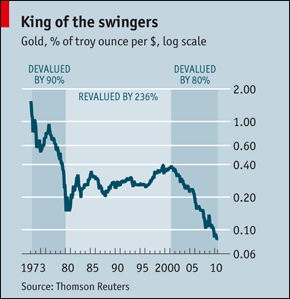
The credit crunch also laid bare a conflict in central banking that goes back to the days of the gold standard. As well as safeguarding the value of the currency, central banks act as lenders of last resort. When push comes to shove the latter duty seems to outweigh the former, and the bankers turn on the monetary taps. The result has been a loss of confidence in the dollar. Gold’s rise since 1999 in effect means a near-80% devaluation of the dollar over the past decade (see chart).
What is striking about the history of the past 40 years is that these three swings in the value of the dollar (ranging from a rise of 236% to a fall of 90%) are huge by previous standards. But they have not been noticed because the dollar is now compared with other paper currencies—like the euro and yuan—where shifts have been nothing like as extreme.
This raises a further puzzle. One reason why countries tried so hard to maintain the gold standard and the Bretton Woods system was to reassure creditors that they would be repaid in sound money. Since 1971 most countries have had the right to repay creditors in money they could print at will. The likes of America and Britain are now perceived as “lucky” because they, unlike Greece, can devalue their currencies and default in real terms.
That prospect did alarm creditors in the 1980s when the real yields on government debt shot up. But it does not seem to now. America and Britain are paying only 3-3.5% to borrow for ten years. That may be because deflation seems the more immediate threat. It may be because bond markets are now dominated by other central banks, which are more interested in managing exchange rates than in raising returns. But it is not stable to combine low yields, high deficits and governments that are happy to see their currencies depreciate. Something has to give.
When I began writing ten years ago, I would offer that the opposite of love wasn’t hate; it was apathy.
I shared that thought after tech stocks dropped 40% in less than two months and then recovered half those losses the next two months. We all know what happened next; the tech sector melted 70% the next few years
Wash and rinse, Pete and repeat; we’ve seen that sequel again and again and again. From the homebuilders (real estate) to China to crude oil, a “new paradigm” arrived. Every time was different and each offered a fresh set of forward expectations that would finally prove historical precedents need not apply.

I traded all of those bubbles thinking quite sure they would follow the path of false hope and empty promises paved by their predecessors. That proved true as the real estate market crashed, China imploded under the weight of the world, and crude crumbled just as it seemed ready to stake claim to the new world order. (See: Oil of Oy Vey)
Sisyphus Now!
While those bubbles hit home for many Americans, they’re hardly unprecedented through a historical lens.
There was the tulip mania in 17th century Holland as Dutch collectors hoarded a hierarchy of flowers.
The Mississippi and South Sea bubbles of the 18th century emerged in the wake of Europe’s dire economic condition.
The roaring twenties, fueled by an expansive use of leverage, led to the crash and Great Depression while not necessarily in that order.
And there’s Japan, perhaps the most frequently referenced modern-day parallel of our current course. The land of the rising sun boasted one of the strongest economies on the planet before a prolonged period of deregulation, money supply growth, low interest rates, bad real estate bets, and “zaitech” (financial engineering) creating a virtuous cycle of speculative frenzy that ultimately collapsed the country.
Does any of this strike a chord?
If familiarity breeds contempt, the percolating societal acrimony shouldn’t come as a shocker. Albert Einstein said the definition of insanity is doing the same thing over and over and expecting a different result. That most certainly applies to our financial fate but as with most journeys, the destination we arrive at pales in comparison to the path we take to get there. (See: What In the World is Going On?)
….continue reading HERE (begin at Federal Reserve)
-
I know Mike is a very solid investor and respect his opinions very much. So if he says pay attention to this or that - I will.
~ Dale G.
-
I've started managing my own investments so view Michael's site as a one-stop shop from which to get information and perspectives.
~ Dave E.
-
Michael offers easy reading, honest, common sense information that anyone can use in a practical manner.
~ der_al.
-
A sane voice in a scrambled investment world.
~ Ed R.
Inside Edge Pro Contributors

Greg Weldon

Josef Schachter

Tyler Bollhorn

Ryan Irvine

Paul Beattie

Martin Straith

Patrick Ceresna

Mark Leibovit

James Thorne

Victor Adair