
Daily Updates
A Holiday-like atmosphere will be with us for the balance of the week in North America.
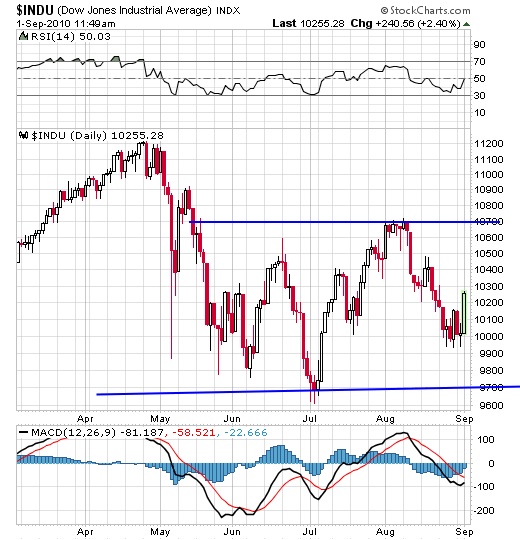
U.S. Stock Market – A no-where’s fast outlook continues to be my best assumption. We’ve defined a trading range and the market should look to buy the bottom of it and sell the top until such time the bands change.
U.S. Bonds – Thankfully I gave up betting against the bond market months ago but I remain extremely bearish going forward. Talk of a bubble should only be addressed to the U.S. bond market. The difficulty is bubbles can grow bigger and last longer than anyone could imagine. That appears to be the case here.
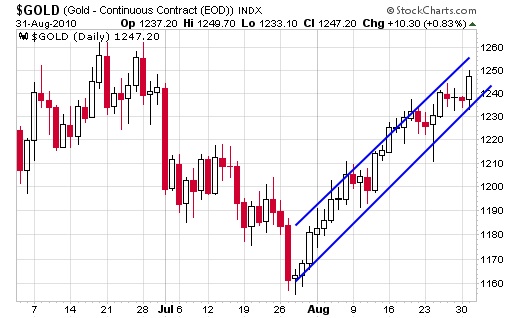
Gold – Despite all the bubble nonsense and predictions of its demise a dime-a-dozen, gold has risen in a very constructive manner. I sooner see it move sideways into next week than a vault up here in this holiday atmosphere.
U.S. Dollar – The technical bounce is playing itself out and it would come as no surprise to see us testing the 80 area in the 4th quarter.
Oil and Natural Gas – Serious conflict in the Middle East is the only factor I see that can cause oil prices to rise dramatically. I have avoided natural gas despite numerous bullish calls for the last couple of years. I continue to see over supply and suggest the sidelines remains the best position until there’s clear evidence the oversupply has truly dissipated or disappeared.
Gold and Junior Mining Stocks
Michael Campbell’s Interview with Peter Grandich
Michael: What does it mean for the junior resource market if that’s the case?
Peter: Well the junior resource market is probably in one of the worst states it’s been in almost the entire time I’ve been around it. Given where metal prices are compared to where they were, juniors in general are probably performing worse now than I can remember in a couple of decades.
Part of that is funding is difficult. There’s not a lot of money that’s flowing into this industry. Secondly, despite the great increases in the Bullion prices we don’t have the same activity level of people participating in the junior resource market that we used to. The US market is all but closed for business for junior resource companies. The ability for an average individual down here to purchase or be solicited to purchase a junior resource stock trading up on the Toronto stock exchange has become almost impossible. Where a lot of Americans used to play the junior market they are just not doing that anymore. So the, all in all it’s a very tough time for the junior resource market despite still very, very attractive prices.
Part of the reason is there’s just been very little overall success in the junior market. We have really only one or two area plays and I wouldn’t even call them an area play compared to how they used to be 10 or 20 years ago. Most notably now in the Yukon we don’t have widespread interest. The hedge fund industry and funds are closing out not getting into juniors. The flow through funding is still there in Canada but it’s not as big as it used to be. So it doesn’t hold well and we see that. We see companies have great news trade up 10% or 15% on that news and two or three days later, all that gain evaporates. I don’t see any significant change in that for the foreseeable future. That’s why despite still being very bullish on precious metals and particularly gold, the junior resource market is still a very tough market. It’s not something you can just buy and be successful because the overall market’s going up. There’s just no way the general stock market’s gonna fall 20 40 50% and the average person’s gonna turn to their advisor and say “listen sell my IBM sell my treasury bonds but buy me some junior resource stocks.”
Michael: In 2008 I was very liquid thanks to Peter Grandich and Bob Hoye I might add, who came out unequivocally and said sell the market October of ’07 right at the top. Peter made no bones about it, he said it’s gonna be the worst bear market in his lifetime. Bob Hoye said it’s gonna be a credit tsunami when we featured both of them on the show in mid October ’07. I took their advice got down to about 92% cash but I kept this little group of juniors. I got it handed to me. My joke Peter, was I found out the term popular prices meant they were free.
Peter: Well I didn’t take all of my advice either as I noted to my readers I kept some juniors and they got hit. But overall we did much better by stepping aside. But I just want to really just close on the point that if you believe it is going to be terrible times the junior resource market is not going to avoid that. I think that’s one of the fallacies that’s been presented at times in our business.
Michael: Does any action that you’ve seen in the market discourage you from a long term view on Gold?
Peter: Mike we’re in the mother of all Bull Markets. The very fact that almost no one can grasp and believe that, when even the most ardent bulls are really concerned every time we have these one step back corrections in this mega bull market just refortifies my point. Recently in these past couple of weeks we’ve seen the correction again. In the last few years, as we went into 2008 we tested 1,000 dollars, then we all know 2008 was a bad year in the market and we got down to nearly 700 and everybody predicted the end of the Gold Bull market. By early 2009 we were testing 1,000 again, then the pull back happened but this time only to 900 and again we were told it was the end of the bull market. Then we got to a thousand again and we finally broke through to a little over 1,200 before pulling back again almost to 1,050 beginning of this year. When that happened again we were told it was the end of the bull market before of course it went to higher highs early this year. Now during the more seasonally weak period which July and August gold had another correction and yet again everybody and his mother seems to suggest that gold has again reached it’s end. Nothing I have stated has changed.
There are three dynamics to this gold bull market. The first is the big sellers are no longer there. Now I’m not talking about the manipulators and the gold cartels I’m talking about what we knew openly and that was during the 90s and the early part of this decade central banks were aggressive net sellers. They aren’t selling anymore and part of the reason is because I believe they just don’t have the gold to sell. Second the mining companies who literally used to cut their nose to spike their face by hedging have now made hedging a four letter word. We don’t have that continuous supply being placed forward in front of us by mining companies. And third and perhaps the most important of that part is gold has returned to it’s rightful place for the last couple of thousand years an alternative to paper money. Think about it, would anybody today, outside of the Canadian dollar which I like very much, entrust my daughter’s life savings to any other currency. But I can deal in gold. And I think gold will continue to be more and more an alternative to paper money in this debt ridden world society that we’re in. So I don’t see anything other than these normal corrections and I still believe before the year is out we’ll see 1,300 on gold. And then depending on what happens, especially some geo-political issues that could come to the forefront next year, we could see substantially higher prices next year. So I remain an ardent bull.
Michael: Do you think there’s strong potential in Silver too over time?
Peter: Over time I think a few times Silver will lead Gold but it will lag overall as one of the reasons is it doesn’t have the monetary attractiveness that gold does. Also unfortunately it’s heavily manipulated in that there’s so few players in the Silver market. Most of them play to the short side and will until someday the commodity commission makes some changes. I think it’s a lagger but I still think it will work it’s way higher. Ultimately, the one metal that I think people need to own first is Gold, before you start trying to play the Bull Market through mining shares and juniors.
Michael: You offered up earlier that things are changing in a dramatic and profound fashion. But it’s those people who end up not having lost are the ones who will be the winners in the end.
Peter: Yes and where the opportunity’s going to come is you need to buy assets on the cheap. Cash is king again. It really is even though it doesn’t pay much interest having liquidity and being able to step in when other people don’t have liquidity is really gonna separate the winners from the losers Mike.
Michael: Great stuff Peter as always I very much appreciate you stopping your weekend for us. Listeners can follow Peter by going to www.grandich.com. We’ll chat in the near future.
Peter: Thank you Mike!
Listening to Trader Tracks Editor Roger Wiegand talk about market conditions and precious metals is like listening to your favorite uncle tell stories at Thanksgiving. The difference is that Roger’s stories are a lot more likely to make you money. In this exclusive interview with The Gold Report, Roger offers up a few of his favorite gold and silver plays and some sage market advice.
The Gold Report: In a recent edition of Trader Tracks you quoted a former Nixon speechwriter who said, “Economics should never be treated as a science. Its claims are not falsifiable, which is why economists can disagree so violently among themselves. Economics is a branch of anthropology and psychology. . .a moral discipline.” Do you believe that’s true?
Roger Wiegand: I definitely agree with that. I think there’s more psychology in economics than many people realize. You can see that with the current economic reports coming out of Washington and New York. It’s obvious to intelligent people who follow these things that there’s a lot of manipulation going on in economics, in the stock market and in politics. It is often effective if it’s very timely. There’s no question that psychology plays a major role in economics.
TGR: Further to the point, do you believe the American public is somewhat conditioned to believe that economics is a science and thus place too much faith in it?
RW: I think that could be true. I really believe that 80%–90% of the American public is regularly sold a bill of goods by the Wall Street media from New York and Washington. It just keeps coming day after day and, after awhile, it wears them out. I think the majority of Americans still believe a lot of this information. From my point of view, a good portion of it is just nonsense.
TGR: If you could speak directly to the public and tell them what you believe they should know, what would you tell them?
RW: Well, I would say that the U.S. president is not really the man in charge. The people who are in charge of world economics, world currencies, governments and corporations are a shadow political group that has a great deal of power. Presidents in the U.S. are just puppets. They’re selected for their ability to do what they’re told. Congress is basically just a tool for these corporations and outsiders to manipulate the rules to get what they want. I think that’s obvious when you look at what’s happened with all the offshoring of American jobs. The issue that’s got a lot of people disturbed right now is the open border between Mexico and the United States. That exists because corporations want cheap labor. And there are obviously a lot of people involved in the Mexican drug trade. There’s a sheriff in Arizona who said that even members of Congress are involved. Until the teeth are taken out of pharmaceutical economics, these things are going to continue.
Recently it’s become much worse because of what’s happened with the global banks and derivatives market. That’s what caused the Lehman Brothers collapse and took down the global economy. To make it worse, then–Treasury Secretary Henry (Hank) Paulson basically took government taxpayer money and gave it to the banks. He conjectured that, if we didn’t, the global financial system would implode. Quite frankly, I think it would’ve been better if we had taken our medicine and just moved on. But what’s happened now is that 90% of the toxic debt in those banks remains in those banks. They’ve taken it off balance sheets and put it into other corporations or partnerships (i.e., offshored it). They’re just holding the money given to them by the U.S. government earning bond interest. They’re not making loans to improve the economy.
TGR: Do you believe U.S. economic policy will ultimately lead to the demise of the USD?
RW: It’s hard to say. These things take years and they happen slowly. Our three- to five-year forecast for the U.S. dollar is 46 on the Dollar Index. One of our better analyst friends, whom you’ve interviewed before, pegs it at 40. We’re now at 82 or 82.5. Eighty is a magnetic number so to speak for the dollar. We expect it to stay there for two or three months, and then gradually drift lower. But is the dollar going to go away? I’m not so sure. It’s going to diminish in value in fits and spurts. Other currencies will replace the dollar to some extent; but, considering that the USD covers about 85% of all reserve currencies, I think it’s doubtful it will go away. They may try backing it by gold, silver or other precious metals; but it would take so much in precious metals to give it even a marginal backing that it’s difficult to imagine.
For people buying and selling shares in our business, the biggest thing to watch for is the bond markets. That’s the Achilles heel of the worldwide credit system. The stock market is big but it’s peanuts compared to bonds. Bonds are 70x larger than stocks. The bond market today is in very big trouble.
TGR: Could you explain that further?
RW: At this point, Fed Chairman Bernanke can’t find buyers for his bonds; so he’s got to print bonds and buy them back himself. Recently, the Fed had a bond auction. It was said that 30% of the offering went to indirect buyers (meaning Bernanke bought the stuff back himself). We’ve seen some other auctions where they’ve had to buy back as much as 60%. In our view, that’s the beginning of the end because the other American bond and bill buyers are backing away.
TGR: You put quite a smattering of different quotes in your newsletter and some are quite grim. You had a couple from accounts of when hyperinflation plagued Germany’s Weimar Republic in the 1920s. Why do you put quotes like that into Trader Tracks?
RW: I’ve been accused of scaring people. But I don’t really do that. I just want them to understand what kind of situation we’re facing. When I speak at conferences, I explain that, while things look pretty nasty right now—and they do look comparatively grim to Germany in the early 1920s and America in the 1930s—if you look at what’s available to us today in terms of trading and investing, I think we’ve got an opportunity that we won’t see again for many, many years. I’m speaking specifically about gold and silver and shorting these major stock markets. While some of these quotes are pretty upsetting—frightening even—it’s merely to get your attention so you’ll get off your duff and do something. A lot of people we talk to at conferences understand and agree, but they don’t do anything. That’s not going to work anymore.
TGR: What are some of those opportunities, Roger?
RW: I’ve got three favorites that I trade for myself. I trade gold spreads, silver spreads and soybean spreads. Last year, on those three kinds of trades, I made 95%. They don’t require a lot of time, which is good, because I’m very busy writing my letter and helping my readers. I’m one of the few newsletter writers who will answer emails from subscribers when they get into trouble on a trade or are looking for some ideas about an opportunity. Our newsletter subscription price is higher than others, but we like to think we give good value because many of our traders can make the subscription cost back on just one or two trades.
TGR: Probably upwards of 80% of the stocks you list in your newsletters are junior gold and silver plays. The majority are juniors. What makes you believe these are places that investors should put their money?
RW: Let’s look at history. From 1979 to 1981, the last time we had a major gold rally to $850, silver went up to $50. If you picked 20 good juniors, probably half would fail. Another 25% would make some money. But there’s probably three to five that would be tremendous homeruns, like 1,000% or 2,000%. Of course, none of us really knows when that big blowoff is coming. Also, we can’t know which ones are going to be the best. I’m constantly sifting through companies, trying to take out the ones that just sit there and don’t move. It may be a good company; but, if it’s not going to move what good is it?
TGR: Do you have a trading philosophy?
RW: We encourage people to trade on the calendar: ‘Sell in May and go away’ and on the September–October selling event, which is quite common. The precious metals stocks, the juniors in particular, have been tied to the big markets. Over the past few months, we can see a separation. We can see now that the HUI, XAU and GDX are all going on their merry ways—away from the inverse trade of the dollar and from some of the big, mainstream stock indexes. We’ve been waiting for this. To me, it indicates that there’s going to be a major divergence or breakout in gold, silver and the related stocks.
TGR: How high is that going to take gold this fall?
RW: This fall we’re looking at $1,325 as a minimum goal on the December futures, which expire after Thanksgiving. We’re in an uptrend at the moment, but I think you’ll see a little leveling off and some light selling in August. After that, you’ll see a rebound. Normally, on the calendar between the last week of August all the way to April or May, we see a big rally in gold and silver with some intermediate profit-taking corrections. The 10-year trend has been solidly up. There’s no question that we’re going to have a good fall season.
TGR: In the August 6th edition of Trader Tracks, your three second-tier choices among the seniors are silver companies. Silver Standard Resources Inc. (TSX:SSO; NASDAQ:SSRI), Silvercorp Metals Inc. (TSX:SVM; NYSE:SVM) and Pan American Silver Corp. (TSX:PAA; NASDAQ:PAAS). What are you seeing in silver that has you sending folks to these companies?
RW: First of all, we think they’re all high-quality companies. Next, silver is more volatile than gold because it’s a smaller market. However, I think silver is really coming into its own. We’ve been hanging around $18 on the futures silver price. We have touched as high as $21.50. Today, the September futures are $19.11. They’re off a bit but we think, before this fall is over, we could go to $20 (resistance). There’s harder resistance at $21.50. Once we breakthrough $21.50–$22, I think you’ll see a big push to $25, $26 and then $30. The question remains: Can we see $25–$26 this fall? I’m not sure, but there’s an excellent chance. Can we see $25–$26 by April 2011? I think we could. With silver moving quickly, these silver companies will move right along with it.
TGR: But those are majors. You may see an increase; but, on a percentage basis, it’s going to be smaller. A smaller silver producer that’s on your list is First Majestic Silver Corp. (TSX:FR; OTCQX:FRMSF). Tell us about that one.
RW: First Majestic is kind of like a senior/junior. The stock price in Canadian dollars was $4.81 yesterday, and has been steadily increasing. The bottom was $1 right after the Lehman event in 2008. The trading channel is also steadily up. We see a bullish cup and handle on the chart. We also see an inverted head and shoulders, which is bullish. Lately there’s been a falloff in volume, but that’s typical this time of year. If silver goes to that top I mentioned, we see some prices on First Majestic going to probably $4.95, $5.52, $6.00, $6.47. They’re making a lot of money. They’ve got three silver mines.
TGR: Are there prospects for growth at the three existing operations?
RW: I think there are because they’re increasing production. They’re putting out more ounces. Their total silver production in the second quarter of 2009 went up 86%. They milled 404,000 tons, which was a 20% increase over a previous quarter. It’s a new record based on tonnage from all three mines. They have good management and the property is in a location we like. We’re very fussy about geographic locations. Many fellow analysts would select mines and mining companies in some areas that, quite frankly, would frighten me.
TGR: What jurisdictions do you prefer?
RW: The three or four spots we like are Northern Mexico, Northeastern Nevada, Canada and Alaska. In Canada, we like Québec, in particular—it’s probably the best place of all. And Alaska has more than enough good companies, both seniors and juniors, to work on.
TGR: Another company in Northern Mexico, and your newsletter, is Timmins Gold Corp. (TSX.V:TMM).
RW: Timmins is a great company. I’ve had probably three or four visits with Timmins management. CEO Bruce Bragagnolo was a Canadian Securities Commission mining lawyer for 20 years. He knows the mining business inside and out, takes things very carefully and thinks things through. Benefiting from the work he did before he got control of this mine, Bruce saw all the mistakes many of the miners made simply because he worked for them as an attorney. That experience is extremely valuable. They’ve got great production. They’ve got super financing. They had a big pop in their stock recently because their first quarter production showed about 11,000 ounces of gold. That is one of our best choices. We like Timmins very much.
TGR: Do you have a price target on Timmins?
RW: I can’t remember off the top of my head, but it just had a breakout based on the first 11 Koz. of gold production. They’ve got top-drawer managers and geologists and a steady plan to remain there and expand into more mines. I think you’ll see a double on that stock easily, perhaps even something higher than that. It’s a very high-quality operation.
TGR: A couple of other companies in Trader Tracks are Exeter Resource Corp. (NYSE.A:XRA; TSX:XRC; Fkft:EXB) and Extorre Gold Mines Ltd. (TSX:XG; Fkft:E1R; OTC:EXGMF), which were once the same company. You recommend them both.
RW: Well, first of all Exeter was the mother company. They split off Extorre because it made a lot of sense as far as management and things to do for the stock and stockholders. It’s proven to be a good thing. We know the managers; I’ve had visits and meals with them and asked their top guy, Yale Simpson, about capital. He said: “We never have problems with capital because we only work on the best projects we can find.” That’s true.
We like Extorre over Exeter simply because of the quality of the property and what they’re finding. They’re so excited about what they found that they’re adding more drills; and this month, they’re moving equipment and assay-lab people onsite for core evaluation because they’ve had some magnificent findings and they’re continuing to focus on those. That’s a great goal. Are they going to make a mine? Sure they will; but I think it will be sold to others who are going to take it over and run with it. That’s a fantastic opportunity—one of our best picks, in my opinion.
TGR: Do you have a target price on Extorre?
RW: Extorre could easily double from where they are today. I don’t want to say anything further.
TGR: What about Exeter?
RW: I can’t tell you as much about Exeter because I haven’t followed it since the companies divided. I focus more on Extorre, but we do still have that one in our newsletter. Where does the stock behavior go from this point? I think it’s going to go up. We’ll have to see what develops and how it goes. I might mention, at this point, that I’m a technical analyst. I’m self-taught. A year and a half ago when we were trading futures strictly on tech analysis, I had 18 wins in a row. I asked my broker how I was doing. He said: “You’re walking on water.” We had our comeuppance when the Lehman event arrived, but we traded our way out of it.
TGR: There were lots of good buys at that point, if you had cash. I think Hecla Mining Co. (NYSE:HL) went under $2.
RW: They did. I was appalled when I saw that because they’re one of my favorite big companies. In 2006, we were suggesting and recommending stock call options on Hecla, Newmont Mining Corp. (NYSE:NEM), Goldcorp Inc. (NYSE:GG; TSX:G), Coeur d’Alene Mines Corp. (NYSE:CDE; TSX:CDM) and maybe a couple of other big ones. We had a good run. We were buying them and making anywhere between 100% and 300%, usually in 90–180 days. I was a happy camper. I thought, “This is easy!” But the minute you think that, you’re going to get smacked. Of course, the Lehman thing came and, when they crunched the gold market, it was the end of that opportunity for a while.
I believe you’re going to see this again. We’re starting to trend that way. It’s going to be easier, I think, to trade options in some of these senior companies because they have a lot of cash. We see them making a lot more money with rising metal prices this year and next. Hecla had a couple of problems that they resolved. When those problems surfaced, their stock went under $2. Considering what we knew about the company at the time, we told everybody to buy it. I had one of my top traders put his mother into it. She made $100,000 in two months. It’s a good stock. They’ve got the cash and the experience. Their Lucky Friday Silver Mine in Idaho is being expanded and they’re buying more property around the mine. They were getting down to 5,000 or 6,000 feet, which gets expensive. I think they’re back mostly at the 3,000-ft. level. They also bought the other half of the Greens Bay Mine from Rio Tinto Ltd. (LSE:RIO; NYSE:TP; ASX:RIO) in Alaska for $750 million. Now, Hecla owns it all.
TGR: What are some other companies that you’re following?
RW: We’ve got some smaller silver companies like Endeavour Silver Corp. (NYSE:EXK; DBF:EJD; TSX:EDR). I’ve spoken at one of their luncheons and have followed them closely because I believe in the stock. They’re in Northern Mexico. It seems that, in Mexico on the east side of the mountains away from the Pacific Ocean, there’s a long seam of property where silver and some of the other metals are prevalent. Juniors find a property in that area where there’s already been a lot of gold and silver removed. They buy that property, and then buy more next door. They do more exploration work and, more often than not, they’re successful. Endeavour and some of the other companies in that area are going to be great.
TGR: Do you have a target on Endeavour?
RW: The Endeavour stock has been lingering, I think, at about $3.50–$4.00. We expect it will probably be around $6 or $7 by spring next year, if not sooner.
TGR: Do you have some parting thoughts Roger?
RW: I don’t mean to terrify people with some of the things in my letter, but I’m a realist. I get so angry because of all the nonsense we see in the news and media. You have to be an original thinker. Most often when a bank, the media—or, particularly, governments—say something, just the opposite is true. What you do is focus on things that are proven moneymakers. Go there and control your risk. Like I said earlier, there is a chance that you’re not going to see this opportunity again for many years. Historically, commodity rallies go anywhere from 13–17 years. I think we’re probably seven, eight, nine years into this one. We’ve got at least five years left, maybe longer. You’re going to see some brand-new minted millionaires in the next three–five years in gold and silver junior stocks, the physical metals and in the related futures.
Roger Wiegand—aka Traderrog—produces Trader Tracks to provide investors with short-term buy and sell recommendations and give them insights into political and economic factors that drive markets. An insatiable reader, he digests a variety of domestic and international publications, with the economic, political, monetary and market news and commentary woven into his opinions and analyses. After 25 years in real estate, Roger has devoted intensive research time to the precious metals, currency, energy and financial market for more than 18 years now. His varied background—which also includes graphics, writing, editing, sales, marketing, commercial printing, consulting and trading—helps shape the view he shares. In addition to Trader Tracks, Roger pounds out a weekly “Rog’s Corner-After The Bell” column for Jay Taylor’s Gold, Energy & Tech Stocks newsletter. For other essays, visit websites such as Kitco and, of course, The Gold Report. Visit Roger and Jay’s website at webeatthestreet.com. Tel: 718-457-1426, Claudio Bassi, Manager cbassi@miningstocks.com.
Want to read more exclusive Gold Report interviews like this? Sign up for our free e-newsletter, and you’ll learn when new articles have been published. To see a list of recent interviews with industry analysts and commentators, visit our Expert Insights page.
Government Defaults and Inflation Are the Norm, Not the Exception
The past 15 years have certainly been exciting for investors. During the second half of the 1990s we experienced one of the largest stock market bubbles of all times … and its bursting. Then, only a few years later, one of the biggest real estate bubbles … and its bursting.
In the aftermath of these events the world stumbled into the most severe economic downturn since the Great Depression of the 1930s. And the banking system came to the brink of a total collapse.
Unprecedented government interventions in the U.S., the UK, and continental Europe were implemented to prevent the breakdown of the financial system. Naturally these interventions came with a price: Ballooning budget deficits.
Now we’re witnessing a veritable debt explosion in the developed world …
Never before, aside from times of major war efforts, have governments amassed as much debt as during the past years. And this debt binge comes atop a decades-long trend of ever higher indebtedness.
Then, seemingly out of the blue, interest rates for Greek government bonds started to rise drastically. Suddenly the Greek state was at the brink of default, and other European countries like Spain, Ireland, Portugal, and Italy were also in jeopardy.
Stronger European countries and the International Monetary Fund (IMF) stepped in with a $1 trillion rescue package to prevent this crisis from running its natural course — that is massive government defaults.
Historically, Greece’s De Facto
Bankruptcy Is All too Common
When examining the current predicament, you could easily conclude that we’re living in extraordinary times. But looking through a historical lens immediately shows that what seems to be extraordinary is in effect somewhat normal …
Sovereign debt defaults and sovereign debt crises are nothing new at all, but as old as the government bond market. Financial history is fraught with examples of government bond investors losing big time.
In their book, This Time Is Different, Carmen M. Reinhart and Kenneth S. Rogoff give dozens and dozens of examples from 1802 Austria-Hungary until 2002 Indonesia, including countries like France, Germany, Argentina, Russia, Turkey, Sweden, Mexico, China, India, and Japan.
Now our leaders have set us up for the same fall by accumulating a debt problem so large …
There Is No
Easy Way Out!
In theory there are six ways out of government debt:
Option #1—
Stimulate economic growth
A growth miracle is highly unlikely here. If anything, history tells us to expect subdued growth in the aftermath of a burst housing bubble.
Option #2—
Cut interest rates
Declining interest rates are already behind us. The Fed is done, interest rates are just about as low as they get.
Option #3—
Bailouts by other governments
Bailouts by other governments are not an option for major economies, and totally impossible for the world’s largest economy and the world’s largest debtor, the U.S.
Since the above three options, let’s call them the easy ones, are not available for the U.S., government officials are left with the remaining three. All of them come with lots of pain …
Option #4—
Implement austerity policies
Austerity policies mean tax hikes and spending cuts. Greece can be seen as a test of this agenda. And its citizens have responded with strikes and social unrest.
Option #5—
Crank up the printing presses
Although time lags are long, money printing is probably the most alluring path for politicians. And there’s always the hope to get away with offering scapegoats, because the mechanics of inflation are difficult to understand.
The Bernanke Fed has often made clear that it strongly prefers an inflationary policy to cope with the effects of the burst bubble and the Great Recession.
That is, however, a very risky undertaking …
In fact, history shows inflation can easily get out of hand and destroy the very fabric of a society. The most prominent example was Germany in 1923 when one U.S. dollar was worth 4 trillion German marks.
And the most recent case was Zimbabwe a few years ago when at one point inflation was estimated at 6.5 quindecillion novemdecillion percent (65 followed by 107 zeros). The country has even issued the world’s first 100-trillion dollar note.
Option #6—
Default
Outright default is what happens if our leaders keep doing what they’ve been doing for the past several years. And for now, they seem determined to continue the very policies that got us into the current mess in the first place.
There are many names or euphemisms for default: Restructuring, rescheduling, repudiation, or moratorium to name just a few. But they all mean the same sad thing: Breaching the terms of debt contracts, such as bonds.
Which One Will They Choose?
So what will it be? Which way will our leaders choose to dig us out of this mountain of debt?
I think we’ll see all three in the coming years: Austerity policies, money printing, and default. It may very well differ from country to country, and it may even come as a succession.
For instance, like was done in Greece, they might first try some tax hikes and spending cuts …
But as soon as the public outcry becomes too loud to bear, politicians will quickly retreat and start money printing instead. Then the bond market could rebel forcing a return to austerity, and so on. Until, in the end, either hyperinflation or outright default terminates the whole cycle.
What Can You Do to
Protect Your Wealth?
Unfortunately there is no easy answer. In my mind, though, one thing is certain: You must be as flexible as never before to act early on initial signs of important policy shifts.
Right now, my cyclical model is giving clear signals of a coming recession or another down leg in a running depression. The right thing to consider doing in this phase of the cycle is avoiding risk, especially stocks and junk bonds.
Best wishes,
Claus
This investment news is brought to you by Money and Markets. Money and Markets is a free daily investment newsletter from Martin D. Weiss and Weiss Research analysts offering the latest investing news and financial insights for the stock market, including tips and advice on investing in gold, energy and oil. Dr. Weiss is a leader in the fields of investing, interest rates, financial safety and economic forecasting. To view archives or subscribe, visit http://www.moneyandmarkets.com.
As part of the Fed’s latest QE iteration, it has already been made clear that despite initial disclosures that the Fed would stay in the 2-10 Year bound of Treasurys, Ben Bernanke is now also gobbling up the very long end of the curve. For all those who are, therefore, still confused why bonds continue to surge to record levels, don’t be: when there is a guaranteed bidder just below you in the face of the Fed, and who you can turn around and sell to at will, there is no pricing risk. The problem, from a bigger stand point, is what happens when the Fed is actively buying up 30 Year bonds with impunity and the much desired (by the Fed) inflation still does not appear? Well, the Fed then, in Michael Pento’s opinion, will begin to purchase stocks and real estate. And as all those who enjoy comparing the US to Japan can attest, outright purchases of securities by the Japanese government is a long-honored tradition in the ongoing fight with deflation in Japan. However, and as the recent BOJ (lack of) intervention demonstrated, Japan never could do anything with the required resolve, and bidding up one stock here and there would never achieve anything. Which is why in this interview with Eric King, Michael Pento makes the case that as opposed to the occasional market intervention via the President’s Working Group, Bernanke will soon make stock purchases an outright policy of the Federal Reserve as its last ditch attempt to engender inflation before the hundreds of billions of Commercial Real Estate and other bank debt start maturing in 2011/2012. Bernanke is running out of time and he knows it. And once the Fed becomes the bidder of last resort in stocks, all bets are off, as the Central Bank will become the defacto only market in virtually every risky category. And the only safe vehicle, once the market then begins to price in Fed driven asset-price hyperinflation, will be gold.
….read more HERE
Read the Whole Rosenberg Commentary HERE
Canada’s Spectacular Performance: No Longer Golden
It’s official, Canada’s spectacular economic performance that spanned two quarters has ended. Second quarter GDP moderated to just 2.0% QoQ SAAR (only four tenths higher than U.S. Q2 GDP growth!), missing our and the consensus estimate for a 2.5% increase. It turns out that the BoC’s downgraded 3.0% estimate was too lofty as well (although, the Bank is probably thinking thank goodness they took their original 3.8% forecast from April down.) While still impressive, Q1 GDP was taken down a few notches to 5.8% from 6.1%, adding to the overall negative tone of the release.
The details were very mixed to be sure. Personal consumption expenditures slowed to 2.6% from 4.3%, the weakest in a year. Unsurprisingly, residential construction ground to a near-halt, up just 1.2% from 20%+ in the prior two quarters. And this will likely be the best result for some time… the incoming data suggest the housing market will continue to deflate and in our view, residential construction will be a drag on GDP growth for at least two quarters.
There were certainly some positives from the business sector. Non-residential construction actually managed to rise 1.0% after a six-quarter string of declines. Investment in machinery and equipment jumped by nearly 30%, which hopefully will translate into some positive productivity improvements down the road.
We saw more evidence of building inventories – the question for growth going forward is whether they were intended or not. The build was so large in Q2 that inventories added 1.8 percentage points to the 2.0% headline number. Final sales (excluding inventories) were a paltry 0.2%, the weakest since Q2 2009.
Trade was a mixed bag as well with exports up 6% and imports up 16.4%. Overall, net exports were a 3ppt drag on overall growth.
On a monthly basis, June GDP did okay, rising 0.2% MoM, improving on the April and May readings. The hand-off to Q3 is decent and with some monthly growth, Q3 could come in at around 2.5%, which is slightly below the BoC’s 2.8% forecast (the downside risk is that we don’t get modest growth and in that case GDP will slip below 2%). We will be watching inventories and housing especially for clues on Q3 growth going forward.
For the BoC rate decision next week, it certainly won’t be a slam dunk, especially after yesterday’s disappointing GDP report. The fixed-income market is pricing in roughly 40% odds that they raise rates. Bay Street economists are more optimistic, collectively voting for a 25 bps increase (but not by a unanimous vote, with eight of 11 economists pencilling in a 25 bps increase). If we had a vote, it would be for the BoC to stand pat next Wednesday, especially in light of a very benign inflation landscape and slowing economy.
Read the Whole Rosenberg Commentary HERE which includes the following:
• While you were sleeping: today, equity markets are firm across the board; bonds, are selling off; adding to the pro-cyclical sentiment was the news that Australia’s economy expanded in Q2
• Market comment: quite the session yesterday in the U.S.
• FOMC minutes review
• Frugality at its best
• Quote of the day goes to … Alan Blinder
• How bad is the U.S. jobs market?
• Housing and jobs
• It’s not Japan all over again?
• You call this capitulation?
• The visible hand: the two largest economies in the world are being sustained by the long arm of the law
• U.S. consumers drawdown savings rate to spend; disinflation trend still intact
• Canada no longer golden
• More evidence that the loonie is overvalued
• Housing prices in the U.S. — the last hurrah?
• U.S. consumers feeling more confident
• Why the U.S. may be contracting in Q3
• Income theme intact
Read the Whole Rosenberg Commentary HERE
-
I know Mike is a very solid investor and respect his opinions very much. So if he says pay attention to this or that - I will.
~ Dale G.
-
I've started managing my own investments so view Michael's site as a one-stop shop from which to get information and perspectives.
~ Dave E.
-
Michael offers easy reading, honest, common sense information that anyone can use in a practical manner.
~ der_al.
-
A sane voice in a scrambled investment world.
~ Ed R.
Inside Edge Pro Contributors

Greg Weldon

Josef Schachter

Tyler Bollhorn

Ryan Irvine

Paul Beattie

Martin Straith

Patrick Ceresna

Mark Leibovit

James Thorne

Victor Adair