
Daily Updates
Given my scathing criticism of most (so called) “bullion ETFs,” I frequently get reader questions about the “prospectus” of one fund or another. I freely confess to not having read these documents. My (stated) reasons for not doing so are that I do not, and would not hold such investments, and that I have already provided enough reasons to doubt the legitimacy of these investment vehicles that such an analysis would be moot.
However, at the persistent urging of one reader, I finally caved in and went through the prospectus of The Mother of all Bullion Scams: GLD. It was at this point I had to deal with my third, unstated reason for avoiding these documents – they make your head hurt. This is especially true for those with a background in law, as we have been trained to attempt to discern the “intent” of every word of such documents, which means attempting to reconstruct the thinking of the lawyer(s) at the time the document was drafted.
At first glance, the SPDR Gold Trust (GLD) is the epitome of simplicity. In the first paragraph of the Prospectus Summary, it states:
The Trust holds gold bars…
Then, a few paragraphs later, is a section titled “Trust’s Gold Holdings as of March 31, 2010.” It lists the total holdings as approximately 36.5 million ounces, almost all of it in “allocated” gold bars. So far, so good … The problem is that as soon as one scratches the surface, to attempt to verify that this ETF-behemoth is actually the straightforward “trust” that is presented, we immediately encounter one serious issue after another, which I am labeling the “seven sins” of GLD.
….read 1-7 of the Seven Sins HERE
We have been advocates of gold and silver exposure for some time now. Last week we wrote, “Gold and discovery opportunities abound and they should be considered.” here are two such opps. One is a mature discovery play (Midway Gold) and one an incubator company (Terraco Gold).
This AM Chris Berry reviews Midway Gold’s (MDW NYSE AMEX) prospects. Last week we conducted an in-depth interview with management of Midway Gold.
Both CEO Dan Wolfus and COO Ken Brunk are optimistic. The recent drill results from Midway’s Spring Valley project are very encouraging. The PAN project should be open pit heap leach with an excellent IRR and NPV. It should commence in 2013.
At Spring Valley Barrick must spend $30 million by 2013 to earn a 60% ownership. Current spending about $9 million. The deposit, on the Black Ridge fault, already has a resource of 1.8 million ounces. We think that will increase to 3 to 5 million ounces. Grades are increasing as Barrick steps out to the north.
Please read this Morning Note. The MDW shares are a value at the current price level and developments.
Also we like Terraco Gold (TEN TSXV) immediately to the north of Spring Valley. CEO Todd Hilditch, Dr. Ken Snyder and Charlie Sulfrian think the Black Ridge fault zone may come north through their property. The market went bid on both stocks last week.
I will be a speaker on the Kitco Precious metals symposium on September 12 and 13th. Please tune in for a list of new gold opportunities.
Please be prepared with a layer of precious metal protection and discovery exposure along with cash in your portfolio. Gold and silver continue higher this AM.
…..read it all HERE
Michael Campbell’s CKNW Mid-Week Update
Sean: Michael, what do you think about some of the financial numbers in the US?
Michael: Well you know one of my big themes here is that I’m surprised at the degree that people in the media, callers or people in the public don’t get that it’s not business as usual any longer. There’s been a real sea change and we have so much evidence that is mounting here but I think people are in a wishful thinking mode and don’t think we are anywhere like they are in the states right now where their housing market brought us into the initial stages of this problem. Housing was a catalyst for the sub prime, and the sub prime led to the credit card problem that led to others. Well the US is not out of that mess right now and it has huge implications. People say “What’s it got to do with me? Well try our lumber industry for example. The numbers we got about US housing stats and new home sales were ridiculously low again, less than half of what the average had been over the last 20 years. It’s devastating. Nobody’s buying lumber out of the states right now.
Sean: The slowest three month period for home sales ending in July, and for new home sales in 47 years. That’s half a century Michael.
Michael: That’s what I mean so it’s just clearly not business as usual. We can go into Las Vegas right now Sean and we could find 200 separate condos under $30,000.
Sean: Wow.
Michael: $30,000! Now this is anecdotal, this part, but I know somebody who went down to Phoenix and a condo was listed at about $325, 000, it dropped down to $265,000. They ended up buying this three bedroom condo, I call it a four star compared to four and five stars, a four star condo for $62,000.
Sean: Holy smokes.
Michael: It’s incredible what’s going on down there and the numbers have this week had another impact. We had very miserable sort of Monday and Tuesday in the markets. When you look at these home sales that was resale homes that people had been living in and I figure a 27 year low for those. The dismal numbers for new home sales, for brand new homes on the market went straight down and now it’s an L. It’s no V recovery, it’s been an L.
Sean: It’s unbelievable, takes an average of 12.5 months now to sell your home in the states, about four times longer than the norm. I guess there’s nobody to buy them right now.
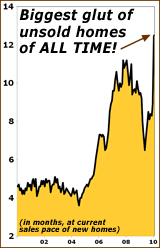
Michael: That’s the problem and there’s certainly no hurry when I think it was 22% of all sales in July were bank related foreclosures. Down there ,not to get too technical, it’s called a short sale in the real estate market down there. That means the bank has to allow your purchase because it’s less than the mortgage owed. So a fifth of their market is that kind of sale.
Sean: Unbelievable.
Michael: Hardly something to get people juiced up. A strong housing market is really important in terms of employment numbers and now they are not hiring construction people. So not only is it impacting up north of the border with our lumber industry but then the whole home decoration market, the home hardware, the home depot, that sort of thing gets impacted also. We’re not buying new paint to put a rosy coat on it if we’re not buying homes out there.
Sean: Is this a permanent change in real estate Michael?
Michael: That’s a great question, The key component here is are we recognizing sort of sea changes happening around us. For example, I’ll digress for a second, very clearly you’re getting a sea change in the role of government in Europe right now. It’s not going grow. It’s in fact going to be less. I think the US is about to face that dilemma here in the next couple of years. Again it’s all just financial constraint. It doesn’t matter what political party is in there. We’ve got tons of pensions problems. These are real changes that are going impact you for the rest of your life for example. Now what about the real estate market? Well in the States I think some of these weak markets are literally a decade or two from recovery, that’s how bad it is.
Sean: 10 to 20 years.
Michael: I think you’re looking at a generation. When you look at Phoenix and the amount of supply. Miami is in that kind of strait; I think Dallas is in that kind of strait, Detroit and some of these areas. You know the old guy who said well my retirement’s in my house? Well that isn’t going to be much of a retirement in some of those centers in the states.
Sean: So if you’re Canadian want to go snap up a condo in Phoenix as a vacation place, you can enjoy it but don’t expect to flip it and make a profit in a couple of years?
Michael: I know a lot of people are talking that way Sean, the sort of wonderful dream. I know myself I keep looking at Hawaiian real estate and still haven’t bitten the bullet because I’m waiting for lower prices. I think people have to look at this seriously. First of all, there’s a lot of different rules for foreigners owning in the States. Beyond that I’m not looking for a quick flip. The very markets that are down, that provide some of those huge discounts over the last few years haven’t showed signs of recovery yet. I think that’s the real problem, they’ve showed signs of a bottom but not any kind of meaningful recovery so I’m not keen on flipping. I think if you want to, if you can see yourself spending six months down in one of those places, do the math. Check out your maintenance fees, your insurance cost that sort of thing. Do the math and see if it’s worth it to you. But don’t sit there deluding yourself that you’re going make that money back over the next two or three years.
Sean: So it’s yeah L shaped not V shaped. Thanks as always Michael, we’ll talk next week.
Michael: Okay Sean, thank you.
Not surprisingly, gold demand for the second quarter of 2010 was up significantly compared to the year ago period, according to the recently released Gold Demand Trends report from the World Gold Council.
Total identifiable gold demand for the quarter was 1,050.3 tonnes. This represents an increase of 36% over the level for the year ago period and an increase of more than 38% over the level for the first quarter of 2010. Demand was led by increases in identifiable investment (+118%) and industrial demand (+14%), which more than offset a small decrease in jewelry demand (-5%).
Behind the increase in investment demand were the concerns about sovereign debt of European countries. This sparked strong demand in German speaking countries, with demand in Germany increasing by 59% year over year. The U.S. was another source of strong demand with an increase of 32% year over year.
The average gold price for the second quarter was $1,196.74 per ounce, or 30% above the average for the year ago period. During the quarter, gold also reached a fresh all time high in dollar terms when it reached $1,261.00 per ounce on June 28, 2010.
The World Gold Council continues to expect robust demand for gold throughout the remainder of 2010, citing growth in demand from India and China, and increasing global investment demand driven by uncertainty about public debt and the economic recovery.
My Take on Gold
by Richard Russell HERE
It is quite clear by merely looking at the current state of the stock market that investors want nothing to do with equities right now. We think this is a huge mistake. As a portfolio manager for more than 40 years I have always found it odd how out of sync I am with general investor attitudes. I tend to find myself giddy when most investors are panicked, and panicked when most investors are giddy. Therefore, you might guess that I am currently giddy, and you would be correct.
Why am I so giddy when pessimism is at a peak and investors everywhere are so full of doom and gloom? The answer is simple. I am giddy because everywhere I look I see my favorite investments currently on sale. From the important perspective of valuation, most of our country’s leading multinational large-cap blue chip companies are trading at attractive valuations not seen in almost 2 decades.
Today many want to dismiss the investing principle “buy low, sell high” as a mere cliché. I, on the other hand, see this as one of the most important principles required to get investing right. To me, it’s counterintuitive to avoid equities when they are low. Common sense would dictate this to be a great time to build long-term positions in outstanding companies. Fortunately, I am not alone in my views, but I’m certainly in the minority today.
….read more HERE
-
I know Mike is a very solid investor and respect his opinions very much. So if he says pay attention to this or that - I will.
~ Dale G.
-
I've started managing my own investments so view Michael's site as a one-stop shop from which to get information and perspectives.
~ Dave E.
-
Michael offers easy reading, honest, common sense information that anyone can use in a practical manner.
~ der_al.
-
A sane voice in a scrambled investment world.
~ Ed R.
Inside Edge Pro Contributors

Greg Weldon

Josef Schachter

Tyler Bollhorn

Ryan Irvine

Paul Beattie

Martin Straith

Patrick Ceresna

Mark Leibovit

James Thorne

Victor Adair