
Daily Updates
Investing in Canada: The World’s Safest Economy
[Editor’s Note: In recent years, global investing expert Martin Hutchinson has made investors a lot of money by telling them what markets to buy. His latest recommendation – Canada – represents the holy grail of investing: It’s got loads of profit potential, yet is one of the least-risky economies on the planet.]
I’ve said it once, and I’ll doubtless say it a few dozen more times before the U.S. economy returns to health: Just because you have to endure recessionary conditions doesn’t mean that your money has to.
That’s the argument I make when I urge Americans to search for investments outside U.S. borders. Ironically, your money doesn’t have to travel all that far: What’s arguably the world’s “safest economy” is actually located just north of the border.
I’m talking, of course, about investing in Canada.
The United States vs. Canada
With the U.S. economy dragging along huge budget deficits and stuck in low gear, it’s time to escape these problems by moving money away from this market.
….read it all HERE including “Profit Plays North of the Border”
Gold — has been higher five weeks in a row. Gold is overbought, and the odds are that gold is ready to correct. I’ve been saying that gold is overdue to correct, but what I’m interested in is how far the correction might carry. For Dec. gold the first support comes in at 1250. If the correction halts this side of 1250, I’d say that gold continues to look very strong. Below 1250, the next theoretical support comes in at the 50-day moving average — which is 1215. Comment by Richard Russell – Dow Theory Letters
Speculating in Gold
SO GOLD is now at “fair value” reckons Bill Bonner, long-time gold bug and my former boss/partner-in-crime at The Daily Reckoning’s London HQ, writes Adrian Ash of BullionVault.
No, he won’t sell yet…if ever…says Bill. But gold’s huge under-pricing a decade ago has clearly passed by. Value-hungry investors got their “reversion to the mean”, and in the form of 400% gains, too. What one ounce of gold bought 2,000 years ago – a good suit of clothes, in Bill’s oft-repeated example – it now matches, if not exceeds in price, here in late 2010.
From here, that makes gold a “speculation”.
Never mind that, around the birth of Christ, all clothes were hand-cut and sewn locally…rather than glued together by the world’s cheapest labor, four or eight thousand miles away. A suitable outfit for visiting the coliseum or agora would have been made-to-measure, too…and today’s finest tailors, at least in London or New York, will ask much more than the $1240 you’d raise by selling one ounce at current “Spot Gold” prices.
Never mind all that. Because Bill’s point is well made, again…
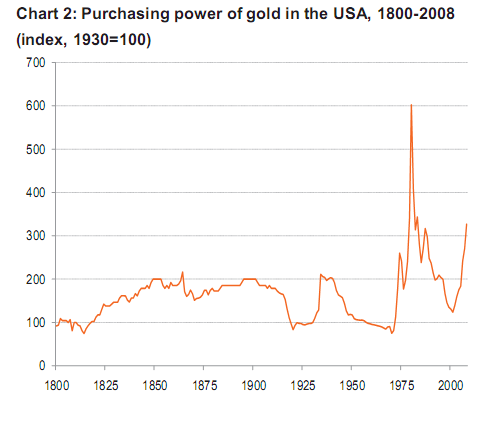
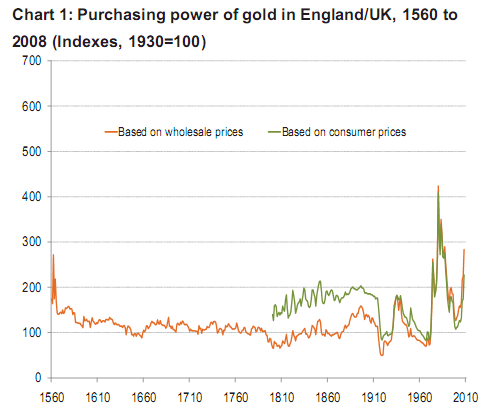
Gold was a screaming buy at the start of last decade, sinking to its lowest price – in real terms – since the early ’70s, as the chart above shows (courtesy of the World Gold Council, and taken from Roy Jastram’s incomparable study, The Golden Constant).
But “Nobody cared! Nobody was interested,” as a (very drunken) London dealer cried at me late last year. “I’d email out jokes, porn-site links, anything to get clients reading so I could repeat three simple words: ‘Buy Gold now!’
“But they didn’t care…I don’t even know if they looked at the porn…”
Today, in contrast, you can’t move for anxious investors and bullish hedge funds piling into gold. Or so the media coverage would make it seem. New gold dealers – online and on Wall Street – are meantime sprouting like fungus to catch the “retail dollar”, and the story’s grown so old, it’s even spawned its own calendar for financial hacks (the summer lull, India’s post-harvest festivals, quarterly data from the mining-backed World Gold Council, the Sept-end of each year of the Central Bank Gold Agreement). Wherever you look, the only debate that counts – “It must be a bubble, so when will it burst?” – rolls on for what is now more than two years.
As for the dumb lump of metal, yes – it continues to pull in new money, nudging its purchasing power ever-closer to the big top of 1980. But look again at that chart above. For while Roy Jastram saw a “golden constant” in his two centuries of US data (and four centuries of British Gold Prices), the shorter-term volatility is striking. Not least since gold ceased being money 39 years ago, and became mere trinkets and collectibles instead.
“In terms of what gold will buy, it does not seem undervalued to us,” Bill Bonner writes. “As near as we can tell, gold is now fairly priced.
“[So] the reward now is different. It is speculative…not inherent. We cannot expect to make money by waiting for the metal to revert to the mean. It’s already at the mean.”
But what is gold’s mean purchasing power – the “golden constant” of Jastram’s peerless research? By our reckoning here at BullionVault today, it has risen sharply since the US abandoned its last pretence of a gold standard and floated the Dollar in August 1971. Compared with the first seven decades of the 20th century, in fact, gold’s real purchasing power has stood more than 75% higher on average. Which seems odd. Because without being used as money – its only utility beyond decoration – gold became only more valuable. So while its purchasing power may have looked “constant” across long historical periods from Roy Jastram’s vantage of 1977 (and again to die-hard gold bugs 20 years later), its utility had in fact changed.
Gold became more useful as a way of storing purchasing power, even though it was no longer money. Or rather, because it was no longer money, in an age where “Every morning, when you look in the mirror, I want you to think ‘What am I going to do today to increase the money supply?’…” as John Ehrlichman, assistant to Richard Nixon, apparently told Fed governor Charles Pardee, sometime in the early 1970s. Post-war economic policy across the West was haunted by the shadow of the Great Depression, and thus flowed from the fear that, unless money was losing value, then spending and particularly investment growth would grind to a halt.
Without the spur of inflation, capital would choose to sit tight – in purses, pockets and deposit accounts – because its purchasing power today would be retained tomorrow. Savers could thus spend (or not) as they chose, rather than being forced to exchange or grow their money to realize or maintain its present value. Devaluing their money, in contrast, via persistent (and obvious) inflation would force savers into the stores and stock-broker’s office. And thus today’s targets for persistent (and obvious) inflation were born.
“[Harvard professor] Kenneth Rogoff is proposing that the United States use a burst of inflation to get out of its slump,” writes Princeton professor Paul Krugman. “I agree…[but] if central banks can gain any leverage at all, it’s only by credibly committing to inflation over a fairly sustained period…[not Rogoff’s] two or three years of slightly elevated inflation.”
Bill Bonner’s bang on the money, in short. Gold from here is a speculation, but a speculation only on academics getting their inside man (whether Mervyn King in London or Ben Bernanke in Washington) to apply their latest hare-brained scheme – massive new money inflation.
What price gold’s utility as a store of real value if…when…they succeed?
Buying Gold today – now simple, secure and cost-effective at world No.1 private-store, BullionVault…
U.S. Stock Market – The market appears to want to trade back up to the top of the trading range but as we get closer to November elections, I suspect we can see a break below the bottom of the trading range as the economy slips back into recession.
A rumor I’ve heard from some credible sources is the Obama administration is considering a plan that effectively would end up having Uncle Sam back all outstanding Fannie and Freddie mortgages if the banks take a 10% hit on the principle amount. If true, this may give a short boost to the markets but I think if there still was a straw to break the camels back, this would be it.
Gold and Silver – Both metals are knocking hard on the door to breakout highs. We saw some of the best two-way action in both metals yesterday and I suspect more of that today. Whether we break through now or we witness one of those sharp short-term dumping’s and then rally back, the bottomline is we’re going much higher IMHO. The gold perma-bears only have this in their future.
U.S. Dollar Index – I believe it’s rolling over and should be testing key support around 80 in the 4th quarter. I continue to greatly favor the Canadian Dollar and it’s the only truly fiscally sound Country in the G-7

U.S. Bonds – While this CNBC anchor person made a complete fool of her self (that seems to be part of the job requirement for most at CNBC), the guest she targeted her tirade at made some very valuable points about bonds.
Oil and Gas – I continue to ignore these two all together.
Silver Quest Resources, The Yukon Gold Rush and Gold and Silver
……read it all HERE
Evolving Gold, Has Taken a Licking But It Keeps on Ticking
…..read it all HERE
Stockscores.com Perspectives for the week ending September 4, 2010
Watch for These Trade Set Ups
In this week’s issue:
Weekly Commentary
Strategy of the Week
Stocks That Meet The Featured Strategy

Remember, when you see a man at the top of a mountain, he did not fall there.
Achievement requires effort, but there are many paths to the top. In stock trading, our goal is simple; beat the market and make money. There are many ways to do that, as a trader that uses chart analysis as my chosen path to success; there are also a number of methods. Here are my Five Typical Trades, each a strategic method for putting money in your account.
Reversals
The first variety of chart pattern set up is the reversal. This class of strategies look for a shift in control from buyers to sellers, or sellers to buyers. I look for two different things when seeking reversals. The first approach is to find stocks that are in sustained price trends and then break their trend line. This can be the break of an upward trend line, telegraphing a downward move, or a downward trend that is broken as the stock makes a bottom.
The other set up is a shift from rising bottoms to falling tops (a topping pattern) or from falling tops to rising bottoms. This second approach to reversals is more conservative but also more reliable. You will get in later on the reversal but the success rate will be higher.
Generally, I prefer waiting for a move from falling tops to rising bottoms when looking for a bottom but I will short sell a simple trend line break on a strong stock rather than wait for the break down from a falling top.
(continued below)
- Get the StockSchool Pro Free

Open and Fund a brokerage account with DisnatDirect and receive the StockSchool Pro home study course free, including special Pro level access through the DisnatDirect client website. Offer only available to Canadian residents. For information, click HERE
Breaks
There are a lot of stocks that trade in boring, sideways trading ranges that show little price volatility. These stocks are marking time, investors having little new fundamental information to motivate strong buying or selling and a upward or downward trend. Stocks in these situations are opportunities waiting to happen, for abnormal price breakouts with abnormal volume signal that well informed investors have found a fundamental reason to buy or sell the stock aggressively. Since the spread of information in the market is not always fair, these well informed investors are leading the crowd. When the wider market learns of the information that caused the breakout, the stock will be accumulated by many, initiating a money making trend.
But buying breakouts alone is not effective. You have to be sure that the break is a signal that there is something going on with the company, that there is a significant change in company fundamentals behind the break. Understanding chart patterns is key to doing this.
Run Aways
Once a stock gathers momentum and starts moving up, the emotion of the market may cause it to move too quickly. A stock that goes up or down too fast has a greater potential for a short counter trend, caused by investors who take profits. If you bought a stock and make a very good return in a short amount of time, you will likely want to exit the trade to lock in profits.
One trading strategy is to play this process, shorting a stock that goes up too quickly or buying a stock that goes down too fast. This trade goes against the longer term momentum of the stock and is only a short term trade. For savvy swing traders, it can be a lucrative move.
Where do you choose to go against the grain? Look for stocks that are trading with emotion, high volume and a very steep trend. Recognize that these stocks will find barriers at historical support and resistance and will like begin their counter trends there. Anticipate a counter move at these price levels.
Pull Backs
Stocks have momentum once a stock has been in a trend for a while, and that momentum will dominate to bring the stock back on course when there is a short counter trend. Pull Back strategies look for stocks that have a long term trend in one direction and a short term trend in the opposite direction. Playing Pull Backs require you enter the trade when the stock pulls back to the trend line and give some sort of confirmation that it is likely to bounce off of the trend line and continue with the longer term momentum.
Anticipations
Some chart patterns show a mood but lack a trend. For example, those familiar with charts will know that ascending triangles show optimism, and descending triangles pessimism. However, they are consolidation patterns, which means price in general is going sideways over time.
One strategy is to anticipate a breakout by buying stocks in ascending triangles or shorting stocks in descending triangles. Since price volatility is low, the risk of the trade is less and the upside greater if the stock does what we expect of stocks in these patterns, breakout.
I have mixed feelings on this strategy. It makes good logical sense but in my own trading I have not had great success anticipating breaks. While the risk reward tradeoff is better, the probability of success is lower. I think you can trade this way, but my preference is to wait for the break with the understanding that the probability of a trend developing is higher.

Each day I run a pretty simple Market Scan that looks for stocks trading abnormal volume and breaking through 15 day resistance. The abnormal volume tells me that something has investors really interested in the stock, and the break through resistance is a sign of optimism. I check the charts of these stocks about an hour before the close, looking to see if these stocks have a good chart pattern. If they do, I will feature them in the daily edition of the newsletter.
I did not find anything on Friday that I liked, to be expected because the market was so slow leading in to the long weekend. I did find one stock on Thursday and alerted the daily edition subscribers to it with a real time alert before the market closed. I think that stock is still worth considering.
Back To Top

1. EGHT
EGHT is breaking out from a long term pennant pattern that has been building over a number of months. The volume over the past two days has been very strong so the market is certainly interested in it for some reason. Support is at $1.35.

References
Get the Stockscore on any of over 20,000 North American stocks.
Background on the theories used by Stockscores.
Strategies that can help you find new opportunities.
Scan the market using extensive filter criteria.
Build a portfolio of stocks and view a slide show of their charts.
See which sectors are leading the market, and their components.
Click HERE for the Speaker Lineup and to Purchase the video if you want to learn from some of the worlds best traders including Tyler Bollhorn.

Tyler Bollhorn started trading the stock market with $3,000 in capital, some borrowed from his credit card, when he was just 19 years old. As he worked through the Business program at the University of Calgary, he constantly followed the market and traded stocks. Upon graduation, he could not shake his addiction to the market, and so he continued to trade and study the market by day, while working as a DJ at night. From his 600 square foot basement suite that he shared with his brother, Mr. Bollhorn pursued his dream of making his living buying and selling stocks.
Slowly, he began to learn how the market works, and more importantly, how to consistently make money from it. He realized that the stock market is not fair, and that a small group of people make most of the money while the general public suffers. Eventually, he found some of the key ingredients to success, and turned $30,000 in to half a million dollars in only 3 months. His career as a stock trader had finally flourished.
Much of Mr Bollhorn’s work was pioneering, so he had to create his own tools to identify opportunities. With a vision of making the research process simpler and more effective, he created the Stockscores Approach to trading, and partnered with Stockgroup in the creation of the Stockscores.com web site. He found that he enjoyed teaching others how the market works almost as much as trading it, and he has since taught hundreds of traders how to apply the Stockscores Approach to the market.
Disclaimer
This is not an investment advisory, and should not be used to make investment decisions. Information in Stockscores Perspectives is often opinionated and should be considered for information purposes only. No stock exchange anywhere has approved or disapproved of the information contained herein. There is no express or implied solicitation to buy or sell securities. The writers and editors of Perspectives may have positions in the stocks discussed above and may trade in the stocks mentioned. Don’t consider buying or selling any stock without conducting your own due diligence.
[Like your editor, Rick’s Picks forum regular Wayne Razzi (aka “Red Will”) is a veteran floor-trader who grew up in South Jersey. When I asked him if he would like to contribute a guest commentary, I was not expecting the provocative tour de force that unfolds, step by step, below. In the essay, Will asserts nothing less that that the impending collapse of our economic system was meticulously engineered by financial and political sociopaths. Let me attest that his is not some whack-o conspiracy theory; rather, it is the closely-reasoned argument of a highly intelligent person who values truth sufficiently to have searched for it, in the form of an answer to a profoundly disturbing question, for many years. Judge for yourself whether his conclusions tally with your own thoughts as to why the American Dream is about to go bust. RA]
Incompetent, But Curious
After being hazed all day and into most evenings by my firm’s Options Specialists for about six months, I was given a seat on the trading floor. It is from that point on that I began the conversion from business school idealist to incompetent cynic. In fact, well before I officially became a trader, I witnessed “broad daylight” collusion every day. The myths of the “fair and orderly market” and the “competitive open outcry system” were dispelled almost immediately as soon as I had learned enough as a trainee to be able to slow down the frenetic action to a pace that was comprehensible. What do I mean? Why is this important? Well, in theory, the traders of options on a given stock are supposed to be competitors that do not cooperate with other members to set market prices on which the public will execute trades. The reality is that the main trader, typically the specialist, makes the bid-ask spread market and the majority of the time the entire trading crowd simply states their level of commitment to the market that he has made. Here is the problem, OUR watch-dog, the SEC, rarely if ever has done anything about this clear violation of the law. Many techniques and devices are employed to encourage market makers to play ball. Any time spent on some of the options floors over the years would have revealed this to the SEC. This means… they know it and they just do not care. They have always known it. This may not be a revelation here in 2010 with Rick’s “crowd” being a rather enlightened one, but 20 years ago this matter-of-fact flouting of the law initially stunned this “Econ/Finance” dual-major as these business practices were conspicuously absent from the textbooks. What does this prove? It proves what many of you — but until recently not nearly enough people — believed: The government is entirely about strategic, selective prosecution. Shocked, right? The government and the markets are corrupt! I am sure that many of you are floored! Hold on though, I am “going somewhere” with this as it is stated.
As you have probably already guessed, this “welcome to the real world of our markets” experience put me on a path that would shatter nearly all of my idealistic beliefs about a country with systems that I was raised to revere. Just in case you weren’t sure how corrupt things actually are within our markets, it’s my hope that any faith that you may have reserved is fully gone by now because if it can happen in plain view amongst competitors then much more can clearly occur behind closed doors. Let’s get back to that “assume that others know what you know” concept and in doing so, we’ll leap ahead in time by about five years.
………
(Ed Note: I have advanced to Wayne’s list of “US Rapidly Deteriorating“
Sticking with the step-back-perspective theme with an eye towards wrapping things up, let’s consider how dire things are at present. I hate to add even more length to this piece but it is clear from just a few headlines that the USA is in rapid deterioration mode, and not just fiscally/economically:
- A nearly perfectly divided electorate that’s addicted to the right/left paradigm
- Police are ignoring calls for certain serious crimes yet indoctrinated citizens are more fearful of firearms than of having to defend their families and homes against illegally armed thugs with no support from law enforcement
- Education here is largely a qualitative and fiscal farce
- In what could be described as an unimaginable achievement, popular culture now makes anything prior to the 70’s appear to have been a modern Renaissance period
- Our government is dedicated to Homeland Security at airports but our borders are porous. The MSM will never highlight this contradiction. Is it possible that “the war on drugs” only applies to those that aren’t with the company?
- Perpetual wars are by and large accepted when they are even thought of at all
- And of those plans to bring back those jobs that are never coming back and about revitalizing and retooling those manufacturing centers that will never hum again?
- Can we really Smartphone and service business our way out of the destructive vortex that we’ve allowed them to conjure at will with an end goal of debt enslavement?
- What I refer to as the “Manipulation Cartels” have amassed and consolidated power like never before
- The “button pushers” seem to want to implode the system but on their timeline and with some fragments of realism included to maintain “believability
…..read the whole commentary HERE (begin with the Heading “Beneath the Surface”)
-
I know Mike is a very solid investor and respect his opinions very much. So if he says pay attention to this or that - I will.
~ Dale G.
-
I've started managing my own investments so view Michael's site as a one-stop shop from which to get information and perspectives.
~ Dave E.
-
Michael offers easy reading, honest, common sense information that anyone can use in a practical manner.
~ der_al.
-
A sane voice in a scrambled investment world.
~ Ed R.
Inside Edge Pro Contributors

Greg Weldon

Josef Schachter

Tyler Bollhorn

Ryan Irvine

Paul Beattie

Martin Straith

Patrick Ceresna

Mark Leibovit

James Thorne

Victor Adair