
Daily Updates
A few weeks ago, we moved from an aggressive cash position (80+%) to about 50% long. We continue to find intriguing set ups and attractive trades, mostly in the small and mid-cap space.
But that doesn’t mean we are sanguine about the likelihood of this rally going on forever. Indeed, there are many factors that are making me uncomfortable with our becoming even more aggressive.
Consider these 10 factors that are making me nervous:
1. Low volume: Friday’s quad-witch volume notwithstanding, volume has been extremely light for weeks now. Historically, light volume is associated with tops (disinterest) while heavy volume tends to accompany bottoms (capitulation).
….read 2-10 HERE
Richard Russell has made his subscribers fortunes. One of the best values anywhere in the financial world at only a $300 subscription to get his DAILY report for a year. HERE to subscribe. Amongst his achievements Richard was in cash before the 2008/2009 Crash and he has been Bullish Gold since below $300
From what I read and from what I hear and from what I see, everybody needs one of two items — or maybe both. The first most needed item is a job that pays them a living wage. The second most needed item is cash. Lately, I’ve been besieged by people I know or I know only slightly, and they all have something to sell me — a used car, a house, an emerald, a battered diamond, an idea for a new business.
This leads me to the inevitable conclusion — America is bust. And most of its people are broke and in dire need of cash.
This week’s Barron’s is unusually interesting. An article appears in this venerable publication that suggests that readers invest “as much as 5%” of their assets in gold.” Never in the article is the suggestion that one owns gold as protection against a sinking dollar. The reason given is that nobody knows what lies ahead, and the reason you own gold is for all-around insurance against deflation or inflation. It’s as if daring to suggest that the dollar may fall is treasonous, yet statistics and charts show that gold (now at a record high) moves inversely to the dollar. As the dollar fades, gold rises.
Gold is the time-honored standard of value. The true value of gold doesn’t change — the value of everything else changes in relation to gold.
To talk about the future of gold, one must talk about the future of the dollar. The US is now being run by Keynesians. Their strategy is to spend and print and borrow the nation out of trouble.
The one member of Barron’s staff who understands money and gold is Editor-in-chief Randall Forsyth. In a second and smaller article this week entitled “Gold’s Glimmer Grows,” Editor Forsyth notes that “it’s apparent that the dollar is in retreat on all fronts. Adding to the pressure is increasing speculation that the Fed could resume expanding its balance sheet as soon as the September 21 meeting of the policy-setting Federal Open Market Committee.”
Russell Comment — The unemployment statistics continue to look dismal. In official economic strategy, politics has a habit of prevailing. Thus I am reasonably certain that the next move by the Fed will be to return to “quantitative easing,” better know as printing money. The result will be a declining dollar, a process that escapes the radar of most Americans.
A declining dollar may not register in the minds of most Americans, but it certainly waves a red flag in front of the keepers of monetary reserves of overseas nations. Their reaction is to reduce the mix of US dollar denominated securities in their country’s reserves, meaning to get rid of their dollar reserves by buying assets, often real estate or businesses in Africa, Australia, South America and the United States..
“America is for sale,” and I see it in the daily tally of real estate sales in San Diego County. And why not? San Diego has some of the best weather on the planet, it has great medical facilities, and it has miles of beaches and a great harbor. Where else can you buy a house that’s a five minute walk from the beach for less than $1.5 million?
Richard Russell has made his subscribers fortunes. One of the best values anywhere in the financial world at only a $300 subscription to get his DAILY report for a year. HERE to subscribe. Richard has been Bullish Gold since below $300. He also loaded up on bonds in the early 80’s when US Treasuries where yielding 18%+. A 30 year bonds through compound interest would turn $1,000 into $300,000 at maturity. (include reinvestment of interest income, which Richard does as his view is compounding interest is the ROYAL ROAD to RICHES)
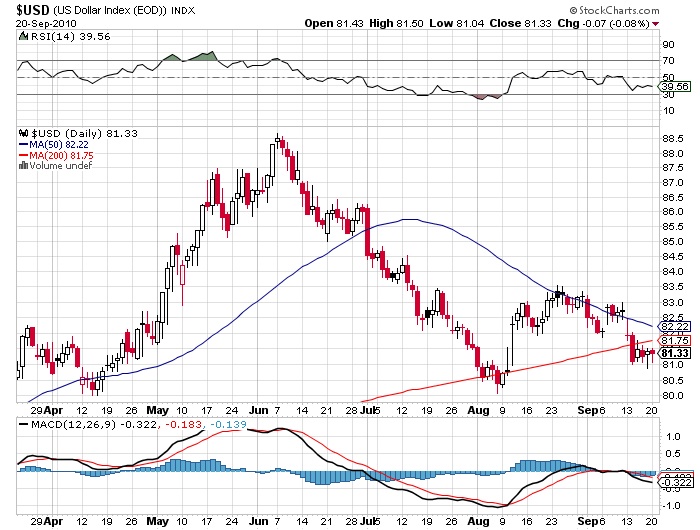
While I noted last week the U.S. stock market could work higher in the near term, I also said the terminally ill U.S. Dollar (remember the only party that doesn’t know the U.S. Dollar is dead is the U.S. Dollar) was breaking down technically and going to test key support around 80.
It’s dipped below some near term support at 81 but 80 is “the” major technical and psychological support number.
$60 trillion in debt
Does anyone know what the US owes? How bad is the nation’s debt problem?
While the official number — $13.4 trillion, according to the Congressional Budget Office — is frightening enough, some analysts say the actual figure is much, much higher. Like a shopaholic who hides their credit card bills, the government pretends certain obligations and expenditures don’t exist. Uncle Sam really owes closer to $60 trillion, or more, and the country is close to bankrupcy.
“The government is lying about the amount of debt,” says Laurence Kotlikoff, an economist at Boston University and co-author of “The Coming Generational Storm: What You Need to Know about America’s Economic Future.” “It is engaging in Enron accounting.”
“The problem is we’re seeing an explosion in spending,” adds Andrew Moylan, director of government affairs for the National Taxpayers Union.
…..read more HERE
America: Love it or (if you’re rich enough) leave it?
Glen Esnard, a Newport Beach executive for real estate services firm Grubb & Ellis, went to bat in the Wall Street Journal last week for high-income-earners who believe it’s unfair that their tax rates should rise on Jan. 1, as President Obama proposes.
Esnard also suggested that the answer might be for the better-heeled to find a new country.
In a letter to the newspaper, Esnard wrote that although he includes himself in the population earning more than $250,000 a year:
…..read more HERE
New Jersey Governor Chris Christie is known for telling it like he sees it.
At a town hall meeting yesterday in Raritan, NJ, he made sure to bolster that reputation. The fireworks start in the beginning and go until about 1:53.
The rest of the video is worth watching, however, as Christie explains how the teacher‘s union in the state refused to compromise to save the state’s crucial education dollars.
The original Cariboo Gold Rush was a period of feverish migration of workers into the Horsefly Creek area in British Columbia in 1859 following the first gold discovery by Peter Curran Dunlevey. This was closely connected by subsequent strikes at Keithley Creek and Antler Horns Lake in 1860; and by 1862, widely publicized stories surrounding prosperous finds throughout the Williams Creek district resulted in a full swing gold rush.
Michael Campbell: Well, could it be a better time? Jim you’ve had your core position in gold for years and you’ve been talking about silver going back to the $4 mark. You have your own silver index and you’ve been saying “never overlook the potential for silver”. Now that we are at a 30 year high in silver what do you think is going to happen going forward?
Jim Dines: Yes, it’s an upside break out which of course overrules all the doubters and all the pessimists but the fundamental fact about silver……
……and this is something you have to really accept before you can go any further, is that silver is a form of gold in that a silver coin is as good as a gold coin anywhere either is accepted. But silver is somehow treated like the bastard step child and looked down on because it has commercial uses. This has always amazed me since that makes it even better that it has more than one use. Unlike gold it also forms a silver oxide which prevents rust and it’s absolutely useful in high technology lockets where grey electrical kinds of activity without corrosion. Silver is a beautiful metal, it’s been used by artists for centuries, it has very high ductility like gold, it’s malleable like gold. Yet silver gets too little respect and it’s very hard to get it. You don’t often find a silver mine the way you do a gold. Silver mines are a relative rarity and Silver is usually a byproduct of lead and zinc. When I first recommended gold at $35 I said it was going to go over 400 and got fired at my job on Wall Street for it. Back then just handful of people believed it, including you, but even then some of them said you’re right about gold but silver will never go up because it’s a commercial metal. And 10 years ago when silver was at a $4 I flashed a new major buy on it. And here it is, it’s gone from 4 to 20 but gold has gone from 288 to over 1,200. And they need to move together, there’s a relationship with them because they’re both monetary metals. So I’m prepared to say on the air right now, in front of the whole world that silver is the single most underpriced commodity on this planet. That it will have a screaming up trend ahead, and these days it’s a great buy down here from its previous high of 50 dollars.
Michael: I’m just letting that sink in for a minute if you don’t mind.
Jim Dines: I don’t what may happen tomorrow but or what it will do tomorrow but it has historically moved with gold. Gold is now making new all time highs almost daily recently and I predict that it will drag silver higher kicking and screaming and resisting all the people talking about a bubble. Nothing will stop these two machines as they now kick into gear.
Michael: I just want your advice about how to play the break outs. So can you help us on how to play it?
Jim Dines: More importantly you need to look, step back and get the big pictures. For example right now another central fact in the world today is that all governments are printing money and they are just printing whatever they think is right.
Now in my mass psychology book the hypothesis is that in addition to regular psychology which is vertical a combination of your genes and experiences is also a mass mind. That mass mind goes and stampedes the way the stock market reacted to a 911 for example , or when I was on your show six years ago and I was warning about the coming real estate crash that would drag down the banks. People didn’t hear it and that’s because its the nature of bubbles. There is one peculiarity about mass psychology in that when your inside the bubble you cannot see it. Bubbles are invisible to those in side the bubble and for some reason I’m cursed with being able to see them and when I told people to get out of real estate they just didn’t, hear me because they could not see the bubble. Well I’ll tell that right now the biggest bubble in history is going on and that is that every bank in the world, every central banker is printing whatever amount of paper money they think is right. That is a bubble of the first magnitude because when that thing collapses, all that’s going to be left standing in the rubble is going to be hard assets and there will be a new currency and it will be based on the Gold in Fort Knox Kentucky.
America in my ‘Goldbug’ book, which is my third and final book on gold, has one interesting factor. You might remember that during America’s civil war the banks were issuers of currency. Each bank issued a dollar and it was backed 100% by gold. During the civil war Abraham Lincoln seized all that gold to pay for the war and immediately after those paper dollars collapsed, the banks collapsed and it was all blamed on gold. That was part of the first 110 pages of my Goldbug book and it is crucial to understand the history of gold. When I first came to see you on your show many years ago, I was the founder of the ‘hard assets movement’. Back then I said when this currency system collapses there would be inflation, then natural deflation and then a currency crisis. The currency crisis is ahead of us. We’re already at the stage right now were they are printing all they want here in America, $9 trillion worth, and we still have 10% unemployed. So its not working anymore the Halo has worn off, has reached its limit and we are now at the risk. Remember I was the first one to use the word deflation when everybody else was talking about how much inflation there would be. We are now in a deflation phase and what’s ahead is a possible hyperinflation and I cover that in my Goldbug book.
As I wait on that and consider whether I should flash a hyperinflation signal, I realize that its hard assets that have to be owned and that’s why I’m in gold and silver and Platinum and Palladium. That’s why we made a killing in uranium, unfortunately we held it too long but I think its just starting to move up again and now my latest market is Rare Earths. Its crucial to get into these bull markets upstream from the herd. You’ve got to get into them before there are 500 analysts writing reports on them. You need to get in there before you hardly even know what the field is and I’ll just give you one example. I can’t give you the name as I’m not going to give you my list of rare metal recommendations but I will say that one of them has gone up 11,150% the last two years. Translated into English $10,000 at the low would be now worth $1,250,000. So the really big money is made getting into these things when they are selling for pennies. When we first recommended silver, you might remember Mike, at $0.92 before it went to $50. $10000 of silver at $0.92 would have been worth $540,000 at the high. Now you are not going to get at the bottom penny and get out at the top penny. But any slice of that is yummy and that’s why that’s the way you use mass psychology. You understand up trends, you understand the basic geopolitical gestalt of a world that we are in right now where there is a massive shift towards hard assets commodities. Look at the price of sugar and cotton and everything is just high. Why is it high? Its not speculation, this is a real understanding that the more paper you print the more that the underlying commodities are worth. Dd I answer your question?
Michael: Yes. It is interesting that one of the things about the ‘Goldbug’ book and your approach is peoples misunderstanding of money. That gold doesn’t change in value just the measuring stick does, gold is gold…
Jim Dines: It’s the amount of paper assigned to each unit of gold per ounce that matters in each country that matters. But gold is unique, gold is money yet it doesn’t have a price.
Michael: So when people see the break out like we’ve seen in silver has a new ball game started?
Jim Dines: That’s right. We’ve conquered the selling that has suppressed it for all this years. It’s all been absorbed and bought and now there is a whole new wave of buyers. The upside break out is the key. I went long silver futures recently and I’m very happy with what’s happening. A trend is your friend, go with a trend. Don’t tell the stock market what to do. It’s bigger and stronger than all of us put together.
Michael: Are the precious metal stocks fully discounting the price movement that’s already happened? Are the stocks reflecting the movement in the underlying Gold and Silver?
Jim Dines: That’s a really smart question that’s why I always enjoy your interviews. In fact the stocks and the commodities do not move together and the secret goes back to Mass psychology. Try to imagine that somebody who actually buys the commodity to use it in the manufacturing process. He’ll pay a certain price to it depending on the economics involved. But the actual stock itself moves with the stock market was what the speculator thinks that mine would produce. There are two different people. The people who buy commodities, normally don’t buy stock and vice versa. So you’ve got two separate mass psychologies and they will move differently and exploit that and I’ll show you how.
I’ll give you an example that’s in the next Dines letter which is going to have a chart that I’ve never showed before. The chart is the price of rare metals themselves. That’s Neodymium, Dysprosium, Cerium and so on. These metals are crucial, you can’t build a wind mill without them. You can’t build a cell phone without rare earth metals. The actual manufacturers of them have set the price vertical in the last two months because China, who produces 96.8% of the worlds rare earth metals, has cut off the rest of the world. So they went vertical and it took almost a week or two before the stocks themselves began to move up . I have a chart of rare earth metals the way I do it and you can just see how the two charts of the metals and the metal stocks are different. I can look at the ratio and the fact that the metals have gone up so steeply tells me that there is anticipatory movement about to happen. That the stocks will catch up with the metals. It’s very important to watch any interplay through a technical indicator like this. The ratio between the commodity and the stock and watching the actual numericalization of mass psychology.
Michael: If you don’t mind I want to just dive a little further into that to impart to new people how to play these things. What is the difference in the movement between a senior producer and a junior producer?
Jim Dines: Well the answer to that lies in the nature of them. The seniors are the companies that already are producers. There have been lots of analysis written on them they know roughly what their resources or actual reserves are. And that can be judged in the market place by professional security analyst. The low priced juniors are more speculators, they are hunters. They barely even have a reserve yet. They are out there hunting for it. So they are much more speculative but they have much bigger upside potential because people just don’t know what they are going to find. I’ve gone through the many rare earth companies and this is a different field because so much was produced in China it’s now a wide open, world race to who can produce a rare earth first. Very few of these companies outside China have reserves and therefore the smart move is to buy a group of them. We’ve gone through and use all the skill and everything we’ve developed over many years and we’ve picked just six companies. And we’ve been saying put I’m pretty sure that whoever the major winner or two is going to be is in that six but could I sweat which one is going to be? No! I can’t because that’s still underground and the mining company itself doesn’t know that answer. So you buy a group of the ones that look best, the most likely ones. Maybe all those six are honeys, all six of them are already rising up trends and the public isn’t even in on the it. The rare earths are not in the headlines yet. If you want to wait you know by the time you see a parade in the stock market you’ll be too late.
Michael: Jim Dines is my guest and you can just go www.dinesletter.com for subscription. One of the things I should mention that in the news letter Jim recommends specific stocks in these groups for levels of risk and the holding periods. He also has when stop losses for when you should get out of them. So if you want the specifics on what Jim is recommending you can get a seven months subscription for as little as $185 US . Lots of good stuff. Always a pleasure we appreciate you making time for our audience across the country.
Jim Dines: Yes my pleasure I’m sorry I couldn’t recommend any stocks but I have to respect my paying subscribers you know. But I’ll tell you something if you want to get in early its no longer the bottom as it was a year ago. I told I said this on your show a year ago Mike. The rare earths are the next big thing. They will be and they are already starting to be.
-
I know Mike is a very solid investor and respect his opinions very much. So if he says pay attention to this or that - I will.
~ Dale G.
-
I've started managing my own investments so view Michael's site as a one-stop shop from which to get information and perspectives.
~ Dave E.
-
Michael offers easy reading, honest, common sense information that anyone can use in a practical manner.
~ der_al.
-
A sane voice in a scrambled investment world.
~ Ed R.
Inside Edge Pro Contributors

Greg Weldon

Josef Schachter

Tyler Bollhorn

Ryan Irvine

Paul Beattie

Martin Straith

Patrick Ceresna

Mark Leibovit

James Thorne

Victor Adair