
Daily Updates
Market Buzz – Correcting Worldwide Mismatches Key to Sustained Recovery
Now three weeks into what promises to be an interesting fall investing season, we take a quick look at the Canadian economy and Toronto’s main market.
We tend to agree with Deputy Chief Economist at TD Financial Group Derek Burleton’s recent assertion that the Canadian economy is coming off a “sugar high” from stimulus measures as well as the unleashing of pent-up consumer demand showing signs of a maturing recovery.
Typically, in the early stages of a recovery, you get a bounce as inventories are restocked after the deep cuts during the recession. As the consumer pauses during the recessionary period, you get a good deal of pent-up demand. We saw this demand hit the economy in full swing in the fourth and first quarters of 2009 and 2010, respectively. Compounding this pent-up demand was significant government stimulus that brought future spending forward for home renovations and other programs.
All these factors lead to a couple of 5 per cent plus quarters (Q4 2009 and Q1 2010). However since then, we have seen clear evidence that some of those early returns are beginning to diminish. While this is perfectly natural as they cannot sustain that growth forever, there are some tailwinds that are turning into headwinds. Not only are we seeing a slowdown, but over the next couple quarters, we could see growth fall below the trend rate.
Heading into 2010, we had stated that on a valuation basis, Toronto was really neither cheap nor expensive and that there was no real compelling reason to “buy the market,” but, there remained compelling reasons to buy some individual growth and value stocks. We saw it as a limited growth environment and a stock pickers market. Our stance is unwavering in this respect with nine months solidly behind us.
Late this past week, we were pleased to report that Boyuan Construction Group Inc (BOY:TSX) announced a rise in profit for the fourth quarter on higher revenues as the company expanded into new core markets. Results for the current quarter were also helped by absence of stock based compensation expenses.
Boyuan’s net income rose 27.4 per cent to US$4.59 million from US$2.31 million last year. On a per share basis, earnings were US$0.17 compared with US$0.09. One year ago, the company had incurred a stock-based compensation expense of US$1.8 million.
The China-based commercial builder attributed the growth mainly to its decision to expand into the Shandong Province, one among the company’s new core market. We will be issuing a full update next week.
Looniversity – Technical vs. Fundamental – at the Mall
Technical analysis is a method of evaluating securities by analyzing statistics generated by market activity, such as past prices and volume. Technical analysts do not attempt to measure a security’s intrinsic value, but instead use charts and other tools to identify patterns that can suggest future activity. Technical analysts believe that the historical performance of stocks and markets are indications of future performance.
Fundamental analysis is about using hard data (price-earnings, price-to-sales) to evaluate a security’s intrinsic value. Although most analysts use fundamental analysis to value stocks, this method of valuation can be used for just about any type of security.
In a shopping mall, a fundamental analyst would go to each store, study the product that was being sold and then decide whether to buy it or not. On the other hand, a technical analyst would sit on a bench in the mall and watch people go into the stores. Disregarding the intrinsic value of the products in the store, his or her decision would be based on the patterns or activity of people going into each store.
Put it to Us?
Q. I often watch CNBC and BNN to find out about the market action during the day. Can you give me a quick overview of the ticker tape and what all the numbers mean?
– Mary McDonald; Edmonton, Alberta.
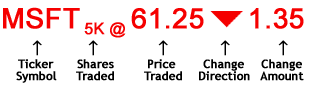
A. Good question, Sandra. Here’s an example of a quote shown on a typical ticker tape, which reports data on the latest significant trades of a stock:
Ticker Symbol: This refers to the unique characters used to identify the company.
Shares Traded: This is the volume for the trade being quoted. Abbreviations are K = 1,000, M = 1,000,000 and B = 1,000,000,000.
Price Traded: The price per share for the particular trade (the last bid price).
Change Direction: Shows whether the stock is trading higher or lower than the previous day’s closing price.
Change Amount: The difference in price from the previous day’s close.
KeyStone’s Latest Reports Section
- Cash Rich Base Metal Producer with Low Relative Multiples , Benefitting from Gold & Silver By-product Price Surge – New Focus BUY (New Buy Report)
- Wireless Phone Retailer Announces Solid Strategic U.S. Acquisition – Upgrading Near-Term Recommendation (Flash Update)
- Rare Earth & Magnetic Powders Post Strong Q2 2010 Revenues & Earnings Growth, Solid Balance Sheet ($0.55 per share in cash) – Maintain Long-Term Rating (Flash Update)
- IP Company’s Q1 2011 EPS Exceed Expectations, Solid Fundamentals, Strong Cash Position & Yields 4.6%, Near-Term Rating maintained – Buy (Flash Update)
- Healthcare/Hospitality Service Trust Posts Solid Q2 2010, Total Return 108%, Yield Remains Solid at 6.81%, Near-Term Organic Growth Challenging – Rating Maintained (Flash Update)
Also see:
When Gold Goes Up
A look at our favorite yellow metal, over the last decade and beyond HERE
Is the Bull Market in Gold Over?
Gold hit three new record highs last week. This week, following the announcement by the US Fed on Tuesday, it is hitting still more highs…closing in on $1,300 as we write.
Gold should go up with consumer prices. But, for nearly two decades – from 1980 to 1999 – gold went down while consumer and asset prices rose. Now, consumer prices are stable. Yet gold hits new records.
All views on gold are baroque. There’s no line of thought on the subject that doesn’t have a curve in it. Some buyers are loading up on gold because they see a recovery coming. Others are buying it because they don’t. Recovery, say some, will boost consumer appetites, resulting in higher inflation levels and a higher price for gold. The absence of recovery, say others, will cause the Fed to undertake more money printing.
Those who have no opinion on the matter are among gold’s most aggressive buyers. To them, gold looks like a “can’t lose” proposition. If the economy improves, gold rises naturally. If it doesn’t improve, the Bernanke team will force it up.
And if not Bernanke, the Chinese. Gold makes up only 1.7% of China’s foreign exchange reserves. Many analysts believe China is targeting a 10% figure. If so, it would have to buy every ounce the world produces for two and a half years. Or, if it relies on only its own production – China is the world’s largest producer – it would take nearly 20 years of steady accumulation to reach the 10% level.
The metal holding down the 79th place in the periodic table has many uses. People make spoons, forks and bathroom faucets out of it. It’s occasionally used as roofing, or even as a murder weapon; Crassus had molten gold poured down his throat after being captured by the Parthians. And Lenin said he would line the public latrines with it. But the best use ever found for it was as money – as a reliable measure of wealth.
Even gold is not perfect as money. During the years following the Spanish conquest of their New World territories, for example, gold flooded back into the Iberian Peninsula. Soon there was much more gold than the other forms of wealth it was meant to represent. Each incremental ounce of gold was disappointing. It bought only a fraction as much as it had before this monetary inflation began. And had you bought it in 1980 you would have seen 90% of your purchasing power disappear before the bottom finally came. Even today, you still would not be back at breakeven. The price of gold will have to almost double from today’s level to reach its inflation-adjusted high of 1980.
But this is what makes gold very different from other money. If you happen to have a billion-Mark note from the Weimar Republic or a trillion dollar note from Zimbabwe, you can hold onto that paper until hell freezes; its value will never return. Gold, on the other hand, will never go away. And when the post-1971 monetary system cracks up, gold is likely to return to its 1980 high…and keep going.
Over the centuries, mankind has often experimented with alternatives to gold. Driven by larceny or desperation, base metal and paper were tried on many occasions. Paper was particularly promising. You could put as many zeros on a piece of paper as you wanted, creating an infinite supply of “money,” as Ben Bernanke once noticed, at negligible cost. But the experiments all ended badly. People realized that money gotten at no expense was only gotten rid of at great cost. Given the ability to create “money” at will, a central banker will sooner or later create too much.
But one generation learns. The next forgets.
By 1971, Americans had forgotten everything they ever knew about money. Richard Nixon cut the final link between the US dollar and gold.
At first, it looked as though investors hadn’t noticed. But then began a great bull market in gold that took the price from $43 to $850. And just then, when investors were most sure that paper dollars would soon be worthless, a remarkable thing happened. Paul Volcker intervened. He made it clear that if the dollar were to go the way of all paper, it wouldn’t be on his watch. Inflation rates fell, along with gold.
Whatever shards of monetary wisdom were still lying on the ground intact in 1971 have since been ground to dust. Now, Ben Bernanke strives as diligently to destroy the dollar as Paul Volcker did to protect it. And another generation awaits a whack on the knuckles.
Regards,
Bill Bonner,
for The Daily Reckoning
Joel’s Note: So where exactly is Bill’s money, his “long-suffering” readers want to know. What is he doing with his own wealth? Is he buying gold? Gold stocks? And, if so, which ones? And what about emerging market stocks, domestic blue chips, currencies, international real estate?
After years of being asked the same questions – and just as long spent researching them, building his own wealth and developing a contact list around the globe – Bill decided to open up his own Family Office. Want in? You won’t have to pay millions to join, just check out his invitation here, and decide if it’s right for you.
The US unemployment numbers that came out on the day before last summer long weekend were less bad than expected. Or so the markets indicated until ISM manufacturing data in the afternoon cooled enthusiasm some. It had been good Australian and Chinese manufacturing data that turned market sentiment earlier in the week. Arguably the most interesting bit of news had been 100 km long traffic halts in China of coal trucks trying to make deliveries to power plants. More infrastructure gains are obviously needed to keep China growing.
Augusts’ chagrin was about some sovereign debt that was excluded from the Euro-zone stress tests, but that has quickly become a Continental issue. To borrow one weather related phrase “if you don’t like the market we’re in just wait 10 minutes”. Volatility in the equities space continues to be balanced by incremental gains for bonds, and uncertainty from everyone else about how to focus. However, recent relative strength metals underscore where wealth is being stored.
It is still impossible to get a proper gauge of how the direction the market’s psychology is going to turn. That is usually done by looking at leaders for a cue. But, who leads when capital hides under low yield government paper fearing a resumed Debt Crunch? Being wrong has become less acceptable than being decisive. At least in the West. In China and other BRIC domains even the lower paid cadres are increasingly proclaiming their views of what is right. Perhaps that what’s being reflected by our favorite neutral leader these days?
The three-city copper warehouse stocks continue to decline while the red metal’s price shifts higher against the greenback. That is a normal pattern if you’re looking for signals of continued growth. There has been somewhat less mine supply than expected which aids the price gains, but copper’s price rarely gains unless the “invisible hand’s” signal is a thumbs up from the consumption side. More clear is the desire to own precious metals, and their related equities.
Although the move into gold has its usual measured pace, the evidence of a growing gold boom is very much there. The senior producers are signaling it with take-over activity, and the juniors are showing it with an unquestionable zip in their markets. The same holds for silver which has now all but made up the declines since its pre Crunch run in February ’08. Silver will soon toy with breaking through the ‘08 high while gold continues to butt against its all time price high from this past June. The yellow metal is increasingly news worthy on a number of fronts.
Even though we don’t get the direct benefits we had with its move on Virginia, we none the less think we owe Goldcorp some beers for its Andean Resources (AND-T) bid. G laid out an eye popping +$3.5 billion bid for Andean to overcome a $3 billion bid from Eldorado Gold (ELD-T) that had looked like a show stopper to us. There is head scratching over the seemingly high cost of what is on the table, but this meal has multiple courses.
Despite being at opposite ends of the western hemisphere, the bids for Virginia and for Andean tie together at the level of being about the potential of a mineralized system rather than about currently defined ounces. In fact Virginia didn’t have any defined ounces (at least not in the official NI43-101 sense) at Eleanor when Goldcorp made its move. Some
considered that bid crazy at the time, but now, with over 9 million gold oz defined to date; it is coming in at less than $50 per oz. That looks good even using the sub $400/oz gold price at the time the bid was made. It is much lower than the cost to find new ounces now even after factoring in Goldcorp’s project work.
Goldcorp obviously feels it can outline many more than the current +3 million gold & 60 million silver oz that Andean has already outlined at its Cerro Negro project in southern Argentina. The move also puts Goldcorp into one of the sector’s strong new discovery districts. That notion brought volume into Minera Andes (MAI-T) and Mirasol (MRZ-V) which both have ground near AND in addition to their own focus holdings.
This came after a much larger bid by Kinross (K-T; KGC-N) for Red Back Mining (RBI-T) which produces and explorers for the yellow metal in West Africa. Here again the bid valuation was much larger than would justified by the existing resource base. The target is ongoing exploration at the Tasiast project in Mauritania that some subscribers may recall as a Eurozinc Mining holding before Lundin acquired it.
The Underworld Resources takeover earlier this year was similarly about mid tier producer Kinross Gold (K-T) wanting in on an exploration play and not simply an existing resource base.
In that case K did have a leg up with an existing low cost equity position in UW. That was important more because it ensured it was focused on what Underworld was doing rather than because it reduced the acquisition cost. It too expects, or at least hopes, to show a low per oz acquisition cost in the new White Gold district once it turns the exploration drills off.
There are rumors that the likes of Barrick Gold are sniffing around the Yukon. Nice to hear, but actually we would be more surprised if they weren’t. Companies the size of Barrick employ more people just to look over projects for potential acquisition than most juniors employ in total. The scale potential being put on the table there is large, and the deposit types can offer up low costs even in a relatively high cost environment like the Yukon.
While neither Coffee nor Rau are entirely new concepts for the Yukon, it’s fair to say they haven’t been seen there before with this much scale potential gathered into packages. How much more work and time is needed to sufficiently outline their true scale is now the question. Both companies have undergone some consolidation after strong price runs. This is to be expected as we approach the autumn solstice, but that doesn’t mean these two, or others working in the north, are going to sleep.
As outlined further in the updates we consider the work at 3Ace by Northern Tiger to be a third discovery area and deposit type for this play. While the scale potential is still in question at 3Ace its worth noting the project is on a gravel highway that will now be maintained for the CanTung mine some 40 km distant that is being readied for new output. This is a big leg up in the potential for a smaller high-grade situation to do well. It also adds to the Yukon as a region that is “in play”.
We do view the Yukon as being a gold based “Area Play”. That is as much market concept as anything else, and we will continue speaking to it more fully over the next while. The important point is that new discoveries have prompted a large number of companies to acquire ground for which interest and funding are readily available. This is generating excitement that supports markets for the lead players and makes markets for others. However, we have entered a new information age since diamonds in the NWT and nickel in Labrador generated their Area Plays.
Drill rigs have been fairly easy to come by, but assay labs are getting backlogged again. That means relevant results will be coming in from Yukon projects through the balance of the year, and perhaps longer. How much potential will be put on the table by then is still an open question. Because of regional scale approaches to the work we don’t expect anyone to be as far along with conceptual mine planning as Underworld was early this year.
Volatility is to be expected, and days like KAM just had when decent results are tossed off because they are less strong than the last release will be repeated. That too is part of an Area Play. However, there is a lot of reporting to come from both the established players and a number who have just started drill programs. That should maintain interest as gold’s price breaks new ground.
Ω
It’s a secular bull market for metals and resources. We’ve been saying that for nine years. And we’ve been right. Another thing we’ve been right about is the growing importance of the Yukon as an exploration destination and, more recently, Area Play. HRA was there early and continues to follow several of the biggest winners in the play and is tracking dozens of others for potential inclusion in HRA.
CLICK HERE to access your FREE Yukon Report from HRA now! HRA initiated coverage on 15 companies since early 2009 – the average gain to Sept. 3, 2010 is 257%!
The HRA – Journal, HRA-Dispatch and HRA- Special Delivery are independent publications produced and distributed by Stockwork Consulting Ltd, which is committed to providing timely and factual analysis of junior mining, resource, and other venture capital companies. Companies are chosen on the basis of a speculative potential for significant upside gains resulting from asset-base expansion. These are generally high-risk securities, and opinions contained herein are time and market sensitive. No statement or expression of opinion, or any other matter herein, directly or indirectly, is an offer, solicitation or recommendation to buy or sell any securities mentioned. While we believe all sources of information to be factual and reliable we in no way represent or guarantee the accuracy thereof, nor of the statements made herein. We do not receive or request compensation in any form in order to feature companies in these publications. We may, or may not, own securities and/or options to acquire securities of the companies mentioned herein. This document is protected by the copyright laws of Canada and the U.S. and may not be reproduced in any form for other than for personal use without the prior written consent of the publisher. This document may be quoted, in context, provided proper credit is given.
In Today’s Breakfast with Dave
• While you were sleeping: mixed equity market action overnight; bonds are generally bid, except for Europe where fiscal concerns are still on the front burner
• Two-year note and the S&P 500 cannot both be right
• Housing still in a deep funk: the 7.6% bounce in existing home sales in August can only be described as noise around a fundamental downtrend
• Follow the leader?
• Gold going higher still: it may be overbought on a near-term technical basis, but gold is likely to remain in a secular uptrend for quite a while longer
…..read it all HERE
Charles Maxwell is senior energy analyst at Weeden & Co. Maxwell discusses where oil’s production peak is and how that affects investments.
Charles Maxwell: The use of petroleum in the world is now up to about 30 billion barrels per year. The rate at which we have found new supplies of petroleum over the last 10 years has fallen to an average, of only about 10 billion barrels per year.
We’re obviously in an unsustainable situation. We are now using up a greater number of barrels that we have found in the recent past and that we have reserved in the ground. We are now beginning to use it up relatively quickly–with scary consequences for the future.
The peak of production usually comes sometime between 30 and 50 years after the peak of finding oil. “The peak of discovery,” as they call it. For instance, in the North Sea, the peak of discovery was in the late 1960s, and the peak of production was in the late 1990s. So it was around 30 years between the peak of finding oil and the peak production of that oil.
Forbes: From those sources in the North Sea?
Maxwell: Yes. In the United States, the actual peak of discovery was 1931, quite a bit earlier. We were the first country to actually peak in the world of oil production. Our peak of production came in late in 1970. So that was a 39-year transition from the peak of finding the oil to the peak of producing it.
Predicting global peak is as much art as science. That’s because you’re dealing with Middle Eastern countries that intentionally do not accurately or fully report their existing estimated reserves.
Now the question remains in front of us, has the world peaked in its level of discovery and if so, how long will it take the world, if it has peaked, to reach the peak of oil output? I believe that the peak of discovery fell in the five-year interval between 1965 and 1970. So if you took it at, say, 1968, and then you added 50 years, you would get to 2018.
Forbes: Is technology reducing the time between finding and producing oil?
Maxwell: Technology is trying to give us the ability to produce more out of a giant field. In the early days we only produced about 25%. Today we’re producing about 40% of the oil in place when a field is found. These numbers are gaining rather slowly now. What’s happening is that the increase in the world’s population and greater use of oil in transportation, particularly in the emerging countries, is working to lift oil demand, and that spurs us to drain a field more quickly, but not necessarily to get a higher proportion of oil out of it. So we have technology improving production capability, but actually taking the oil out faster rather than getting much more out. I cannot tell you whether we are lengthening the life of a field very much in these times. It’s a slow process, at best.
….read pages 2-5 HERE
-
I know Mike is a very solid investor and respect his opinions very much. So if he says pay attention to this or that - I will.
~ Dale G.
-
I've started managing my own investments so view Michael's site as a one-stop shop from which to get information and perspectives.
~ Dave E.
-
Michael offers easy reading, honest, common sense information that anyone can use in a practical manner.
~ der_al.
-
A sane voice in a scrambled investment world.
~ Ed R.
Inside Edge Pro Contributors

Greg Weldon

Josef Schachter

Tyler Bollhorn

Ryan Irvine

Paul Beattie

Martin Straith

Patrick Ceresna

Mark Leibovit

James Thorne

Victor Adair