
Daily Updates
The world is in an “international currency war” as governments manipulate their currencies to improve their export competitiveness, said Guido Mantega, the Brazilian Finance Minister.
Mr Mantega’s speech to Brazilian industrial leaders on Monday included some of the strongest comments to date by any senior government official on the recent bout of currency intervention by countries, including Japan and China.
Brazil’s currency, the real, is now the world’s most overvalued major currency, according to Goldman Sachs.
Near a 10-month high against the dollar, the real continued to rise after Mantega’s comment as traders bet the government may be waiting for the outcome of Sunday’s presidential election before taking action.
“We’re in the midst of an international currency war,” Mr Mantega said. “This threatens us because it takes away our competitiveness.”
“Japanese authorities intervened to sell yen on September 15, the first such intervention since March 2004, while the United States has vowed to rally global heavyweights on China’s currency, the yuan, which many economists say is undervalued.”
….read more HERE
In Today’s Breakfast with Dave
• While you were sleeping: sloppy day so far on global equity markets; commodity prices and resource-based currencies are under a tad of pressure
• Stick with what is certain in an uncertain environment
• Did you know that 30% of the U.S. population now has a FICO score of under 620?
• Reality check on the U.S. macro outlook
• What has been working? Our call on bonds (both Treasuries and corporates), commodities, and gold
…..read summary HERE
…..read Full Article HERE
Junior stocks face tougher sell – Grandich
miningweekly.com – It is more difficult for junior exploration companies to generate excitement and draw investors to their stocks than may have been the case ten years ago, financial commentator and editor of The Grandich Letter Peter Grandich commented on Saturday.
Speaking at the Cambridge House resources investment conference under way in Toronto this weekend, Grandich said that a lot of the “ingredients” that have ignited junior stocks in the past are no longer as prevalent.
,,,,,read more HERE
Gold ‘not cheap’, but no bubble either
miningweekly.com – Market watchers at this weekend’s Cambridge House Resource Investment Conference were by and large in agreement on Saturday that the price of gold, which reached above $1 300/oz for the first time on Friday, is not in a bubble.
That said, financial commentator and editor of The Grandich Letter Peter Grandich added that the metal could no longer be described as “cheap”.
…..read more HERE
via ZeroHedge.com = One has to wonder by now just what is so magical about the Dow 1,000 that Prechter has been so infatuated with since time immemorial. Why not 999? Or 1,001. Oh well, as the rest of the world continues to expect the Dow’s drop to precisely 1,000, Prechter’s call for a surging dollar (ahem), for a plunge in gold (ahem, ahem), and for a rout in stocks, has left quite a few investors with some unpleasant margin calls. What is odd, is that Prechter seems to completely miss the natural hedge offsets of his bearish trade, and he confuses both inflationary and deflationary outcomes that reinforce each other’s loss, in his blind pursuit of a market crash. Perhaps Mr. Prechter would be wise to heed the statement from Brazilian finance minister, who earlier acknowledged there is now a full-blown war of central bank attrition. And, no this is not a zero sum war, as all currencies are devalued equally against each other, but absolutely lose value against other fixed assets like gold.
The Bottom Line
Preferred strategy remains the same. Short term upside potential for equity markets into October appears limited and downside risk appears significant. Downside risk for most major equity indices is to their 50 day moving average (i.e. 3-5%). Upside potential by the end of October and into next year is significant. Weakness in October will provide a buying opportunity. Sectors that will perform best after equity markets reach a short term low are economically sensitive sectors including industrials, technology, consumer discretionary and materials.
A 5 chart sampling and the Bottom Line taken from the comment plus 45 Charts Don Vialoux analyses in this great Monday comment HERE
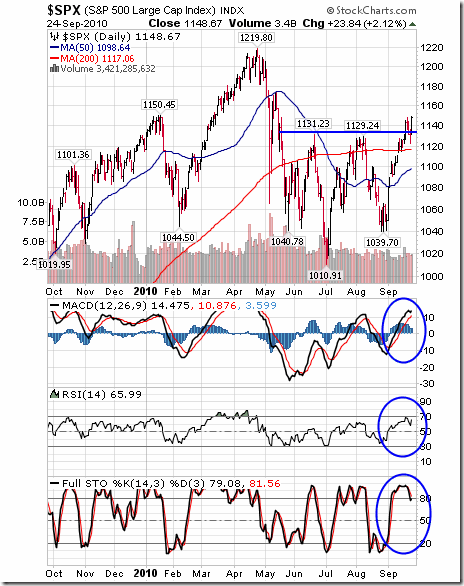
The S&P 500 Index gained 23.08 points (2.05%) last week. All of the gain occurred on Friday. The Index broke decisively above resistance at 1,131.23. Intermediate trend changed last week from down to up. New support is at 1,039.70. Next resistance is at 1,219.80. The Index remains above its 50 and 200 day moving averages. Despite strength on Friday, short term momentum indicators are overbought and showing early signs of peaking: RSI briefly touched 70% last week and closed at 65.99 on Friday. Stochastics closed below 80% on Friday. MACD continues to trend higher, but also appears to be stalling. Intermediate downside risk is to its 50 day moving average at 1,098.64.
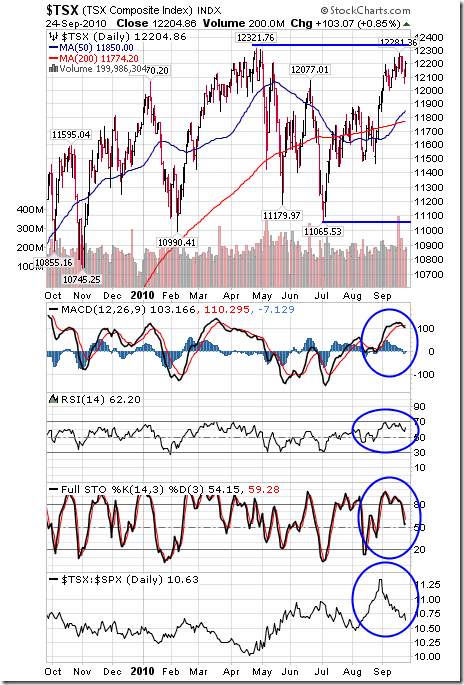
The TSX Composite Index added 40.03 points (0.33%) last week. More than all of the gain was recorded last Friday. Intermediate trend remains neutral. The Index trades above its 50 and 200 day moving averages. All of the short term momentum indictors recorded sell signals last week despite gains recorded on Friday. The Index tried but failed to break above intermediate resistance at 12,321.76. Strength relative to the S&P 500 Index has turned negative. Intermediate downside risk is to its 50 day moving average at 11,850.00.
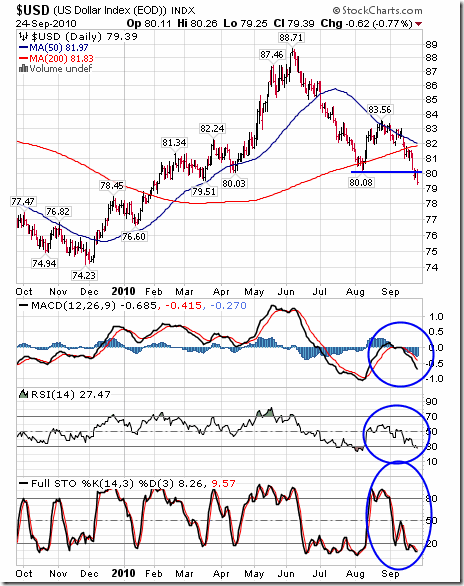
The U.S. Dollar Index plunged 2.04 (1.88%) last week with all of the decline occurring after news from the FOMC meeting on Tuesday implying possibility of a second monetary stimulus package (QE2). The Dollar broke support at 80.08. Some technical analysts are talking about completion of a head and shoulders pattern implying intermediate downside risk to 72.25. Other technical analyst note that the Dollar is about to complete a Death Cross (i.e. a move by its 50 day moving average below its 200 day moving average). Next support is at 76.60. Short term momentum indicators are oversold, but have yet to show signs of bottoming.
Gold gained another $24.10 U.S. per ounce (1.89%) last week to another all time high. Upside potential based on the previous trading range is to $1,384. Short term momentum indicators are overbought, but have yet to show signs of peaking.

Gold bullion has a history of moving higher in September, peaking early in October, bottoming in early November and moving higher until the end of December (October is the weakest month of the year for gold bullion).
Gold Futures (GC) Seasonal Chart

…..view the entire 45 Charts analysed and Don’s comments HERE
Don Vialoux has 37 years of experience in the Investment Industry. He is a past president of the Canadian Society of Technical Analysts (www.csta.org) and a former technical analyst at RBC Investments. Don earned his Chartered Market Technician (CMT) designation from the Market Technician Association in 1995. His CMT paper entitled “Seasonality in Canadian Equity Markets” was published in the Spring-Summer 1996 edition of the MTA Journal. Don also has extensive experience with Exchange Traded Funds (also know as Index Participation Units) as well as conservative option strategies. In 1990 he wrote a report that was released in the International Federation of Technical Analyst Journal entitled “Profiting from a Combination of Technical and Fundamental Analysis”. The report introduced ” The Eight Phases of the Stock Market Cycle”, an investment concept that continues to identify profitable entry and exit points for North American equity markets. He is currently a member of the Toronto Society of Fundamental Analyst’s Derivatives Committee. Now he is the author of a daily letter on equity markets available free on the internet. The reports can be accessed daily right here at www.dvtechtalk.com.
-
I know Mike is a very solid investor and respect his opinions very much. So if he says pay attention to this or that - I will.
~ Dale G.
-
I've started managing my own investments so view Michael's site as a one-stop shop from which to get information and perspectives.
~ Dave E.
-
Michael offers easy reading, honest, common sense information that anyone can use in a practical manner.
~ der_al.
-
A sane voice in a scrambled investment world.
~ Ed R.
Inside Edge Pro Contributors

Greg Weldon

Josef Schachter

Tyler Bollhorn

Ryan Irvine

Paul Beattie

Martin Straith

Patrick Ceresna

Mark Leibovit

James Thorne

Victor Adair