
Stocks & Equities
“What keeps us up at night? Well I can’t speak for the others, having spoken too much already to please PIMCO’s marketing specialists, but I will give you some thoughts about what keeps Mohamed and me up at night. Mohamed, the creator of the “New Normal” characterization of our post-Lehman global economy, now focuses on the possibility of a” T junction” investment future where markets approach a time-uncertain inflection point, and then head either bubbly right or bubble-popping left due to the negative aspects of fiscal and monetary policies in a highly levered world.”
 Ed Note: More key excerpts from Bill’s Newsletter: On the Wings of an Eagle
This year’s April taper talk by the Federal Reserve is perhaps a good example of this forward path of asset returns. Admittedly the reaction in the bond market was rather sudden and it precipitated not only the disillusioning of bond holders, but also an increase in redemptions in retail mutual fund space. But then the Fed recognized the negative aspects of “financial conditions,” postponed the taper, and interest rates came back down.Sort of a reverse “Sisyphus” moment – two steps upward, one step back as it applies to yields.
… investors are all playing the same dangerous game that depends on a near perpetual policy of cheap financing and artificially low interest rates in a desperate gamble to promote growth.The Fed, the BOJ (certainly), the ECB and the BOE are setting the example for global markets, basically telling investors that they have no alternative than to invest in riskier assets or to lever high quality assets. “You have no other choice,” their policies insinuate. “Get used to negative real interest rates, move out on the risk spectrum and in the process help heal the real economy,” they seem to command.
Stock investors, however, were only mildly discouraged and continued their faith-based, capital gain dependent investments despite what should be the obvious conclusion that QE and low interest rates were as critical to their market as they were to bonds. “What other choice do we have?” has become the mantra of stock investors globally, which speaks more to desperation than logical thinking.
… Deep in the bowels of central banks research staffs must lay the unmodelable fear that zero-bound interest rates supporting Dow 16,000 stock prices will slowly lose momentum after the real economy fails to reach orbit, even with zero-bound yields and QE.
For the full article continue reading On the Wings of an Eagle HERE

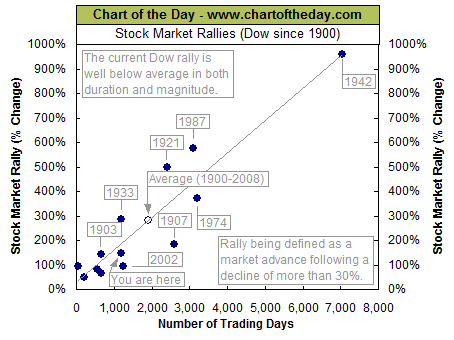
The Dow just made another all-time record high. To provide some further perspective to the current Dow rally, all major market rallies of the last 113 years are plotted on today’s chart. Each dot represents a major stock market rally as measured by the Dow with the majority of rallies referred to by a label which states the year in which the rally began. For today’s chart, a rally is being defined as an advance that follows a 30% decline (i.e. a major bear market). As today’s chart illustrates, the Dow has begun a major rally 13 times over the past 113 years which equates to an average of one rally every 8.7 years. It is also interesting to note that the duration and magnitude of each rally correlated fairly well with the linear regression line (gray upward sloping line). As it stands right now, the current Dow rally that began in March 2009 (blue dot labeled you are here) would be classified as well below average in both duration and magnitude. However, the magnitude of the current post-financial crisis rally has now reached median status — its magnitude is greater than six and less than six Dow rallies since 1900.
Quote of the Day
“An expert is someone who has succeeded in making decisions and judgments simpler through knowing what to pay attention to and what to ignore.” – Edward de Bono
Events of the Day
November 27, 2013 – Hanukkah (1st day)
November 28, 2013 – Thanksgiving Day
December 10, 2013 – Nobel Prizes awarded (announced in October)
Stocks of the Day
— Find out which stocks investors are focused on with the most active stocks today.
— Which stocks are making big money? Find out with the biggest stock gainers today.
— What are the largest companies? Find out with the largest companies by market cap.
— Which stocks are the biggest dividend payers? Find out with the highest dividend paying stocks.
— You can also quickly review the performance, dividend yield and market capitalization for each of the Dow Jones Industrial Average Companies as well as for each of the S&P 500 Companies.

Asian stocks swung between gains and losses as signs the U.S. economy is strengthening fueled speculation that the Federal Reserve will soon start tapering stimulus.
The MSCI Asia Pacific Index rose less than 0.1 percent to 141.78 as of 9:31 a.m. in Tokyo, after losing 0.1 percent. More than $8 trillion has been added to the value of global equities this year, the biggest increase since 2009, as central banks took steps to shore up economies worldwide. U.S. stocks fell yesterday as investors speculated on the impact retail and manufacturing data will have on Federal Reserve bond buying.
“Economic data over the past few weeks have been progressively coming in better and markets are now in the mood to put good economic news as bad news because that will bring forward any reduction in central bank support,” Matthew Sherwood, head of investment markets research at Perpetual Ltd., which manages about $25 billion, said by telephone. “There might be a little bit of downward pressure this month.”
Japan’s Topix index rose 0.2 percent. South Korea’s Kospi index dropped 0.4 percent. Australia’s S&P/ASX 200 Index lost 0.1 percent and New Zealand’s NZX 50 Index declined 0.7 percent. Markets in China and Hong Kong have yet to open.
The Reserve Bank of Australia is expected to keep its benchmark interest rate at a record-low 2.5 percent today, according to all 30 economists surveyed by Bloomberg News. A gauge of China’s non-manufacturing index is due today.
(Reuters) – Asia’s manufacturing-sector expansion held around multi-month highs in November, factory surveys showed, with China maintaining its momentum but growth in other key exporters such as Japan, South Korea and Taiwan picking up speed.
Activity in India expanded after three months of contraction as new orders grew for the first time since May, supporting government figures on Friday that suggested an economic slump may have bottomed out.
Purchasing managers’ indexes released on Monday showed the factory sector in Taiwan grew at its fastest pace in 20 months in November and at its fastest in six months in South Korea.
Japan’s PMI, released on Friday, showed manufacturing activity expanding at its quickest pace in more than seven years as new export orders reached their highest level in over three years.
The Asia data suggests the global economy is showing signs of a more solid recovery as 2013 draws to a close. PMI reports from the euro zone and the United States later on Monday are expected to show both regions maintained factory-sector growth in November.
The HSBC/Markit China PMI on Monday edged back to 50.8 in November from a seven-month high of 50.9 in October, although HSBC economist Qu Hongbin said the survey also pointed to spots of weakness.
“The renewed contraction of employment and the slower pace of restocking activities call for a continuation of accommodative policy,” he said.
However, China’s official PMI released at the weekend, which focuses more on bigger firms compared with smaller ones in the HSBC survey, held at 51.4 in November, unchanged from the 18-month high hit in October.
A reading of 50 separates contraction from expansion compared with a month earlier.
While the HSBC survey showed China’s new export orders growth dipped to a three-month low, the official reading showed the pace picking up.
Still, the combination of PMIs on China suggested resilience that augurs well for the country’s plans to gear the economy more towards domestic consumption and away from investment-led growth. Beijing has said it will accept lower economic growth to achieve the shift.
Japan’s strong reading showed domestic demand and exports are recovering strongly from a dip in the middle of the year, which means the economy could be building up enough momentum to weather an increase in the sales tax rate in April, which could dampen domestic consumption.
The Markit/JMMA Japan Manufacturing Purchasing Managers Index (PMI) rose to a seasonally adjusted 55.1 in November from 54.2 in October, its highest level since July 2006.
Prime Minister Shinzo Abe has overseen massive monetary and fiscal stimulus this year to revive the economy, which has now grown in the past four quarters.
The HSBC/Markit PMI of South Korea’s manufacturing sector rose to a seasonally adjusted 50.4 in November from 50.2 in October, marking the highest reading since May.
Taiwan’s PMI showed manufacturing activity expanding for a third straight month as the overall index, and sub-indexes for output and new orders hit their highest levels in 20 months.
(Additional reporting by Rahul Karunakar in Bangalore, Aileen Wang and Jonathan Standing in Beijing, Rieka Rahadiana in Jakarta, Faith Hung in Taipei and Yoo Choonsikin Seoul; Writing by Subhadip Sircar; Editing by Neil Fullick)
….what I would call a feast for the Fed in terms of the amount of data,” said Kristina Hooper, a U.S. investment strategist for Allianz Global Investors.
After the stock market’s strong gains in November, investors will focus next week on the government’s jobs report and early reads on holiday shopping.
The Labor Department’s report on November nonfarm payrolls will cap a data-heavy week on Friday. It’s the last such report before the Federal Reserve’s Dec. 17-18 policy-setting meeting. If the employment data are much stronger than expected, the Fed might decide at that meeting to scale back its $85 billion-a-month in bond buying that has boosted equities, according to Hooper.
“I would say it’s very unlikely, but this is our last big piece of data,” she told MarketWatch
Ed Note: To read more on the Data go to:
Jobs report headlines big data week ahead – Conflicting economic signals from ISM, jobs, GDP likely to sow more confusion.

-
I know Mike is a very solid investor and respect his opinions very much. So if he says pay attention to this or that - I will.
~ Dale G.
-
I've started managing my own investments so view Michael's site as a one-stop shop from which to get information and perspectives.
~ Dave E.
-
Michael offers easy reading, honest, common sense information that anyone can use in a practical manner.
~ der_al.
-
A sane voice in a scrambled investment world.
~ Ed R.
Inside Edge Pro Contributors

Greg Weldon

Josef Schachter

Tyler Bollhorn

Ryan Irvine

Paul Beattie

Martin Straith

Patrick Ceresna

Mark Leibovit

James Thorne

Victor Adair