
Stocks & Equities
Following a great 2013, many stocks likely disappointed investors in January. For those who follow the investing adage, “as January goes, so goes the year,” the U.S. stock market may not be looking so bright for the rest of 2014. But research suggests there are opportunities to be found.
“Negative Januarys do have interesting implications” for U.S. stocks, says Brian Belski of BMO Capital Markets. He recently dissected monthly S&P 500 Index performance, taking a look at the years when the market declines in January.
I think you’ll be surprised at his results.
Going back 24 years, the stocks that performed the best in January significantly lagged for the rest of the year compared to the stocks that did the worst. You can see in the chart that the companies in the bottom quartile for January performance rose a significant 20 percent from February through December. The stocks that did the best in January increased only an average of 12 percent during the rest of the calendar year.

Belski’s analysis aligns with the recent poor performance in sectors that we previously identified as having strength over the past several months. Of the 10 sectors in the S&P 500, our models have identified consumer discretionary, health care and industrials sectors as having sustained leadership.
But in January, industrials and discretionary stocks were among the worst-performing sectors. Energy and materials were also in the bottom half.

While past performance does not predict future results, BMO’s research suggests that many of these stocks in the lagging sectors could outperform for the rest of 2014.
Already in February, materials, consumer discretionary and energy stocks are up more than 4 percent.
The Holmes Macro Trends Fund (ACBGX) portfolio managers and I are especially bullish on domestic dividend-paying companies experiencing robust fundamentals, including strong revenue and earnings growth. We believe this focus has helped the fund outperform its benchmark, the S&P 1500 Composite Index, by more than 7 percent over the past year as of January 31.
Join us for our live webcast on March 5
During our webcast on the “5 Reasons the Naysayers are Wrong about the Markets,” Director of Research John Derrick and resources expert Brian Hicks will join me to share many more key strategies in following the smart money in the domestic market, gold, resources, emerging markets, and bonds.Click here to register today.

Ted Weschler explains why he likes a particular health-care stock. The Berkshire portfolio manager also lays out at the beginning of the video exactly how he came to choose this stock and what he expects it to do in the next 5 years. Weschler, hired in late 2011 after paying a total of $5.3 million in charity auctions for two meals with Buffett, has been accumulating shares of dialysis company DeVita HealthCare Partners since he came aboard – Money Talks
A stock pick from Warren Buffett’s stock picker
In a rare public appearance, Berkshire portfolio manager Ted Weschler explains why he likes a particular health-care stock.
Warren Buffett isn’t the only person at Berkshire Hathaway making decisions on stocks to buy and sell. In the last few years, he’s brought on two portfolio managers, Todd Combs and Ted Weschler.
Along with Tracy Britt Cool, his financial assistant, they are what he calls his “three Ts.” They generally keep a very low profile.
But Monday, for the first time ever, they joined their boss for a live appearance on CNBC’s “Squawk Box.” View the whole video in which he makes this recommendation HERE

THE WEEKLY VIEW


 Two days after publishing his annual letter to shareholders, Warren Buffett is on speaking on CNBC in an extremely rare appearance – Money Talks
“We were buying it on Friday, but it’s cheaper this morning and that’s good news.” Will he buy more? “Absolutely.” – Warren Buffett
Warren Buffett: Ukraine won’t stop my stock buying
Warren Buffett said he’s not at all discouraged that the stock market is under pressure due to the conflict in Ukraine.
In a live interview Monday on CNBC’s “Squawk Box,” Buffett said, “When I got up this morning, I actually looked at a stock on the computer (for) the trades in London (of a stock) that we’re buying, and it’s down and I felt good.” He would only acknowledge it is an “English” stock.
“We were buying it on Friday, but it’s cheaper this morning and that’s good news.” Will he buy more? “Absolutely.”
Buffett said that would be true even if he knew Ukraine would turn into a major conflict.
“You’re going to invest your money in something over time. The one thing you can be quite sure of is if we went into some kind of very major war, the value of money would go down. That’s happened in virtually every war I’m aware of. The last thing you’d want to do is hold money during a war. You might want to own a farm, you might want to own an apartment house, you might want to own securities. During World War II the stock market advanced.”
Buffett recalled that he bought his first stock in 1942, just after Pearl Harbor, when the macro situation didn’t look very good, either.
….whole interview HERE
Opportunities, Dangers & Risks that produce these Opportunities & Timing – This article contains Michael’s interview with Don Vialoux on Money Talks March 1st. Just below is Don’s Monday comment which is extensive, focusing on this weeks coming Economic Events, Stocks & Market Breakouts & Breakdowns and a Weekly Review of over 40 charts. One of the most thorough and valuable assembly of facts, opportunities & risks to avoid that you will find – Money Talks
U.S. equity markets have a history of moving higher during the first two weeks in March. The period is the second highest two week period in the year, second only to the Santa Claus rally period. March is the fourth strongest month in the year for the S&P 500 Index and third strongest month in the year for the TSX Composite during the past 62 years. Best performing sectors in the month during the past 22 periods are Energy, Consumer Discretionary and Financials. Weakest performing sectors are Health Care and Consumer Staples. Strongest sub-sectors are Retail and Chemicals. Weakest sub-sectors are Gold and Biotech.
Don Vialoux’s Interview with Michael Campbell March 1st 2014:
{mp3}mtmar114hourxyz{/mp3}


Selected seasonal trades continue to work (e.g. energy, oil services, gasoline, crude oil, base metals, grains, uranium, chemicals)
International events could influence equity markets. The Ukraine is a focus, but developments in Turkey, Venezuela and Argentina also are on the radar screen. China’s PMI reports are scheduled to be released over the weekend and on Monday. A wide variety of other China data is released and the People’s Bank of China is expected to make an important announcement in the middle of the week.
Economic news this week is expected to confirm that weather has slowed growth. The latest weather forecasts call for colder than average temperatures in North America for the next two weeks.
Earnings reports are not a significant influence on equity markets this week.
Short and intermediate technical indicators remain overbought.
The Bottom Line
Stick with favoured seasonal trades for now.
Much more HERE including 50 Charts & Commentary
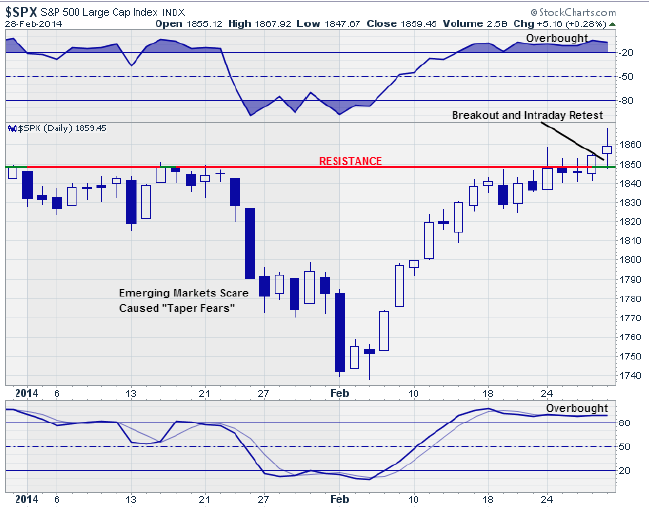
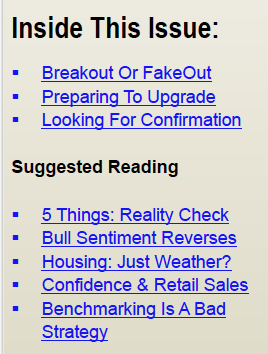 After a very brief respite in the forward momentum of the market, the market was finally able to break above overhead resistance on Friday. As I stated previously, such a breakout above resistance would confirm that the current “bull market” trend remains intact.
However, as I write that, it is also important to keep the current bull market in perspective. Valuations are stretched, economic data has been weak and the Federal Reserve is in the process of extracting liquidity from the markets. Contrary to what logic would suggest, the markets have rallied in recent weeks in the face of weaker economic data. However, in the markets today, “bad news” is welcomed as it will potentially keep the Fed passing out “dime bags” of “liquidity goodness” for a while longer. However, that sets the market up for disappointment if the Fed continues to “taper” their bond purchases on schedule to end the current QE program by October.
With the markets still on a valid short term “sell” signal I am not going to adjust the model back to full exposure as of yet. However, I am going to suggest beginning to slowly build equity exposure in portfolios in anticipation of a reversal of those “sell” signals.
Important note: There is a high degree of risk in doing this. Therefore, if you are more conservative and/or do not pay consistent attention to your portfolio, then I would suggest awaiting a confirmed reversal of the current sell signals.
As I will discuss below, this is not the first time that the market has broken out to “new highs” only to fail once again in a very short time frame. Such a reversal would entail a reversal of any “buys” made which is why I am suggesting that if you are NOT paying close attention to your portfolio – you may just want to be patient for a little while longer
“Prediction is very difficult, especially if it’s about the future” – Neils Bohr
This past week the market broke above resistance for the first time since the beginning of this year.
>> Download This Weeks 10 page Issue HERE

-
I know Mike is a very solid investor and respect his opinions very much. So if he says pay attention to this or that - I will.
~ Dale G.
-
I've started managing my own investments so view Michael's site as a one-stop shop from which to get information and perspectives.
~ Dave E.
-
Michael offers easy reading, honest, common sense information that anyone can use in a practical manner.
~ der_al.
-
A sane voice in a scrambled investment world.
~ Ed R.
Inside Edge Pro Contributors

Greg Weldon

Josef Schachter

Tyler Bollhorn

Ryan Irvine

Paul Beattie

Martin Straith

Patrick Ceresna

Mark Leibovit

James Thorne

Victor Adair