Stocks & Equities

Powerful Setups on 3 Stocks Just Beginning to Move

Tyler unearths 3 stocks that have not only sold off more than 50% from their previous highs, but have also built large bases & have just begun to move powerfully out of those bases. Buy signals that as Tyler explains below give an investor the opportunity to buy wholesale – Money Talks

 
Should I Already Be In?
 
Screen Shot 2014-03-02 at 9.03.22 AMIn this week’s issue:
  • Weekly Commentary

  • Strategy of the Week

  • Stocks That Meet The Featured Strategy


Screen Shot 2014-03-02 at 9.03.31 AMWEEKLY COMMENTARY

Stockscores Market Minutes Video
This week’s Market Minutes video is titled, how to get more bang for your buck. It focuses on earning a higher percentage return on your trades without taking more risk. Plus, the regular weekly market analysis,View the video by clicking here.

Upcoming Events
I will be on the Talk to the Experts radio show in Edmonton on Saturday March 8th at 11:00 MT (630 CHED).

Stockscores events planned for Calgary, Vancouver and Surry in April. More details next week but you can register now at this page.

Free refresher classes are being planned for April as well, anyone that has completed one of the Stockscores Trader Training courses in the past can attend. Register at this page. for those events as well. These are only open to past students who must register in advance to attend.

Should I Already Be In?
 
Good traders know that they need to buy the stocks that are going up. All strong stocks must start with strength, so following stocks that are making gains is a good way to find the winners of tomorrow.

There is, however, a fine line between buying the stock at the right time and getting in too late. Whether you are a long term trader or a very short term active trader, chasing a stock higher can lead to frustration as you get stopped out on the inevitable pull back.

Buying strength is best if you are doing it at the earliest stage of strength.

When analyzing a stock that you are considering for purchase, ask yourself a simple but essential question. “Should I already be in this stock?”

If you look at the chart and can see other recent buy signals that have resulted in moves higher, you have to question whether you are getting in to the stock with the most well informed investors or if you are buying with the general public. Are you buying wholesale, or retail?

Whether I am buying a stock to hold for months or taking a day trade to hold for a few hours, I want to be part of that wholesale group that is buying the stock just as it is starting to behave abnormally and make gains. The higher the stock rises, the farther it gets from support and the closer it gets to resistance. That means as the stock climbs, the potential reward for the risk of the trade falls.

I often see traders take entry signals that are valid if they take a very short term view of the chart. However, if they took a step back and looked at the bigger picture, they would see that the trend started some time ago and they are jumping on the bandwagon late.

This is why it is important to look at different time frames on the chart. If you do your analysis on daily charts, make sure you also look at the weekly chart. If you day trade off of the 2 minute chart, be sure to check the 15 or 30 minute chart to see if the strength you are following is the initial pop or if the trend is already well under way.

Doing this only takes seconds but the impact on performance can be massive. Just ask yourself the simple question, “Should I already be in this stock?”

STRATEGY OF THE WEEK

This week, I ran my scan to find the gainers for the week and then inspected their weekly charts to see which ones have breaks from predictive chart patterns on the three year weekly charts. I focused my scan on the Canadian market because that market has been producing some of the best candidates lately. Here are three stocks to consider:

STOCKS THAT MEET THAT FEATURED STRATEGY
 
1. T.CCO
A lot of the Uranium stocks were up this week, T.CCO is one of the larger and higher priced stocks in the group and it is breaking through long standing resistance at $24 this week. Rising bottoms in to the breakout tell us that investors are gaining optimism. Support at $23.25.
 
Screen Shot 2014-03-02 at 9.27.18 AM
 
 
2. T.VNP
$3 resistance has been unbroken for over a year but the market was willing to take the stock up and through that price level this week with strong volume support. Looks like a good turnaround chart
 
Screen Shot 2014-03-02 at 9.27.38 AM
 
3. T.BKX
T.BKX has been strong since the Fall of 2013 but has been trending sideways and building a base for the past 5 months. This week, the stock broke out of that sideways trading range and looks likely to continue its long term upward trend. Support at $1.60.
 
Screen Shot 2014-03-02 at 9.27.54 AM

References


Disclaimer
This is not an investment advisory, and should not be used to make investment decisions. Information in Stockscores Perspectives is often opinionated and should be considered for information purposes only. No stock exchange anywhere has approved or disapproved of the information contained herein. There is no express or implied solicitation to buy or sell securities. The writers and editors of Perspectives may have positions in the stocks discussed above and may trade in the stocks mentioned. Don’t consider buying or selling any stock without conducting your own due diligence.


Don Vialoux – Opportunities Created Yesterday

Opportunities, Dangers & Risks that produce these Opportunities & Timing – Michael interviews Don Vialoux on Money Talks March 1st. Below is Don’s Friday comment which is extensive, focusing on the Breakouts & Breakdowns Yesterday plus a Weekly Select Sector Review highlighting 40 charts.

{mp3}mtmar114hourxyz{/mp3}

Comments for Friday February 28th (pre-opening)

Index futures were virtually unchanged following release of revised U.S. annualized fourth quarter real GDP growth. Consensus was a decline to 2.5% from a previous estimate of 3.2%. Actual was a decline to 2.4%.

The Canadian Dollar was virtually unchanged following release of Canada’s fourth quarter GDP growth rate. Consensus was a gain of 2.5% from the third quarter. Actual was a gain of 2.9%. On the other hand, consensus for month-over-month GDP was a decline of 0.3%. Actual was a decline of 0.5%.

Gap Stores (GPS $43.16) is expected to open higher after Atlantic Equities upgraded the stock from Underweight to Neutral.

Catamaran (CCT Cdn$51.25) is expected to open lower after ISI Group downgraded the stock from Buy to Neutral.

Pan American Silver fell $0.14 to$14.05 after Deutsche Bank downgraded the stock from Buy to Hold. Target is $15.

Silver Standard (SSO Cdn$11.65) is expected to open lower after Deutsche Bank downgraded the stock from Hold to Sell. Target is $9.

EquityClock.com’s Daily Market Comment

Following is a link:

http://www.equityclock.com/2014/02/27/stock-market-outlook-for-february-28-2014/

Interesting Charts

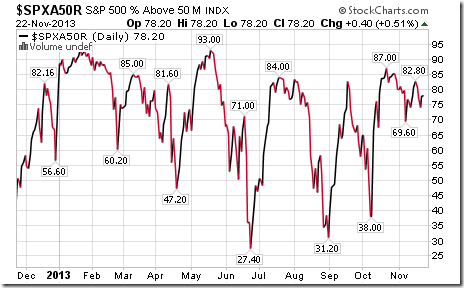
Finally, the S&P 500 Index managed to close at an all-time high.

clip image001 thumb11

Chinese equities continue to recover. Equity markets are starting to anticipate an important announcement on economic reform on March 5th.

clip image002 thumb14

Breakouts and Breakdowns Yesterday &

Weekly Select Sector Review

Quiet day yesterday ! Two S&P 500 stocks broke resistance: EMC Corp. and FMC Corp. FMC reached an all-time high.

One TSX 60 stock broke resistance: Commerce Bank to an all-time high and one TSX stock broke support: Catamaran.

…..read more HERE

“A Bull Market is Like Sex…….it Feels Best Just Before it Ends.” – Barton Biggs

So where do we go from here ? That’s the question that Eddy Elfenbein of Crossing Wall Street  attempts to answer his analysis below. He outlines why he thinks the Housing Market Holds the Key, and includes his  Buy List, which has an 8 year compounded gain of 124.76% vs the S&P 500’s 8 year compounded gain of 75.62%. Please note if you are interested in any of Eddy’s “Buy List Stocks” be sure to read his disclaimer before you do as it outlines the risks involved in purchasing any of the stocks on the list Money Talks
 
CWS Market Review – February 28, 2014

“A bull market is like sex. It feels best just before it ends.” – Barton Biggs

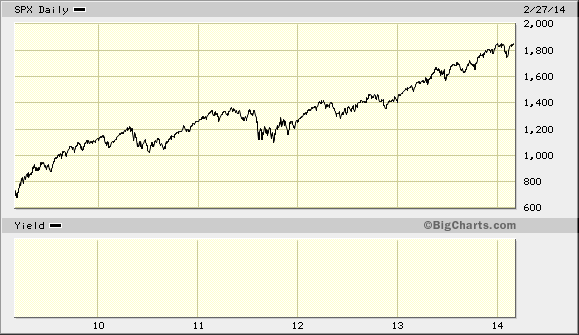
The fourth time’s a charm! For three days in a row, the S&P 500 rallied above 1,850 and was ready to make a new all-time record close, but each time, the bears arrived late in the day to pull us back down. On Thursday, it looked like it was going to happen for a fourth time, but this time, the bulls prevailed, and the S&P 500 closed at 1,854.29—a new record close.

We’re coming up on the fifth anniversary of a generational low for stocks. The climate back then was dreadful. On Friday, March 6, 2009, the Labor Department reported that the unemployment rate had hit a 25-year high and the economy had lost a staggering 651,000 non-farm payroll jobs the previous month. That morning, the S&P 500 touched an evil-sounding intra-day low of 666.79, which was the index’s lowest point in more than 12 years. The Dow was in even worse shape. Adjusted for inflation, the Dow was back to where it had been 43 years before.

The closing low came the following Monday, March 9, when the S&P 500 finished at 676.53. That was nine years to the day after the Nasdaq Composite first closed above 5,000. Now it was roughly one-quarter of that. The following day, Ben Bernanke told the Council on Foreign Relations that he thought we should review our mark-to-market accounting rules, and a few weeks later, the FASB agreed. That gave a huge boost to the rally. Five years on, the S&P 500 has gained 174%. Including dividends, it’s up 205%. In plainer terms, investors have tripled their money in five years. This is one of the greatest rallies in Wall Street history.

big02282014a

So where do we go from here? In this week’s CWS Market Review, we’ll take a look at the economy and how it could impact our portfolios. I’ll also highlight some good news from our Buy List. An entertaining battle of billionaires is helping our position at eBay. The stock just touched an all-time high. Also, Ross Stores just announced that it’s raising its dividend by 17%. This is the 20th year in a row that Ross has increased its payout. Not many stocks can make that claim. But before we get to that, let’s look at some recent economic news and what it means for us.

Why the Housing Market Holds the Key

On Thursday, new Federal Reserve chair Janet Yellen told Congress that it’s possible the Fed would hold off on its tapering plans if there were a “significant change” in the economic outlook. Frankly, that’s not really news; the Fed has consistently held this line. But this time, investors are taking it more seriously since the economic news has been less favorable. Eric Rosengren, the president of the Boston Fed, who incidentally was the only FOMC member in favor of cutting rates in September 2008, said the Fed should be “very patient” in cutting stimulus. Lousy weather has been a convenient scapegoat for poor numbers, but it’s pretty hard to separate out what’s been caused by the weather and what hasn’t.

On Thursday, the Commerce Department said that orders for durable goods fell 1% last month. But on closer inspection, there were bits of good news in this report. If you exclude transportation, which can be very volatile, durable-goods orders actually rose 1.1% last month. That was the biggest increase since May. Economists were expecting a decline of 0.3%.

On Wednesday, the Census Bureau said that new-home sales rose to a five-year high. The housing situation is critical in determining where the economy goes from here. Even though new-home sales are up, the current level is still near the low point of previous cycles. That tells you just how crazy the housing boom was. It created a massive, gigantic oversupply of homes. All those empty homes weren’t incinerated. Instead, it’s taken us this long to work off the inventory. Only now is housing inventory back to normal.

This is why I’m optimistic on housing. We’ve finally burned off that excessive inventory, and people are going to need more new homes. Normally, housing leads a recovery, and we didn’t get that this time. As a result, we got a sluggish recovery—and for many folks, there was no recovery at all. In fact, I think we could have very easily dropped back into a recession in 2011-12 if not for the assistance of the Federal Reserve. Budget-cutting from the government was a major drag on the economy. (Please note I’m not saying whether I approve of this or not, just that government austerity was a big factor.)

It’s true that mortgage rates have risen. The average rate for a 30-year fixed mortgage jumped from 3.35% last May to 4.33% now. While higher mortgage rates have crushed the refi market (Wells Fargo just announced more layoffs in their mortgage unit), they don’t appear to be holding back new buyers. The simple fact is that we’ll need more new homes. Despite the poor weather, the economy is slowly gaining steam. That’s why I strongly doubt we’ll see the Fed shelve its tapering plans this year.

Let me also touch on the consumer end of the economy. Retail stocks got off to a terrible start this year. That was reflected on our Buy List with bad performances from Ross Stores and Bed Bath & Beyond, but they weren’t alone. Nearly everyone from Walmart on down had a lousy quarter. The retail sector came back to life this week; even troubled retailers like J.C. Penney and Target saw big gains this week.

I suspect that the bad times for retailers have passed. The facts are clear. Consumers have paid down their debts. The great enemy of consumer spending, the price at the pump, is below its average of the last three years. Lastly, the labor market has improved, though at a very leisurely rate.

The Perils of Complacency

One of the concerns I have is the unintended consequences of the Federal Reserve’s policies. No matter how you feel about QE, and I do think it’s been a plus for stocks, massive bond buying distorts the market’s gauging of risk and reward. In short, the Fed has encouraged more risk-taking. That was understandable when everyone was terrified, but what about now?

I’ll give you an example of some possible distortions we’re seeing. Since February 3, the most-shorted stocks, meaning those with the most bets against them, have done the best. The hated stocks have doubled the return of the rest of the market. Tesla is a perfect example. Shorts make up an astounding 37% of their shares, yet the stock has skyrocketed. Shares of Tesla got to $265 this week; a year ago, they were at $35.

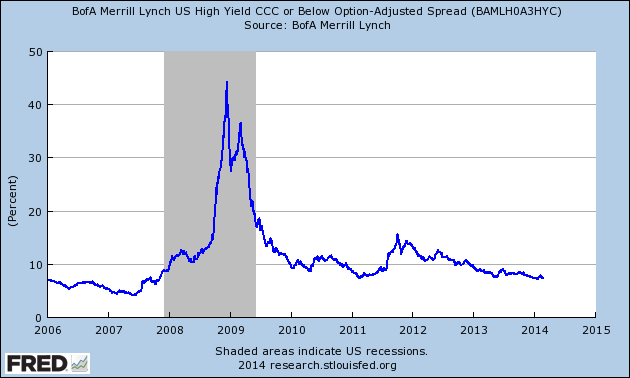
Another example is in the biotech sector. In the last ten weeks, the biotech index is up 25%, yet one-third of the companies don’t turn a profit. Facebook broke $71 per share this week, which is more than 90 times last year’s earnings. Some folks are claiming that the rash of big-ticket M&A deals is due to non-existent returns from sitting on cash. Also, everyone’s favorite alternative asset, gold, is having a good year so far (after a very rough 2013). Or we can look at the bond market. The yield spread between junk debt and Treasuries narrowed to its lowest level in six years (see below).

fredgraph02282014

These are all signals that investors are willing to shoulder more risk. On one hand, that’s a good thing. The danger comes when investors become complacent and feel they have little reason to worry. Consider that investors have become programmed to buy every dip. Since the bull market began five years ago, there have been 19 nervous breakdowns of 5% or more. Every single one was turned back.

The problem with risk is the things we don’t know we don’t know. Let’s look at what’s been happening in China’s economy. The growth of their “shadow banking” system has been alarming. No one truly knows its size. What if there’s a major default in China and that ignites a panic? What’s interesting is that growth from China has helped ease our pain from the Great Recession.

I don’t have a specific worry that I see looming on the horizon. Rather, it’s that I see investors becoming sloppy. I’m not so concerned about a large-scale bubble; I worry about small things like poorly thought-out acquisitions. (Peter Lynch has referred to this as the “Bladder Theory” of corporate finance.) The key for investors is not to be tempted by easy gains or to feel the need to chase stocks for fear of being left behind. Frustrated investors are bad investors. Now let’s look at a long-term strategy that works.

Our Buy List Is up for the Year

I’m happy to report that our Buy List is up slightly for the year, and we’re leading the market. Of course, it’s still very early, but through Thursday, our Buy List is up 0.45% this year, while the S&P 500 is up 0.32% (not including dividends). Bear in mind that only a few weeks ago, we were down nearly 6%. Our Buy List has beaten the S&P 500 for the last seven years in a row. Now let’s look at some recent news from our Buy List stocks.

Just after I sent you last week’s CWS Market ReviewExpress Scripts ($ESRX) had a rough day on the market. Shares of ESRX dropped 4% last Friday. This was despite reporting earnings that were in line with estimates, and they offered a good guidance for this year. I’m a little baffled by the market’s sour reaction, as there was little in this report that anyone should find surprising. The company said it’s aiming to return 50% of its cash flow to investors as dividends or buybacks. I still like Express Scripts and think it’s a good buy up to $83 per share.

Shares of eBay ($EBAY) had a good week, and we have our friend Carl Icahn to thank. The multi-gazillionaire released three open letters this week. In them, he’s reiterating his call for eBay to spin off their very lucrative PayPal business. The company has made it abundantly clear that they’re not interested.

The battle between Icahn and eBay’s board is getting ugly. Icahn doesn’t like the fact that Scott Cook and Marc Andreessen are on the board. Cook founded Intuit which competes against PayPal, and Andreessen’s company bought Skype from eBay and then sold it to Microsoft.

Pierre Omidyar, eBay’s chairman and founder, shot back and said that Icahn’s views are “false and misleading.” I love it when billionaires fight, especially when it helps our stock. Thanks to the high-profile kerfuffle, shares of eBay rallied above $59 on Thursday and took out the all-time high from 2004. Now Icahn has challenged eBay to a public debate, which sounds a bit nutty. The irony is that ever since Icahn went on the warpath, Omidyar has made $450 million from the eBay rally. My take: I think it’s clear that the board isn’t going to budge. Meanwhile, I’m raising my Buy Below on eBay to $62 per share.

This is actually a lull period for Buy List earnings reports. Our only earnings report for the next several weeks will be Oracle ($ORCL), which should report sometime in mid-March. I’m expecting another good report from them. Oracle tested our patience last year, but I think it’s starting to pay off. For Q3, Oracle sees earnings coming in between 68 and 72 cents per share. On Thursday, the shares broke above $39 for the first time since Bill Clinton was president. Oracle remains a very good buy up to $41 per share.

Ross Stores Announces Big Dividend Increase

After the closing bell on Thursday, Ross Stores ($ROST) reported Q4 earnings of $1.02 per share. This is for the crucial holiday shopping quarter. In November, the deep-discount retailer spooked Wall Street when it said that Q4 earnings would be below forecasts. The Street had been expecting $1.09 per share; Ross said to expect between 97 cents and $1.01 per share.

Overall, Ross is doing quite well. For the entire year, Ross earned $3.88 per share which was a nice increase over the $3.53 from 2012. The fiscal year for 2012 was 53 weeks which added 10 cents per share to that year’s earnings.

Michael Balmuth, Ross’s CEO, said, ”Our fourth-quarter sales performed in line with our guidance, with earnings that were slightly better than expected, primarily due to above-plan merchandise gross margin. Despite a very promotional retail environment throughout the holiday season, customers responded favorably to the compelling bargains we offered on a wide assortment of fresh and exciting name-brand fashions and gifts.”

Now for some guidance. For Q1, Ross sees earnings coming in between $1.11 and $1.15 per share. Wall Street had been expecting $1.20. For all of 2014, Ross sees a range of $4.05 to $4.21 per share. The Street was at $4.34 per share. That’s a disappointing forecast, and the shares were weak in the after-hours market.

But there is good news. Ross announced a 17.6% dividend increase. The quarterly payout will rise from 17 cents to 20 cents per share. This is Ross’s 20th year in a row of raising its dividend. At 80 cents per share for the full year, that works out to a yield of 1.1%. I’m raising my Buy Below on Ross to $76 per share.

That’s all for now. Next week, we get several important economic reports. On Monday, the ISM report comes out. Last month’s report was surprisingly weak, so it will be interesting to see if this was a temporary move or the start of a larger trend. The Fed’s Beige Book comes out on Wednesday, followed by the productivity report on Thursday. Then on Friday is the big jobs report for February. The last two jobs reports were noticeably subdued, and it appears that the weather excuse has outlived its welcome. Be sure to keep checking the blog for daily updates. I’ll have more market analysis for you in the next issue of CWS Market Review!

– Eddy

Posted by  on February 28th, 2014 at 7:47 am


The information in this blog post represents my own opinions and does not contain a recommendation for any particular security or investment. I or my affiliates may hold positions or other interests in securities mentioned in the Blog, please see my Disclaimer page for my full disclaimer.


Image
Named by CNN/Money as the best buy-and-hold blogger, Eddy Elfenbein is the editor of Crossing Wall Street. His free Buy List has beaten the S&P 500 for the last seven years in a row. This email was sent by Eddy Elfenbein through Crossing Wall Street.

The S&P 500 closed at its highest level ever today at 1854.


Drew Zimmerman

Investment & Commodities/Futures Advisor

604-664-2842 – Direct

604 664 2900 – Main

604 664 2666 – Fax

800 810 7022 – Toll Free

dzimmerman@pifinancial.com

Stocks to Buy Where “There’s Blood in the Streets….”

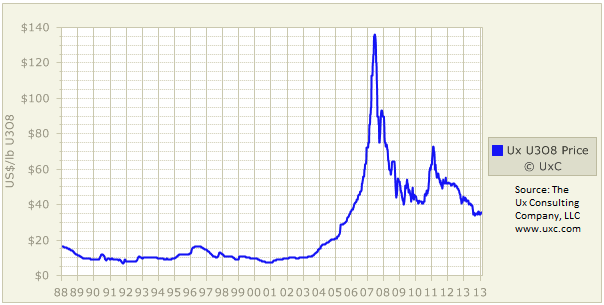
Uranium, Platinum & Gemstones. For example Uranium is down 70% from its 2007 highs, Japan and other countries bringing reactors back online as they find out nobody can afford the inefficiencies or cost of inefficiently generating energy with wind or solar, there are opportunities to buy sold out stocks in this arena. As Baron Rothchild observed, the time to “Buy When There’s Blood in the Streets….” and there is no doubt that a lot of selling has occurred in some of these markets. 

Paul Renken takes a look at 3 commodites markets below and lists out stocks that have suffered from selloffs in Uranium, Platinum Group Metals, and Gemstones. Keep an eye on each recommended stock and make sure it matches the risk levels you are able to take – Money Talks

P.S. A related article by someone who got in on Uranium stocks early has some trading advice where he is planning on selling specific shares into price strength or positive news  HERE 
Screen Shot 2014-02-24 at 7.57.49 AM

For 2014 Gains, Look to Uranium, PGMs and Gems
 

Paul Renken, senior geologist and analyst with VSA Capital, calls 2014 a soft year for gold and silver prices, but foresees stronger prices—and demand—for nickel, copper and tech metals as the year progresses. In this Mining Report interview, he lists the three commodities investors should feel good about and digs into the details of the Indonesian ban on exports of raw ore.

Screen Shot 2014-02-27 at 2.34.36 AMThe Mining Report: Paul, what three predictions for 2014 does VSA Capital have for mining investors?

Paul Renken: We believe three commodities offer the best opportunities for capital or investment gains in 2014. First, several factors indicate that the uranium space will revert to the positive side. The end of Russia’s Megatons to Megawatts program will take a significant amount of material out of the spot market. And while the Japanese reactors haven’t yet come back on-line—and indeed Japan has been leaking some yellowcake, now surplus to requirements, into the market—we expect at least two reactors will be allowed to restart in 2014. Japan’s balance-of-payments deficit is getting serious, due to the need to import liquid natural gas to make up its energy demand shortfall. All of this is favorable to uranium’s spot price, which should rise to the $40/pound ($40/lb) level.

Second, we’re bullish on the platinum group metals (PGMs). There is a significant amount of above-ground stocks, but labor issues remain volatile in South Africa. Last year, the country’s Mines Minister had conversations with the Russian government about creating what they called a cooperative agreement, but which the commercial markets would call a cartel, to gain more control over the price and availability of PGMs. Another piece of news in the PGM space is the difficulties Colossus Minerals Inc. (CSI:TSX; COLUF:OTCQX) is having obtaining financing on its project in Brazil. That was to be a significant gold and PGM producer outside of South Africa. Today, that project no longer appears to be reasonable or even probable, due to financial difficulties. Given the improved auto-manufacturing outlook in Europe, China and elsewhere, we think PGM prices will continue to firm through the year.

Third, we think that gemstones, specifically the diamond space, is a good place to be this year. The luxury market continues to show buoyancy. We appreciated the comments Gem Diamonds Ltd. (GEMD:LSE; GEMD:VIRTX; ZVW:FSE) issued last month on its production figures and sales. That company is in production in Lesotho and announced that its average selling price on the stones has improved by 43% since H1/13. That indicates a lot of interest in the retail space. Any company in position to produce gemstones—diamonds in particular—will do well this year.

TMR: Looking back on 2013, which predictions in the mining space did VSA get right?

PR: I have to start by admitting that many analysts, myself included, got many things wrong as far as equities were concerned, with the big downdraft in precious metals selling that began in April. But we did get a good many things right.

We correctly forecast the average of both thermal and metallurgical coal prices for 2013 in the relative range of $90-100/ton for thermal and in the $140/ton range for metallurgical coal.

We also were proved right in predicting that the copper equities, particularly the large copper producers, would underperform in relation to the copper price. The copper price came off from an average, but the copper equities sold off significantly more.

TMR: How would you describe the current state of the mining space?

PR: We do see significant pressures on gold and silver prices, with the selloff of exchange-traded fund products continuing into 2014. At the same time, there are concerns that the Federal Reserve’s tapering will be whittled back. That will have the effect of improving the U.S. dollar. Overall, until we get some clear sense of direction, we think it’s a mixed bag.

TMR: VSA Capital CEO Andrew Monk predicts that the FTSE will finish the year at 72.50. It’s currently around 65.50. What will account for that 11%?

PR: The general investor sentiment among European and North American institutional managers is that U.K. equity valuations overall are somewhat of a bargain. In addition, going into 2014, the U.K. economy appears to be the strongest among the major economies.

Those two factors are causing institutional investors to buy into U.K. equity. Of course, the biggest names in U.K. equity are in the FTSE, so that’s where we see the strength coming from.

TMR: In general, Western market strength leads to currency strength, which is typically a recipe for lower gold prices. What is VSA’s forecast for gold and silver prices in 2014?

PR: We are in the modestly bearish camp at this point. Our market view sees the gold price spending much of the year between $1,100–1,200/oz ($1,180/oz average for the year), with some strengthening going into Q4/14, when we expect signs of inflation to start appearing.

Because of industrial demand for silver, we expect the silver:gold ratio to improve over where it was in 2013. We expect the silver price to remain below $21/oz for much of the year. Toward the end of 2014, it too should move up on inflationary expectations.

TMR: A recent VSA research report said that Indonesia will no longer ship raw ore. This has limited the supply of nickel laterite ore available to Chinese steel smelters. Does this mean nickel prices are heading higher?

PR: We’re generally constructive on the nickel price, because of concerns raised by the Indonesian ban among nickel pig iron producers in China, who had steered their industry toward this high-grade laterite nickel ore from Indonesia. We think the nickel price will improve from here. By the same token, there is a lot of nickel metal in warehouse inventory and we would have to see those inventories come down before having sustained confidence in a higher price.

TMR: When is that likely to happen?

PR: There was evidence throughout 2013 of the Chinese stockpiling nickel laterite ore for use in the event of an Indonesian ban. We figure there’s a good four to eight months worth of high-grade nickel laterite ore in stockpiles in China. This gives the Chinese mills time to seek alternative supplies.

TMR: In your last Mining Report interview, you talked at length about Royal Nickel Corp. (RNX:TSX). What’s happening with Royal Nickel now?

PR: Royal Nickel is in the process of obtaining the final permits to gain its construction license. These permits are the kind of thing debt financiers and major capital investment institutions will be looking for to provide the capital to build the mine and mill itself.

Certainly the improvement in the outlook for nickel helps a firm like Royal Nickel. Its deposit is generally low-grade, but it is very, very big. It offers a secure supply, not for just a few years but for a few decades. And it’s located in Québec, a world-class mining jurisdiction in terms of government and infrastructure support. All of that will help Royal Nickel’s case as far as getting financed and starting construction.

Explorers are not finding nickel deposits that are easy to mine. It’s a question of finding the companies that will become the most reliable suppliers. You have to believe that Royal Nickel can deliver a reliable supply of nickel for a really extended period of time to buy into it.

TMR: Do you follow other nickel equities?

PR: We follow quite a number of them, because we are curious to see if they are able to produce what they say they will produce, according to the timeline they claim.

For example, Horizonte Minerals Plc (HZM:LSE; HZM:TSX) has a nickel laterite deposit in Brazil. It’s in an area that is already producing nickel from other laterites. The company is coming along through the process. Teck Resources Ltd. (TCK:TSX; TCK:NYSE) is a significant shareholder in Horizonte, which indicates Teck’s confidence that this particular deposit will eventually be mined.

We also follow Talvivaara Mining Company Plc. (TALV:LSE), also London listed, based in Scandinavia. It has been trying to produce nickel from very low-grade material by bioleaching. The company has been struggling to get up to capacity. We are skeptical that the company will be able to make it work commercially.

Among the big players there is Norilsk Nickel (GMKN:RTS; NILSY:NASDAQ; MNOD:LSE), the big Russian supplier of nickel and PGMs. That’s the elephant in the room as far as worldwide supplies are concerned.

There are a number of ASX (Australian Securities Exchange) juniors as well, such as Western Areas Ltd. (WSA:TSE; FX9:FRA; WSA:ASX; WNARF: OTCMKTS;), which has mined high-grade sulfide material. That company has consistently made profits year after year.

TMR: VSA adjusted its 2014 copper price up to $3.67/lb to account for improved annual Chinese GDP (gross domestic product) growth expectations. Which companies have exposure to high copper prices?

PR: Freeport-McMoRan Copper & Gold Inc. (FCX:NYSE) has to be one of the companies that people want to keep an eye on. It will be most affected by the Indonesian ban, because the ban includes copper concentrates.

If Freeport-McMoRan complies with the ban, it would have to cut back production at its Grasberg mine by about two-thirds, producing only as much concentrate as the existing smelters inside Indonesia can handle.

Freeport-McMoRan got a temporary exclusion to allow exports through 2017. If it is not allowed to export the rest after 2017, it will be a significant impairment for both the asset and the firm’s ability to make sizeable money. The Grasberg deposit is one of the 10 largest in the world and it happens to have the biggest gold endowment of any single deposit in the world as well.

Other producers that have significant exposure to copper or to a better copper price would be firms likeFirst Quantum Minerals Ltd. (FM:TSX; FQM:LSE)Taseko Mines Ltd. (TKO:TSX; TGB:NYSE.MKT)Grupo México (GMEXICOB:MXN) and Southern Peru Copper Corp. (SCCO:NYSE). All of those should be able to benefit from a reasonably buoyant copper price.

TMR: VSA has reported growing demand for niobium, tantalum, indium and lithium, all of which are used in products like tablets and smart phones. What are your theses for those metals?

PR: Niobium and tantalum are produced from minerals called colombite and tantalite—combined by the industry into the word “coltan.” They are used in the battery packs of every portable communication device we have: cell phones, laptops, tablets. Granted, the amount used in each battery is small, but millions of these devices are being produced, making this a significant market.

Niobium and tantalum producers are in places like Australia, Brazil and Canada. The minerals have a high specific gravity, and thus can be easily concentrated with very nominal or artisanal mining methods. As a result, a lot of this material moves in the shadow world of individually traded barrels, often from countries that have had difficulties with social and civil strife. That’s one of the specific reasons why the United States passed a conflict-free mineral law targeting the Democratic Republic of the Congo and neighboring states. The objective of the law is to get control of the trade or provenance of this coltan so consumers are not indirectly financing civil wars.

TMR: Are there any equities in the tantalum and niobium space?

PR: There are. Among producers, Lynas Corp. (LYC:ASX) and Molycorp Inc. (MCP:NYSE) stand out for the rare earth elements that they produce, as well as niobium and tantalum. The Niobec division ofIAMGOLD Corp. (IMG:TSX; IAG:NYSE) has been consistently profitable for quite some years now because of its mine in Canada.

TMR: Do you want to talk about another of those metals you named?

PR: Indium is what makes touch screens work. There’s a little coating of indium on the back of the quartz or a zircon screen you look at on your tablet or cell phone. The indium picks up a little signal of electricity when you touch the screen.

Lithium is all about the coming electrification of the transportation industry, specifically lithium-ion batteries. Within the lithium space are companies like FMC Lithium Corp. (FMC:NYSE) and a significant Latin American producer, Sociedad Química y Minera de Chile S.A. (SQM:NYSE; SQM-B:SSX; SQM-A:SSX). Both are in a good position to capitalize on lithium’s growth.

TMR: Do you have any parting thoughts for us?

PR: Don’t give up on the mining industry. A lot of people did tax-loss selling for 2013 because of the significant losses they had in equities. I agree with Rick Rule: If you’ve hung in there this long, then why not hang on long enough to participate when these materials rally in 2014 and 2015?

Timing is the particular issue. The rally will happen when we start seeing inflation numbers and rising interest rates around the world. We’re not there yet.

TMR: Paul, thank you for your time and your insights.

Paul Renken has a broad range of experience in various aspects of the mining and minerals business. He began his career as a geologist for Canadian junior resource companies in the Western United States. Owning a stake in a private consulting firm as vice president of exploration, Renken searched for various base metals, precious metals and industrial minerals. In the U.K., he worked in the equity market media outlets of Digitallook and Hemscott before joining VSA as mining analyst in 2006.

Read what other experts are saying about:


Want to read more Mining Report interviews like this? Sign up for our free e-newsletter, and you’ll learn when new articles have been published. To see a list of recent interviews with industry analysts and commentators, visit our Streetwise Interviews page.

Related Articles


DISCLOSURE: 
1) Brian Sylvester conducted this interview for The Mining Report and provides services to The Mining Report as an employee or as an independent contractor. He or his family own shares of the following companies mentioned in this interview: None.
2) The following companies mentioned in the interview are sponsors of The Mining Report: Royal Nickel Corp. Streetwise Reports does not accept stock in exchange for its services or as sponsorship payment.
3) Paul Renken: I or my family own shares of the following companies mentioned in this interview: None. I personally am or my family is paid by the following companies mentioned in this interview: None. My company has a financial relationship with the following companies mentioned in this interview: Royal Nickel Corp. I was not paid by Streetwise Reports for participating in this interview. Comments and opinions expressed are my own comments and opinions. I had the opportunity to review the interview for accuracy as of the date of the interview and am responsible for the content of the interview. 
4) Interviews are edited for clarity. Streetwise Reports does not make editorial comments or change experts’ statements without their consent. 
5) The interview does not constitute investment advice. Each reader is encouraged to consult with his or her individual financial professional and any action a reader takes as a result of information presented here is his or her own responsibility. By opening this page, each reader accepts and agrees to Streetwise Reports’ terms of use and full legal disclaimer
6) From time to time, Streetwise Reports LLC and its directors, officers, employees or members of their families, as well as persons interviewed for articles and interviews on the site, may have a long or short position in securities mentioned and may make purchases and/or sales of those securities in the open market or otherwise.


test-php-789