
Bonds & Interest Rates
 Ben Bernanke is running “the most inappropriate monetary policy in history” relative to the state of the market warns Stanley Druckenmiller.

 The Fed is freaking out…
- We’ve got another bubble on our hands.
- And this time they’re tapped out.
- More!
Having pumped the system with liquidity non-stop since the Crash of 2008, the Fed now realizes it’s in big trouble and needs to manage down expectations of further stimulus.
As we noted earlier this year, the Fed, while attempting to appear committed to endless money printing via its QE 3 and QE 4 programs, was in fact decidedly split on whether to commit to more as well as the risks inherent to additional QE. Indeed, the Fed FOMC minutes indicate that some Fed members were concerned about whether QE even worked as a monetary policy.
Below are the notes from the Fed’s December 2012 FOMC minutes (the meeting during which the Fed announced QE 4). I’ve added highlights to emphasize the shift in tone.
With regard to the possible costs and risks of purchases, a number of participants expressed the concern that additional purchases could complicate the Committee’s efforts to eventually withdraw monetary policy accommodation, for example, by potentially causing inflation expectations to rise or by impairing the future implementation of monetary policy.
Participants also discussed the implications of continued asset purchases for the size of the Federal Reserve’s balance sheet. Depending on the path for the balance sheet and interest rates, the Federal Reserve’s net income and its remittances to the Treasury could be significantly affected during the period of policy normalization.
Participants noted that the Committee would need to continue to assess whether large purchases were having adverse effects on market functioning and financial stability. They expressed a range of views on the appropriate pace of purchases, both now and as the outlook evolved. It was agreed that both the efficacy and the costs would need to be carefully monitored and taken into account in determining the size, pace, and composition of asset purchases.
http://www.federalreserve.gov/monetarypolicy/fomcminutes20121212.htm
There are three key implications here:
1) The Fed acknowledged that QE causes inflation expectations to rise(red text)
2) The Fed was divided on the efficacy of QE (green text)
3) The Fed was not committed to employing QE forever despite its public declarations to that effect (blue text)
This shift in tone went largely unnoticed by the media. However, the implications are very serious. By way of explanation, let’s quickly review the Fed’s primary moves in the post-Crisis era.
In 2008 the Fed had its back against the wall in terms of saving the system. Since that time every new Fed intervention (verbal or monetary) has been aimed at propping up the Too Big To Fail Banks and pushing the stock market higher.
The first wave of this came via QE 1 and QE 2 in which the Fed collectively monetized nearly $2 trillion in assets. However, once QE 2 ended in 2011, we noted the Fed began to realize that it could get the “positive” effects of additional stimulus (higher asset prices) without actually having to engage in more stimulus, simply by issuing verbal interventions at critical moments.
Thus, between QE 2’s end (June 2011) and the start of QE 3 (September 2012), the Fed became increasingly reliant on verbal intervention as opposed to actual money printing.
During this period, any time the markets began to dip, a Fed official, usually an uber-Dove such as NY Fed President Bill Dudley or Chicago Fed President Charles Evans, would indicate that the Fed was ready to act aggressively if need be and VOOM the markets would take off again.
This changed in May 2012, when the entire financial system began to implode courtesy of Spain (see our issue The “C” Word for an explanation of this). At that time the Fed switched back into aggressive monetary policy mode, first promising to provide more QE before launching QE 3 in September 2012 and then QE 4 in December 2012.
Unlike previous QE programs, which had definitive timelines, QE 3 and QE 4 were open-ended, meaning that they can continue forever. This was the Great Global Rig we referred to earlier this year. And while it did push the stock market higher, it did next to nothing for the US economy.
Which brings us to today. The US economy is contracting sharply again (without the massaged data inflation, real GDP growth would have been -1% last quarter) right as stocks close in on new all-time highs (the S&P 500 and Dow) or have already broken to new highs (the Russell 2000).
This is happening at a time when earnings are falling (despite companies booking profits), the economy is slowing, and stocks are closing in on all-time highs.
In plain terms, the stock market has become totally detached from economic realities. There is a term for when asset prices become detached from fundamentals, it’s called “A BUBBLE.”
THIS is the reason the Fed is beginning to shift its tone. It realizes it has blown another bubble and that we’re likely headed for another Crash. And this time around the Fed will be totally out of ammo to stop it. Unlike 2008 which was just a warm-up, this will be the REAL CRISIS featuring full-scale systemic failure.
So if you have not already taken steps to prepare for systemic failure, you NEED to do so NOW. We’re literally at most a few months, and very likely just a few weeks from the economy taking a massive downturn, potentially taking down the financial system with them. Think I’m joking? The Fed is pumping hundreds of BILLIONS of dollars into financial system right nowtrying to stop this from happening.
Ed Note: The author of this article is Private Wealth Advisory which asserts that it made the following gains listed below and that you can join this service… RISK FREE… for 30 days!
In 2011, the S&P 500 closed the year with a stagnant 0% return. But we did much better, closing the year with a solid 9% gain.
In 2008, the S&P 500 handed investors a devastating 36% loss. While we banked a 7% gain– crushing the index by a whopping 43%.
2011 to July of 2012 , we recorded 74 consecutive winning trades and ZERO losers producing an incredible 34% return.


If Precious Metal Stocks are going to bottom in this important area, or fall through, every Trader/Investor is going to need some great vehicles to take advantage.
At this critical time, when Money Talks is holding the Emergency Gold Summit, Greg Weldon was kind enough to offer all Money Talks readers/listeners/subscribers the thursday copy of of his TrendTRAKR. TrendTRAKR is a Simple Solution to locating those investments whether they be long or short.
For those who attended The Emergency Gold Summit or bought the Video you will likely be in the position to want to exploit Greg’s service now. So here they are in Excell Format. Links to the tutorials can be found on the first page of each workbook:
1. All the 200+ Metal & Energy Equities Trending and marked bullish or bearish can be found HERE. Be certain to click on the 3rd folder in the left hand column titled “Metal & Energy StocksTRAKR” to view the list.
2. All the TSX60 Trending can be found HERE. To find the entire list of bullish/ bearish, strengthening/weakening, and or no significant trend be certain to click on the 3rd folder in the left hand column titled “TrendTRAKR”
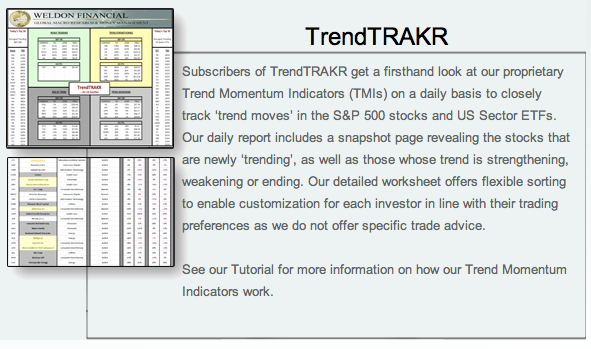
For a FREE TRIAL of Weldon’s TrendTRAKR go HERE. Others may wish to subscribe straightaway HERE is the pricing information.
In the conference last thursday night Martin Armstrong’s perspective fascinated many as you can tell from this email sent to Martin:
Thank you. Your insight into how everything is connected has saved me a fortune. I cannot tell you how many people showed up tonight simply to hear you. As the moderator said, you have the best track record of anyone. Your insight into the world is amazing. I understand what you said tonight as so many were talking about your speech walking out. It will be the markets that force political change. You have thousands of followers here in Vancouver. You should know that.
Thanks for everything you are doing.
R…S,,,
Martin Armstrong’s Answer to R…S,,,
Thank you. It is nice to see the understanding of the world economy is growing. I believe to create political change that will preserve our liberty, it requires the public to grasp the world is all connected. If we can accomplish that, we have a chance at leaving our children and their’s a better life rather than a dismal one. I have been speaking in Vancouver for 30 years. It has always been one of my favorite spots in North America.
Ed Note: To order the entire Video Presentation of the Emergency Gold Summit including Martin Armstrong’s presentation click on the image below or HERE


DOW +9 on 350 net decline
NASDAQ COMP – 1 on 100 net advances
SHORT TERM TREND Bearish (change)
INTERMEDIATE TERM TREND Bullish
SHORT TERM TREND Bearish (change)
INTERMEDIATE TERM TREND Bullish
DOW +9 on 350 net declines
NASDAQ COMP – 1 on 100 net advances
STOCKS: The stock market seems to be increasingly of the opinion that the Fed is going to taper off with its money printing. At least that’s the opinion of the media talking heads over the past few days.
I don’t see it that way. Bernanke has already said that he is going to continue debasing the currency as long as the unemployment rate remains above 6.5%. I think what we may be getting is simply profit taking on a market that has had a solid run.
GOLD: Gold was down $9, but it’s making a pattern of rising tops and rising bottoms which is a positive.
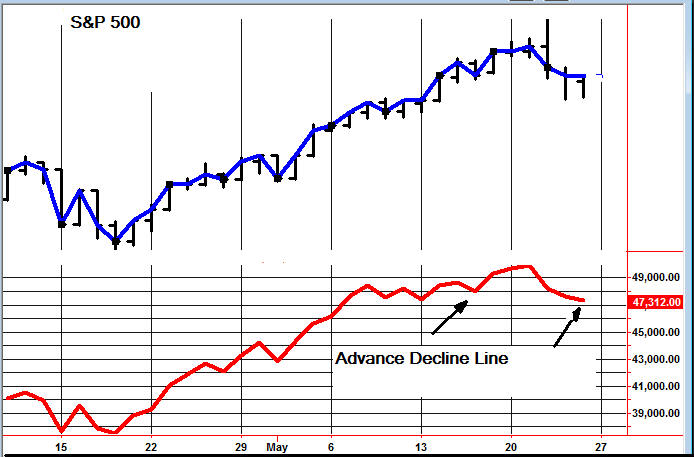
CHART: The S&P 500 has been much lower in the early going, but buyers have continued to come in. However, this time they haven’t been able to push it into positive territory by the close. Also, the advance decline line is now making a clear break of the previous low (arrows). This puts us into the short term bearish camp.
RANKED # 1 BY TIMER DIGEST
Timer Digest of Greenwich, CT monitors and ranks over 100 of the nation’s best known stock market advisory services.
Once per year in January, Timer Digest publishes the rankings of all services monitored for multiple time frames.
For the years 2003, 2004 and 2005, The Todd Market Forecast was rated # 1 for the preceding ten years. For the year 2006, we slipped to # 3 and in 2007, we were ranked # 5.
Our bond timing was rated # 1 for the years 1997, 2007 and 2008.
Gold timing was rated # 1 for 1997 and # 2 for 2006. Late word! We were rated # 1 for 2011.
We were # 1 in long term stock market timing for the years 1998 and 2004 and # 4 in 2010.
To subscribe go to Contact Us.
 U.S. stock indices ended down for the week as concerns over Chinese manufacturing data and a possible end to QE3 startled investors. The S&P500, which is up over 15% since the start of the year, posted its first weekly loss since mid-April. China’s manufacturing PMI fell to 49.6 from 50.4 in April, missing the consensus estimate of 50.5. Officials in China blamed the lower consensus numbers on weak global demand and declining domestic consumption. The poor performance from the world’s second largest economy continues to weigh on commodities and commodity investors as China has been a leading force behind strong energy and metals demand over the past decade. The effects of the weak data from China were felt abruptly in Asia, and particularity in Japan, where the Nikkei index which fell 7.3% on Thursday, its largest one day decline in 2 years.
Also weighing on investor’s minds were recent comments from the U.S. Federal Reserve Chairman, Ben Bernanke, who told congressmen this week that the American economy had improved relative to a year ago. One would expect that a long awaited recovery in the U.S. economy would be a boost to capital markets but many investors feel that the Federal Reserve may look to end their aggressive monetary stimulus, otherwise known as QE3, in the wake of better economic performance. We would strongly disagree with proponents of the idea that Bernanke would want pull his foot off the monetary stimulus pedal so quickly after only modest signs of improvement in the U.S. economy. It appears to be the U.S. government’s plan to continue to encourage a stronger export market in order to drive more jobs back into the American manufacturing engine. A quick end to monetary stimulus would mean a rather quick increase in long-term interest rates and in the U.S. dollar exchange rate which would put the brakes on U.S. export growth.
In spite of the jitters felt throughout the rest of the world, Toronto’s main index held firm trading roughly flat and ending the week at 12,667 points. Canada’s resource sectors remain largely under pressure with stocks in mining and oil & gas continuing to languish. Although overall the TSX index continues to produce lackluster returns and TSX Venture is outright bankrupting investors, KeyStone has continued to discover and recommend individual stocks which are producing outstanding investment returns in a challenging market. Lots more HERE & Below
KeyStone’s Latest Reports Section
In March, KeyStone recommended a profitable small-cap company that is benefiting substantially from the resource development taking place in Northern British Columbia and with no direct exposure to commodity prices. This stock has already generated our clients a return of almost 50% in only 2 months and we just reiterated our BUY recommendation this week after they released outstanding Q1 financial results. Not only does this stock trade at around 4 times earnings, but it remains well positioned to continue to benefit and grow from the resource and infrastructure development expected to occur in Northern BC over the next 5 years.
To find out more about this exciting company and several others, go to our website (www.keystocks.com) and become a client of KeyStone’s small-cap and dividend growth stock research.


-
I know Mike is a very solid investor and respect his opinions very much. So if he says pay attention to this or that - I will.
~ Dale G.
-
I've started managing my own investments so view Michael's site as a one-stop shop from which to get information and perspectives.
~ Dave E.
-
Michael offers easy reading, honest, common sense information that anyone can use in a practical manner.
~ der_al.
-
A sane voice in a scrambled investment world.
~ Ed R.
Inside Edge Pro Contributors

Greg Weldon

Josef Schachter

Tyler Bollhorn

Ryan Irvine

Paul Beattie

Martin Straith

Patrick Ceresna

Mark Leibovit

James Thorne

Victor Adair