
Currency

U.S. economic, military and foreign policy blunders make China’s global dominance appear entirely realistic, and for many observers inevitable.
Last week the Nicaraguan congress approved a $40 billion project for a Chinese company to build an Isthmian canal parallel to Panama’s. For those of us prone to peering anxiously into the future, this gave a disquieting advance picture of the new world of Chinese hegemony into which we are probably entering, whether we like it or not. As President Reagan famously remarked, Nicaragua is only two days’ drive from Harlingen, Texas. And presumably we can rely on China to cut that down a bit by improving the road!
Historically we must remember that the natural position of China is hegemony, though for several hundred years it only achieved that position by being deliberately geographically obtuse. Nevertheless, like ancient Egypt, for all but about 200 years of her history China has been militarily dominant over all powers it felt it had to deal with.
We should also remember that the high point of Chinese civilization was not the early Ming period of exploration by Admiral Zheng He under the Yongle emperor, but the apogee of the Song dynasty some three centuries earlier.
…..read more HERE

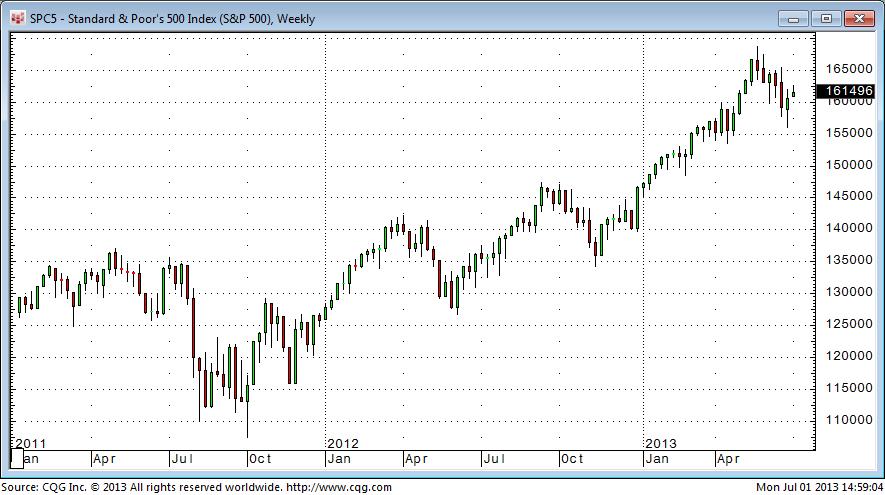
The stock market made a low early last week and then rallied on the idea that Market Psychology had “over-reacted” to Bernanke’s June 19 message. Stocks, Bonds and Crude Oil all had a similar trading pattern from Wednesday June 19 through Friday June 28. The S+P, which had fallen nearly 8% from the May 22 All Time Highs to the June 24 lows, bounced back ~3% by last Friday’s close. My trading theme has been that Market Psychology across asset classes registered a Major Key Turn Date on May 22…so, has the sell-off from the May 22 highs just been a correction in the bull market that started in March 2009…or is there more to go on the downside? Well, that depends on your time frame…and two key chart levels…see the Charts section below.

“Sentiment against gold is so bearish that I thought gold could have struck a capitulation low last week.” – Comment extracted from the writing below by the legendary 89 year old Richard Russell. Russell has been writing about markets for 60 years. He has lived through depressions and booms, through good times and bad, through war and peace. He was educated at Rutgers and received his BA at NYU. Russell flew as a combat bombardier on B-25 Mitchell Bombers with the 12th Air Force during World War II.and is widely known as the Godfather of Newsletter writers. Since the advent of the internet he has written daily and delivers his subscribers an extraordinary value for the market experience that they get and the pittance that he charges (for Trial see below). Russell’s stunning comment below:
“Friday ended with a late sell-off in the Dow, and some fireworks in the gold area. The real gold action was in the mining shares, which, because they are highly leveraged, tend to lead the actual price of gold bullion.
It’s notable that nobody talks or writes any more about the price movement in the market. 99% of everything written about the market has to do with the news and how it might affect the market. As a result, I feel all alone in writing about the action of the stock averages, and its implications.
For instance, I’ve described the “box” or the trading range that we now find the Dow in. What are the implications of a Dow break out above or below the trading range? In the meantime, what are the Transports and the A-D line doing? I search Barron’s for a column or even a paragraph on the price action but not a word. It’s all endless conjectures regarding what the Fed may or may not do.
When I first started Dow Theory Letters in 1958, technical analysis was unknown, and most market people called technical analysis “voodoo.” I feel as though I’m back in 1958 again.
………………………………….
Next, I want to talk about another forbidden and hated subject — gold and gold miners (my, how gold is despised these days).
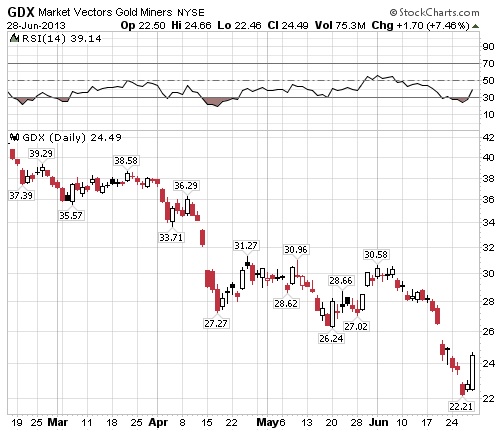
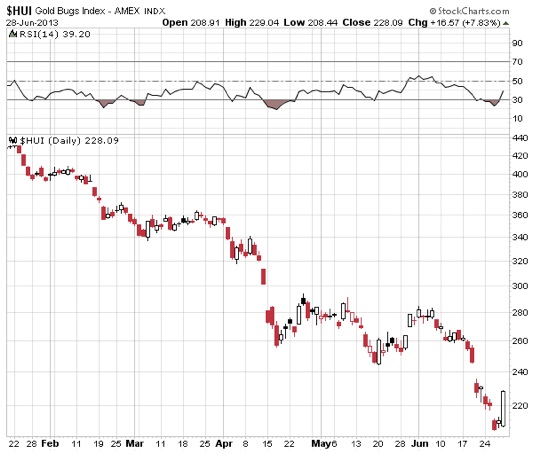
I am going to show charts of some representative gold miners, and you’ll notice that RSI (relative strength) is, or was, in almost all cases below 30 which puts them in the oversold area. And note the bullish action of last Friday, which almost nobody has commented on.

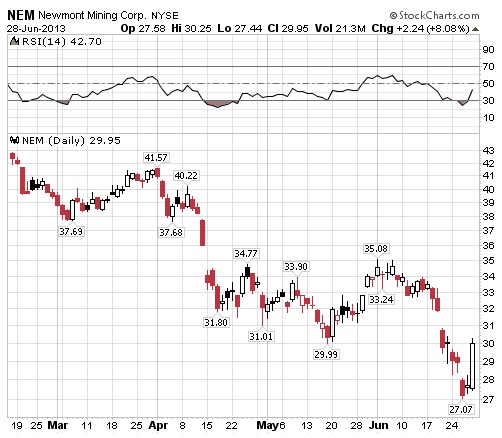
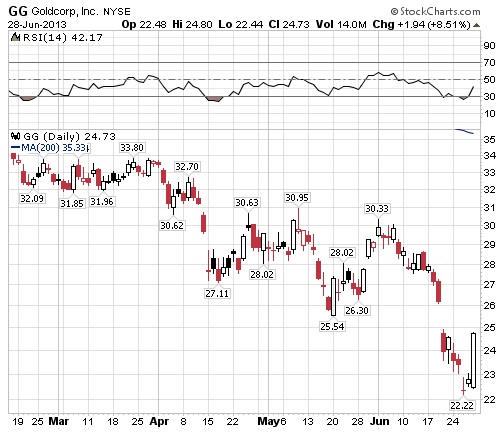
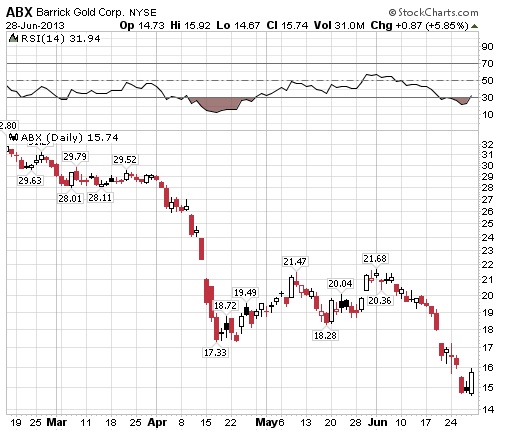
Below, the ARCA “gold bugs” Index
The AMEX gold miners index
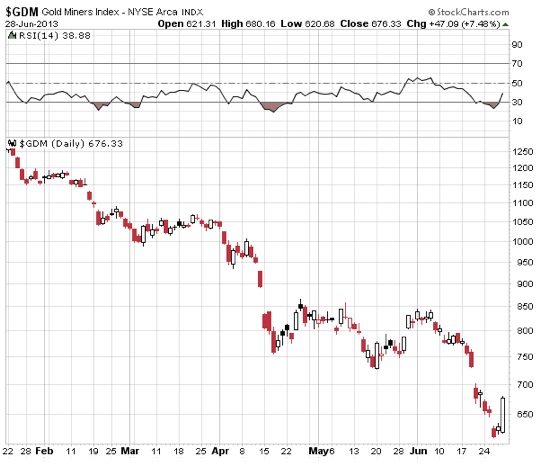
What’s significant is that all these gold items saw RSI in the oversold (below 30) area, and all surged higher on Friday. Also, anti-precious metals sentiment was so black-bearish last week that I thought, along with RSI below 30, that we might, at last, have struck a true bottom in the precious metals. Of course, it’s always possible that after Friday’s explosion, the gold miners may back off this week and test last week’s lows.
I thought it significant that when gold was declining, there was no end of publicity about the “dreadful action” of gold. But when the gold miners surged on Friday — not a word appeared about the bullish action of gold and the gold miners, NOT a word!
If true, that gold has seen its lows, then adventurous subscribers might buy some out-of-the money gold calls. If gold and silver head higher, you’ll make money with the calls, and all you can lose is the original price of the calls you buy. Check with your broker.
………………………………….
Gold was up 32.00 to 1255.70 (on Monday) and the whole gold universe closed higher. Gold is so hated that it could rally over $1500, and nobody would notice it. Sentiment against gold is so bearish that I thought gold could have struck a capitulation low last week. Another bearish piece in today’s issue of USA Today. Talk about rising on a stairway of hatred, you’re seeing it now in gold!”
Richard Russell’s Dow Theory Letters, which he publishes daily for a small annual fee can be subscribed too HERE.
About Richard Russell
Russell began publishing Dow Theory Letters in 1958, and he has been writing the Letters ever since (never once having skipped a Letter). Dow Theory Letters is the oldest service continuously written by one person in the business.
Russell gained wide recognition via a series of over 30 Dow Theory and technical articles that he wrote for Barron’s during the late-’50s through the ’90s. Through Barron’s and via word of mouth, he gained a wide following. Russell was the first (in 1960) to recommend gold stocks. He called the top of the 1949-’66 bull market. And almost to the day he called the bottom of the great 1972-’74 bear market, and the beginning of the great bull market which started in December 1974.
The Letters, published every three weeks, cover the US stock market, foreign markets, bonds, precious metals, commodities, economics –plus Russell’s widely-followed comments and observations and stock market philosophy.
In 1989 Russell took over Julian Snyder’s well-known advisory service, “International Moneyline”, a service which Mr. Synder ran from Switzerland. Then, in 1998 Russell took over the Zweig Forecast from famed market analyst, Martin Zweig. Russell has written articles and been quoted in such publications as Bloomberg magazine, Barron’s, Time, Newsweek, Money Magazine, the Wall Street Journal, the New York Times, Reuters, and others. Subscribers to Dow Theory Letters number over 12,000, hailing from all 50 states and dozens of overseas counties.
A native New Yorker (born in 1924) Russell has lived through depressions and booms, through good times and bad, through war and peace. He was educated at Rutgers and received his BA at NYU. Russell flew as a combat bombardier on B-25 Mitchell Bombers with the 12th Air Force during World War II.
One of the favorite features of the Letter is Russell’s daily Primary Trend Index (PTI), which is a proprietary index which has been included in the Letters since 1971. The PTI has been an amazingly accurate and useful guide to the trend of the market, and it often actually differs with Russell’s opinions. But Russell always defers to his PTI. Says Russell, “The PTI is a lot smarter than I am. It’s a great ego-deflator, as far as I’m concerned, and I’ve learned never to fight it.”
Letters are published and mailed every three weeks. We offer a TRIAL (two consecutive up-to-date issues) for $1.00 (same price that was originally charged in 1958). Trials, please one time only. Mail your $1.00 check to: Dow Theory Letters, PO Box 1759, La Jolla, CA 92038 (annual cost of a subscription is $300, tax deductible if ordered through your business).
IMPORTANT: As an added plus for subscribers, the latest Primary Trend Index (PTI) figure for the day will be posted on our web site — posting will take place a few hours after the close of the market. Also included will be Russell’s comments and observations on the day’s action along with critical market data. Each subscriber will be issued a private user name and password for entrance to the members area of the website.
Investors Intelligence is the organization that monitors almost ALL market letters and then releases their widely-followed “percentage of bullish or bearish advisory services.” This is what Investors Intelligence says about Richard Russell’s Dow Theory Letters: “Richard Russell is by far the most interesting writer of all the services we get.” Feb. 19, 1999.
Below are two of the most widely read articles published by Dow Theory Letters over the past 40 years. Request for these pieces have been received from dozens of organizations. Click on the titles to read the articles.

 They say that one sign of creeping old age is that memories from past decades are more vivid than those from past days or weeks. They’re right. I don’t remember what I had for lunch yesterday but clearly recall bragging about refinancing our mortgage for 6% back in the early 2000s. That was a killer rate at the time, and my thought was that if banks were dumb enough to give us such cheap money for 30 years, then we should take as much as possible.
This illustrates the relaxed attitude about debt that a lot of baby boomers had back then, and also the way the previously-unthinkable becomes normal after a while. Where a 6% mortgage seemed cheap ten years ago, now 4% seems expensive. And apparently even 4% is now in the rear view mirror:
Say goodbye to ultralow mortgage rates
CHICAGO (MarketWatch)—Mortgage rates spiked over the past week, causing some to believe the ultralow rates of recent years could be gone for good.
The 30-year fixed-rate mortgage averaged 3.93% last week, according to Freddie Mac’s weekly survey of conforming mortgage rates. But the results to be released this Thursday could very well shock the average mortgage shopper, as the average rate for the 30-year mortgage could move closer to 4.5%—or maybe even higher than that, said Dan Green, loan officer with Waterstone Mortgage in Cincinnati.
“Since Wednesday morning [June 19], pricing is worse by roughly four points. This means that last week’s zero-point rate of 4.25% would require four discount points today,” Green said. A point is 1% of the mortgage amount, charged as prepaid interest.
“Since May 1, rising mortgage rates have reduced the purchasing power of U.S. home buyers by 18%,” he said.
Surveys by HSH.com pegged the conforming 30-year fixed-rate mortgage at 4.56% on Tuesday, said Keith Gumbinger, vice president of the consumer loan information firm. That’s up from 4.33% on Friday.
Mortgage rates started rising last week, after Federal Reserve Chairman Ben Bernanke spoke of the Fed’s intention later this year to scale back the stimulus program that kept rates low. Rates jumped again over the weekend, a reflection of the unsettled market.
Gumbinger said it’s likely the market overreacted and that mortgage rates could move downward. But it’s probable that very low rates are gone for good. “Do I think we’re going back to 3.5%? No. Do I think we should be closer to 4% than 4.5%? Probably,” he said.
Even if market did overreact, it doesn’t necessarily mean that rates will reverse, Green said. “Mortgage rates are trading on fear and sentiment, and right now those forces are pulling rates higher.”
What it means for housing
The rate spike reduces the number of people who could benefit from a refinance. When people save on their mortgage each month, that extra money in their pockets can be spent elsewhere, also helping the economy.
But the new concern, Gumbinger said, is how much rising rates will affect the housing market recovery.
Even assuming a 30-year mortgage with a 4.33% rate, the monthly payment on a median-priced existing home has risen by 11% from the low at the beginning of May, Gumbinger figured. That also assumes a 20% down payment. The median-priced existing home was $208,000 in May, according to the National Association of Realtors.
“Active home buyers, and there are a lot of them, are finding that their purchasing power has decreased,” Green said. “It’s not enough that there’s a race to beat rising home prices, but there’s a race to beat rising interest rates.” Prospective buyers may now need to make new choices between amenities, or in the size of house that they can afford, he said.
Borrowers on the cusp of affordability to begin with could become priced out of the market in a rising-rate environment, Gumbinger said.
Some Thoughts
Mortgage rates are a crucial piece of the transition to a post-quantitative easing economy. “Normal”, historically, would be 7%, or roughly double the rate that ignited the past year’s mini-housing bubble.
What would this do to the average buyer’s ability to get out of their existing house and into a bigger, better one? It would definitely change the calculation for the worse, but how much worse? The answer is probably not within the housing market but the overall economy. Things nearly fell apart back in 2009 because society-wide debt had grown to unmanageable levels. The only way to keep the system together was for interest rates to fall to the point where debt service costs were commensurate with a much smaller debt load.
In the ensuing four years we’ve lowered consumer debt a bit but replaced it with a more-or-less equal amount of government debt. So the system remains just as leveraged as it was in 2008. The plan seems to be to take that same amount of leverage and impose the interest rates on it that were in place in 2008, and to hope for a different outcome. As with so many other things, you have to wonder if they’ve thought this through.
also from John:
Developing Crisis in the Developing World
Things have been a little erratic lately here in US, but not really headline-worthy. The economy continues to grow, sort of, houses continue to sell and stock and bond prices fluctuate but can’t seem to follow through in either direction. We are not, in short, engulfed in any kind of crisis.
But out in the world, especially in once-hot emerging markets like Brazil and China, the story is very different. As Prudent Bear’s Doug Noland explains in his most recent Credit Bubble Bulletin:
In this July market update Brooke describes specifically how conditions differ this particular July from those of years previous. Indeed the period July 19th – July 27 has produced an average loss of .4% in the time span from to1950 to 2012.
Further examination of the data shows that August also tends not to be a good month and that from 1950 to 2011 September has not only been the worst month of the year, producing an average loss of .6%, but has also only been positive 44% of the time.
While the market can rally during this time period, there has been 1 of 3 causes of a strong rally present when it has:
- If the market is bouncing off a big bottom after a correction (“not the case this year”)
- The economy is improving strongly after a recession (“definitely not the case this year”)
- There is an increase in liquidity, Quantative Easing, coming into the market (“has been the case in the last few years but is definitely not the case this year”)
More on the Market as well as a Sector Update in the 2 videos below:
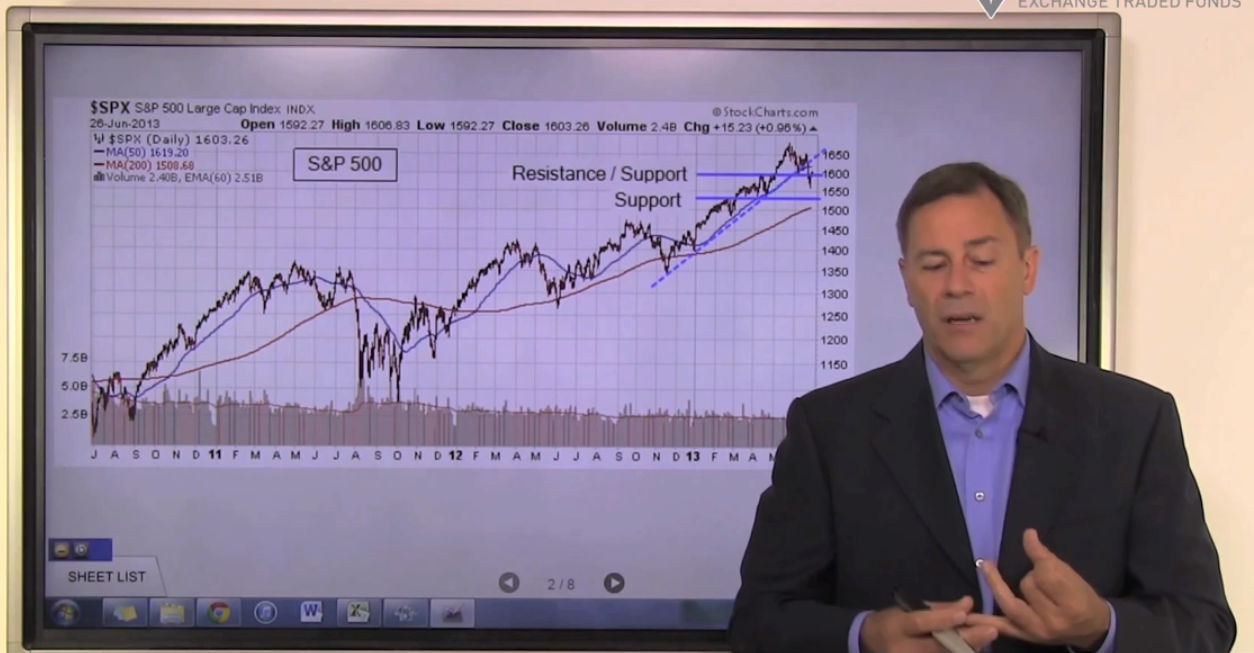
Thackray’s Sector Update:

-
I know Mike is a very solid investor and respect his opinions very much. So if he says pay attention to this or that - I will.
~ Dale G.
-
I've started managing my own investments so view Michael's site as a one-stop shop from which to get information and perspectives.
~ Dave E.
-
Michael offers easy reading, honest, common sense information that anyone can use in a practical manner.
~ der_al.
-
A sane voice in a scrambled investment world.
~ Ed R.
Inside Edge Pro Contributors

Greg Weldon

Josef Schachter

Tyler Bollhorn

Ryan Irvine

Paul Beattie

Martin Straith

Patrick Ceresna

Mark Leibovit

James Thorne

Victor Adair