
Personal Finance
You don’t have to be hiding something to want to tightly guard your online privacy.
Privacy is your right, guaranteed by the Constitution. Besides all three branches of the U.S. government complicit in wanting to monitor everything you do and everywhere you go, large companies want to track your every move as well.
When you surf the Internet, when you send emails, when you’re on your mobile phone, you are exposed to the prying eyes of all kinds of entities, some meaning no harm, but, still, most wanting to track all of your actions and behavior. And then there are the fraudsters and “phishers” who make their living by stealing your identity and your money.
I’ve received dozens of emails from readers asking what I’m doing to protect my online privacy. So in this column, I’m going to review the steps I’ve taken, and then I’ll update you on what I’m seeing in the markets.
Mind you, I receive no compensation whatsoever for mentioning any of the privacy companies below. They are simply at the top of their game based on my research.
 First, digital storage. I no longer keep my storage local on my computer or local network. Why? Because local storage is not secure. Virtually anyone can hack into your computer or local network.
So I now store all of my digital records offshore, encrypted and in the cloud.
After much research and trying many different offshore storage providers,
I concluded Wuala (http://www.wuala.com) is the best.
Wuala maintains its servers in Switzerland, Germany and France ? none of which are likely to cave in to a subpoena. Everything you store with the firm is encrypted, and only you can access your files. And that means no one else.
Wuala offers 5 gigabytes of free online storage, which is a lot. You can add more storage at competitive rates. The user interface and software is easy to use. There’s nothing fancy you need to do. Just download Wuala’s software, play with it a bit, and you’re ready to store your files offshore, encrypted.
Wuala offers many additional features, including secure sharing of files, a mobile app for cell phones, secure collaboration online, file versioning, and a local “briefcase” sync folder for current documents you need or are working on. If your Internet connection goes down, you can continue working offline and those files will automatically sync up with Wuala once you’re back online.
Wuala uses the strongest encryption around ? an SSL or secure communication channel for transmitting and receiving, and AES-256 encryption for all your storage. AES-256 is military-grade encryption.
And, of course, as with all cloud storage, you can access your files from anywhere in the world.
Second, email. I have not yet moved my email. The reason: Offshore email providers are few and far between. And since I get more than 100 emails a day, on average, and keep my calendar on email as well, I want to make sure I am switching to the very best and most secure offshore email provider I can find.
The top two candidates so far are Neobox (http://www.neomailbox.com), whose servers are in the Netherlands, and Swiss Mail (http://www.swissmail.org) of Switzerland.
I’m leaning toward going with Neobox. But check out both of them.
Third, browsing. Microsoft’s Internet Explorer, Google Chrome, and Apple Safari all collect information on virtually everything you do. Mozilla Firefox is somewhat better, but still not safe enough for me.
Therefore, I have switched to Tor (https://www.torproject.org).
You will sacrifice speed as the Tor browser is nowhere near as fast as the mainstream browsers. But you can surf the Internet, shop online, and do your online banking securely and anonymously. You are not tracked, period.
In fact, Tor is so secure, it is the first choice among journalists working around the globe. It uses a network of virtual tunnels that allows you to access the Internet without compromising your privacy.
There are others out there but, in my opinion, none are as secure as Tor. I highly recommend it.
Fourth, cell phones. This is a tough one. Security on cell phones has not caught up to security in other areas of the wireless and wired world.
But there’s one solution I expect to soon implement. It’s called Silent Circle (https://silentcircle.com).
The company was founded by a team of world-renowned cryptographers, Silicon Valley software engineers, German VoIP engineers, systems analysts and former U.S. Navy SEALs and British Special Air Service (SAS) security experts.
They offer several secure services. I’m very interested in this solution and will be trying out its secure mobile services to encrypt my cell-phone calls and video.
Fifth, online security. I am implementing the use of a virtual private network, or VPN. A VPN gives you a secure tunnel through the Internet, free from spying eyes.
There are many VPN services out there. The most versatile I have found is StrongVPN (https://strongvpn.com).
It’s simple to use. Once installed, your VPN operates in the background. It does compromise on speed a bit, but the security tradeoff is well worth it. I highly recommend it.
Now, on to the Markets …
Here’s a brief rundown of what my models are telling me about the recent action in the key markets I follow:
Gold: The strong rally last week was merely short-covering. Expect gold to move a bit higher, but then begin a new leg down. Whether or not gold has bottomed remains to be seen. Either a new low or a retest of the recent low at the $1,178 level is coming. But either way, long-term positions in bullion and mining shares are becoming mouth-watering.
Silver: Much the same as gold above.
U.S. dollar: Sold off after Bernanke’s comments about interest rates. But don’t bet on much of a further decline in the dollar. It’s still in an interim bull market.
Broad stock markets: My models still point to a top, despite the new recent record highs. But remember what I have been saying all along: U.S. equity markets are in a new bull market that will eventually see the Dow top at least 21,000.
The question now is whether or not the June pullback was the correction I was expecting. I’ll need a couple more days to say for sure. So stay tuned to my columns.
You’ll especially want to keep up with anything I publish on the metals and mining shares. Mining shares are now at the top of my radar screen.
Best wishes,
Larry

 A new research report entitled “The Powerful Case for Silver” (pdf format). In it, Peter Schiff explains why the upside potential of silver is greater than the one of gold. Peter Schiff believes that the fundamentals for silver are the strongest they have ever been and that silver is massively undervalued at today’s prices.

Bernanke Reverses Course
At the beginning of June we began discussing the approach of an initial “sell” signal. I stated at that time that the onset of such a signal would be a “warning” that you should begin paying much closer attention to what is happening inside of your portfolio. The selloff that began in late May coincided with mounting expectations that the Federal Reserve would begin reducing their monetary interventions later this summer and cease the program entirely by 2014.
As I discussed in “The Diminishing Effects Of QE Programs” the economy remains far too weak for the Federal Reserve to begin reducing support for the financial markets anytime soon. I stated:
“…the real issue is that IF the recent negative trends in consumption, employment and inflationary pressures do not start to reverse it is highly likely that the Fed will not be able to extract the monetary supports anytime soon. The recent increases in interest rates, combined with still very weak wage growth, higher costs of living and still elevated unemployment is likely to keep the Fed engaged for the foreseeable future as any attempt to remove its ‘invisible hand’ is likely to result in unexpected instability in the financial markets and economy.”
Consequently, the “trial ‘tapering’ balloon” lofted by the Federal Reserve after the last FOMC fell quickly to earth as stock prices sagged, which began to erode consumer confidence, and interest rates spiked sharply higher putting economic growth in danger. Those realties pushed the Federal Reserve to back pedal on their “tapering” stance as Ben Bernanke clearly stated that:
“I think you can only conclude that highly accommodative monetary policy for the foreseeable future is what’s needed in the U.S. economy. And I guess the final thing I would say in terms of risks of course is that we have seen some tightening of financial conditions, and that if, as I’ve said and as I said in my press conference and other places that if financial conditions were to tighten to the extent that they jeopardize the achievement of our inflation and employment objectives then we would have to push back against that.”
There was a clear confirmation by the Fed to market participants that the Federal Reserve will not take away accommodation because they cannot afford to let the markets “tighten.” Rising interest rates and falling asset markets are one thing and put the economy at risk. However, the lack of inflation is also a real concern.
As the chart below shows, every time the Fed has embarked on such a program to increase borrowing costs it has let do an economic recession or worse.
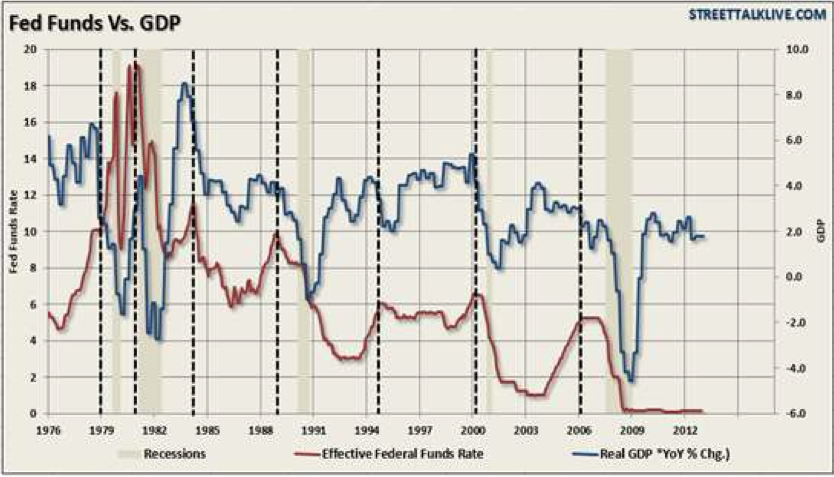
……read the 10 page report HERE

- Markets in Asia were higher in overnight trading. The Hong Kong Hang Seng rose 0.1% and the Shanghai Composite advanced 1.0%. European markets are higher this morning with the exception of Spain, currently down 0.5%. In the United States, futures point to a positive open.
- China’s annual GDP growth rate slowed to 7.5% in the second quarter from 7.7% in Q1, matching consensus estimates. That puts the average 2013 growth rate so far at 7.6%, just above the government’s official growth target of 7.5%.
- Chinese industrial production rose at an 8.9% annual rate in June, below consensus estimates for a 9.1% advance. Year-to-date fixed asset investment growth stood at 20.1% in June, just below predictions for 20.2% growth. Retail sales rose 13.3% annualized last month, above expectations for 12.9% growth.
- Spanish opposition leaders turned up the pressure on Prime Minister Mariano Rajoy to resign Sunday after Spanish newspaper El Mundo published text messages linking Rajoy to a slush fund used to pay off politicians. Luis Barcenas, the former Popular Party treasurer on the other end of the text messages, told the paper last week that the party has long been financed illegally.
- The main focus for markets this week will be Federal Reserve Chairman Ben Bernanke’s semi-annual Humphrey Hawkins testimony before Congress Wednesday on the U.S. economy and monetary policy. Market participants will be paying close attention to any words from Bernanke that build on his comments last week regarding the recent rise in bond yields and attendant tightening of financial conditions.
- At 8 AM ET, Federal Reserve Governor Daniel Tarullo will give a speech on banking regulation in Washington. Although the speech is unlikely to address current monetary policy, market participants have been giving increased attention to Fed appearances in recent weeks as bond markets have been roiled by the prospect that the central bank will begin to taper bond purchases later this year.
- The advance retail sales report for June is due out in the United States at 8:30 AM. Economists predict sales rose 0.7% in June after advancing 0.6% in May. Excluding autos, sales are expected to post gains of 0.4% after rising 0.3% in May.
- The results of the New York Fed’s July Empire State Manufacturing Survey are also out at 8:30 AM. Economists predict the headline index slipped to 5 in July from 7.84 in June, suggesting a continued but slowing expansion in regional manufacturing over the past month.
- Rounding out the U.S. data is the May business inventories release, due out at 10 AM. Economists predict inventories rose 0.2% in May after posting a 0.3% gain in April. Follow all of the data releases LIVE on Business Insider >
- George Zimmerman was found not guilty of manslaughter in the Trayvon Martin case over the weekend. President Barack Obama released a statement calling the death of Martin a tragedy, and the Department of Justice also made its own statement leaving the door open to a civil-rights case against Zimmerman.
It was a time not all that long ago that all of the attention in the coming week would be focused on one thing and one thing only in corporate earnings. And with a large number of major companies scheduled to report their quarterly results over the next few days, it should be the primary thing to which most investors should be paying attention. However, the post crisis market environment no longer seems to care all that much about fundamentals. Sure, it still makes a difference on a stock specific level, but the eyes of investors on the most part are now focused elsewhere. Instead, it is now all about monetary stimulus and the words of key policy makers. And it will be two key events over the next several days that have the potential to send the market swinging wildly along the way.
Act 1: China GDP
The first key event takes place on Sunday night before the U.S. markets open on Monday morning. This is the release of China’s second quarter GDP data.
 …..read more about China & Act 2: HERE

-
I know Mike is a very solid investor and respect his opinions very much. So if he says pay attention to this or that - I will.
~ Dale G.
-
I've started managing my own investments so view Michael's site as a one-stop shop from which to get information and perspectives.
~ Dave E.
-
Michael offers easy reading, honest, common sense information that anyone can use in a practical manner.
~ der_al.
-
A sane voice in a scrambled investment world.
~ Ed R.
Inside Edge Pro Contributors

Greg Weldon

Josef Schachter

Tyler Bollhorn

Ryan Irvine

Paul Beattie

Martin Straith

Patrick Ceresna

Mark Leibovit

James Thorne

Victor Adair