
Bonds & Interest Rates
The statement contained no new language on the conditions for maintaining the current pace of asset purchases. The Fed repeated the pledge it has used since September that it will continue the purchases until the U.S. labor market outlook has improved substantially.
Policy makers also left unchanged their commitment to hold the target interest rate near zero as long as the jobless rate remains above 6.5 percent and the outlook for inflation over one to two years doesn’t exceed 2.5 percent.
Speculation about the Fed’s $85 billion in monthly bond purchases has whipsawed stocks since May, when Chairman Ben S. Bernanke first indicated policy makers could begin reducing the stimulus this year if the job market continues to improve.
A Commerce Department report earlier today showed that gross domestic product, the value of all goods and services produced, rose at a 1.7 percent annualized rate, after a 1.1 percent gain the prior quarter. The median forecast of 85 economists surveyed by Bloomberg called for a 1 percent advance for last quarter.

For anyone who sold physical gold in the current precious metal downturn, money manager Peter Schiff says, “There’s going to be a big problem because the gold they sold on the way down isn’t going to be available on the way back up because the people who own it aren’t going to sell it at any price. . . . This is the time to load the boat, to back up the truck.”
Ed Note: For a few more key transcripts and the entire 16 minute interview go HERE


We sold our position in Potash Corp (POT-TSX) back in 2011 after it was announced that BHP Billiton was seeking to buy the Company. The premium looked too attractive to ignore. Subsequently, we purchased Agrium (AGU-TSX) which we continue to hold. Not only did we deem AGU to be fairly priced, but it also had some features that made it stand out. It had far less direct exposure to the price of potash and it had a substantial retail division which provided insight into local demand for fertilizer. Also, because of the importance of food politics, especially in the Developing World, we were reluctant to reduce our exposure to global agriculture. Food inflation has been enough to trigger protests and revolutions in the Middle East and Asia over the last couple of decades. Governments concerned about their own survival are willing to pay a very high price in order to keep food costs contained. Whether it is crop yield technologies, food processing and distribution, or fertilizer, there will be a steady source of demand for these things for the foreseeable future.
With the news that the Russian potash giant Uralkali is leaving the global cartel and is expected to flood the global market for potash regardless of price, AGU has taken a bit of a hit. However, because of AGU’s diversification and retail operations, it was not hit as hard as the more pure potash plays such as POT and Mosaic (MOS-NYSE).
This news also highlights the issues surrounding the attempt by the New York hedge fund JANA Partners to break up AGU back in April, separating the wholesale operations from the retail operations. We voted against the proposal to break it up since AGU’s diversification was one of the reasons for buying it. And, now with the announcement of the collapse of the global potash pricing cartel, we believe that AGU integrated strategy limited the overall impact compared to the sum effect had the Company been divided in two.
The opinions expressed in this report are the opinions of the author and readers should not assume they reflect the opinions or recommendations of Richardson GMP Limited or its affiliates. Assumptions, opinions and estimates constitute the author’s judgment as of the date of this material and are subject to change without notice. We do not warrant the completeness or accuracy of this material, and it should not be relied upon as such. Before acting on any recommendation, you should consider whether it is suitable for your particular circumstances and, if necessary, seek professional advice. Past performance is not indicative of future results.
Richardson GMP Limited, Member Canadian Investor Protection Fund.
Richardson is a trade-mark of James Richardson & Sons, Limited. GMP is a registered trade-mark of GMP Securities L.P. Both used under license by Richardson GMP Limited.

The Perverse Focus on the FOMC and Jobs Data
This week will bring the types of news that are generally considered to be among the most important for gold – the FOMC statement, as well as the July payrolls report (which in turn derives its perceived importance from its effect on central bank policy). It should be pointed out here that it actually makes very little sense for the market to focus on these data points (even though it is clear that the focus exists and cannot be ignored).
Let us consider the payrolls report first: what does it actually tell us? In reality it is a fairly meaningless datum. Not only is it merely an account of the past, it is not even a particularly precise account of the past. The report gets revised several times (at least thrice if memory serves, with the final revisions being done a full year after the report’s first publication, when the BLS does its annual revisions). Even the thrice revised version of the report isn’t really all that meaningful. After all, the employment statistics are collated in such a manner that all those who are long-term unemployed and considered ‘discouraged’ are simply no longer counted as unemployed, even though that is what they are. Lastly, even if there were some way of obtaining a perfect payrolls report, it would not really mean much or tell us anything about the future. Employment is a lagging economic indicator. The economy could well be in recession already, even in the face of employment data that still ‘look good’.
That is in fact what happened in late 2007: in hindsight it was determined that the economy entered a recession in late 2007, even though most of the real time economic data releases at the time – including payrolls data – appeared to still look fine. In fact, the Fed, whose reaction to economic data is what the market really cares about, still proclaimed in summer of 2008 that the US economy was likely to ‘avoid a recession’. At the time, the recession had been in train for more than half a year already. In short, the Fed is not only incapable of forecasting an economic downturn, it is not even able to recognize a recession that is staring it right into the face.
Now let us consider the FOMC statement, which this month may contain news about the planned ‘tapering’ of ‘QE’ as well as refined ‘forward guidance’ regarding the Fed’s interest rate manipulations. Fresh Hilsenblather to that effect has been published late last week, entitled: “Up for Debate at Fed: A Sharper Easy-Money Message”. Apparently we need a more forceful reminder that there will be easy money for as far as they eye can see, or for however long it takes for easy money to bring the economy to utter ruin, whichever comes first.
A pertinent excerpt:

If you want to be an effective and profitable investor you should look at the situation from different perspectives and make sure that the actions that you are about to take is really justified.
In the precious metals market it turns out very often that if you take a look at the gold’s price chart only, the outlook might be incomplete or even unclear. For this reason, we usually complement the yellow metal’s analysis by the analysis of silver, mining stocks, the general stock market, important ratios and other related markets.
As you know, precious metals usually move together on a short-term basis, even though they may evolve into different formations in the medium- and long term. That’s why we decided to feature the palladium chart today. Does it provide us with interesting clues as to the next possible moves in the entire sector? Let’s take a closer look at the below chart and find out (charts courtesy by http://stockcharts.com).
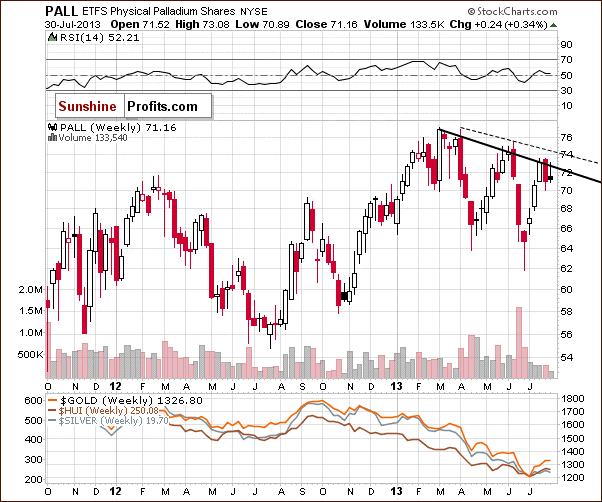
On the above chart we see that in recent weeks, palladium continued its rally and reached the declining resistance line based on the 2013 top and the May peak (in terms of weekly closing prices). This stopped buyers and we saw a decline, which took the price to the 70 level last week. Although we saw a pullback at the beginning of this week, buyers didn’t manage to push the prices above the above-mentioned resistance line. This might result in further declines.
What’s next? In the short term we might see some strength and a small move to the upside, but there is another declining resistance line based on the 2013 top and the May peak (on an intraday basis), which may trigger a correction.
Please note that when we saw a similar price action at the end of March and in late May, gold, silver and mining stocks didn’t move visibly higher. Therefore, even if palladium climbs up once again to the next declining resistance line, it will likely not trigger a significant increase in the rest of the precious metals sector.
But what could happen if the buyers fail? If palladium declines, it seems that it will move the rest of the sector lower.
The shape of this relationship is rather similar to the one between gold and crude oil. So,
let’s move on to the “black gold” chart and check if this commodity is still quite useful in analyzing the precious metals market.
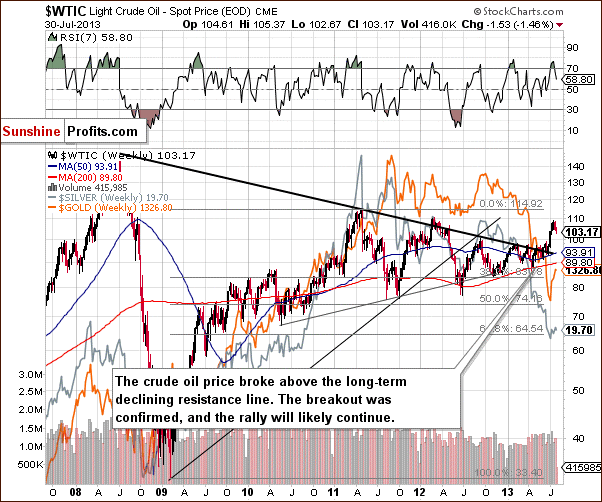
On the above chart we see that the situation has deteriorated slightly. In the recent weeks the situation was overbought on a short-term basis (the RSI indicator was above 70) and that a short-term correction was quite likely. In recent days, the RSI has dropped below 70 and generated a sell signal. This circumstance encouraged the oil bears to go short and triggered a corrective move. Although the price of crude oil still remains above the broken long-term declining resistance line, the recent correction took it below $105 per barrel.
At this point, we would like to draw your attention to the fact that in the past we saw the yellow metal’s price move higher along with the price of crude oil (there are periods when this relationship worked, but it was not always the case).
The current rally in gold took place along with a rally in crude oil. From this point of view, if oil corrects, this could trigger another move lower in gold as well.
Once we know the current situation in the commodities discussed before, and its implications for the precious metals sector, let’s turn to our final chart. Today, we would like to present you the gold chart from the perspective of the Australian dollar once again. In our opinion this is a very interesting chart which may provides important clues as to further gold’s price movements.
Click HERE or on image for larger view

On the above chart, we see that the price of gold in Australian dollars hasn’t changed much. Although gold climbed up above the declining resistance line, the breakout was invalidated very quickly, and the price came back below this declining resistance line (currently close to 14.5).
We saw similar price action in June. After the invalidation of the breakout above the above-mentioned declining support/resistance line, there was a pullback to this resistance line. The buyers, however, didn’t manage to push gold above it. This resulted in strong declines, which took the price all the way back down to the April bottom area.
As we wrote in our essay on gold, silver and mining stocks on July 24:
If we see similar price action here, gold priced in Australian dollars will likely decline once again. Such a triple-bottom, in this case, would likely mean a breakdown below the previous lows in the price of gold seen from our regular USD perspective, a price action similar to what was seen in June.
So, from this point of view, the recent moves up haven’t changed much and the current outlook and the implications remain bearish.
Summing up, both palladium and crude oil are in medium-term uptrends whereas gold, silver and mining stocks remain in a downtrend. The implications of the palladium chart for the whole precious metals sector are rather bearish for the short term, as the chart indicates that the current move to the upside is over or might be over soon. The short term picture for crude oil is also bearish which may translate into lower precious metals prices in the near future.
Thank you for reading. Have a great and profitable week!
Przemyslaw Radomski, CFA
Founder, Editor-in-chief
Gold Investment & Silver Investment Website – SunshineProfits.com
* * * * *
Disclaimer
All essays, research and information found above represent analyses and opinions of Przemyslaw Radomski, CFA and Sunshine Profits’ associates only. As such, it may prove wrong and be a subject to change without notice. Opinions and analyses were based on data available to authors of respective essays at the time of writing. Although the information provided above is based on careful research and sources that are believed to be accurate, Przemyslaw Radomski, CFA and his associates do not guarantee the accuracy or thoroughness of the data or information reported. The opinions published above are neither an offer nor a recommendation to purchase or sell any securities. Mr. Radomski is not a Registered Securities Advisor. By reading Przemyslaw Radomski’s, CFA reports you fully agree that he will not be held responsible or liable for any decisions you make regarding any information provided in these reports. Investing, trading and speculation in any financial markets may involve high risk of loss. Przemyslaw Radomski, CFA, Sunshine Profits’ employees and affiliates as well as members of their families may have a short or long position in any securities, including those mentioned in any of the reports or essays, and may make additional purchases and/or sales of those securities without notice.

-
I know Mike is a very solid investor and respect his opinions very much. So if he says pay attention to this or that - I will.
~ Dale G.
-
I've started managing my own investments so view Michael's site as a one-stop shop from which to get information and perspectives.
~ Dave E.
-
Michael offers easy reading, honest, common sense information that anyone can use in a practical manner.
~ der_al.
-
A sane voice in a scrambled investment world.
~ Ed R.
Inside Edge Pro Contributors

Greg Weldon

Josef Schachter

Tyler Bollhorn

Ryan Irvine

Paul Beattie

Martin Straith

Patrick Ceresna

Mark Leibovit

James Thorne

Victor Adair